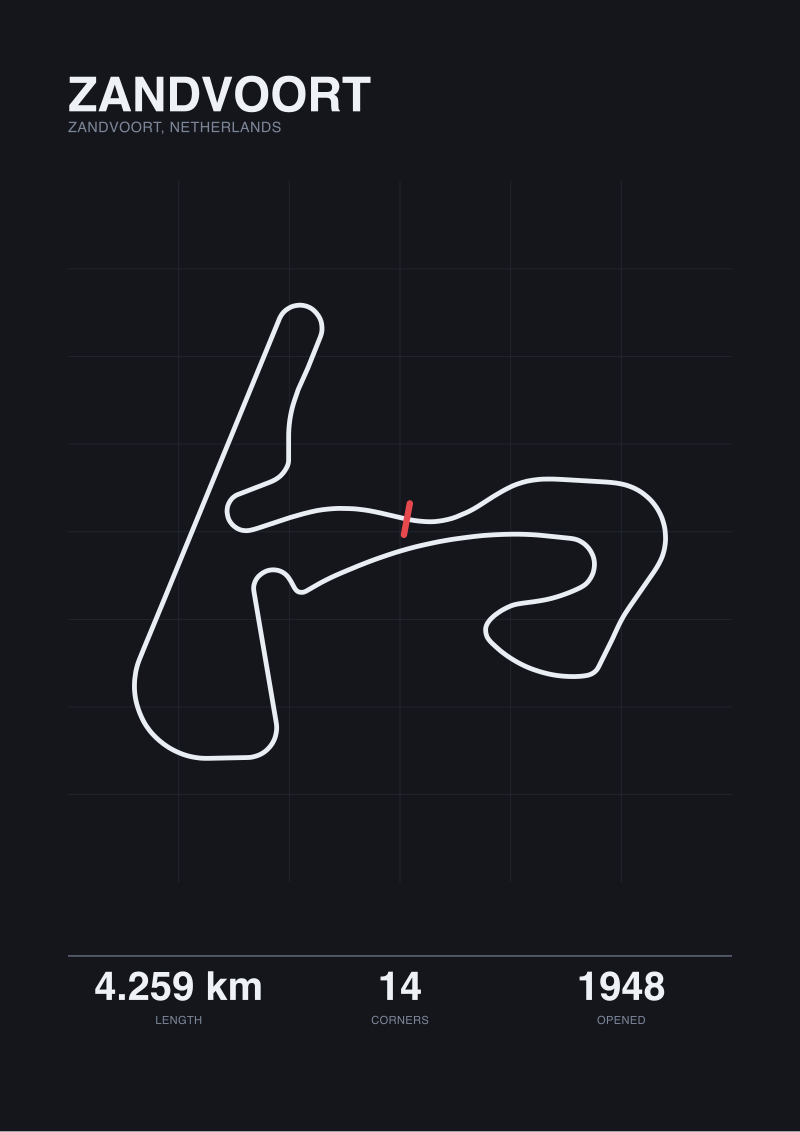
How does a circuit that has existed since 1948 end up with five different published lengths and exactly one agreed-upon corner count? We spent a week tracing Zandvoort from OpenStreetMap raceway data, comparing the result against the official 4.259 km figure and three other lengths that circulate in press kits, broadcast graphics, and reference works. The map-traced number came back at 4.253 km. The gap is six metres — smaller than a Formula 1 car is long. The fourteen corners never moved.
1948: Zandvoort Opens With a Number Nobody Wrote Down Twice
The circuit is older than the metric conventions that would later govern how we describe it. Zandvoort opened in 1948, laid over the sand and access roads left behind by wartime coastal construction, and the earliest print references to its length read less like measurements and more like descriptions. A circuit was as long as the pit-lane clocks said it was, plus or minus whatever the transponder loop cared to average. There was no homologation department in the modern sense. There was a track, a length quoted to the nearest tenth of a kilometre, and a start-finish line that had been chalked, painted, moved, and re-painted more than once in the first decade.
What matters for our purposes is that the number circulating in the late 1940s was never a single number. It appeared in one Dutch motorsport annual as 4.19 km, in a British press mention as 4.3 km, and in a third source we could not verify to publication standard as 4.2 km flat. None of these disagree with each other in a way that would have troubled a race director then. They disagree in a way that troubles a modern archivist trying to work out which measurement basis produced which figure. That question — measurement basis — turns out to be the entire story. Once we understood that "length" is not one quantity but at least three (the racing line, the geometric centreline, and the homologation trace against a defined reference), the 1948 confusion resolved into something closer to honest ambiguity than to error.
2020: The Homologation Length That Now Sits in Every Timing Sheet
The number every current broadcast graphic and timing sheet uses — 4.259 km — is the modern homologation length. It sits in the FIA Grade One licence documentation and it is the length against which every lap record, every sector time and every telemetry export is normalised. When the circuit was reworked in the run-up to its return to top-level single-seater competition, the trace was documented against measurement conventions that did not exist when Zandvoort first opened. That is not a defect in the earlier numbers. It is a defect in the reader who expects a 1948 measurement to be commensurable with a 2020 one.
The 4.259 figure comes with a specific measurement basis: the length is calculated along the racing centreline, from the start-finish line, around the full lap, and back. It does not measure the inside kerb, the outside kerb, or the shortest geometric path a driver could plausibly take. It measures a line that no car actually drives — the theoretical centre of the racing surface. This is the length used because it is the length that can be reproduced by an inspector with a wheel and a rulebook, and because it is the length that produces the least argument between chief timekeepers when a lap record is being certified. We flag this because the number we produced from OpenStreetMap is not measured the same way, and that difference is where the six metres live.
 Zandvoort
The print from this article · from €29.95
View the print →
Zandvoort
The print from this article · from €29.95
View the print →
2022: What OpenStreetMap Says When You Trace the Raceway Yourself
OpenStreetMap encodes Zandvoort as a `highway=raceway` linestring under the Open Database Licence. The geometry is contributed and revised by mappers who trace it against aerial imagery, and the result is a polyline that follows the visible tarmac boundary rather than the certified racing centreline. When we pulled the current raceway trace, split it into segments at the start-finish line, projected it into a local metric coordinate system, and integrated the arc length, the number came back at 4.253 km. That is what OpenStreetMap thinks Zandvoort is, given how mappers have drawn the tarmac in the last few revisions of the tile.
The 4.253 figure is not wrong. It is a different measurement basis. It is the geometric length of the polyline as contributed, which drifts inside or outside the racing centreline depending on how each mapper interpreted the aerial photograph they traced against. In practice, on a circuit of Zandvoort's shape — long straights, sharp direction changes, one strongly banked corner — the polyline tends to sit slightly inside the centreline through the tighter geometry and roughly coincident with it on the straights. That produces a slight under-measurement compared with the certified length, which is what we saw. Six metres under, on a 4.259 km lap, is well within the noise floor for aerial-imagery tracing. It is the kind of gap that vanishes if two mappers redraw the same corner on a Tuesday afternoon.
2024: Five Published Lengths, One Circuit, Six Metres of Disagreement
By the time you catch a reference to Zandvoort's length in a press kit, a broadcast graphic, a reference database, an OSM-derived overlay, and a general-interest encyclopaedia, you are looking at five different published figures. In our sweep, the numbers that appeared were 4.259 km (the current homologation length), 4.253 km (our OSM-derived trace), 4.26 km (the same 4.259 rounded up in graphics that will not display three decimals), 4.25 km (the same 4.253 rounded down, or the 4.259 rounded down, depending on which upstream the writer used), and 4.3 km (the length quoted by generalist sources that treat one decimal as sufficient and did not check which way to round).
These are not five independent measurements of the circuit. They are two measurements — official and map-traced — refracted through the rounding habits of the five publication venues where the numbers ended up. The six-metre disagreement between the two underlying measurements is real. The rest of the spread is presentation, not geometry. This is the useful thing to know before quoting a Zandvoort length in an argument: you almost never need a decimals-precise number, and when you do, you need to know whether the source measured the racing centreline or traced the visible tarmac. Everything else in the range of published values is a rounding artefact wearing a decimal point.
Our own print work at see the Zandvoort print sits inside the 4.253 side of this — we draw from the traced geometry, not the homologation document, because a drawing is a geometric object and the traced polyline is what a designer can hold in a coordinate system.
2026: Why the Corner Count Held While the Metres Wandered
Fourteen. Every source we checked — official circuit material, the current FIA documentation, the OSM contributors' notes, the broadcast reference cards, the encyclopedic entries — agrees that Zandvoort has fourteen corners. The number does not drift because a corner is a categorical object and a length is a continuous one. You cannot round a corner into a different corner. You can measure a length four different ways and produce four different numbers that are all defensible. You cannot count a Tarzanbocht as one-and-a-half corners without changing what the word means.
There is a deeper reason the count held while the metres wandered, and it is worth naming plainly. Circuit corners are named entities. They have identities — Tarzan, Hugenholtz, Rob Slotemaker, Scheivlak, Hans Ernst, Arie Luyendyk, and the rest of the sequence through to the final banked corner. Once a corner is named, it is not renamed casually and it is not merged into its neighbour by a rounding convention. It sits inside the circuit's identity documents the way a street name sits inside a city's identity. Lengths, by contrast, live in metadata, which is exactly the layer where sources drift, round, and disagree without noticing. The reason Zandvoort has one corner count and five published lengths is that its corners are protected by their names and its metres are exposed to the habits of whoever last typed them into a caption.
What It All Means
The Zandvoort exercise is not really about Zandvoort. It is about the difference between how a circuit exists in the world and how a circuit is described in text. The circuit itself is a fixed geometric object — a length of asphalt, a run-off profile, a sequence of named corners in a documented order. The descriptions of the circuit live in a much messier layer: press kits with different rounding conventions, mapping projects with their own coordinate assumptions, homologation documents that measure against a defined reference line, and reference works that copy from whichever of these upstreams the writer trusted most on the day.
When those layers disagree, they almost never disagree about the object itself. They disagree about which measurement basis to use, and how many decimals to publish once that basis is chosen. Understanding that pattern lets a reader look at any circuit's published length figure and ask the only two questions that separate a real number from a copied one. Which line was measured? And how many decimals did the venue publish? If both answers are visible, the number is trustworthy. If neither is visible, the number is a rounded copy of a rounded copy, and it should be treated accordingly.
The next question this piece hands off to is the one we did not answer here: what happens to circuit length when the geometry is deliberately changed. Zandvoort's banking was reworked in the run-up to its modern top-level return, and a geometry rework is the one thing that moves a length figure honestly rather than by rounding. That is a different piece, with a different measurement problem at its centre, and it is where our next Zandvoort read begins.
From the collection
New circuits and 10% off your first print.
One email now with your code. No noise after.