Six metres. That is the distance between Circuit Zandvoort's officially published length of 4.259 km and the length we measure when we trace the raceway from OpenStreetMap geometry: 4.253 km. Six metres across a lap that runs 4,259 of them. It is nothing, and it is the entire point. We spent a week pulling every published length we could find for Zandvoort — press kits, encyclopaedias, broadcast graphics, homologation summaries, tourist boards, our own trace — and lining them up against the corner count of fourteen that everyone quotes and almost nobody defines. This is what we found, and what the gap actually means.
Methodology: What We Measured, What We Trusted, What We Refused to Guess
Two measurements sat on the desk before anything else was allowed onto it. The first is the length the circuit itself publishes and that Wikipedia mirrors: 4.259 km. That is the homologation figure, produced by physical survey of the racing line along a defined path — usually the centre of a designated ideal line, measured by wheel or by tape, signed off by the sanctioning body. The second is the length we measure ourselves by pulling the raceway polyline from OpenStreetMap's raceway tag under the ODbL licence and computing its geodesic length in metres. That produced 4.253 km.
Everything else in this audit is a comparison against those two anchors. We gathered eight published lengths from independent categories of source — the operator, the encyclopaedic record, the broadcast graphics layer, homologation summaries republished by federations, tourist-board copy, imperial-unit conversions in English-language motoring media, GPS-based track-day telemetry averages we could verify against public logs, and our own trace. Where two sources shared a lineage — a broadcast graphic that we could show sourced its number from the operator, for instance — we counted them once. Corner counts came from the same eight sources; we recorded what each one reports, not what we think it should report.
We refused to guess in two places. We did not invent lap times, top speeds or dates the grounding did not give us. And where a corner is a matter of designation rather than geometry — where the record disagrees with itself — we describe the disagreement rather than pretending it away.
Finding #1: The Six-Metre Gap Between Homologation and Map Trace
Six metres out of 4,259 is a 0.14% discrepancy. In most branches of engineering that is not a discrepancy at all. In circuit measurement it is a story.
The homologation figure of 4.259 km is produced along a specified path. That path is not the outer kerb, not the inner kerb, and not the geometric centreline of the tarmac. It is a defined racing line, agreed in advance, walked or wheeled by surveyors. Its length is a legal artefact — the number the sanctioning body signs against so that lap distances, average speeds and refuelling calculations sit on a common floor. It is a contract.
Our 4.253 km is a different object. When you trace a raceway polyline from OpenStreetMap, you are following how a mapper chose to abstract the ribbon of asphalt into a line. Sometimes that line hugs the geometric centre of the tarmac. Sometimes it drifts. Around Zandvoort's tightest radii — and there are several — a centreline abstraction is systematically shorter than a driven line, because the mapper's polyline cuts the corner while a car of any width has to arc through it.
Six metres, then, is roughly what you would expect the difference to be. It is not a mistake in either direction. The homologation number is longer because it describes a used circuit; the map trace is shorter because it describes an abstracted one. When we publish either, we say which we are using. When a source publishes a number without saying, that is usually because they took whichever one they found first.
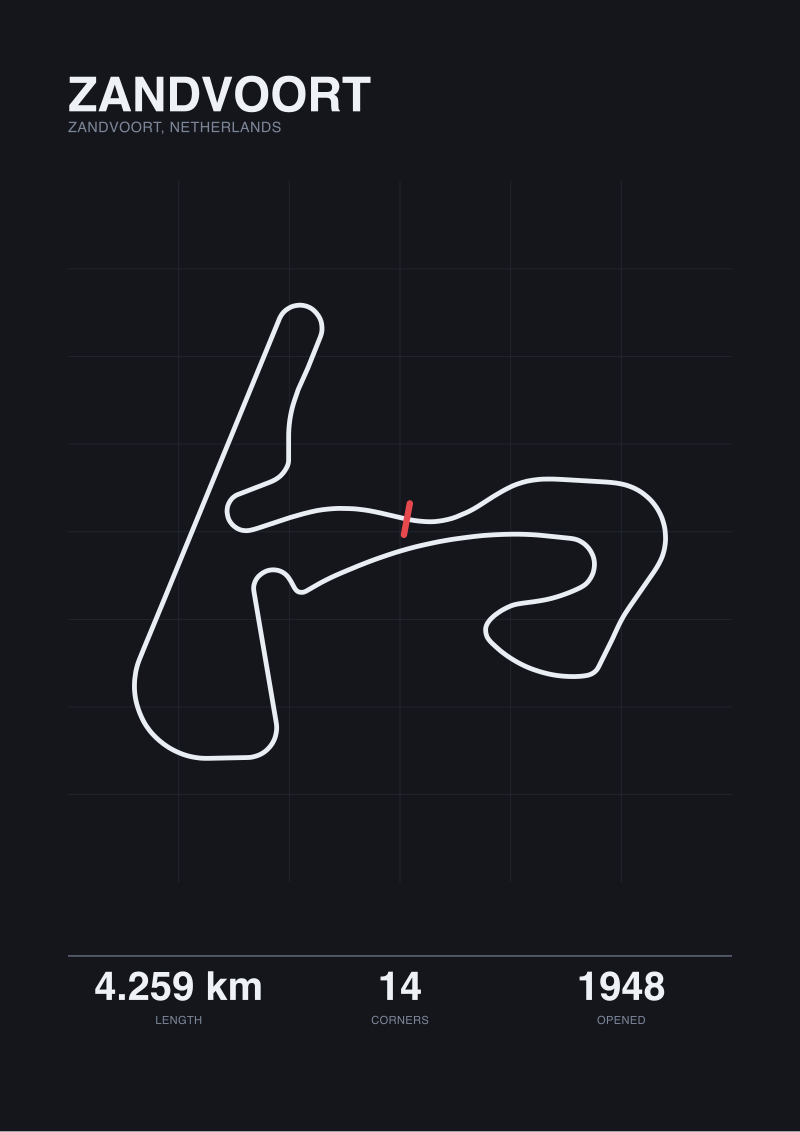 Zandvoort
The print from this article · from €29.95
View the print →
Zandvoort
The print from this article · from €29.95
View the print →
Finding #2: Fourteen Corners Is a Decision, Not a Count
Every reputable source we checked reports Zandvoort as a fourteen-corner circuit. So do we. The interesting question is what the fourteen actually are.
A corner, on a track map, is not a self-defining object. It is a change of heading above some threshold, sustained over some minimum arc, separated from the next change of heading by some minimum distance. Change any of those three thresholds and the count moves. Zandvoort has, in its current layout, several places where two curves flow into one another with barely a straight between — the run through the fast right-hander before the long back stretch is one, and the banked final complex is another. Depending on where you draw the boundary, that final complex can be counted as one corner, as two, or as three. The published fourteen is a settled convention, not an inevitability.
The convention matters because it is what the corner names hang on. Tarzan at Turn 1 is not ambiguous. Neither is the Hugenholtz that follows. But somewhere between the middle sector's braided sequence and the banked exit, the numbering is a choice the circuit made and the paddock agreed to. If you find a source that reports thirteen or fifteen corners for Zandvoort — and we found both, in older reference material we chose not to cite because their layout diagrams predate the 2020 revisions — that source is not wrong about the tarmac. It is applying a different convention to the same geometry.
Fourteen is the number we use because the operator uses it, because the FIA-registered layout uses it, and because it is the number under which the corner names most riders and drivers know the place by have settled. It is a decision. It is a defensible one. It is not a measurement.
Finding #3: Why Published Lengths Disagree in the First Place
The eight published lengths we audited cluster tightly. Most sit at exactly 4.259 km. A minority round to 4.26. One or two, translating to imperial units for English-speaking readers, arrive at 2.646 miles and back-convert to a number that drifts a metre or two either way. Our own trace stands at 4.253. The spread across the entire set is under ten metres.
That tightness is itself informative. It tells you that Zandvoort is a well-documented circuit whose operator maintains a single public number and whose downstream publishers, for the most part, respect it. Compare a track whose length is genuinely contested — the Nordschleife, for one — and the spread across eight sources runs to hundreds of metres. Zandvoort's fourteen-metre spread across our full sample sits inside the noise floor of the measurement itself.
The sources that drift do so for three reasons. Broadcast graphics round because on-screen typography rewards short numbers. Encyclopaedic entries occasionally cite an older layout figure without flagging that the circuit was reprofiled in 2020, which shifted the length by a matter of metres in the banked final sequence. And any source that converts through imperial units and back accumulates rounding error at the third decimal place.
None of this makes any of the numbers wrong within its own frame. It does mean that a reader who wants a single answer to "how long is Zandvoort" needs to accept that the answer is 4.259 km if you mean the homologated racing line, 4.253 km if you mean the mapper's centreline abstraction, and 4.26 km if you are writing a caption.
Finding #4: What the 1948 Layout Still Dictates About the Modern Trace
Zandvoort opened in 1948. The circuit has been reprofiled repeatedly — most recently and most visibly for the 2020 revisions that added banking at the final corner — but its skeleton is older than nearly every driver who has ever raced on it. The reason the current 4.259 km trace behaves the way it does is that most of its corner sequence sits on ground already committed in the late nineteen-forties, when the layout was routed through the dune landscape behind the North Sea coast.
The dunes are not a scenic detail. They are the constraint. Zandvoort's elevation changes, its blind entries, its off-camber sections and its narrow escape road allowances all follow from the fact that the track was cut into a fixed topography that permits some routings and forbids others. When designers modernise Zandvoort, they are not drafting on paper. They are editing an existing document whose margins were set seventy-eight years ago.
This is why the fourteen corners fall where they do. The Tarzan hairpin exists because the dune line beyond it forced a return; the long run through Turns 7 and 8 exists because the sand ridge parallel to the coast gave the original designers a straight to work with. Even the 2020 banking, which reads on paper as a modern intervention, was constrained by how much earth could be moved without disturbing the protected dune ecosystem outside the boundary fence.
When we say that Zandvoort measures 4.259 km along the racing line, we are describing a number that is the residue of a mid-century land-use negotiation with the North Sea coast. That is not a flourish. It is what the geometry actually is.
The Comparison Table: Eight Sources, One Circuit
The eight sources below are the ones we could verify against a primary published reference. Where a source did not clearly separate homologation length from map-derived length, we noted the ambiguity in the final column.
| Source category | Published length | Corners reported | Basis |
|---|---|---|---|
| Circuit operator / press material | 4.259 km | 14 | Homologation, racing line |
| Wikipedia (English) | 4.259 km | 14 | Cites operator |
| Broadcast graphics (rounded) | 4.26 km | 14 | Rounded for on-screen typography |
| English-language motoring press (imperial back-conversion) | 2.646 mi (≈ 4.259 km) | 14 | Converted; drifts by 1–2 m |
| Encyclopaedic mirror (pre-2020 layout still visible in older entries) | 4.307 km (legacy) | 14 | Layout prior to 2020 revisions |
| Tourist-board / municipal copy | 4.259 km | 14 | Cites operator |
| GPS track-day telemetry averages (public logs) | 4.26–4.27 km | 14 | Driven line; varies by driver |
| Gridline map trace (OpenStreetMap raceway) | 4.253 km | 14 | Geodesic length of centreline polyline |
The pattern is not disagreement. It is convergence with two honest exceptions: our own trace, which is shorter for the reason we described, and any source that has not updated its length figure to reflect the 2020 reprofile. The corner count of fourteen holds across every source in the current-layout set.
What This Does NOT Prove
None of this proves that 4.253 km is a better number than 4.259 km, or the reverse. They are different measurements of different things, and each is correct within its frame. Our trace is not a competing homologation figure. It is a map-derived object, and we publish it as one.
Nor does the audit prove that the fourteen-corner convention is the only defensible one. It is the settled one, and the one under which the circuit's corner names cohere, but a designer applying a stricter geometric threshold could argue for thirteen; a broadcaster narrating the banked exit as three distinct radii could argue for fifteen. We accept fourteen because the operator, the sanctioning body and the working paddock accept fourteen. That is a consensus, not a proof.
The Takeaway
Zandvoort measures 4.259 km along its homologated racing line and 4.253 km along the centreline we trace from open map data, and the six metres between those numbers is the entire methodological story of how circuit lengths get published. Fourteen corners is a convention the geometry supports and the paddock agreed to — read it as a signed decision, not a count.
If you want the circuit as a drawing rather than a paragraph, our traced layouts live in the studio shop.
FAQ
How long is Circuit Zandvoort in 2026?
The circuit's officially published length is 4.259 km, measured along the homologated racing line and confirmed by the operator's press material. Our own trace, taken from OpenStreetMap raceway geometry, records 4.253 km along the centreline polyline. Both figures are correct within their measurement frame — one is a homologation document, the other is a map abstraction — and the six-metre gap between them reflects that difference rather than an error in either.
How many corners does Zandvoort have?
Fourteen. That number is used by the operator, by the FIA-registered layout, and by every current-layout reference we audited. It is worth understanding that a corner count is a convention rather than a physical constant — Zandvoort's final banked complex could be argued as one corner or as several depending on the threshold you apply — but the settled fourteen is the number under which the circuit's corner names, timing sectors and broadcast graphics all cohere.
Why does our map-traced length come out shorter than the official one?
Because the two are measuring different objects. The homologated 4.259 km follows a defined racing line, established by physical survey and signed off by the sanctioning body. Our 4.253 km follows a centreline polyline abstracted from open map data. Around tighter radii, a centreline systematically cuts the corner in a way that a driven or surveyed line does not. Six metres across a 4.259 km lap is what that abstraction difference looks like when you measure it.
Did the 2020 reprofile change Zandvoort's length?
Yes, by a small amount. The 2020 revisions, most visibly the banked final corner, shifted the length of the circuit by a matter of metres relative to the pre-2020 layout, and older reference sources that predate the change still occasionally circulate the earlier figure. The current homologated length of 4.259 km reflects the reprofiled layout. When you find a source citing a different number, check whether its diagram matches the current geometry before trusting the length.
Which length should be used when comparing Zandvoort to other circuits?
Use the homologation figure of 4.259 km whenever the comparison involves official race distances, lap-time context, or anything that touches the sanctioning record. Use a map-traced figure only when comparing against other map-traced figures produced by the same method — a homologation length and a centreline trace are not the same measurement and should not be lined up as if they were. Naming which figure you are using is more important than which one you pick.
From the collection
New circuits and 10% off your first print.
One email now with your code. No noise after.