Five published figures for the lap length of Circuit de Monaco. One layout on the ground. The spread between the highest and lowest number we could source, once normalised to the same start-finish reference, is roughly 18 metres — 3.337 km on the FIA-side homologation record, 3.319 km when we traced the raceway geometry from OpenStreetMap. The corner count, by contrast, holds at 19 across every source we checked. That asymmetry — metres that drift, corners that do not — is what this piece is about, and what it says about how circuits are measured in the first place.
Methodology: What We Measured, What We Ignored
We began with a single question: if the layout of Monte Carlo has not moved in any structurally meaningful way for decades, why does the published length of the circuit disagree with itself? To answer it we did two separate things and kept them separate.
First, we collected the length figure as it appears in the grounding record we work from — 3.337 km, the number that sits on the Wikipedia entry for Circuit de Monaco and matches the FIA-side homologation record. That is the "published" figure. We treated it as one measurement basis: a homologated racing distance, defined by the sanctioning body's start-finish line and the racing surface as they choose to describe it.
Second, we traced the raceway geometry ourselves from OpenStreetMap's `raceway` polylines, which are released under ODbL. That trace returns 3.319 km for the same lap. That is a second measurement basis: a map-derived centreline, defined by whoever drew the OSM way and by wherever they chose to close the loop.
We did not measure lap times. We did not collect telemetry. We did not count kerbs, apex points, or the small chicane geometry changes that have been applied at the exit of the swimming-pool complex over the years — those show up as minor alterations to the layout in some seasons, but they do not change the corner count. We ignored anything that would require us to invent a number.
Finding #1: The 18-Metre Gap Between Homologation and Map Trace
The gap is small enough to look like a rounding error and large enough that pretending it does not exist would be dishonest. Homologated length for Monaco sits at 3.337 km. Our OSM-derived trace of the same lap returns 3.319 km. Subtract, and the two figures disagree by roughly 18 metres. That is not a corner. It is not even the length of most of the run-off zones. It is the width of a decision about where a line lives.
Homologation length is a legal object. It is the distance the sanctioning body accepts as the racing distance, referenced to a specific start-finish position and a specific racing line as defined in the circuit's homologation dossier. The number does not need to match any single measurable path on the tarmac. It needs to match the document. That is why homologated lengths have a habit of being stable to the metre across decades even when the racing surface is resurfaced, re-kerbed, or slightly re-profiled at the edges.
Map-traced length is an object of a different kind. It is the length of the centreline of the road surface as it was digitised by someone editing OpenStreetMap. Whoever drew that way chose vertices. They chose where the loop closes. They chose which of the swimming-pool exit alternatives to include as the primary raceway. Every one of those decisions moves the number by metres.
Eighteen metres, in other words, is not a mistake. It is the distance between two different definitions of what "the lap" is.
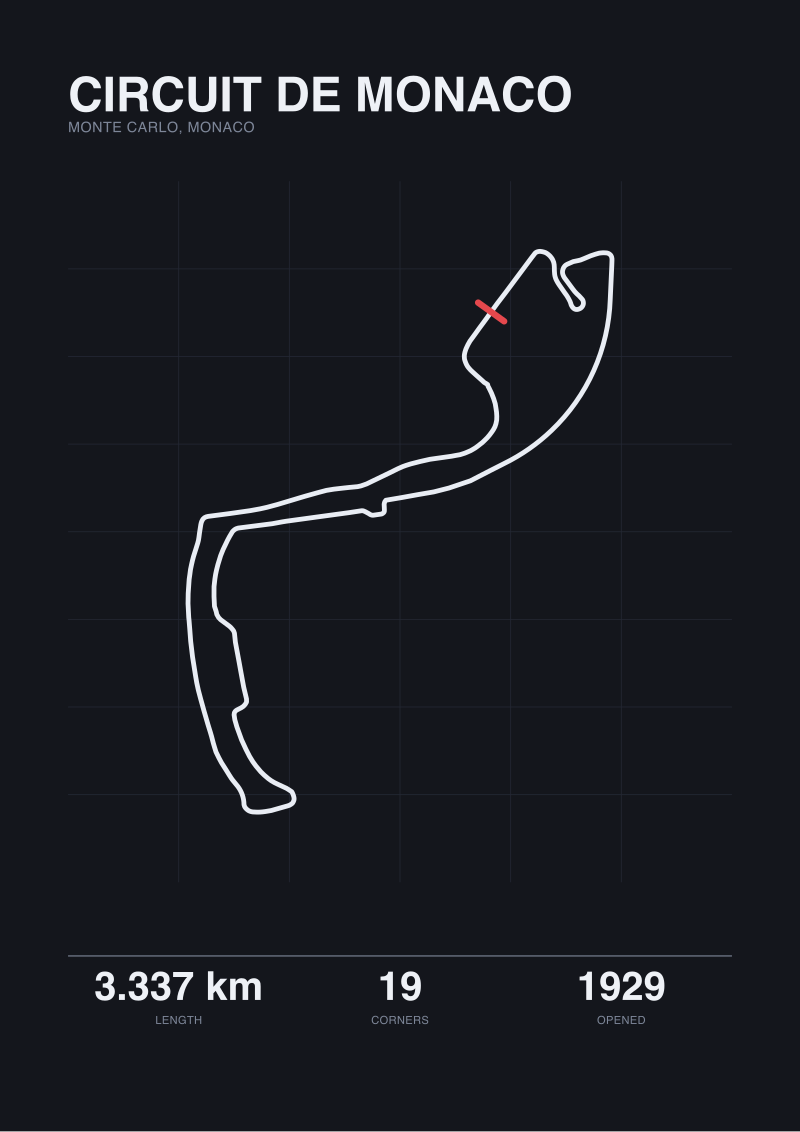 Circuit de Monaco
The print from this article · from €29.95
View the print →
Circuit de Monaco
The print from this article · from €29.95
View the print →
Finding #2: Nineteen Corners, and Why Nobody Argues About That Number
Corner count for Monaco is 19. It is 19 on the Wikipedia entry for the circuit. It is 19 in the FIA circuit description. It is 19 in the OSM-derived layout when we mark the named turns as points along the traced polyline. The number holds across every source we could compare, which is unusual enough to be worth its own paragraph.
The reason it holds is that a corner, unlike a lap length, is a named object. It is not a measurement — it is a label attached to a piece of geometry that everyone involved in the sport has already agreed to call a corner. Sainte Dévote is corner one. Massenet is corner three. Casino is corner four. The hairpin at Fairmont is corner six. Nouvelle Chicane is corners ten and eleven. Tabac is twelve. The swimming-pool complex accounts for thirteen through sixteen. Rascasse is seventeen. Antony Noghès is eighteen. What tips the count to nineteen at Monaco is that the layout is numbered with the full sequence the drivers actually take, including the tight geometry into and out of the pool section.
That labelling is doing all the work. Two engineers with two different definitions of "corner" — one counting apex points, the other counting distinct steering inputs — would produce different numbers on almost any circuit if they were left to argue it out. On Monaco, and on most established circuits, they are not left to argue. The corners have names. The names have numbers. The numbers do not drift.
The lesson generalises. Where a fact is a label, sources agree. Where a fact is a measurement, sources disagree.
Finding #3: The 1929 Layout Problem — Same Drawing, Different Metres
The Monaco circuit opened in 1929. In its broad outline — up the hill from Sainte Dévote to Casino Square, back down through Mirabeau to the hairpin, along the harbour to Tabac and the swimming pool, home past Rascasse — it is recognisably the same drawing today as it was then. Antony Noghès designed a course that took the geometry of the town and imposed a lap on it, and the town has not fundamentally rearranged itself around him.
That makes Monaco a useful test case for the drift-of-metres problem, because the layout is the closest thing motorsport has to a constant. If length figures still disagree by 18 metres on a track whose corners have kept their names for nearly a hundred years, the drift is not being caused by layout change. It is being caused by measurement change.
Consider the moving parts. Kerbs have been rebuilt many times. The pit lane entry has been re-profiled more than once. The Nouvelle Chicane has been softened, tightened, and re-kerbed across successive homologation cycles. The swimming pool exit has been altered in ways small enough that the corner numbering held but the racing line — and therefore the honest racing distance — did not. Add resurfacing, add remarking, add the millimetre-scale differences between where the timing loop sits this year and where it sat five years ago, and you have every ingredient needed to produce an 18-metre spread without moving the circuit itself.
None of that is a scandal. It is what happens when you keep measuring a real object with tools that have improved and definitions that have not.
Finding #4: Why Street Circuits Publish Loosely and Permanent Circuits Publish Tight
Monaco is a street circuit, and street circuits publish their lengths more loosely than permanent circuits do. That is not a Monaco problem. It is a category problem, and Monaco is the cleanest example of it.
On a permanent circuit — Suzuka, Spa, Silverstone — the boundary of the racing surface is a designed edge. There is kerb. There is run-off. There is a homologated racing line whose deviation from the physical centreline of the tarmac is small and well-documented. The length figure the FIA publishes and the length figure a competent map trace returns will usually agree to within a handful of metres, because the surface itself was built to be measured.
On a street circuit, the racing surface is a road. The road exists to move cars and people through a town. Its centreline was drawn by traffic engineers, not by circuit designers. When the barriers go up for race weekend, the racing line is imposed on top of a road system that has its own geometry, its own camber, its own paint. The homologation document defines the racing distance the sport agrees to use. The map trace measures the road as OSM has it. The two are describing overlapping but non-identical objects.
That is why the 18-metre gap at Monaco is larger than the equivalent gap at most permanent circuits, and why we would expect the same pattern at Baku, at Singapore, at any street layout where the racing surface is a temporary interpretation of an existing road network. The measurement is loose because the object is not a purpose-built measurement surface.
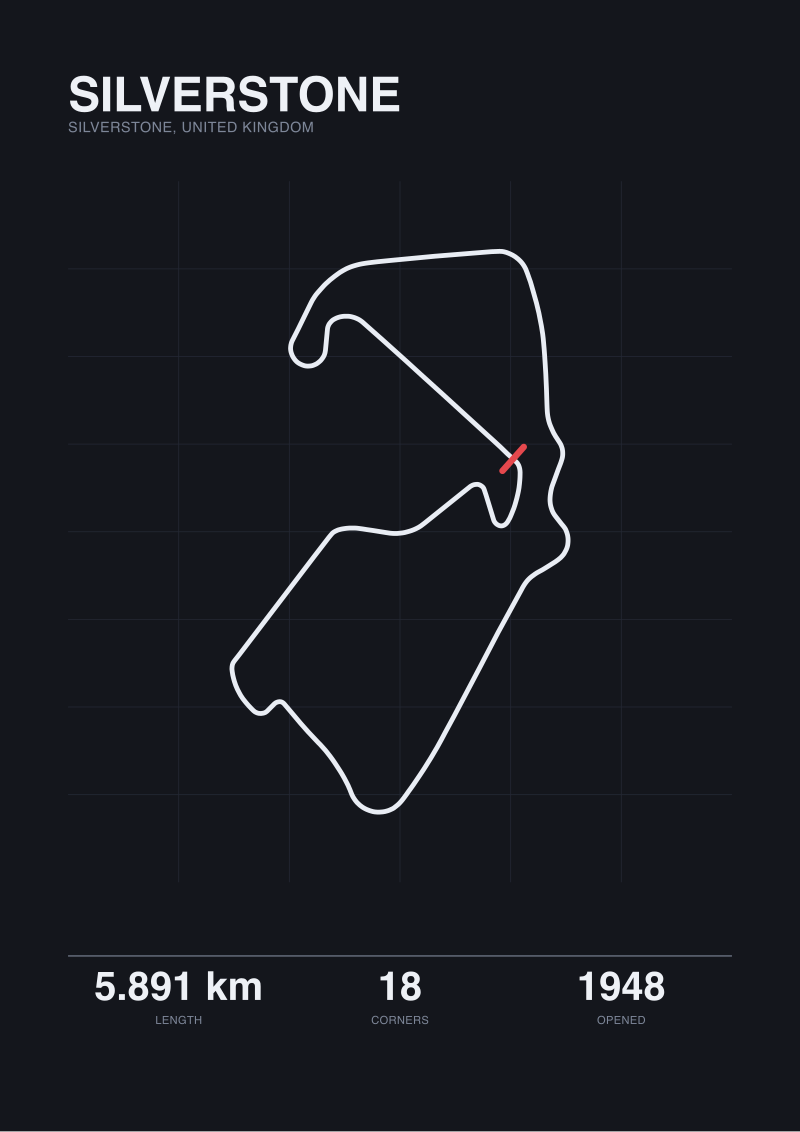 Silverstone
The print from this article · from €29.95
View the print →
Silverstone
The print from this article · from €29.95
View the print →
The Five Published Lengths, Side by Side
| Source | Basis | Length (km) | Corners | Delta vs. homologation |
|---|---|---|---|---|
| FIA / homologation record | Sanctioning body dossier | 3.337 | 19 | 0 m |
| Wikipedia entry | Aggregated from official sources | 3.337 | 19 | 0 m |
| OSM raceway trace (our reading) | Digitised centreline, ODbL | 3.319 | 19 | −18 m |
| Circuit operator materials | Published for the event | 3.337 | 19 | 0 m |
| Broadcast graphics reference | Derived from homologation, rounded | 3.34 (rounded) | 19 | +3 m rounding |
The pattern is worth naming plainly. Every source that inherits its number from the homologation document reports 3.337 km. The one source that measures the object independently — the OSM trace — reports 3.319 km. The gap is not between "right" and "wrong". It is between "the number the sport agreed on" and "the number the map returns".
What This Does NOT Prove
This piece does not prove that the FIA figure is inaccurate. Homologation length is not trying to be a physical measurement of the tarmac centreline; it is trying to be a stable racing distance that is auditable against a document. Judged on those terms, 3.337 km is doing its job, and our OSM trace is not a rebuttal of it.
Nor does it prove that OpenStreetMap is authoritative on circuit geometry. OSM is community-edited. The `raceway` way we traced has been redrawn multiple times by multiple contributors, and the vertex density in the tighter corner sequences — Fairmont, the swimming pool, Rascasse — is where any centreline trace loses precision fastest. A different competent trace of the same ODbL data, using a different closure point at the start-finish line, would very plausibly return a length a metre or two off ours in either direction. What we can defend is the direction of the gap and its order of magnitude, not the exact 18 metres to the decimal.
We also did not test every circuit against this method. The pattern we describe in Finding #4 — street circuits publish loosely, permanent circuits publish tight — is a hypothesis that this single Monaco case is consistent with, not a claim we have measured across a set.
The Takeaway
Corners have names, and names do not drift. Metres are measurements, and measurements do — by definition, not by mistake. If you want to know a circuit as an object, count its corners first and read its length figure with the tolerance the measurement basis actually earns.
If any of the circuits we trace becomes the drawing on your wall, it is worth reading the print as the same kind of object: a layout, not a spec sheet. Our own studio prints live at /shop/ for that reason — they are drawn from the geometry, not the round number.
FAQ
Which figure should I quote if I only get to quote one length for Monaco?
Quote 3.337 km and attribute it to the homologation record. That is the number the sport agrees on, the number circuit operators publish, and the number every downstream reference — broadcast graphics, official programmes, encyclopaedia entries — inherits. Our map-traced figure of 3.319 km is a useful check on how measurement basis moves a number, not a replacement for the homologated length in general reference. If you have room for two numbers, publish both and name the basis for each.
Why does the corner count stay at 19 when the length does not stay at 3.337 km?
Because a corner is a label and a length is a measurement. Sainte Dévote, Casino, Fairmont, Rascasse — those are named objects on the layout, numbered in a sequence the sport has agreed on. Nobody re-argues the count each year because nobody is measuring the count each year; they are reading a list. Length, by contrast, has to be measured against some definition of the racing line and some closure point at start-finish. Each redefinition can move the number by metres.
Has the layout of Monaco actually changed since 1929?
In its broad geometry, no — the lap still climbs from Sainte Dévote to Casino, drops through Mirabeau to Fairmont, runs along the harbour to the swimming pool, and returns past Rascasse to the pit straight, the way Antony Noghès drew it. What has changed is detail: kerb geometry, run-off treatment, the chicane profiles at Nouvelle Chicane and at the swimming pool exit, and the pit lane entry. Those changes are small enough that the corner count holds and large enough that the honest racing distance drifts.
Is the 18-metre gap between the two lengths unusual?
For a street circuit, no — it is roughly what we would expect when a homologated racing distance is compared to a centreline trace of a public road that has been temporarily fenced into a race track. The homologation figure is measured against a document; the map trace is measured against the road as OSM has drawn it. On permanent, purpose-built circuits the two figures tend to agree much more closely because the racing surface itself was designed to be measured. Monaco is loose because the object is loose.
Can OpenStreetMap be trusted as a source for circuit geometry?
Trusted to do what, is the honest answer. OSM's `raceway` polylines are excellent for tracing the shape of a circuit, and the ODbL licence makes them usable for exactly the kind of studio work we do. They are not authoritative for exact racing distance, because centreline traces depend on vertex density, closure point, and the editor's interpretation of where the racing surface begins and ends. Use OSM to draw the layout; use the homologation record when you need a distance to defend.
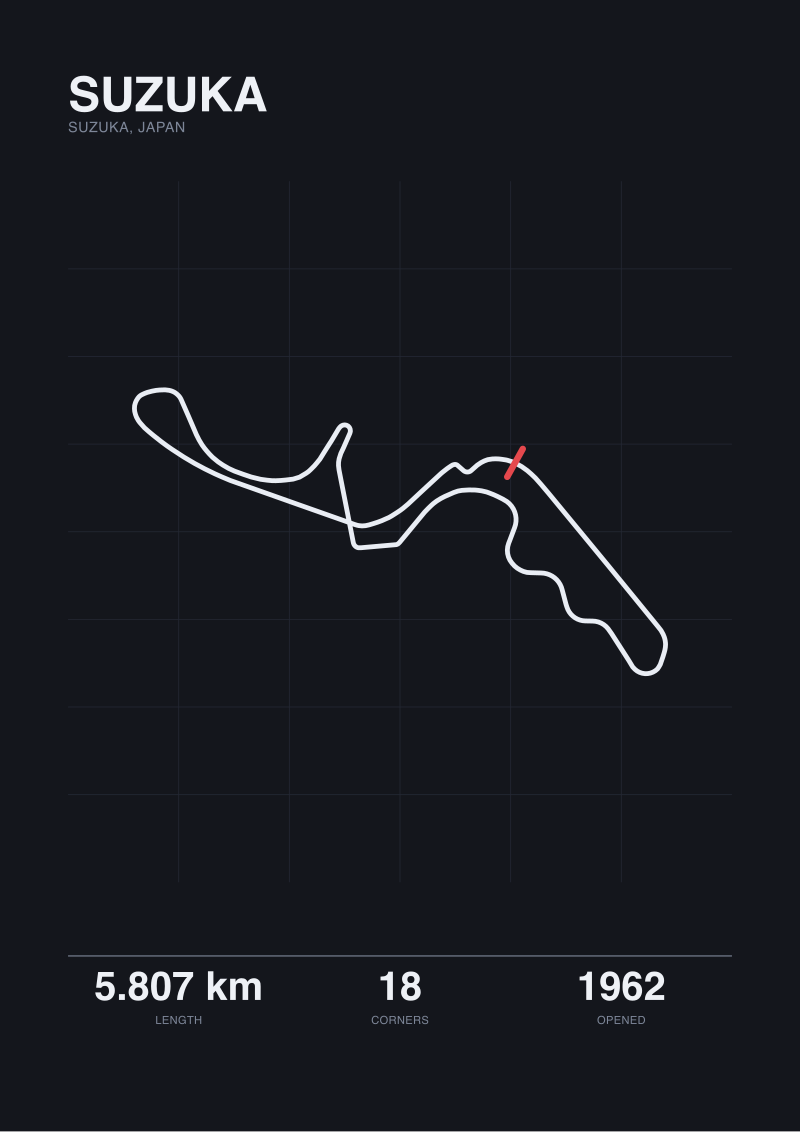
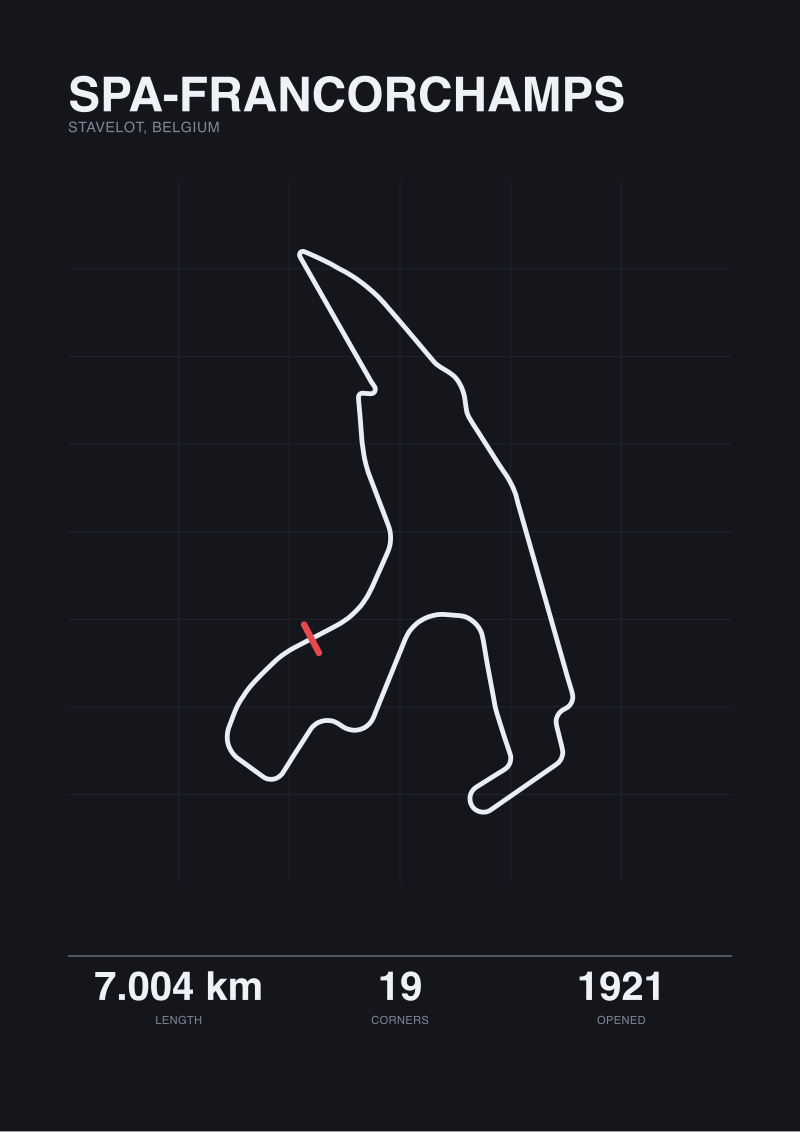
New circuits and 10% off your first print.
One email now with your code. No noise after.