Most gift guides for motorsport fans ask what the recipient likes. That is the wrong first question. The right first question is whether they can name a corner on the layout they claim to love, because the answer decides whether a print belongs on their wall at all. This guide is a flowchart in prose. We will ask three questions, in order, and route the answers to a specific recommendation from our studio's catalogue, which begins with the Circuit de Monaco: 3.337 km on the homologation documents, 3.319 km when we trace the raceway from OpenStreetMap, nineteen turns, open since 1929.
Question 1: Does the Recipient Already Know Their Favourite Circuit?
This is the qualifying lap. Before anyone asks about frame colour or paper stock, establish whether the person receiving the print has a specific layout in mind or a general affection for the sport. The two require different objects on the wall.
The reason this matters comes down to what a circuit print is doing in a room. A traced layout is a document. It rewards the viewer who can look at a line on paper and recognise the geometry underneath. If the recipient cannot name a single corner on the layout they claim to love, the print reads as decoration. That is not a failure of the print. It is a mismatch between the object and the audience.
Ask before buying, if you can. A single question — "which circuit would you want on the wall" — separates the two branches cleanly. If they answer with a name, proceed. If they hesitate, or answer with a driver, or answer with a championship, you are on the other branch and the recommendation changes.
If Yes
They named a circuit. Good. Now check whether the name they gave has a print in our catalogue. Our first release is the Circuit de Monaco. Monte Carlo, 3.337 km on the FIA homologation, 3.319 km when we trace the raceway centreline from OpenStreetMap, nineteen turns, in continuous use since 1929. If Monaco is what they said, you are done with Question 1.
If they named a circuit we have not yet drawn, the honest answer is to wait for the release rather than substitute a different track. A circuit print is specific. There is no version of "close enough" that respects the recipient. Note the request, save it, and revisit when we announce the next map. This is the branch where restraint reads as respect.
If No
They love the sport but not a particular layout. The print they want is one that teaches them a circuit rather than confirms one they already know. Monaco is the correct answer here for a specific reason: it is the layout with the highest recognition-to-literacy gap in motorsport. Almost everyone recognises the Monte Carlo waterfront. Almost no one can name the sequence from Sainte Dévote through Massenet, Casino, Mirabeau, the hairpin, Portier, the tunnel, Nouvelle Chicane, Tabac, the swimming pool complex, Rascasse, and Anthony Noghes.
A traced Monaco print on the wall gives them a year of low-effort learning. Every glance is a chance to attach a name to a geometry. By month twelve they will read the layout the way you read a familiar route home. That is what a print earns its wall space by doing.
Question 2: Is the Print Going on a Wall They Look At, or a Wall They Pass?
The physical placement decides the format. Motorsport prints are often bought for the corridor between the front door and the kitchen, which is the wall people pass but never study. That is the wrong wall for a traced circuit and the right wall for something we do not make.
A studied wall is one where the viewer stops. Above a desk. Beside a reading chair. In a home office at eye level from the seated position. In a bedroom on the wall opposite the pillow. These are the walls that repay geometric detail, because the viewer accumulates minutes of quiet inspection over a year and a print that rewards close reading pays back that time.
A passed wall is different. It works on silhouette, colour block, and one legible word from three metres away. A traced circuit does not read from three metres. The corner names disappear. The tunnel section becomes a curved line. What was documentation becomes wallpaper. If the wall in question is passed rather than studied, you are on the wrong branch of the guide and the honest move is to route the gift elsewhere.
If Yes
The wall is studied. This is the branch our prints were designed for. A traced Monaco at A2 or larger sits above a desk and gives the viewer the full corner sequence at readable scale. The measurement basis is printed in the margin — 3.337 km official versus 3.319 km map-traced — and the difference itself becomes a conversation the recipient can have with anyone who asks why the numbers disagree.
Pick the size by seated eye-line distance. A desk at 70 cm from the wall wants A3 minimum. A reading chair at two metres wants A2. A bedroom wall at three metres from the pillow wants A1. The print scales its readable detail linearly with distance, which is not a marketing sentence, it is what happens when you draw a 3.319 km centreline at a fixed line weight.
If No
The wall is a passed wall — hallway, stairwell, guest bathroom, kitchen splashback area. A traced circuit will underdeliver in that context because no one will stand in front of it long enough to read it. This is where we recommend against the sale. Not every gift budget wants to hear that, but the alternative — placing a document on a wall that treats every image as wallpaper — devalues the object and dulls the recipient's relationship to it.
The correct move on this branch is either to wait for a wall to open up (a home office in the new year, a redecoration) or to reroute the gift to something photographic, high-contrast, and legible at three metres. That is not our catalogue. It is a genuinely different product and we would rather say so than sell into the wrong context.
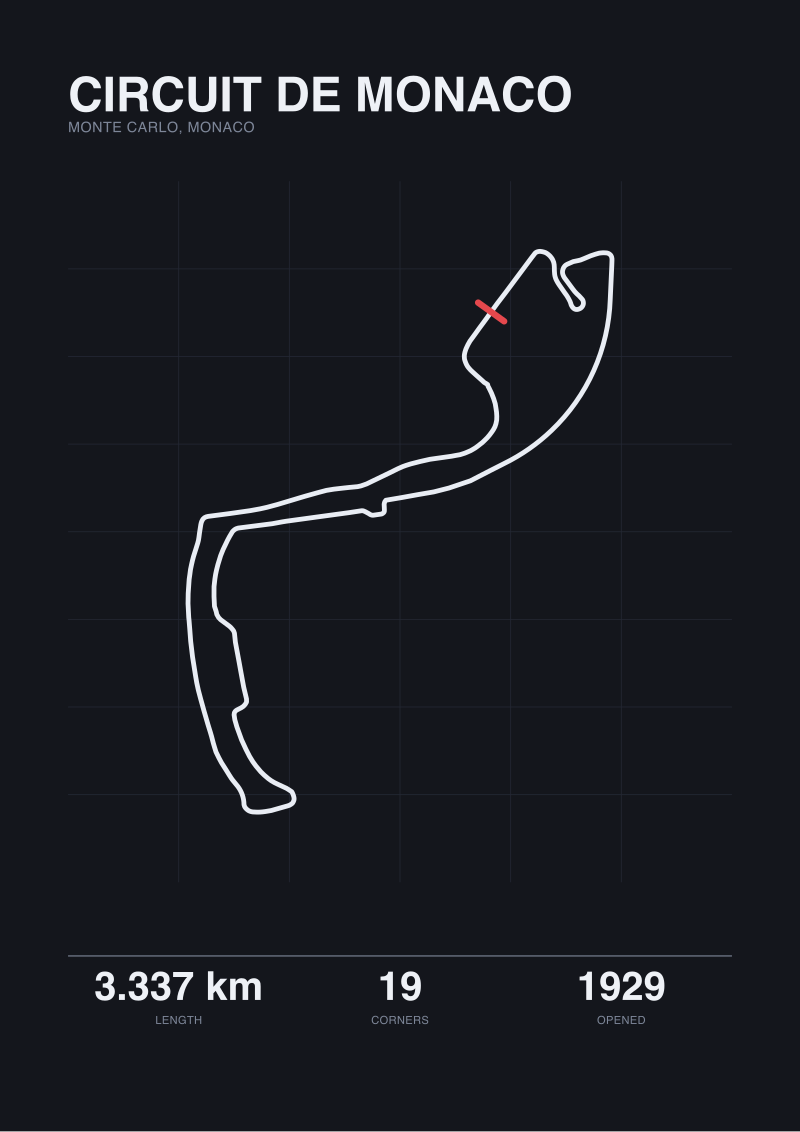 Circuit de Monaco
The print from this article · from €29.95
View the print →
Circuit de Monaco
The print from this article · from €29.95
View the print →
Question 3: Do They Read a Track Map, or Do They Read a Picture?
This is the literacy question. It sounds pedantic. It is not. It decides whether the print teaches the recipient something new every month or bores them by month two.
Some viewers read a track map the way a musician reads a score: they see the line and hear the sequence. They know that a tight radius after a long straight means heavy braking, that a compound corner rewards the driver who compromises the first apex for the second, that a crest before a corner means the car goes light exactly where you want it heavy. For these viewers, the traced layout is dense with information, and each read discovers a new relationship between geometry and racing.
Other viewers read a picture. They enjoy the shape, appreciate the colour, and register the general aesthetic without decoding the line. Both are valid. Only one is the audience for a traced-geometry print.
If Yes
They read maps. The traced Monaco print is not a decorative object for them — it is a piece of reference material that happens to be beautiful. The margin data matters to them. The distinction between homologation length and map-traced length matters to them. The fact that we drew from OpenStreetMap raceway data under the Open Database Licence rather than tracing a screenshot from a broadcast graphic will matter to them the first time they ask where the file came from.
For this recipient, size up rather than down. An A1 traced Monaco at eye level from a desk gives them room to see the compound geometry through the swimming pool complex without squinting, and rewards the year they will spend looking at it. This is also the recipient most likely to return for a second print when we release the next circuit in the catalogue, so leave room on an adjacent wall.
If No
They read pictures. The traced print will hang, and it will not disappoint anyone, but the depth of information built into it will go unused. That is a fine outcome — a well-composed map is still a well-composed image — but it is worth naming honestly before you spend the money. The recipient will get an object they like. They will not get the year of quiet learning that Question 1's other branch depended on.
For picture-readers, size matters less and framing matters more. A smaller print in a heavier frame reads as an object rather than as a document, which is closer to what the picture-reader wants. Do not oversize. An A1 traced circuit above a desk owned by a picture-reader tips into decoration-at-scale, which is a different aesthetic and one we would rather not be responsible for.
If You Answered Everything: The Recommendation Table
Eight combinations of yes and no across three questions. The table below routes each one to the specific recommendation from our catalogue, or to the honest answer that the gift does not belong with us this year.
| Q1: Knows a circuit? | Q2: Studied wall? | Q3: Reads a map? | Recommendation |
|---|---|---|---|
| Yes | Yes | Yes | Traced Monaco A1, framed, eye-level above the studied wall — the flagship match. |
| Yes | Yes | No | Traced Monaco A2, heavier frame, treated as an object rather than a document. |
| Yes | No | Yes | Wait for a studied wall to open, or gift the A3 desk edition for their office. |
| Yes | No | No | Reroute — a traced print will not repay a passed wall for a picture-reader. |
| No | Yes | Yes | Traced Monaco A1 as a learning surface; expect corner-name fluency by month twelve. |
| No | Yes | No | Traced Monaco A2 for the composition; the geometry education is a bonus. |
| No | No | Yes | Hold the gift; a studied wall will unlock the print's full value later. |
| No | No | No | Not our catalogue this year — a photographic gift will serve them better. |
Five of eight combinations route to a Monaco print at some size. Two route to waiting. One routes out of the catalogue entirely. That distribution is deliberate. We would rather refuse three sales in eight than sell into contexts where the object underdelivers, because the print on the wrong wall damages every future print the recipient sees from us.
The table is also a checklist for the gift-giver. If you cannot answer the three questions honestly, ask the recipient before buying. A ninety-second conversation about which circuit they would want on their wall, where it would hang, and whether they read maps, is worth more than a guess dressed up as a surprise. The surprise still holds — they will not know the size, the frame, or the moment — but the routing will be correct.
How We Trace Before We Draw
The catalogue starts small and grows slowly because every print begins as a measurement problem before it becomes a design decision. Monaco is a useful worked example. The FIA homologation document lists the circuit at 3.337 km. When we pull the raceway data from OpenStreetMap under the Open Database Licence and trace the centreline of the racing surface, we measure 3.319 km. The eighteen-metre gap is not an error on either side. Homologation length follows a defined measurement convention that does not always coincide with the geometric centreline of the tarmac, and different sources will produce slightly different figures depending on where they place their line.
We publish both numbers in the margin of every print for exactly this reason. The traced figure is what the drawing shows. The homologation figure is what the sport publishes. A viewer who notices the disagreement is a viewer we respect, and the answer to their question is printed on the same wall as the drawing.
Nineteen turns, 1929 as the opening year, Monte Carlo as the setting — these facts stay constant across sources. The layout has changed less than most modern circuits, which is part of what makes Monaco a good place to start a catalogue that intends to draw each track the way an engineer would draw it: measure first, name what you measured, then commit to paper. The next release will be treated the same way, and the numbers in its margin will do the same work.
For anyone routed to the Monaco recommendation by the table above, the print is available at our /shop/, sized A3 through A1, on paper stock chosen to hold fine line detail at readable weight.
FAQ
Which sizes of the Monaco print work at which viewing distances?
Match the paper size to seated eye-line distance from the wall. At 70 cm — a desk against the wall — A3 is the minimum that keeps corner names readable. At around two metres — an armchair or a bed foot — A2 preserves the full nineteen-turn sequence without requiring the viewer to lean in. At three metres or more, A1 keeps the swimming pool complex and the tunnel section legible as distinct geometries rather than as a general curve.
Why do you publish two different lengths for Monaco on the print?
The FIA homologation document lists the Circuit de Monaco at 3.337 km. When we trace the raceway centreline from OpenStreetMap data, we measure 3.319 km. Both figures are correct within their measurement convention. Homologation follows a defined method that does not always coincide with the geometric centreline of the tarmac. We print both numbers in the margin so the viewer can see what the drawing shows and what the sport publishes, side by side.
Is a traced circuit print a good gift for someone who does not follow motorsport?
Usually no, but Monaco is a defensible exception. Its waterfront is one of the most recognised images in sport even among non-fans, and the layout has been broadly unchanged since 1929, which means the print doubles as a compact geography of Monte Carlo rather than a specialist document. For a recipient with zero motorsport interest, treat it as an architectural drawing of a place, not as circuit intelligence.
Do you make prints of circuits other than Monaco?
Not yet. The catalogue opens with the Circuit de Monaco because it is the layout we finished measuring, tracing, and drawing first. Every subsequent release goes through the same process — pull the raceway geometry from OpenStreetMap, compare against published homologation figures, note the disagreement in the margin, commit to paper — which is deliberately slow. We would rather add one carefully drawn circuit than five approximations.
What paper and frame recommendations do you make?
The prints are produced on stock chosen to hold fine line weight at close reading distance, which matters more at A1 than at A3. For framing, we recommend matching the frame weight to the reading mode: a lighter frame for map-readers, who want the geometry to dominate, and a slightly heavier frame for viewers who will read the print as a composed object first. Non-reflective glazing is worth the small premium at any size larger than A3.
How is the print licensed, and can I share the underlying map data?
The traced geometry is derived from OpenStreetMap raceway data under the Open Database Licence, which requires attribution and share-alike on any derivative dataset. The finished print itself — layout, typography, margin data, composition — is our studio's copyrighted work and is not licensed for redistribution. The distinction matters to anyone thinking of tracing their own version of a circuit: the underlying geometry is open; a specific drawing of it is not.
Can I request a circuit not yet in the catalogue?
Yes, and we log requests to inform release order, but we do not accept custom commissions on demand. Each circuit takes weeks to measure, cross-reference against homologation documents, and draw at the studio's standard. A request from a gift-giver whose recipient has a specific track in mind is more useful as a signal than as an order — it moves the requested circuit up the priority list without committing to a delivery date we cannot promise honestly.
From the collection
New circuits and 10% off your first print.
One email now with your code. No noise after.