5.793 kilometres, eleven corners. 5.245 kilometres, fifteen corners. Those are the two objects on the table when a buyer asks us which circuit map print to hang: Monza, opened in 1922, or Mugello, opened in 1974. The received wisdom in circuit-print collecting is that the older, more famous name wins on the wall — Monza traces to the first purpose-built autodrome in continental Europe, and the shorthand Temple of Speed does most of the talking. It is a strong argument, made in good faith by people who love the sport. It is also, once we trace both layouts from the raceway geometry, the wrong argument for most of the walls we ship prints to.
Why the Monza-by-Default Argument Is Actually True
The case for Monza is not a weak case, and we would not pretend otherwise. The circuit opened in 1922. That date is not decorative. It puts the layout in a small group of purpose-built venues whose plan predates the invention of nearly every convention now taken as given about how a permanent racing facility should be arranged. Someone drew a road that looped back on itself in a park in Lombardy before the modern grand prix even had a stable ruleset. When a print of Monza hangs on a wall, that history is in the geometry.
The name does work that no other Italian circuit's name does. Ask a person who does not follow racing to name one circuit anywhere, and Monza comes up in the answers a non-trivial fraction of the time. That recognition is a real commercial asset for a print. It gives the object something to say to the visitor who does not know a chicane from a hairpin — a short, legible caption that translates without a footnote. Prints that require a paragraph of explanation before they read as anything are, in our experience of what actually ships, harder to place.
There is also the coherence of what the name refers to. Monza's central identity, the long straights and the compression of the layout into a shape that rewards top speed above almost everything else, has been part of the vocabulary of the sport for a hundred years. The reader who picks up on that reads the print quickly. Corner names — Parabolica, Lesmo, Ascari — carry weight in the culture the print sits inside. None of this is manufactured. It is the honest strength of choosing the older, more famous of the two Italian permanent circuits for a wall you want to be immediately understood.
But every one of those arguments is about the name, not the drawing. Once we look at the drawing, the calculus stops holding.
Where the Fame-First Rule Breaks Down at 5.245 Kilometres and Fifteen Corners
A circuit map print is not a nameplate. It is a piece of geometry hung at reading distance on a wall, and what the eye does with it depends on what the drawing gives the eye to do. Here the two objects diverge sharply. Monza's 5.793 kilometres — 5.794 when we retrace it from OpenStreetMap raceway data, a one-metre gap that reflects the difference between homologation figures and cartographic centreline tracing — contain eleven turns. Mugello's 5.245 kilometres, where the official published length and our map-traced measurement agree to three decimals, contain fifteen.
That is not a marginal difference. Monza gives the eye a compressed shape with long, straight edges and a short catalogue of decisions in between them. From across a room, the outline reads as a rounded triangle with two interruptions. It is a strong graphic. It is not, in strict visual terms, a rich one. There is a limit to how long a viewer can stand in front of eleven corners and 5.793 kilometres of mostly straight line before the drawing has given up everything it has to give.
Mugello is doing something different at 5.245 kilometres. Fifteen turns folded into a shorter loop mean the drawing has more places where it changes direction, more visible relationships between one corner and the next, more moments where the eye follows an arc into a counter-arc and has to slow down to read it. The Tuscan layout, opened in 1974 and drawn into the hills above Scarperia, does not have Monza's straight-line brutality on its side. What it has instead is a shape that repays the second look and then the third. A print that keeps working after the first week on the wall is a different kind of object from a print that landed on the first day and then went quiet.
The corner-count difference — fifteen against eleven, on 548 fewer metres of racing surface — is the specific number that decides most of this. When we compare like with like, using the same measurement basis on both, Mugello is drawing four more directional changes into a smaller footprint. That density is not a subjective claim about which circuit is more beautiful. It is a property of the geometry that any viewer standing in front of the two prints, without knowing either name, can read at a glance. The fame-first argument is silent about the density. It has to be silent about the density, because the density is not what fame measures.
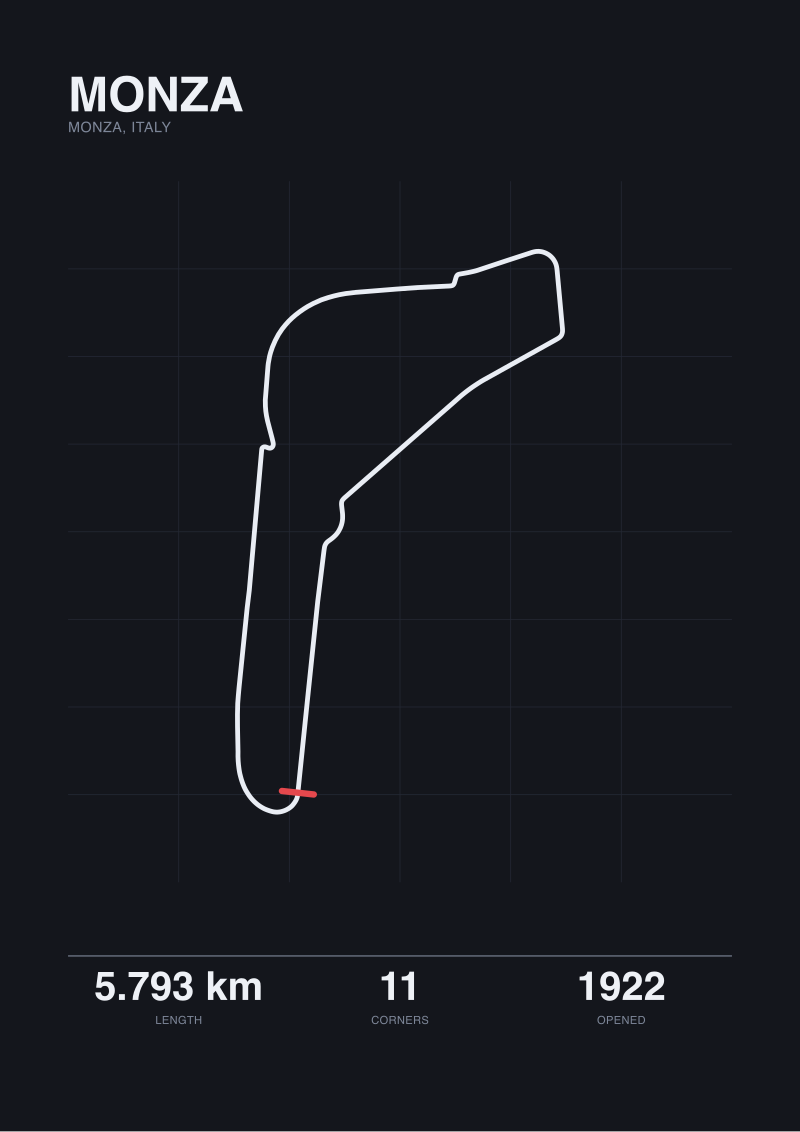 Monza
The print from this article · from €29.95
View the print →
Monza
The print from this article · from €29.95
View the print →
The Rule We Use Instead: Corner Density Per Metre, Not Name Recognition
The framework we work from at this desk is straightforward, and it starts with a division we can do out loud. Monza's eleven turns across 5.793 kilometres of published length come to roughly 1.90 corners per kilometre. Mugello's fifteen turns across 5.245 kilometres come to roughly 2.86 corners per kilometre. That is a fifty per cent higher corner density in Mugello's favour, measured on the same basis. It is not a preference. It is what the traced geometry produces when we do the arithmetic.
Corner density per kilometre is the metric we reach for first because it correlates with what a print actually does on a wall. A circuit whose layout produces more direction changes per metre of racing surface gives the drawing more anchor points for the eye. That means the outline holds together as a composition when it is scaled to a print's frame — because the shape has enough internal events to remain interesting at any viewing distance — and it means the individual corner sequences remain legible when someone stands close enough to read the labels.
The lower-density layout has the opposite property. Monza's 1.90 corners per kilometre is a real number about a real layout: the drawing is dominated by the transit between direction changes, not by the changes themselves. That is exactly what makes Monza fast on the racing side of the ledger — cars spend disproportionately more time at high speed because the geometry gives them less to do — and it is also what makes a Monza print, as an object, more graphic and less textural. The two facts are the same fact seen from different sides.
We do not run this metric alone. We cross it against opened-year context (1922 for Monza, 1974 for Mugello — two very different decades of circuit design philosophy show up in the drawings), against the geographic setting the raceway is embedded in, and against what the buyer tells us about the wall. But corner density per kilometre is the first cut, and it is the cut that most of the received wisdom skips. Skipping it is how a fame-first framework ends up recommending the layout with less to read.
When Monza Still Wins the Wall
The rule is a rule, not a law. There are walls where Monza is the correct print and Mugello is not, and we would rather name them plainly than pretend our framework generalises further than it does. The most common case is a wall whose whole reason for existing is that it references the history of the sport as an institution — a room organised around the century-scale story rather than the geometry of any one circuit. On that wall, 1922 does work that 1974 does not, and the compressed, graphic Monza outline carries the historical weight better than a more textural drawing would.
The second case is the wall that needs to read instantly to a viewer who is not going to stop and look twice. A hallway, a landing, a corridor between rooms — spaces where the print has one moment to land before the viewer keeps walking. Monza's stronger silhouette wins there. Mugello's density is wasted on a viewer who never gets close enough to reward it. And the third case is the buyer who is buying the name honestly, knowing that is what they are doing. That is a legitimate reason to hang a print, and our framework has nothing useful to say against it. If you want the Monza name on the wall, buy the Monza print — from our own studio at /shop/, or from anyone else who has traced it carefully. The received wisdom is not wrong for those rooms. It is only wrong when it is applied to every room.
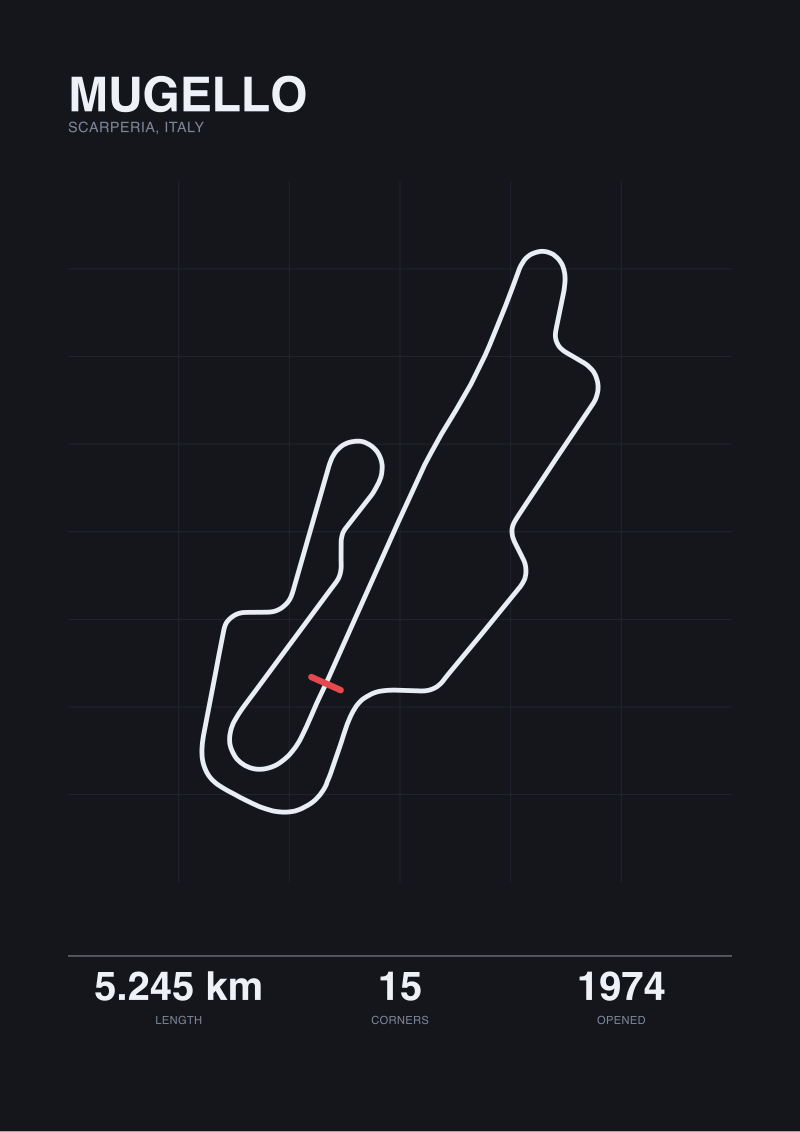 Mugello
The print from this article · from €29.95
View the print →
Mugello
The print from this article · from €29.95
View the print →
FAQ
Which of the two circuits is longer, and by how much?
Monza is the longer of the two by 548 metres on the published figures — 5.793 kilometres against Mugello's 5.245 kilometres. When we retrace both from OpenStreetMap raceway data, Monza comes out to 5.794 kilometres and Mugello to 5.245 kilometres, so the map-traced gap is 549 metres. The difference between homologated length and cartographic tracing shows up on Monza and not on Mugello, which is a small technical curiosity worth naming when the numbers appear next to each other on a print.
How many corners does each circuit have on the standard layout?
Monza has eleven corners on the standard grand prix configuration. Mugello has fifteen. Both counts refer to the currently used layouts as recorded in the public references we work from. Corner counts occasionally shift when a circuit is modified, and neither number should be read as a fixed property across all of the circuit's history — Monza in particular has passed through several distinct configurations since 1922 — but the two counts, taken together, are the correct comparison for a buyer looking at prints of the current layouts.
Why do published length and map-traced length differ for Monza but not Mugello?
Published circuit lengths come from homologation documents, which are measured along the racing surface using specific procedures that depend on which line is treated as the reference. Our map-traced measurements pull the centreline of the raceway geometry from OpenStreetMap and calculate its length. Small disagreements — Monza's one-metre gap between 5.793 and 5.794 kilometres is a good example — are normal artifacts of two different measurement methods. Where the two figures agree to three decimals, as at Mugello, that is a coincidence of the underlying geometry rather than a rule.
Does the older circuit always make the better print?
No, and this article argues the opposite in most cases. Monza opened in 1922 and Mugello in 1974, and that fifty-two-year gap does matter for the reader who is buying primarily for the historical association. But age is a property of the name, not of the drawing on the wall. If the print is being chosen for what the eye does with the geometry at reading distance, corner density and layout legibility matter more than opening date, and by those measures Mugello is the more rewarding print on a majority of walls.
What is corner density per kilometre and why does it matter for a print?
Corner density per kilometre is the number of turns on a circuit divided by its length. Monza sits at roughly 1.90 corners per kilometre; Mugello at roughly 2.86. Higher density means the drawing has more direction changes packed into the outline, which gives the eye more to read and typically produces a print that holds attention longer. Lower density produces a more graphic, silhouette-driven print. Neither is universally better, but the metric is the first cut we take on print selection.
Where is each circuit located?
Monza is at the Autodromo Nazionale Monza in Monza, in the Lombardy region of northern Italy. Mugello is at the Mugello Circuit in Scarperia, in the Tuscan hills north of Florence. The two settings are geographically and topographically distinct — a park-embedded autodrome on the plain of the Po in one case, a rolling hillside layout in the other — and that context sometimes matters to a buyer who is choosing between the two prints for reasons that go beyond the racing geometry itself.
Are there rooms where neither print is the right choice?
Yes. A wall that has no reference point for motorsport as a subject — a room whose visual vocabulary is doing something else entirely — will not be improved by adding a circuit outline, regardless of which circuit it is. Our framework assumes the buyer has already decided that a circuit print belongs in the room. The decision we help with is which one, not whether. When the answer to the whether question is no, no amount of corner density or historical weight makes it yes.
From the collection
New circuits and 10% off your first print.
One email now with your code. No noise after.