There is a pattern we see whenever a reader arrives asking what makes Monza fast. They hold two facts at once, and the facts disagree. The first is that Monza fits eleven turns into 5.793 kilometres of homologated length — dense enough, on paper, to read as a technical circuit. The second is that Monza has produced the highest average lap speeds of any track on the modern Formula 1 calendar. Both statements are documented. The gap between them is where most explanations of the temple of speed collapse.
This is a survival handbook for reading Monza. Not for celebrating it. It is written for the reader who is going to sit down with the map anyway and wants to avoid the four common failure modes. We trace the raceway polygon from OpenStreetMap before we draw anything, and the trace disagrees with the official figure by one metre — 5.794 against the FIA's 5.793. We will come back to that gap. It is not a rounding accident. It is the most instructive fact in the file.
The Straight-Line Fallacy
The pattern: readers arrive convinced Monza is fast because of its main straight, treat the circuit as a dragstrip with punctuation, and stop asking questions the moment someone mentions the pit-straight speed trap.
Straight-line length matters. It is not what makes Monza Monza. Several circuits on the current calendar have straights that measure within a hundred metres of Monza's longest. Some have longer ones. None produce the same average lap speed, because average lap speed is not a function of maximum straight length. It is a function of how much of the lap is spent at or near the top of the car's speed envelope, and how quickly the car returns to that envelope after every deceleration event.
Monza's advantage is not the length of any single straight. It is the layout's refusal to spend time below top speed. Trace the 5.793 kilometres and count the sections where a modern F1 car is off the throttle: the two Variante chicanes, the two Lesmos, the Parabolica, and the middle of Ascari. Everything else is throttle-open running, most of it near maximum. The Curva Grande, for cars in current aerodynamic configuration, is not a corner in the sense of a lap-time-costing deceleration. It is a slight change of direction taken with the throttle pinned.
The straight-line fallacy is why Monza gets grouped with Baku or Jeddah in loose speed conversation. Those circuits also feature long full-throttle sections, but their corner sequences drop the car back into low gears with an aggression Monza's chicanes do not repeat. Baku demands slow, often. Monza demands slow only twice per lap in a serious way. That is a structural difference, and it is invisible if you are only looking at which circuit's longest straight measures longest.
The Corner-Count Confusion
The pattern: someone opens a Monza discussion by pointing out that the circuit has only eleven turns, treats the count as proof of the layout's character, and moves on.
Corner counts without corner character are almost meaningless. Circuits with more turns than Monza can absolutely be faster in average speed if those turns do not cost time. What Monza has is not a low corner count but a specific mix. Two chicanes — the Variante del Rettifilo at the end of the main straight, and the Variante della Roggia after the Curva Biassono — that are effectively hard braking events immediately reversed into acceleration. Two Lesmos, medium-speed direction changes that punish poor lines but do not require deep braking. One Curva Grande that most modern F1 chassis take without a lift. The Ascari chicane, a three-part left-right-left that is genuinely time-critical and rewards commitment more than pace. And the Parabolica, now formally the Curva Alboreto, a long decreasing-radius right that closes the lap.
Count the turns that actually decide lap time and you land between four and six, depending on how you treat Ascari's three parts. The other turns exist as layout notation, not as time-costing geometry. This is the specific reason "only eleven turns" both undersells and oversells Monza in the same sentence — the number does not describe what those turns do to the car.
A tighter reading of the corner map is this: Monza's eleven is a rounding artefact of how the homologation counts direction changes. Functionally, the circuit is closer to a five-corner layout wrapped in a very long full-throttle sequence. That gap between notation and function is where the temple of speed actually lives.
Monza is not fast because it has few corners. It is fast because most of its corners are not, functionally, corners.
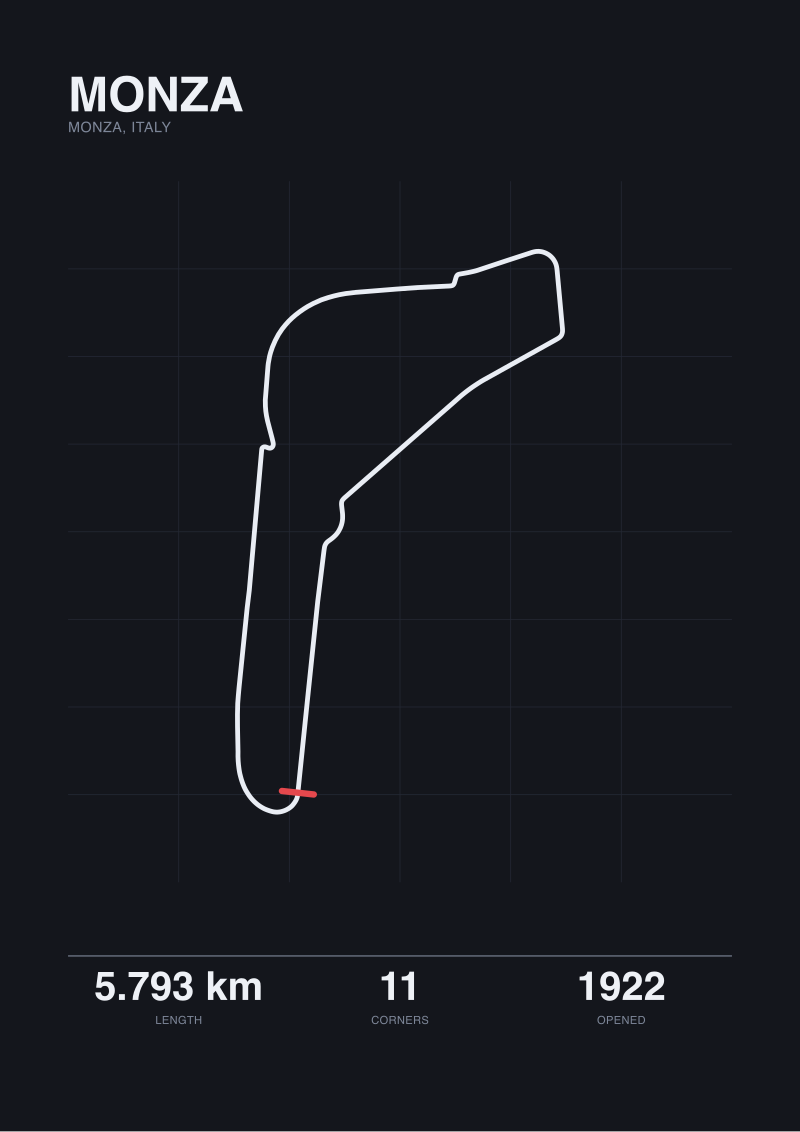 Monza
The print from this article · from €29.95
View the print →
Monza
The print from this article · from €29.95
View the print →
The Elevation Silence
The pattern: elevation change gets discussed for Spa, for Suzuka, for Interlagos, for Circuit of the Americas. It is not discussed for Monza. The silence is treated as a non-fact — Monza is flat, and the sentence ends there. But flatness is a design property with speed consequences, and refusing to name it loses part of the argument.
A circuit with elevation costs time in ways plan-view distance does not capture. An uphill section demands energy the car cannot fully recover on the way down. The descent then becomes, functionally, a braking zone dressed as a straight, because the driver must manage speed into whatever waits at the bottom. Monza's site does not do this. The Parco di Monza that the circuit occupies is essentially level ground. The circuit's elevation profile, traced against its plan view, is a rounding error.
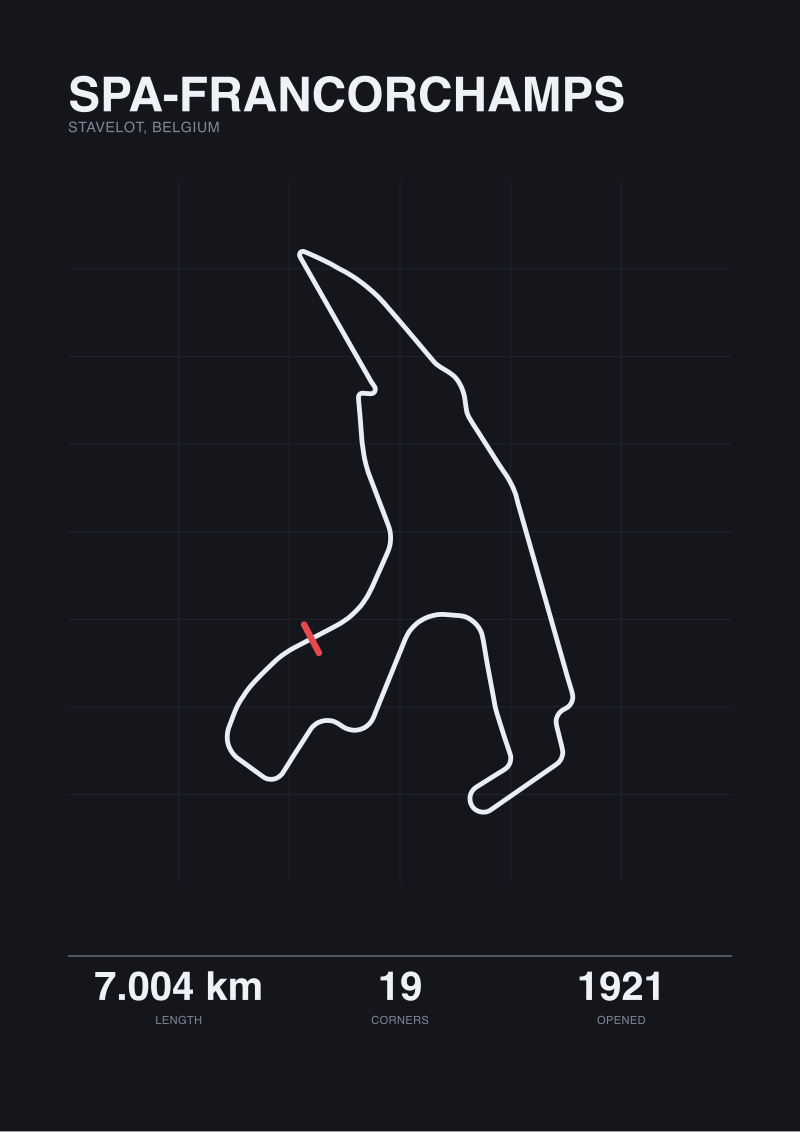
The consequence is that every metre of the 5.793 kilometres is a metre of horizontal running. No energy is spent lifting the car. No braking event is imposed by topography. The circuit's total length is closer to its effective racing length than at almost any other venue on the calendar. Spa is 7.004 kilometres by homologation, but a lap of Spa contains vertical work — the climb through Eau Rouge and Raidillon is documented, well-photographed, structurally important — that Monza's lap simply does not contain.
To describe Monza as "flat" is not praise and not criticism. It is a measurement. A circuit built on a river valley or a hillside would not produce Monza's average speeds even if its plan view were traced identically.
The Homologation Gap
The pattern: readers see a length figure and treat it as ground truth. Monza is 5.793 kilometres. The number is stated as fact and then used to compute everything downstream — theoretical top speed, sector times, tyre degradation windows, fuel loads. But the length figure is not a single number, and pretending it is skips the most interesting question a circuit-map reader can ask.
The homologated length published by the FIA and by Autodromo Nazionale Monza is 5.793 kilometres. Our own trace of the raceway polygon in OpenStreetMap returns 5.794 kilometres. One metre of difference. Small enough to be irrelevant to any race outcome, large enough to be structurally interesting. The homologated figure is measured along a specific racing line at a defined offset from the inside kerb. Our trace follows the centreline of the raceway polygon. These are not the same line. They should not return the same length. That they only disagree by a metre says something flattering about both sources — not something to explain away.
The question is not whether 5.793 or 5.794 is correct. Both are correct measurements of different things. The question is what any given length figure is measuring. Length quoted without measurement basis is a number that looks precise and is functionally ambiguous. Any explanation of Monza's speed that treats "5.793 km" as an unquestioned constant is skipping the most interesting question in circuit description: along which line.
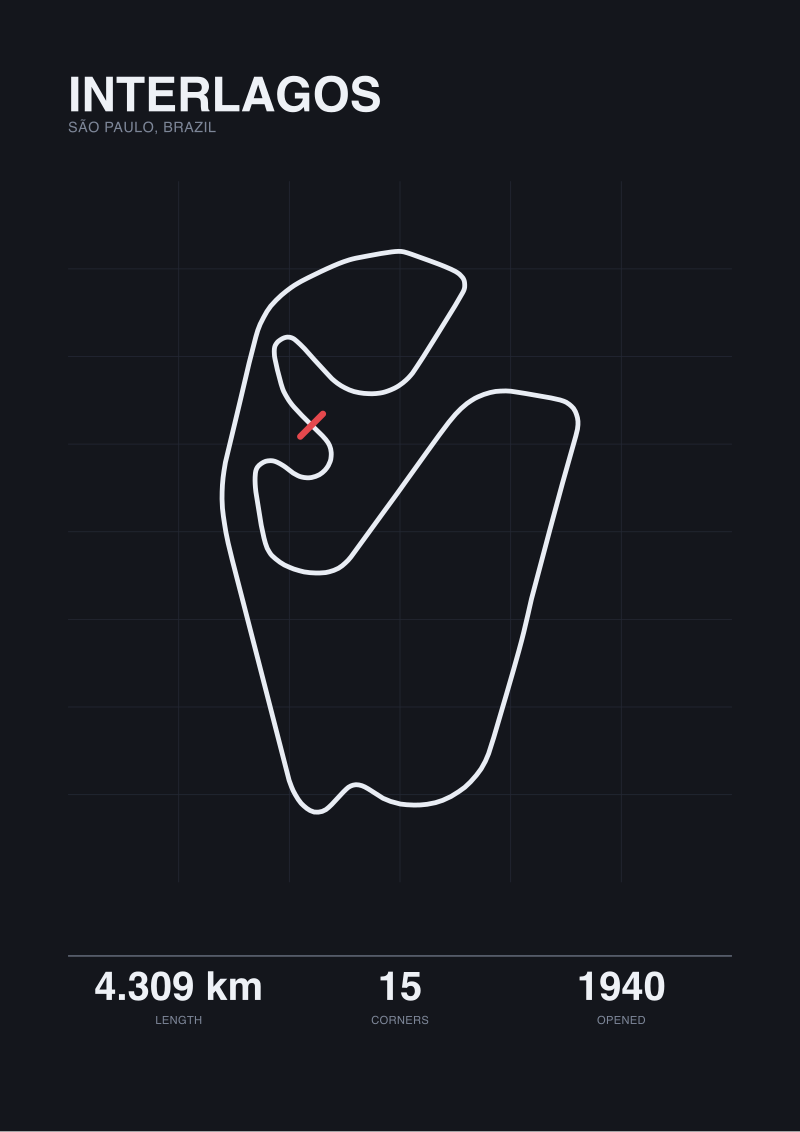 Interlagos
The print from this article · from €29.95
View the print →
Interlagos
The print from this article · from €29.95
View the print →
So What Do You Actually Do
Three rules. First, when someone tells you Monza is fast because of the straights, ask which straights they mean and how they compare to Baku's or to Spa's Kemmel. If they cannot answer, the explanation is inherited, not observed. Monza's speed lives in what its corners refuse to cost, more than in what its straights are able to give.
Second, when someone gives you a length figure to three decimal places, ask what line it was measured along. 5.793 kilometres is not a fact about Monza. It is a fact about a specific racing line at a specific offset from a specific kerb, and the offset matters. Our own centreline trace returns 5.794. Both are honest. Neither is universal. A writer who does not name the line is quoting confidence they have not earned.
Third, look at the elevation profile before you look at the plan view. Every circuit on the calendar has an elevation profile worth reading. Monza's is nearly flat, and that flatness is doing more work than the corner count or the straight length in producing the average lap speed. If a Monza article does not mention elevation, that absence is the argument the writer did not know they were making. We sell a traced plan-view print of Monza in the studio shop at /shop/, drawn from the OpenStreetMap raceway geometry that returned 5.794 kilometres. We do not put an elevation profile on it. At Monza there is not one worth drawing. That is the point.
FAQ
Is Monza the fastest circuit on the current Formula 1 calendar?
Monza has produced the highest average lap speeds on the modern F1 calendar. Whether it holds that position in a given season depends on aerodynamic rules, tyre compounds, and hybrid deployment strategy, which shift year to year. The structural reason Monza tends to top the average-speed table is not any single straight but the low aggregate time the layout spends below top speed. Read the corner map, not the speed trap.
Why do our 5.794 km trace and the official 5.793 km length disagree?
The FIA homologates Monza at 5.793 kilometres, measured along a defined racing line at a specific offset from the inside kerb. Our own trace uses the centreline of the OpenStreetMap raceway polygon, which follows a slightly different path. One metre of difference across nearly six kilometres is what you would expect from measuring two different lines through the same circuit. Neither number is wrong; they measure different things.
How many turns at Monza actually decide lap time?
The homologated count is eleven, but the count includes direction changes that do not require meaningful deceleration. In practical terms the lap is decided at the two Variante chicanes, the two Lesmos, the Ascari sequence, and the Parabolica — somewhere between four and six turns, depending on whether you count Ascari as one corner or three. The other turns are notation. That gap between count and function is central to reading Monza.
Why is Curva Grande sometimes described as not really a corner?
Curva Grande is a long right-hand direction change between the first chicane and the Variante della Roggia. In current F1 aerodynamic configuration it is taken flat or near-flat. A corner, for the purpose of lap-time analysis, is a deceleration event. A direction change taken without lifting is a curved straight. Curva Grande sits on that line — geometrically a corner, functionally an extension of the throttle sequence. Both descriptions are defensible.
Is Monza's flatness a design choice or an accident of geography?
It is a consequence of the site. The circuit was built inside the Parco di Monza, opened in 1922, and the parkland is essentially level ground. The layout designers did not choose flatness in the sense of rejecting elevation; they built on the land they had. The consequence for speed is the same either way — no energy is spent lifting the car — but the causal chain runs from geography to layout, not from designer intent to flat ground.
Why does the main straight matter less than most articles claim?
The main straight matters, but only as one component of a lap that stays near top speed almost throughout. Circuits with straights of similar length do not produce Monza's average speeds, because their corner sequences cost more time. If you fixate on the main straight, you cannot explain why Monza is faster than tracks with comparable or longer full-throttle segments. The straight is a symptom of the layout's character, not the cause of it.
Does the "temple of speed" name still hold with modern hybrid F1 cars?
The name predates the current power-unit regulations by decades and originated with the pre-war layout, which included high-speed banking now removed from the racing circuit. Modern hybrid cars are heavier and produce more downforce than their predecessors, which changes what "fast" means at Monza. The average speed is still the highest on the calendar, and the corner mix still favours minimal deceleration. The nickname survives because the underlying geometry survives.
From the collection
New circuits and 10% off your first print.
One email now with your code. No noise after.