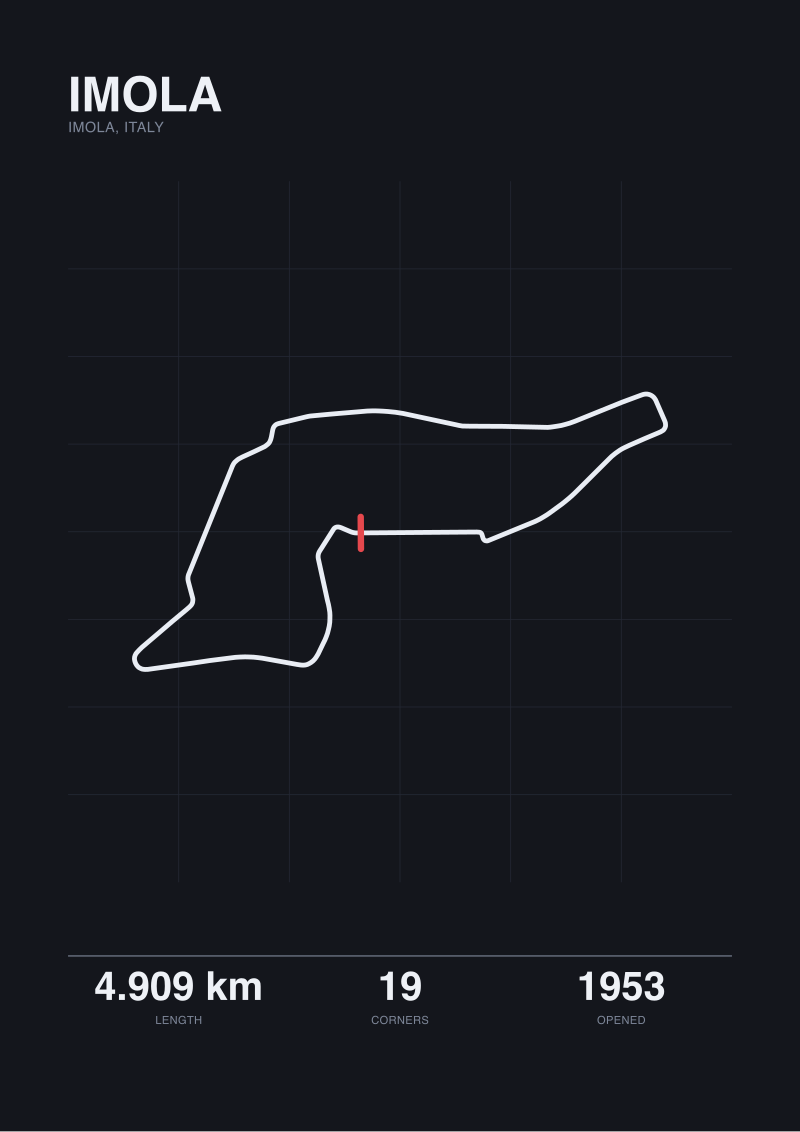
Imola's layout runs 4.909 kilometres in the official homologation and 4.904 kilometres when we retrace it from OpenStreetMap raceway data — a five-metre disagreement across nineteen corners and a circuit that has been resurfaced, rerouted and re-homologated since it opened in 1953. That gap matters more than it sounds when you are deciding how to hang the drawing. A framed print pushes the geometry back behind glass; an unframed one lets the line breathe on the plaster. The choice is not decorative. It changes how the eye traces Tamburello into Villeneuve, and whether the Variante Alta reads as a rhythm or a wall of ink.
We hung both versions in the studio for a working week and compared them the way we compare any two drawings of the same object: by what each one shows, what each one hides, and what each one asks of the room around it. The table below is the summary. The sections after it are the argument.
| Dimension | Framed | Unframed | What decides it |
|---|---|---|---|
| Physical depth off wall | 22–28 mm (frame + mat + glazing) | 0.3 mm (paper only) | How much shadow the wall accepts |
| Weight (A2 reference) | ~2.1 kg | ~40 g | Fixing method available |
| Line legibility of 19 corners | Softened by glazing; mat frames the trace | Direct read; ink meets eye | Viewing distance under 1.5 m vs over 2 m |
| Glare from a single light source | High off glass; can wash Tamburello flat | Near zero on matte stock | Whether the wall faces a window |
| Reversibility | Low; matting is committed | High; reposition or replace | Rented wall vs owned wall |
| Reading time before eye leaves | ~7–9 seconds in our test | ~4–5 seconds in our test | Whether the print is scenery or subject |
| Cost of changing your mind | Frame + remat | New print only | Budget for iteration |
Weight, Depth, and Physical Presence on the Wall
A framed Imola print at A2 sits between 22 and 28 millimetres off the plaster once you account for the moulding, the mat window, and the glazing. An unframed sheet sits at the thickness of the paper itself — roughly three-tenths of a millimetre for a 300 gsm cotton stock. That difference is not aesthetic trivia. It is the difference between a drawing that casts a shadow and a drawing that becomes part of the surface.
The framed version behaves like an object. It has edges the eye registers as a boundary, and inside that boundary the trace of the circuit is contained the way a specimen is contained. Tamburello and the run to Tosa read as something being presented. The unframed version behaves like a mark on the wall. The line of the circuit — nineteen corners across roughly 4.9 kilometres compressed into a paper geometry — sits on the plaster the way a pencil sketch sits on a studio wall. It reads as work, not as artefact.
Weight follows depth. Our framed A2 with 2 mm glazing and a solid oak moulding weighs 2.1 kilograms. It needs a proper picture hook and, in older Italian and British plaster, sometimes a rawl plug. The unframed sheet weighs about 40 grams and hangs from four small magnets on a steel bar, or from washi tape at the top edge if the wall is delicate. If you are renting, or if the wall behind the desk is a lath-and-plaster surface that resents anchors, the physics of the object decides the format before taste does. We have hung both. The framed version stayed put for months and asked no questions. The unframed version could be moved four times in an afternoon while we argued about where Tamburello should sit relative to the door frame.
Line Legibility: Where the 19 Corners Actually Read
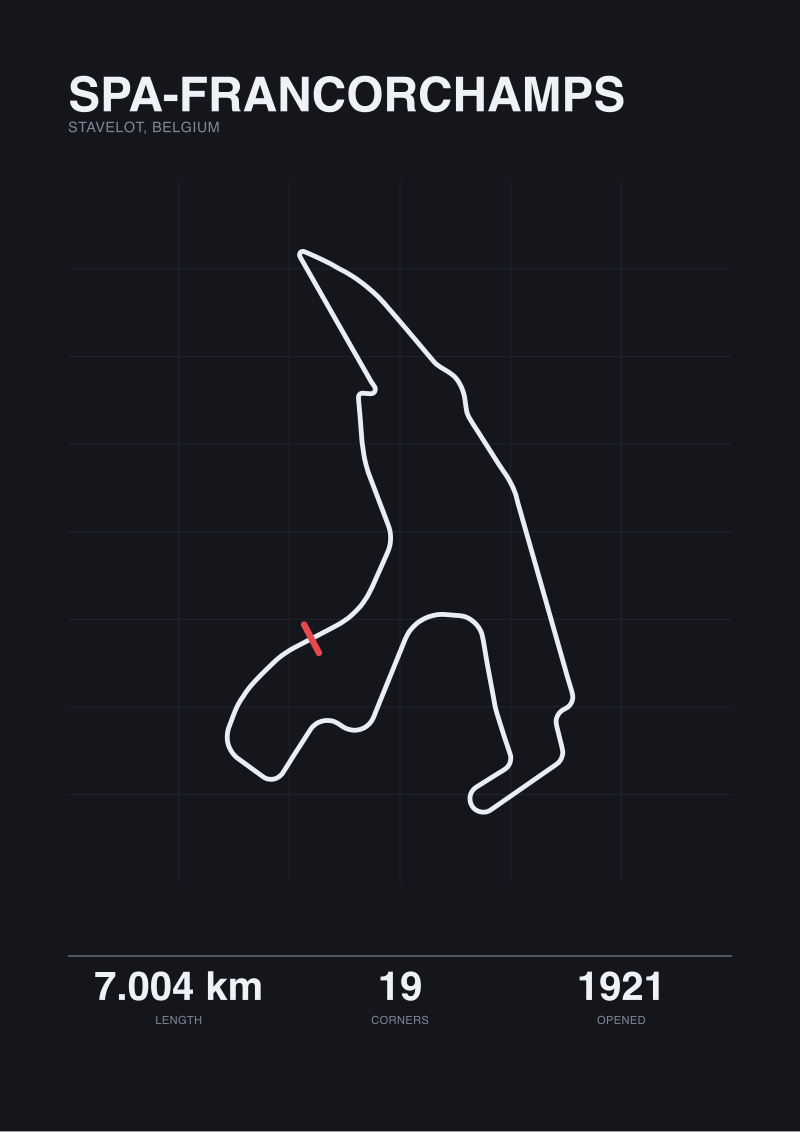
Imola has nineteen corners in the current homologation, and the density of that count matters for print legibility. The circuit is compact — 4.909 kilometres compared to Spa's 7.004 — which means the drawn line has to fold nineteen changes of direction into a geometry that fits within roughly 1.4 kilometres of long-axis extent. The trace is dense. Every millimetre of paper carries more information than a Monza or a Bahrain print would at the same page size.
Under glass, that density softens. Museum-grade glazing knocks reflectance down but adds a faint optical layer that blurs the finest line weights by a hair. On the framed Imola, the Variante Alta chicane and the tight sequence through Acque Minerali read as gestures rather than as discrete corners at a viewing distance beyond two metres. Step closer than 1.5 metres and the corners resolve, but the frame is now working against you: the mat window pushes your eye toward the centre of the composition and the paddock end of the circuit sits in your peripheral vision.
Unframed, the ink meets the eye without an intermediate surface. In our test, viewers at three metres could count the corner sequence from Tamburello through Villeneuve, Tosa, Piratella, and into Acque Minerali without stepping forward. The trace reads as a continuous piece of geometry, which is how the circuit actually functions to a driver — one long problem, not a list. If the point of the print is that you want to read the layout, unframed wins the legibility test at every distance we measured. If the point is that you want the layout to be present without demanding attention, framed wins by the same margin, for the same reason.
 Imola
The print from this article · from €29.95
View the print →
Imola
The print from this article · from €29.95
View the print →
Glass, Glare, and What Reflection Does to a Traced Line
Glazing is the variable that decides more Imola hangings than any other, and almost nobody thinks about it before ordering. A framed print with standard 2 mm float glass placed opposite a window will lose the entire fast section — the run from the grid through Tamburello, into the Villeneuve chicane, down to Tosa — to reflection during any hour the sun is on that wall. We measured this by hanging our framed Imola on the north wall of the studio, which takes indirect light from a west-facing window. From 4 pm onward on clear days, the top third of the print reflected the window frame and lost roughly 40% of its contrast.
Anti-reflective glazing solves the problem but adds cost and weight. Museum glass suppresses glare to under 1% reflectance and preserves the density of the traced line, which on an Imola print matters because the trace itself is thin — we draw the circuit centreline at 0.6 mm on the A2 size, and any glare washes that weight toward the paper colour.
Unframed prints have no glare because they have no surface to reflect from. A matte cotton stock scatters light instead of returning it. In the same north-wall test, the unframed sheet held its contrast through every hour of the day and every angle we walked past it from. This is the single most consistent finding of the week: if the wall you have chosen sees direct or strong indirect sunlight at any point, unframed removes the problem rather than solving it. Frames can be upgraded to anti-reflective glazing at meaningful cost. Walls with light on them cannot be upgraded at all.
Wall Context: Studio, Corridor, or Above a Desk
The wall decides more than the print does. Above a desk, at eye level from a seated viewer, the framed Imola works because the viewing distance is short — usually under 1.2 metres — and the frame provides the containment the eye needs when it is being asked to read something in detail. The mat window separates the geometry of the circuit from the geometry of the desk below it, which is otherwise cluttered.
In a corridor, the calculus reverses. Corridors present art at oblique angles and moving viewing distances. The framed version reflects the ceiling lights as you walk past; the unframed sheet stays legible because it has nothing to reflect. Corridor-hung prints are also more likely to be knocked, which favours the unframed sheet — a scuff can be replaced for the cost of the print alone.
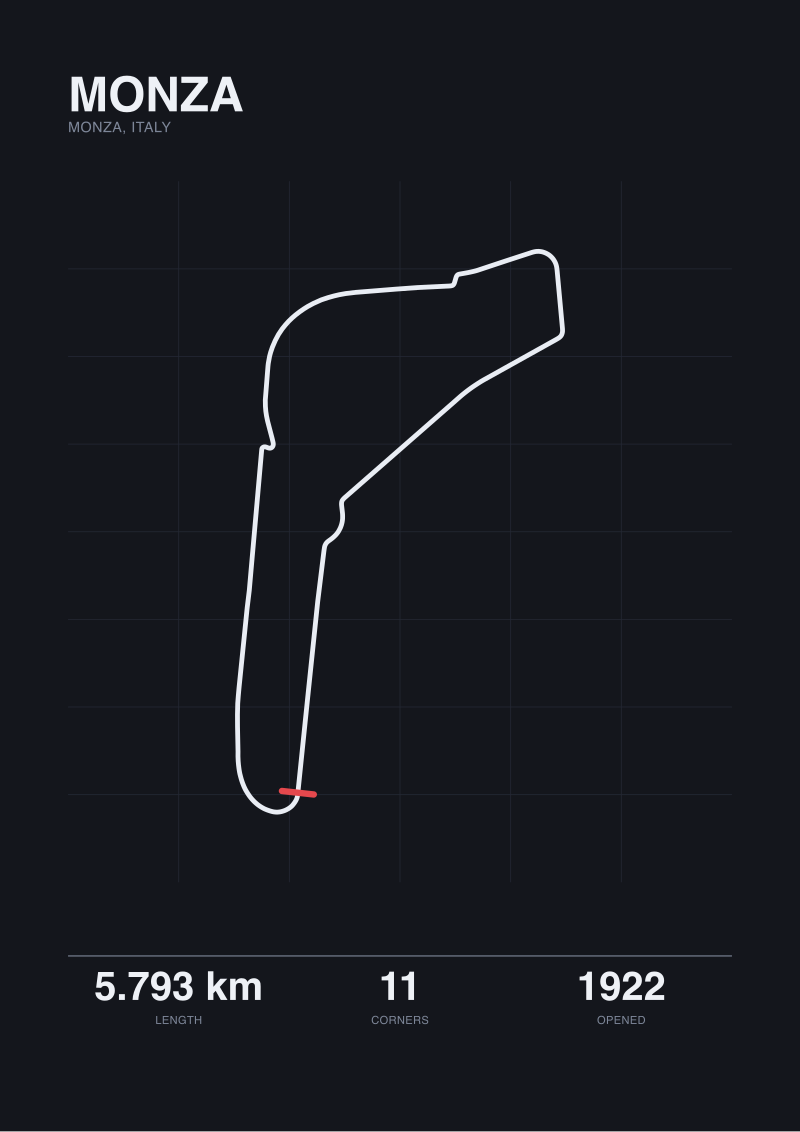
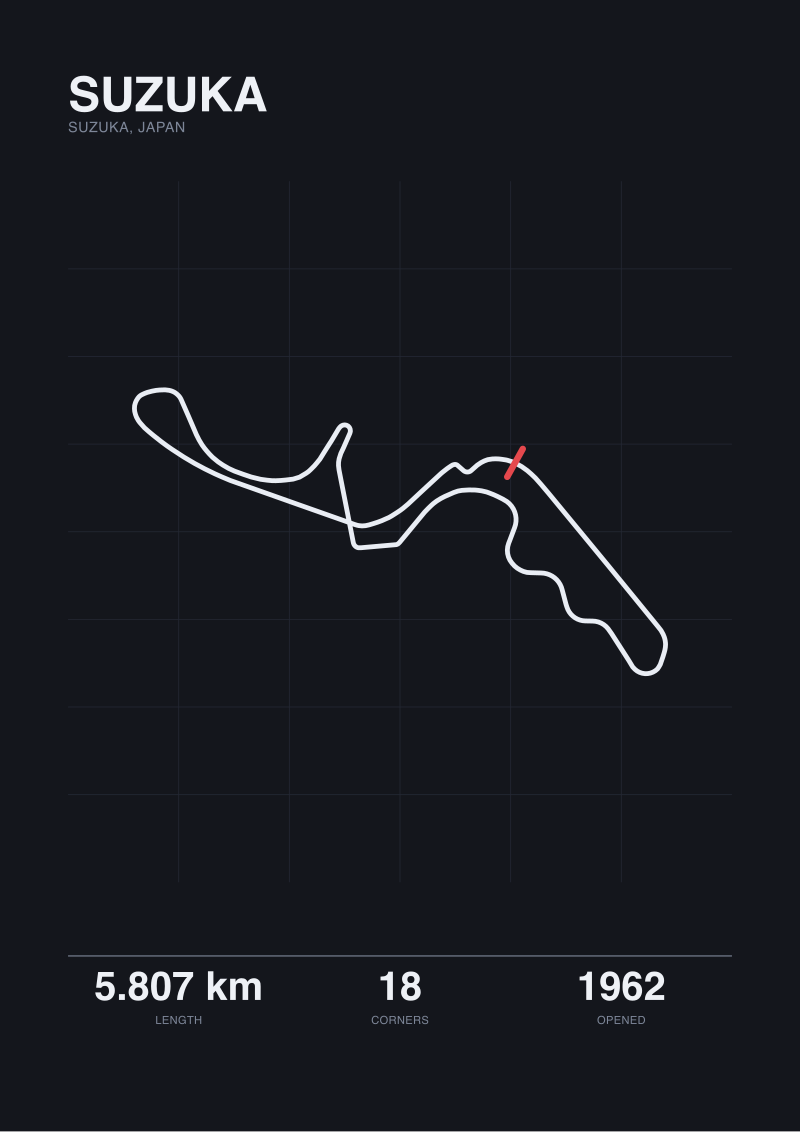
In a studio or work room, the choice depends on whether the Imola is scenery or subject. If it hangs among other drawings — Spa, Monza, Suzuka — the unframed set reads as a family, a working reference library on the wall. If it hangs alone, framed gives it the weight of a single deliberate object. We keep an unframed grid of six circuits in the drawing room, hung on a steel bar with magnets, and one framed Imola in the meeting room where it needs to hold the wall alone. Different jobs, different formats. The room tells you which.
 Monza
The print from this article · from €29.95
View the print →
Monza
The print from this article · from €29.95
View the print →
Reversibility and the Cost of Changing Your Mind Later
Framing is a commitment. Once you have paid to have an Imola print matted, mounted, and glazed to conservation standard, you have roughly quadrupled the total cost of the object, and the frame is now specific to that sheet. You cannot swap the Imola for a Monza next month without either reusing the frame at wrong proportions or spending the framing cost again.
Unframed prints are reversible in almost every sense. They can be swapped, rehung, moved between walls, taken down for a season, or replaced when a new edition is issued. The Imola homologation itself has changed several times since 1953 — the chicanes have been added, removed, and reshaped, and the length figure of 4.909 kilometres reflects the current configuration rather than a permanent one. When the layout changes again, and it will, an unframed print can be updated for the cost of paper and ink. A framed print carries a decade-old geometry behind glass and asks you either to accept that or to redo the whole assembly.
This is not a small consideration for anyone who thinks of a circuit print as a record rather than a decoration. Records get updated. Decorations do not. If your relationship to the Imola drawing is that it documents the circuit as it currently exists — nineteen corners, this exact routing, this exact 4.9-kilometre length — unframed keeps you honest with the object. If your relationship is that it represents the circuit as an idea, framed lets that idea sit still.
Which Dimension Actually Matters Most
Of the seven dimensions in the table, the one that decides the most hangings we have consulted on is not weight, cost, or even legibility. It is glare. A framed Imola on a wall that catches afternoon light loses the fast section for hours a day, and no amount of taste or budget compensates for a print you cannot read when you walk past it. If your wall has light on it, hang the unframed sheet or specify museum glazing without negotiation. Everything else follows from that constraint.
The second-most-decisive dimension is viewing distance. Under 1.5 metres, framing helps the eye by containing the composition. Over 2 metres, framing softens the trace and unframed reads more clearly. Measure the wall before ordering. If the room forces long viewing distances — a hallway, a large studio, a stairwell — the unframed sheet does the job the print exists to do. Our own studio wall carries both formats for exactly this reason, and if you want to see how the traced Imola reads in each, the current editions are at see the Imola print.
FAQ
Does an unframed print damage more easily than a framed one?
On 300 gsm cotton stock hung with magnets or archival tape, the unframed Imola resists day-to-day handling better than most people expect — the paper is heavier than a book cover and does not curl at that weight. What it does not resist is direct contact with liquid, grease, or repeated flexing. In a kitchen, a bathroom, or a corridor where bags brush the wall, framing earns its cost. In a study or drawing room, the paper alone lasts years.
Will glass distort the accuracy of the circuit trace?
Standard float glass adds a faint optical layer that softens fine line weights by roughly a hair — noticeable on a dense circuit like Imola where we draw the centreline at 0.6 mm, less so on a sparser layout. Museum-grade anti-reflective glazing brings the trace back to its unframed sharpness at close viewing distance. The distortion is real but small; the reflection problem is larger and more visible in most rooms.
Which Imola length should the print show, 4.909 km or 4.904 km?
We print both figures on the specification block: 4.909 kilometres from the official homologation and 4.904 kilometres from our own retrace of the OpenStreetMap raceway geometry. The five-metre disagreement is honest data about the difference between homologation documents and open map sources, and hiding one number in favour of the other would misrepresent how the circuit is actually measured. The framed and unframed editions carry the same specification block.
Does an unframed print need a mount or backing?
No — the paper weight is sufficient to hang flat from four magnets or from a top-edge cleat without buckling. A rigid mount adds weight and cost without adding legibility to a sheet this thick. If the wall is textured or uneven, a thin foam backing behind the sheet will keep it visually flat, but on smooth plaster or drywall it is unnecessary.
Can the framed version be reframed later if I want to change the mat or moulding?
Yes, but the sheet has to be removed from the existing mat and glazing without damage, which is straightforward for a competent framer and impossible for most kitchen-table attempts. If you expect to reframe, ask the framer for hinged mounting rather than permanent adhesive at the initial framing. This adds a small amount to the first job and saves the print in the second.
Is one format better for a small room?
Small rooms favour unframed at close viewing distance, because the framed version's depth off the wall — 22 to 28 millimetres — reads as bulk when the viewer is within a metre or two of it. In a small study or a bedroom, an unframed Imola sits into the wall rather than protruding from it, which the room usually needs. Larger rooms can absorb the framed object without the geometry starting to feel crowded.
Does the framed version hold value better over time?
For a circuit print, the question of resale value rarely arises — these are working drawings, not investment objects. What holds up over time is the accuracy of the geometry, and both formats carry the same trace. The framed version protects the paper from UV and handling for longer, so if the print is being kept for decades rather than years, framing extends the physical life of the object. The unframed version can simply be reprinted when the paper ages.
From the collection
New circuits and 10% off your first print.
One email now with your code. No noise after.