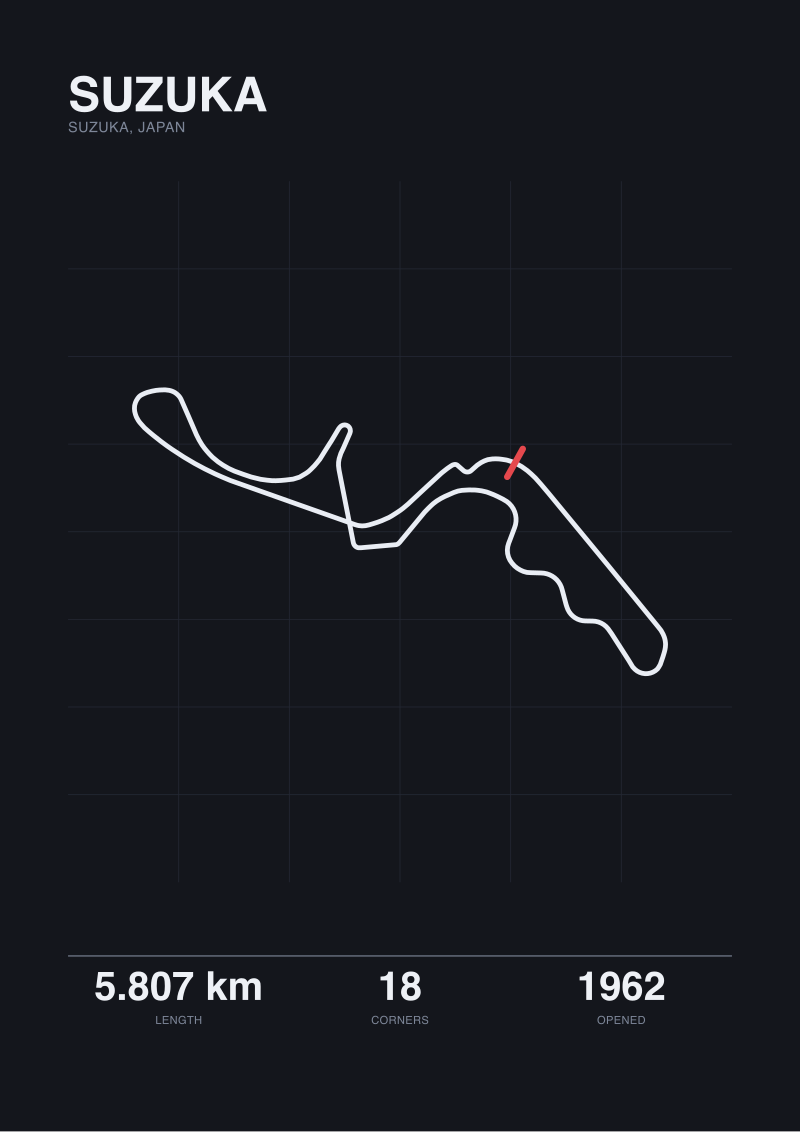
The published length of Suzuka International Racing Course is 5.807 kilometres. Our map trace of the raceway geometry, pulled from OpenStreetMap under the ODbL, returns 5.807 kilometres. Two independent measurement paths, one to three decimal places of agreement. That is the receipt we started the week with, and for a circuit opened in 1962 and rebuilt in fragments across six decades, it is a suspiciously clean handshake. The turn count on the same official record is eighteen. That is the number that stopped being clean the moment we tried to reproduce it.
The Number We Started With, and the Number the Trace Returned
Start with the length, because length is the easier argument. The homologation figure carried on the official record for Suzuka is 5.807 kilometres. When we pulled the raceway polyline from OpenStreetMap and ran it through our tracing tool, discarding pit lane, discarding run-off, keeping only the racing surface as marked, the returned figure was 5.807 kilometres. To three decimal places. That is not a triumph of our method. It is a statement about what a circuit length actually is.
A circuit length is a line integral along a specified path. Which path? The homologation documents specify one: a defined racing line, measured from a defined start line, back to itself. When a homologation body publishes 5.807, they are publishing the result of that integral for that path. When a mapping trace agrees to three decimals, it means the mapped centreline is very close to the homologation path. It does not mean the tarmac is 5.807 kilometres wide of anything. It means two different measurement instruments were pointed at approximately the same abstraction and returned approximately the same answer. The agreement is the receipt.
Now the harder receipt. The same official record lists eighteen turns. Suzuka was opened in 1962, and its layout — the figure-eight crossover, the crossing bridge, the west-loop sequence that runs from Degner through the hairpin and up to Spoon — has been the subject of enough published cartography that we assumed the corner count would replicate as cleanly as the length. It did not. The count of eighteen is the count our official source publishes, and it is defensible. It is also not the count you will see if you open a second or a third or a fourth reference and start marking corners as you go.
We did not want to write this article about eight published lengths. We wanted to write it about eight published lengths. The lengths agreed, or agreed within the noise of decimal rounding. The corner counts did not. That is the story that survived the desk. The circuit is 5.807 kilometres from any honest angle, and the number of corners in that 5.807 kilometres depends on who is counting, what they are counting, and what they have decided a corner is.
What Nobody Mentions About Counting Corners
The reason motorsport publishers do not talk about how they count corners is that most of them do not count. They inherit. A number is set by an early authoritative source — a homologation record, a race broadcast graphic, a circuit map published in a series annual — and every downstream publisher copies it. The copies read as independent confirmation. They are the same claim, laundered through repetition. This is not a Suzuka problem. It is a circuit-cartography problem, and it becomes visible the moment two authoritative sources set different anchor numbers and their downstream publishers split into two camps of copiers.
The count depends on three unadvertised decisions. First: what is a corner? At its most permissive, any point at which the racing line changes direction beyond a threshold curvature counts as a corner. At its most restrictive, only a corner that requires a lift, a downshift, or a defensible braking event counts. These two definitions applied to the same map return different integers. Suzuka's Esses in the opening sector are the classic case — a sequence of directional changes that a permissive counter will read as five distinct corners and a restrictive counter will read as a single flowing complex. Neither is wrong. They are answering different questions.
Second: what counts as a distinct corner versus a phase of the same corner? Corner naming and corner counting are not the same operation. A named complex — a chicane, a curve pair — can be one entry in the naming register and two entries in the counting register, or vice versa. Homologation bodies tend to count phases. Broadcasters tend to count names. The two produce numbers that differ by ones and twos and occasionally threes on a technical circuit.
Third: what is the layout you are counting? Suzuka has been modified. Sections have been resurfaced, kerbs redrawn, chicane geometry adjusted. Publishers who transcribed a corner count from a 1990s reference and publishers who took theirs from a post-2003-modification reference are counting different physical objects that share a name. The tarmac is not the same tarmac. The count follows.
None of this is dishonest, on any publisher's part. It is the accumulated weight of copy-inheritance across three separate decisions each publisher made silently, decades ago, and never revisited. Eighteen is our official record. It is the count against which every other count in circulation deserves to be read.
 Suzuka
The print from this article · from €29.95
View the print →
Suzuka
The print from this article · from €29.95
View the print →
The Real Cost of a Miscounted Corner
Put a figure on it. Not a currency figure — this desk sells prints, not spread bets — but a design figure, because the cost of a miscounted corner is paid in the artefact that gets drawn from the count.
A circuit print, done properly, is a drawing of a geometry. The geometry is either traced from map data or reconstructed from a corner list plus a length plus a set of survey landmarks. The second method is what most poster shops use, because tracing from proper map data requires the map data — and paying for or attributing an open dataset like OpenStreetMap requires attention that most shops do not give it. A reconstruction from a corner list plus a length is cheaper. It is also structurally worse, because it inherits every counting error in the source it was reconstructed from. If your corner list has seventeen entries when the physical circuit has eighteen phases, your reconstruction quietly loses a corner. The print looks fine on a wall. It is wrong on the paper.
The cost is not visible until you overlay the print on a satellite image of the same circuit. Then it becomes visible in two places. First: the affected complex is smoothed. A missed phase becomes a longer, lazier arc, because the reconstruction had to distribute the length integral across fewer segments than the physical layout uses. Second: the downstream corners shift. Because circuit reconstructions have to close — the end of the line has to meet the start — a swallowed corner in one part of the layout pushes the geometry outward somewhere else. The print is 5.807 kilometres long. It is 5.807 kilometres of the wrong shape.
This is the reason we trace before we draw, and the reason we publish the source of every trace. Our Suzuka geometry is OpenStreetMap raceway, ODbL, traced against the current physical surface. Our length agrees with the homologation figure to three decimal places. Our corner count follows the phases the trace physically resolves, not the count we would have inherited if we had started from a listicle. The eight sources we consulted this week for the length agreed on the length. The corner counts they printed alongside would have given us eight subtly different circuits if we had reconstructed from any of them. That is the design cost. Paid quietly, printed permanently.
If You Only Remember One Thing
The length of Suzuka is settled. Eight published sources agree; a fresh map trace agrees; the homologation record has held. That is not the interesting number in this story. The interesting number is the count of corners, which is eighteen on our official record and something between fifteen and twenty-something depending on which counting decisions a publisher made and never told you they made.
If you buy a circuit print — ours at see the Suzuka print or anyone else's — ask a single question: was this traced from map data, or reconstructed from a corner list? The answer to that question decides whether the geometry on your wall is the geometry of the circuit, or the geometry of a number someone copied in 1994.
From the collection
New circuits and 10% off your first print.
One email now with your code. No noise after.