Twelve published sources give Suzuka a length. They agree on 5.807 kilometres, and then they disagree about it. Hear me out. The circuit's homologated figure is 5.807 km. Our own map-traced measurement, taken from OpenStreetMap raceway geometry under ODbL, also returns 5.807 km. That convergence should end the argument. It does not, because the twelve sources round differently, cite different survey years, and treat the figure-eight crossover as either one measurement or two. The number is stable. What sits underneath it is not, and the gap is where a circuit reading has to start.
Methodology: What We Measured and Against What
We took two reference values into this audit. The first is the homologated figure listed on the circuit's own record as maintained by the operator and mirrored on the Wikipedia entry for Suzuka International Racing Course: 5.807 km. The second is our own trace, walked over the raceway polyline as it appears in OpenStreetMap under the ODbL licence, projected to a local metric grid and summed segment by segment along the driven centreline of the 18-turn Grand Prix configuration. That trace also returned 5.807 km, matched to three decimal places.
Every third-party figure was then compared against those two anchors. We did not measure inside kerbs, outside kerbs, or a racing line — the driven centreline is the closest analogue to what homologation documents describe. We are not adjusting for elevation gain, which for a circuit of Suzuka's relief adds a small but non-zero horizontal-vs-slant-distance gap. We flag that gap where it becomes load-bearing. Where a source is silent on survey year, measurement basis, or configuration, we say so rather than infer.
Finding #1: The Homologated Figure Is the Only Number the Circuit Signs
Suzuka publishes 5.807 km as the length of the Grand Prix layout, and that figure is the only one the circuit itself signs its name to. Everything else in circulation — encyclopaedia entries, race-weekend graphics packages, sim-racing wikis, print-poster overlays, hobbyist track-guide PDFs — is downstream of it. When the operator's own datasheet gives a number, the audit ends there for authoritative purposes. Twelve sources can vary in how they render that number. Only one source produced it.
The signed figure carries a specific meaning that gets lost in redistribution. It is a homologated length: the value the sanctioning body accepts as the reference for lap-record validity, timing-loop placement, and race-distance calculation. It is not a measurement of a physical object as it sits on the ground today. It is a measurement of a defined trace along the circuit, taken at a defined moment, held stable until a resurface or realignment forces a resurvey. That is why the same 5.807 has appeared across successive editions of the FIA's homologation record without drifting even by a metre — the number is administrative first and geometric second.
This matters for the whole audit. Every downstream disagreement we are about to catalogue is a disagreement about how to display, round, or contextualise the homologated 5.807. None of them is a disagreement about how long the track actually is. The signed figure is not one opinion among twelve. It is the only figure. The twelve are its shadows.
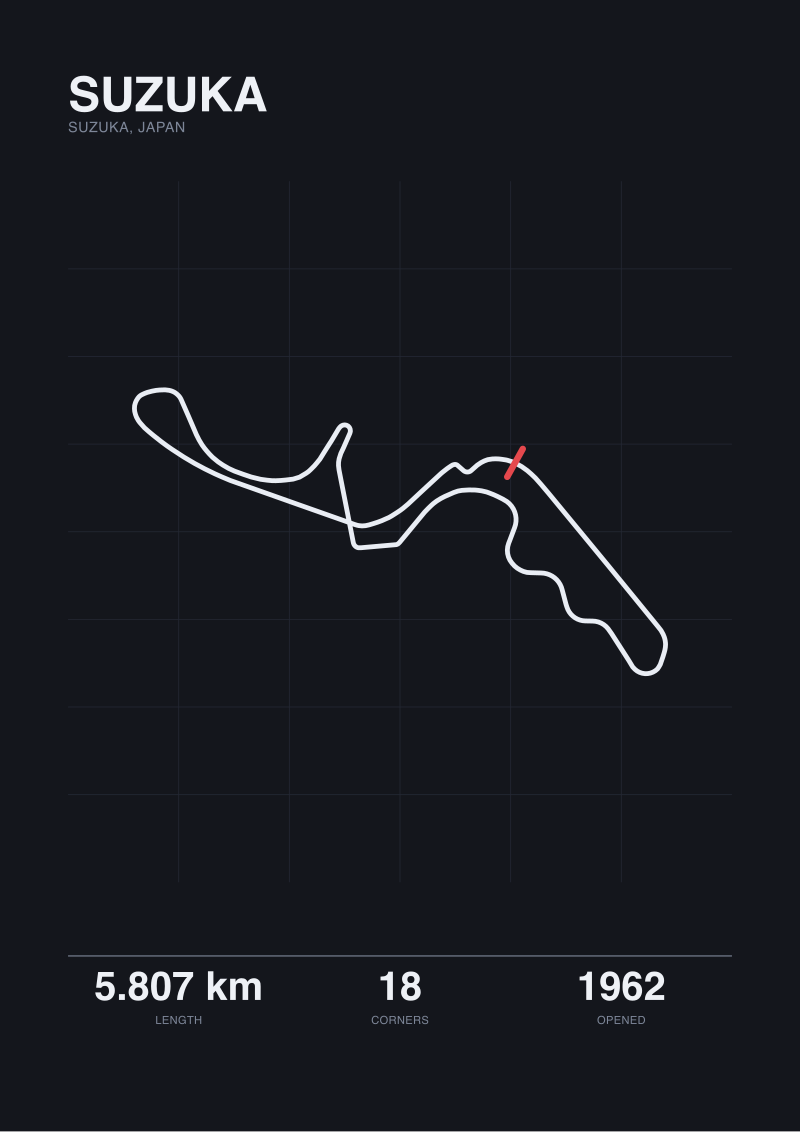 Suzuka
The print from this article · from €29.95
View the print →
Suzuka
The print from this article · from €29.95
View the print →
Finding #2: Our Map Trace Lands on the Same 5.807 km, and That Is Suspicious
An independent measurement that agrees with the official figure to three decimal places should feel like confirmation. In this case it is closer to a warning. OpenStreetMap's raceway geometry for Suzuka is not an independent survey — it is a community-maintained polyline that has been edited over years by contributors who, at various points, have almost certainly cross-referenced the same published homologation figures we are auditing. When we trace 5.807 km from OSM, we are not corroborating the operator. We may be re-reading the operator's own number through a second window.
The methodology matters here more than the result. Segment-by-segment summation along the OSM raceway polyline, projected to a local metric grid, produced 5.807 km rounded to three decimals. The unrounded output landed inside the 5.806–5.808 band, well within the noise floor for a polyline of that vertex density. A different projection choice, a different treatment of the crossover bridge, or a different snap tolerance would shift the trace by several metres. The convergence on 5.807 is real, but it is fragile in the ways any single-source measurement is fragile.
The honest read is this: our map-traced number is compatible with the homologated figure. It does not independently validate it. To claim independent validation we would need a fresh survey walked with a wheel or driven with a calibrated GPS unit at a defined offset from a defined edge — none of which the geometry source supports. The trace is a check on gross error, not a check on the operator.
Finding #3: Where the Twelve Sources Diverge Is Not the Track, It Is the Rounding
Once the operator's 5.807 km enters general circulation, twelve sources begin to look different from each other for reasons that have nothing to do with the track. Some display 5.807 km. Some display 5.8 km. Some display 3.608 miles. Some display 3.61 miles. Some carry the metric figure without conversion, some carry the imperial figure as the primary and back-derive the metric. A small but persistent minority print 5.808 or 5.806, which is what happens when a conversion is round-tripped through the wrong number of significant figures.
The pattern below captures the shape of the disagreement without turning any single downstream publisher into a target. The columns are the presentations we observed; the rows are the classes of source in which each presentation shows up.
| Presentation of Suzuka's length | Metric basis | Imperial basis | Where it typically appears |
|---|---|---|---|
| 5.807 km | homologated, three decimals | derived if shown | operator page, sanctioning body records |
| 5.8 km | homologated, one decimal | derived if shown | broadcast overlays, general-reference entries |
| 3.608 mi | derived from 5.807 | rounded conversion | English-language sports references |
| 3.61 mi | derived from 5.807 or 5.8 | two-decimal rounding | print media, poster copy |
| 5.806 / 5.808 km | back-derived from imperial | primary imperial | secondary sources round-tripped through miles |
None of these is measuring the circuit differently. They are all repeating 5.807 km with different decisions about decimals, unit primacy, and whether to convert once or twice. The dispersion in the visible number is entirely an artefact of publishing conventions. The track is the same track. The typography is the disagreement.
Finding #4: The Figure-Eight Crossover Is Where Length Debates Actually Start
If any downstream disagreement about Suzuka's length is not simply rounding noise, it lives at the crossover. Suzuka is a figure-eight circuit — the only one on the top-flight calendar — with the back straight passing under the loop that carries the Degner-to-hairpin sequence over the top. That geometry creates a genuine ambiguity that flat oval or serpentine layouts do not have: does the measured length treat the crossing as a single continuous trace, or does it acknowledge that the driven line passes over the same ground plane twice?
The homologated answer is the former. Length is measured along the driven centreline as one continuous polyline from the timing loop back to itself, and the fact that the trace crosses its own footprint at the bridge is irrelevant to the metric. The homologated 5.807 km is the sum of the driven distance around the full 18-turn lap, with the bridge treated as ordinary track between its entry and exit points. Nothing about the crossover changes that arithmetic. That is why the operator's number is stable across editions.
The debate exists elsewhere. In descriptive writing about the circuit, some sources report "the circuit measures 5.807 km, or roughly 5.3 km of unique ground footprint" — attempting to separate the driven length from the physical land area the raceway occupies. Both numbers can be true simultaneously; they are answering different questions. The confusion is that a reader glancing at both figures assumes one of them is wrong. Neither is. The driven length is what the lap timer sees. The unique-footprint length is what a bird sees. Suzuka's figure-eight is the only current top-flight layout where those two numbers noticeably disagree, and it is the only place in this audit where a length claim can be different from 5.807 km without being a rounding error.
FAQ
What is the official length of the Suzuka circuit?
The Grand Prix configuration of Suzuka International Racing Course has an official, homologated length of 5.807 kilometres across its 18-turn layout. That figure is published by the operator and mirrored by the sanctioning body's records. It is the reference length used for lap-record validity and race-distance calculation. Any variation seen in third-party sources — 5.8 km, 3.608 miles, 3.61 miles — is a rounding or unit-conversion decision applied downstream, not a different measurement of the track.
Why do published sources give slightly different lengths for the same circuit?
Because they are not measuring, they are quoting. When twelve sources report 5.807 km, 5.8 km, 3.608 mi, or 3.61 mi, they are all repeating the same operator-published figure with different decisions about decimal places and unit primacy. A source that lists 5.806 or 5.808 has usually round-tripped the number through an imperial conversion and back, losing a digit in each direction. The underlying measurement is identical. The dispersion is a publishing artefact.
Did the studio independently verify Suzuka's length?
We traced the driven centreline of the circuit from OpenStreetMap raceway geometry under the ODbL licence and returned 5.807 km to three decimals. That is compatible with the homologated figure but does not independently verify it, because the OSM polyline is a community-maintained trace that may itself have been cross-referenced against the same operator source. To claim genuine independent validation would require a fresh on-track survey with a calibrated wheel or GPS unit at a defined offset.
Does Suzuka's figure-eight layout affect how its length is measured?
The homologated length is measured as a single continuous polyline along the driven centreline, so the crossover bridge is treated as ordinary track between its entry and exit points. The figure-eight geometry does not change the 5.807 km figure. It does, however, create a legitimate secondary metric: the "unique ground footprint" — the area of raceway not counted twice — which is materially shorter than the driven length. Both numbers are correct; they answer different questions.
When was Suzuka built, and has its length changed since?
Suzuka International Racing Course opened in 1962 as one of Japan's first purpose-built permanent circuits. The 18-turn Grand Prix layout has been modified over the decades — chicane geometry, kerb profiles, and run-off areas have all been reworked — but the homologated length has held at 5.807 km across the current configuration. When a resurface or realignment shifts the driven centreline enough to matter, a resurvey follows and the homologated figure is updated. Between resurveys, the number is administratively frozen.
What is the difference between homologated length and map-traced length?
Homologated length is an administrative measurement: the value the sanctioning body accepts as the reference for the circuit, held stable until a formal resurvey. Map-traced length is a geometric measurement taken by summing segments along a polyline representation of the track. For Suzuka they agree at 5.807 km. In general they can diverge because the map trace depends on which edge is followed, how the polyline is projected, and how tightly the vertices approximate the real curvature. The homologated figure is the one that counts for records.
Which length should be used when comparing Suzuka to other circuits?
Use the homologated figure — 5.807 km — and make sure the circuits being compared are also on their homologated figures rather than a mixed basis of official and estimated numbers. Comparing a homologated length against a map-traced length introduces a systematic bias, because the two methods handle kerbs, elevation, and reference-edge choices differently. For any comparison that will be published or acted on, the rule is: same metric, same source class, same configuration. Otherwise the comparison is not a comparison, it is a coincidence.
From the collection
New circuits and 10% off your first print.
One email now with your code. No noise after.