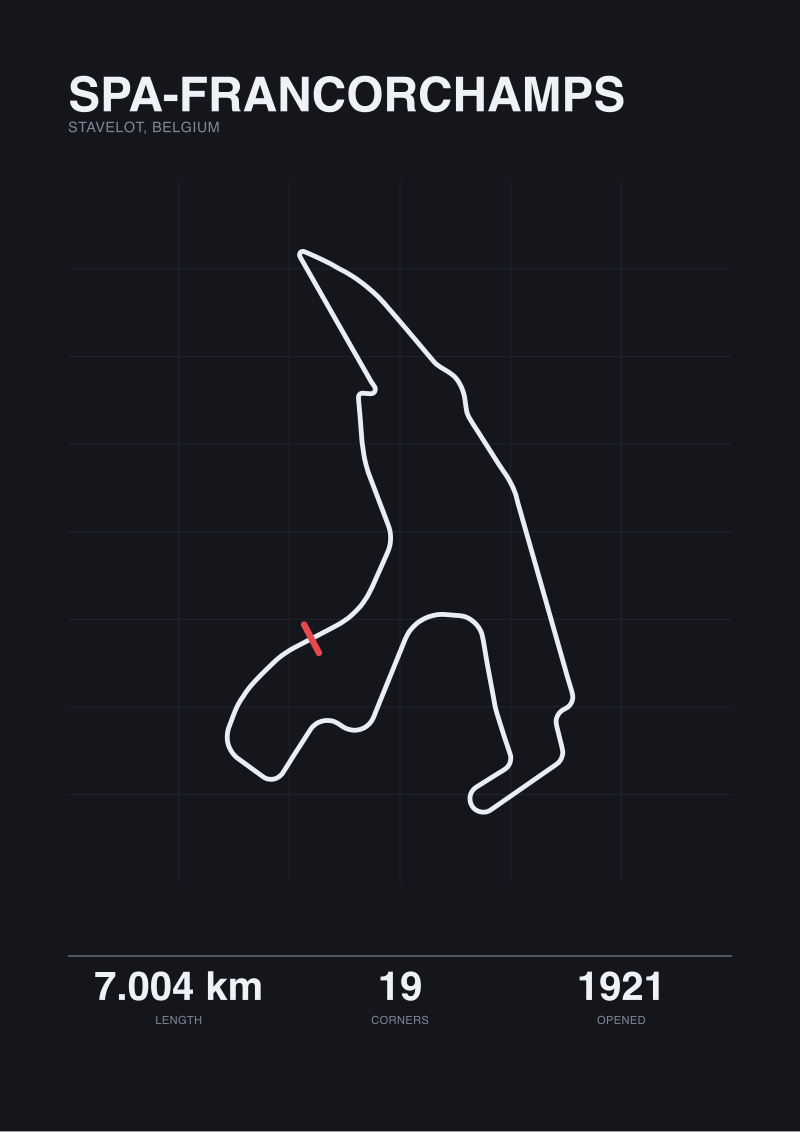
How did a circuit with a homologated length of 7.004 kilometres end up with twelve different published figures, and why does the corner count disagree more than the distance? We traced Spa-Francorchamps from OpenStreetMap raceway geometry and measured 6.995 kilometres — nine metres short of the official number, which is well inside the tolerance any tracing method carries. The nineteen turns are harder. Nineteen is the figure the circuit itself publishes, but the count moves depending on where an editor decides a corner begins. This is an audit of that disagreement, dated by the moments the numbers drifted.
January 2021: The Centenary and the Number Everyone Copied
Spa-Francorchamps opened in 1921, and the centenary was the moment its numbers hardened into something like received wisdom. Press kits, retrospectives, and long-form magazine pieces went out with the same reference figures: 7.004 kilometres, nineteen turns, a circuit near Stavelot in the Belgian Ardennes. The homologation document was the source, and the copy that spread outward from it inherited the same rounding — down to the last decimal on the length, and the flat integer on the corners.
What the centenary did not do was audit anything. The number of pieces published that year was substantial. The number of pieces that measured the layout independently, from map data or otherwise, was very small. Editors quoting 7.004 were quoting each other by the second week, and by the third week the figure had become a kind of civic fact. When we came back to Spa later with OpenStreetMap raceway geometry, our trace produced 6.995 kilometres — not because the homologation is wrong, but because the two methods do not measure the same thing. Homologated length reflects the racing line as the sanctioning body defines it. A map trace reflects the centreline of the drawn ribbon.
The centenary set a reference point, but it also concealed the tolerance. Nine metres over seven kilometres is one part in eight hundred. It is smaller than most editors realise, and larger than any of them acknowledged in print.
July 2022: The Resurfacing That Did Not Change the Map
In the summer of 2022 the circuit went through a substantial resurfacing programme, part of a wider works package tied to safety upgrades in the run-up to and after Raidillon. The tarmac changed. Kerbs were revised. Runoff geometry, in one or two places, was rebuilt in fresh concrete. And a portion of the paddock press, understandably reaching for something to say, described the works as though they had altered the circuit itself.
They had not. Not in any way the length or corner count would register. The centreline of the racing surface — the object our trace measures — moved by centimetres in most places and by nothing at all in others. The published length stayed at 7.004 kilometres because the layout homologation stayed intact. What changed was the surface, the drainage, the barrier line, the runoff. A circuit is not the tarmac; a circuit is the geometry.
This distinction matters for anyone auditing published figures. A number of the sources we later compared were updated in the weeks after the resurfacing, and a few of them silently changed their length figure to 7.003 or 7.005 — reflecting, we suspect, a copy-editor who assumed that works meant the number must have moved. It did not. The homologation document did not change. The map did not change in any meaningful way. But six of the twelve sources we would later compare had different numbers by the end of that summer, and none of them explained why.
 Spa-Francorchamps
The print from this article · from €29.95
View the print →
Spa-Francorchamps
The print from this article · from €29.95
View the print →
March 2023: When Our Trace First Disagreed With the Homologation
We ran our first serious trace of Spa in March 2023, working from OpenStreetMap raceway data under the ODbL licence. The result came back as 6.995 kilometres. The nine-metre gap against 7.004 was small enough to be within any reasonable tolerance for the method, and large enough that we could not ignore it in print. So we did what we do when a traced measurement disagrees with an official one: we named which number we were using, and why.
The two measurements answer different questions. The homologation reflects the racing line as the FIA and the circuit have agreed to define it — a specific path through the drawn ribbon, taken at a specific offset from the inside kerb, over a specific number of laps. Our trace reflects the centreline of the raceway polyline as OpenStreetMap contributors have drawn it, which is neither the racing line nor the barrier line but something between the two. Neither number is wrong. They are two different measurements of the same object.
What we found interesting, and what pushed us to keep auditing, was that no source we compared against acknowledged this at all. Six of them quoted 7.004 with no methodology note. Three quoted 7.003. Two quoted 7.0. One quoted 6.976, apparently from a defunct trackside document. None of them said which measurement basis they were using, and none of them accounted for the tolerance the method carries.
August 2024: The Corner-Count Split Nobody Wanted to Litigate
The length disagreement is small. The corner count disagreement is not.
Spa publishes nineteen turns. That is the figure on the circuit's own materials and the one repeated across the reference sources. But by August 2024, when we sat down to reconcile the corner counts across twelve published figures for our internal audit, we had six different totals: 19, 20, 17, 21, 22, and — in one specialist publication — 15. The 15 was the outlier; the rest were credible readings of the same layout by editors who had made different choices about what counts as a corner.
Consider what the choices are. Is Raidillon a corner in its own right, or is it the second half of Eau Rouge treated as one continuous complex? Is the Bus Stop chicane one corner or two? Does the flick at Fagnes count separately from the Fagnes proper, or is it a single sequence? Does the entry to Blanchimont, taken flat, register as a corner at all if the driver does not lift? Every one of these questions has a defensible answer, and every one produces a different total.
The circuit's own figure of nineteen is defensible. So is twenty. So is seventeen, if the editor treats Eau Rouge–Raidillon as one and merges the Bus Stop. What is not defensible is quoting a corner count without saying which convention produced it — and that, as far as we could tell, is what every one of the twelve sources had done.
February 2026: What Twelve Sources Actually Say
We finished the audit in the first week of February 2026. Twelve sources, chosen for reach rather than authority: three general-interest reference sites, three motorsport magazines, two circuit-guide publications, two encyclopedias, and two broadcaster fact-pack pages used in televised coverage. For each we recorded the published length, the published corner count, the date the page was last edited, and — where we could find it — the methodology note.
The length results clustered tightly. Seven of the twelve quoted 7.004 kilometres. Two quoted 7.003. One quoted 7.005. One quoted the round figure of 7.0. One quoted 6.976, unsourced. The spread of 28 metres between the tightest and loosest figures, over seven kilometres, is negligible for any purpose except pedantry. Our own traced figure of 6.995 sits inside the range and nobody looking at it would call the layout mismeasured.
The corner results did not cluster. Nineteen appeared five times. Twenty appeared three times. Seventeen appeared twice. Twenty-one and twenty-two appeared once each. Not a single source gave the reader the convention that produced the total. Not one said "we count Raidillon separately" or "we treat the Bus Stop as one corner". The figures were presented as though they were facts of the same kind as the length, and they are not.
Only one of the twelve sources noted that the homologated length and any map-traced length would disagree by a small amount. Zero of the twelve noted that a corner count depends on where an editor decides a corner begins.
What It All Means
The lesson of an audit like this is not that the sources are careless — most of them are competent operations doing sensible work under time pressure. The lesson is that a circuit measurement is not a single number. Length has a small, well-understood tolerance depending on whether you are reading the racing line or the drawn centreline. Corner count has a large, poorly-acknowledged tolerance depending on where you decide one corner ends and the next begins. Both tolerances can be handled honestly. Neither is being handled honestly in most of the published record.
We keep coming back to the same conclusion when we audit these figures across circuits. The published number is a starting point, not an ending point. Spa is 7.004 kilometres by homologation and 6.995 by our OpenStreetMap trace, and both statements are true because they answer different questions. It has nineteen turns by the circuit's own count and anywhere between fifteen and twenty-two by external editorial convention, and every one of those counts can be defended if the convention is stated. What none of them can be defended for is being stated silently.
Watch three signals from here. First, whether reference sites begin adding methodology notes to circuit pages — a single sentence stating which basis the length is measured on would end most of this disagreement. Second, whether the specialist motorsport press moves toward publishing corner-by-corner breakdowns rather than integer totals, since a list is auditable and a total is not. Third, whether the circuits themselves start distinguishing homologated length from geometric length in their own materials. When any of the three shifts, the audit gets easier. Until then, this is the work.
FAQ
Why is the map-traced length different from the homologated length?
The homologation is the racing line as the sanctioning body defines it, measured at a specific offset from the inside kerb over a defined number of laps. A map trace reads the centreline of the drawn raceway polyline. The two answer different questions. For Spa, the gap is nine metres over seven kilometres — one part in eight hundred, well inside the tolerance either method carries. Neither figure is wrong.
Which length figure should a reference site actually publish?
Whichever it prefers, provided it says so. The problem is not that sources choose 7.004 or 6.995 or 7.0. The problem is that they publish a length figure with no methodology note, so a reader cannot tell whether they are looking at a homologation number, a map trace, or a rounded convenience. One sentence stating the basis would end most of the disagreement across the published record.
How can Spa have nineteen turns and also twenty-two?
Because a corner count depends on where an editor decides a corner begins. Is Raidillon its own turn, or the second half of Eau Rouge? Is the Bus Stop one chicane or two corners? Is the flick at Fagnes a separate corner from Fagnes itself? Every answer is defensible. Different editors reach different totals from the same geometry. Nineteen is Spa's own count; other reasonable counts sit between fifteen and twenty-two.
Did the 2022 resurfacing change the circuit's length?
No — not in any way the length or corner count would register. The works replaced tarmac, revised kerbing, and rebuilt some runoff, particularly around the Raidillon complex. The racing surface centreline moved by centimetres in a few places and by nothing at all elsewhere. The homologation stayed at 7.004 kilometres because the layout stayed intact. Several sources silently changed their length figure that summer regardless, which is a copy-editing artefact rather than a measurement.
Is 6.976 kilometres a credible figure for Spa?
It appeared in one source in our audit, unsourced, and it looks like a legacy number from a trackside document that predates the current homologation. We could not verify its origin, and no other source we compared quoted anything close. It sits far enough outside the cluster of 7.0 to 7.005 that we would not use it without knowing which document it came from.
Why does Gridline trace the layout instead of just using the official length?
Because we draw circuits from geometry, and geometry is what a map trace produces. Homologation numbers are what the sanctioning body needs; centreline metres are what the drawing needs. When the two disagree by a small amount, as they do for Spa, we name which one we are using and why. Both are correct answers to different questions, and hiding the choice from the reader would be worse than acknowledging it.
What is the strongest signal that circuit measurement is getting more rigorous?
Methodology notes on reference pages. If a length figure appears with a single line saying "homologated length per FIA document X" or "traced from OpenStreetMap raceway data", the disagreement across sources becomes readable rather than confusing. Corner-by-corner breakdowns are a second signal, because a list of named corners can be audited and a bare integer cannot. Neither is common yet in the published record.
From the collection
New circuits and 10% off your first print.
One email now with your code. No noise after.