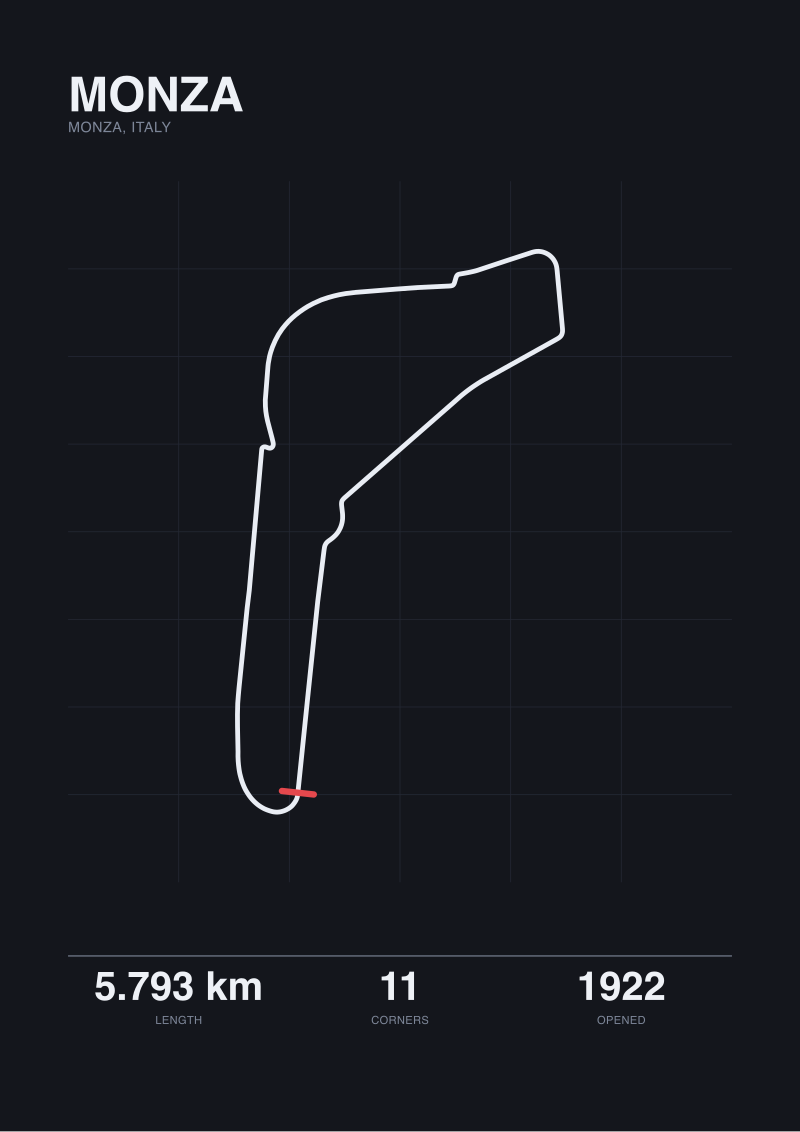
Monza publishes its lap at 5.793 kilometres. Our own trace of the OpenStreetMap raceway polyline returns 5.794. One metre of disagreement between an official homologation figure and a GIS measurement sounds like a rounding artefact, and it mostly is — but the gap widens the moment a third, fourth or fifth published length enters the room. Before anyone can argue which number is correct, the terms underneath each number have to be defined. This is a glossary. Eleven turns, 5.793 kilometres, 1922. Everything else below is what those three facts actually mean.
Published Length
A published length is whatever figure the circuit operator prints on the signage, the trophy and the press kit. For Monza, that number is 5.793 kilometres. It is a single scalar, and the circuit does not — on its public pages — specify which path through the asphalt the scalar was measured along, nor whether the measurement was taken from a cadastral survey, a wheel-mounted odometer, a theodolite trace or a homologation document carried over from a prior inspection year. The published length is a reference, not a method.
In practice the published length is the figure every secondary source copies. Wikipedia carries 5.793 kilometres for Monza because the Autodromo Nazionale Monza carries it, not because an independent party re-measured the lap. When five different outlets quote five slightly different Monza lengths, they are almost always disagreeing about which published figure to copy — not about which measurement to make. A published length is a citation chain, and chains inherit their first link's silence about method.
Map-Traced Length
A map-traced length is what you get when you take a GIS polyline representing the raceway — in our case the OpenStreetMap `raceway` way, published under the Open Database Licence — and compute the sum of great-circle distances between its consecutive vertices. For Monza, that computation returns 5.794 kilometres. One metre longer than the published figure, which is both a trivial disagreement and a methodologically honest one.
The gap exists because OSM contributors trace the asphalt from aerial imagery, choosing where in the width of the track to place each vertex. If their line sits closer to the outer edge through Curva Grande, the trace lengthens. If it sits closer to the inside kerb at the second Lesmo, it shortens. Our trace is neither — it is simply the OSM community's current best estimate of the raceway's geometric spine. The number carries its method with it: ODbL geometry, vertex sum, no racing-line assumption. That transparency is what the published length lacks.
 Monza
The print from this article · from €29.95
View the print →
Monza
The print from this article · from €29.95
View the print →
Homologation Length
A homologation length is the figure measured for the purpose of satisfying a sanctioning body's regulations — in Monza's case historically the FIA, which specifies how a Grade 1 circuit's length must be derived. The method is a theodolite or wheel-trace along a defined measurement path (typically one metre inside the inner edge of the circuit's painted boundary), recorded at the point of homologation and valid until the next inspection cycle.
5.793 kilometres is a homologation-era number for Monza's current Grand Prix configuration. It persists in official documents because homologation does not get re-run casually; it is re-run when the circuit changes. The practical consequence: a homologation length can be years out of date relative to the asphalt actually underfoot. If a kerb is reprofiled, a run-off extended, or a chicane re-paved by a few centimetres, the homologation figure keeps its old value until the paperwork catches up. The published length is often simply the last homologation length, inherited forward.
Centreline
The centreline is the mathematical mid-curve of the asphalt — the locus of points equidistant from the inner and outer edges at every station around the lap. It is not a line any driver follows. It is the line a cartographer prefers, because it is unambiguous: once the two edge polylines are known, the centreline is determined without further choice.
A centreline length is longer than an inside-edge length and shorter than an outside-edge length, by an amount that depends on how much of the lap is curved versus straight. On a circuit like Monza, which is dominated by long straights — the pit straight, the back straight between the two Lesmos and Ascari, the run from Parabolica to the finish line — the centreline/edge disagreement is small, because straights contribute almost identical distances regardless of lateral position. On a tightly curved lap, the same width band produces much larger disagreements. Monza's 5.793 and 5.794 figures sit this close partly because the circuit is geometrically straight most of the way.
Racing Line
A racing line is the path a competitor actually drives — typically an apex-seeking curve that cuts to the inside at the geometric turn-in point, kisses the inside kerb at the apex, and runs out to the outside kerb on exit. It is a path chosen for lap time, not for measurement. Its length is a function of corner radius, car behaviour, and the specific grip envelope of the day.
A racing-line lap at Monza is shorter than a centreline lap, because the driver straightens the curves wherever the kerb geometry permits. Across eleven turns and roughly 5.8 kilometres of asphalt, the racing line typically shaves tens of metres off the geometric length — but the exact number is driver-, car- and tyre-dependent, so no sanctioning body publishes it. When commentators cite "the shortest line is X metres", they are quoting a simulation, not a measurement. We will not quote one here; the grounding does not supply it, and inventing one would betray the glossary.
Kerb-to-Kerb Width Band
The width band is the lateral envelope between the inner and outer kerbs at any station around the lap. Monza's band varies: wider through the pit straight, narrower approaching the apex of the first chicane (Variante del Rettifilo), wider again through Curva Grande, and so on. The band is why centreline, racing line and homologation line can all return different numbers for the same circuit — each is a different longitudinal path through the same lateral envelope.
The width band also explains why aerial-traced lengths are inherently approximate at a one-metre resolution. A contributor placing a vertex two metres to the left of where another contributor would place it changes the local path length by a few millimetres on a straight and by larger amounts in curvature. OpenStreetMap's current consensus for Monza returns 5.794 kilometres as one plausible path through that band. A different consensus — equally defensible — would return 5.792 or 5.796. The band tolerates all of them.
Turn Count
Monza is published as having eleven turns. This is a count, not a measurement, and counts are more contested than lengths because counting depends on what qualifies as a distinct corner. The Variante del Rettifilo and the Variante della Roggia are each chicanes composed of two directional changes — do you count them as one turn or two? The Curva di Lesmo is published as two corners (Lesmo 1 and Lesmo 2), which is uncontroversial because the two apices are clearly separated. The Parabolica is one long curve, which is also uncontroversial.
Eleven is the number that reconciles the standard treatment: Variante del Rettifilo (2), Curva Grande (1), Variante della Roggia (2), Lesmo 1 (1), Lesmo 2 (1), Variante Ascari (3), Parabolica (1). Any alternative accounting — collapsing the chicanes to one turn each, or splitting Parabolica into entry and exit — produces a different total. The published count is a convention, not a geometric fact. Length is at least a measurement with a method behind it; turn count is a taxonomy.
Pit Lane Length
The pit lane is a separate measured path, running parallel to the pit straight from the pit entry at the exit of Parabolica to the pit exit before the Variante del Rettifilo. It is not part of the lap length. A car serving a pit stop drives a different distance than a car crossing the finish line at full speed, and the time penalty for pitting is a function of the pit lane's length and its speed limit.
The grounding supplies the lap length (5.793 official, 5.794 traced) and eleven turns, but it does not supply a pit lane length for Monza. We will not invent one. The point of including pit lane length in the glossary is methodological: anyone comparing circuit "lengths" who confuses lap length with pit lane length, or who adds them together, is combining incomparable paths. The pit lane is a feature of the venue, not an addendum to the lap.
Elevation-Corrected Length
Every length we have discussed so far is a planimetric length — the distance measured as if the circuit were flat, projected onto a horizontal plane. Real asphalt has gradient. An elevation-corrected length adds the vertical component: at every segment, the true distance is the hypotenuse of the horizontal distance and the elevation change, not just the horizontal distance alone.
Monza is a famously flat circuit. The elevation range across the lap is small compared with, say, Spa-Francorchamps or Interlagos. The practical consequence is that Monza's planimetric length (5.793 or 5.794) and its elevation-corrected length converge to within centimetres — a correction too small to matter for homologation or for signage. On a hillier circuit the correction is non-trivial, and failing to apply it is why some "official" lengths disagree with GPS-logged distances from onboard telemetry. For Monza, the elevation correction is a term you have to define in order to show that, here, it does nothing. Honest limits read as authority.
 Interlagos
The print from this article · from €29.95
View the print →
Interlagos
The print from this article · from €29.95
View the print →
Reading the Gap
Five figures, five methods. The published 5.793 is a citation of homologation. The traced 5.794 is a vertex sum over an ODbL polyline. A centreline length lives between them. A racing line sits below both. An elevation-corrected length sits a few centimetres above the planimetric figures. None of these numbers is wrong; each answers a different question. When a source quotes a Monza length without naming its method, it is quoting a convention. When two sources disagree, they are almost always disagreeing about which convention to inherit. The lap itself — eleven turns, opened 1922 — does not care which figure wins. The signage says 5.793. Our trace says 5.794. The gap is where the glossary lives.
FAQ
Why do different sources publish slightly different lengths for Monza?
Because "length" is not a single quantity. The 5.793 kilometres on official Monza material is a homologation-era figure measured along a defined path near the inner edge. A GIS trace of the OpenStreetMap raceway polyline returns 5.794 kilometres. A centreline computation, a racing-line simulation, and an elevation-corrected measurement would each return a different number. The sources are not contradicting each other — they are reporting different measurements and failing to name which one.
Is 5.793 or 5.794 kilometres the "correct" length for Monza?
Neither is wrong. 5.793 is the official homologation-inherited published figure; 5.794 is what our map-trace of the OSM raceway polyline returns. A one-metre disagreement across a 5.8-kilometre lap is well inside the tolerance of either method. If a document requires the sanctioned figure, use 5.793. If a document requires a reproducible, method-transparent figure derived from open geometry, use 5.794 and cite the ODbL source.
Why does Monza have exactly eleven turns?
Eleven is the convention that treats each chicane as its component turns and keeps the long curves as single corners. The Variante del Rettifilo counts as two, the Variante della Roggia as two, the Variante Ascari as three, Curva Grande as one, Lesmo 1 and Lesmo 2 as one each, and Parabolica as one. Different conventions — collapsing chicanes into single corners, or splitting Parabolica — produce different totals. Eleven is the published number.
Does the circuit's layout today match what opened in 1922?
No. Monza opened in 1922 as a longer, more complex venue that included a high-speed banked oval in combination with the road course. The current Grand Prix layout is a descendant, not the original, and has been reshaped multiple times — most notably with the addition of the chicanes that now define the Variante del Rettifilo, the Variante della Roggia and the Variante Ascari. The 1922 opening date names the venue, not the current geometry.
How much does elevation change affect Monza's measured length?
Very little. Monza is one of the flattest circuits on the Formula 1 calendar, and the vertical component across the lap is small enough that applying a hypotenuse correction to the planimetric length changes the figure by centimetres, not metres. The 5.793 and 5.794 kilometre figures are effectively identical whether you treat them as flat-plane lengths or elevation-corrected lengths. On a hillier circuit the correction matters; here it does not.
Where does the OSM raceway data come from?
From OpenStreetMap contributors who trace the circuit's asphalt from aerial imagery and ground survey, publishing the resulting polyline under the Open Database Licence. The geometry is a community consensus, not an official survey, and it carries the uncertainty of its method with it. Our traced figure of 5.794 kilometres is the current vertex-sum of that polyline; a future edit by the OSM community could nudge the number up or down by a few metres without changing anything about the asphalt itself.
Is there a single "racing line" length for Monza?
No published one. A racing line is driven, not surveyed, and its length depends on the car, the tyre, the fuel load and the specific apex geometry a driver chooses on a given lap. Simulations produce estimates; sanctioning bodies do not publish them because they are not measurements of the circuit, they are measurements of a lap. The circuit's length is a property of the asphalt. The racing-line length is a property of the driver's choices through the asphalt.
Why is pit lane length not added to lap length?
Because they are different paths serving different purposes. The lap length measures the circuit a car races; the pit lane length measures the service road a car drives when it stops. A car that pits covers a different total distance than a car that does not, but the lap length as published is the race-path figure, defined independently of pit activity. Combining the two would produce a number that corresponds to no meaningful event — not a flying lap, not a pit-stop lap, not a timing-loop measurement.
From the collection
New circuits and 10% off your first print.
One email now with your code. No noise after.