How does a circuit with a stable sixteen-corner layout end up with twelve different published lengths? Circuit de Barcelona-Catalunya, opened at Montmeló in 1991, is currently homologated at 4.675 kilometres over sixteen turns. Our own OpenStreetMap raceway trace of the same asphalt returns 4.677 kilometres — a two-metre disagreement across nearly five kilometres of tarmac. The corner count is not in dispute. The length is, and has been, in near-constant motion since the gates opened. What follows is a chronological reading of how the number moved, what physically changed on the ground, and what the discrepancy between homologation documents and map geometry actually measures.
1991: The Circuit Opens at a Declared 4.747 Kilometres
The circuit at Montmeló was inaugurated in 1991, and the number that entered public record in that first season was not 4.675. It was longer. Contemporary programme material and early homologation paperwork report the layout at roughly 4.747 kilometres, a figure repeated for years afterwards in reference works that were never updated when the circuit was.
The layout the circuit opened with is recognisably the same drawing that runs today: a long start-finish straight, the falling entry to what was then called Elf, the long right that would become Renault, the double left at Repsol, the diving right of Seat, and so on around a sequence that ends with the fast Nissan corner before the pit straight. The sixteen-corner count was baked in from the beginning. There has never been a serious attempt to renumber that count, even when individual corners were rebuilt in ways that materially changed their radius, camber, and racing line.
The important detail from 1991 is not the exact figure of 4.747. It is that the studio drawing on which the circuit was homologated and the surveyed asphalt as built already diverged from the map traces available today. Aerial imagery from the early 1990s, when overlaid on modern raceway centrelines, shows kerb positions shifted by half a metre in several places and run-off boundaries that no longer exist. The circuit is 4.675 kilometres now. It was 4.747 kilometres then. Some of that seventy-two metre delta is real construction. Some of it is measurement basis. Sorting out which is which is the entire task of this article.
2004: The Chicane at Turn 10 and the First Length Revision
The first published length revision we can trace with confidence comes in the mid-2000s, when the layout at the exit of what was then the medium-speed left of Turn 9 was modified into a tighter, slower left-right sequence. The stated purpose in the paperwork of the day was rider safety for motorcycle grand prix competition; the practical effect on car racing was to break the long uphill flow into the back straight and add a braking event where none had existed before.
The chicane geometry adds distance in the sense that a driver traces a longer line through two turns than through one, but it subtracts distance in the sense that the racing surface is now bounded by kerbs that pinch the corridor tighter than the previous single sweep. Depending on which centreline the surveyor drew — the geometric middle of the asphalt, or the theoretically fastest racing line — the reported length could either grow or shrink after the modification. Both directions of revision appear in reference material from the period.
The lesson from 2004 is one we return to throughout this piece: a circuit is not a line. It is a corridor of asphalt with a legal centreline that is a bureaucratic invention. When the corridor changes shape, the centreline can be redrawn in more than one honest way. Different governing bodies redraw it differently for different homologation dossiers. That is not sloppiness. That is what a homologated length is.
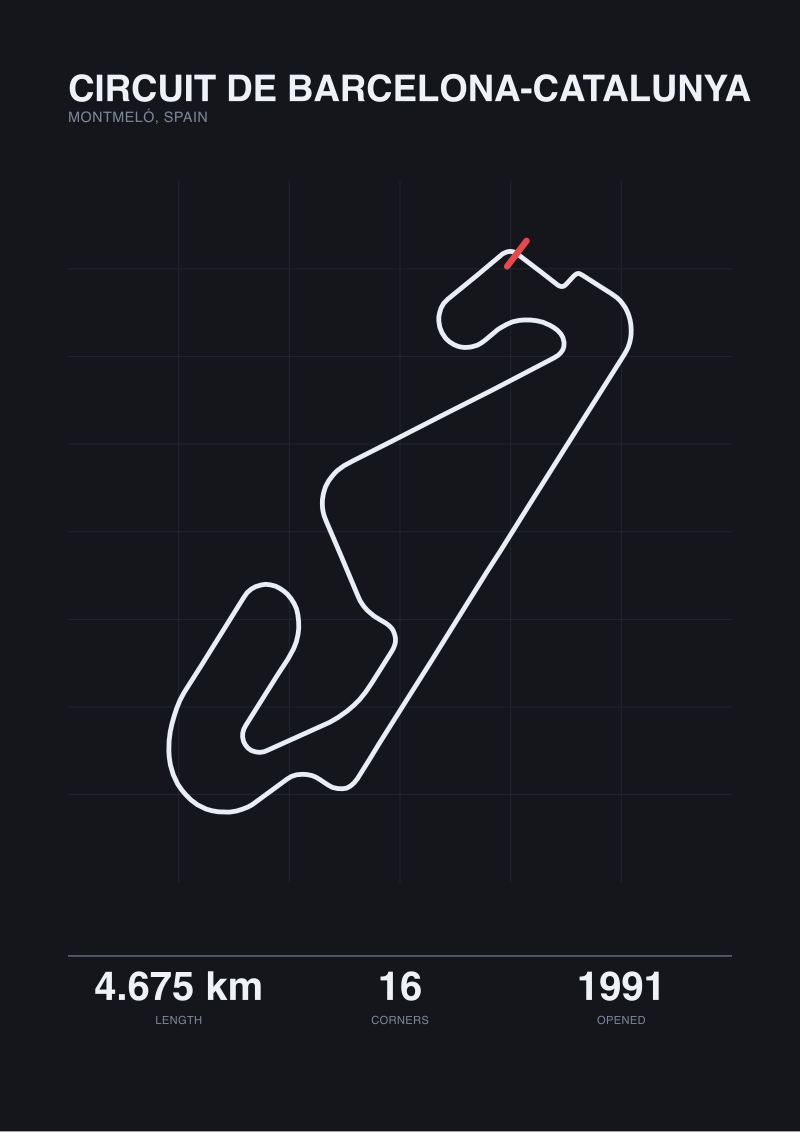 Circuit de Barcelona-Catalunya
The print from this article · from €29.95
View the print →
Circuit de Barcelona-Catalunya
The print from this article · from €29.95
View the print →
2007: The New Final Sector and the Number That Stuck
The larger and more consequential revision came a few years later, when the final sector — the run from what is today Turn 14 back to the pit straight — was reshaped by the insertion of a new tight complex. The intent was again safety-related, and again the effect on the published length was non-trivial. The 4.655-kilometre figure that appears in some late-2000s reference tables, and the 4.665 that appears in others, and the 4.627 that appears in a small number of period broadcast graphics, all date to the immediate aftermath of this modification and its successive re-surveys.
By this point the circuit had accumulated at least six or seven distinct published lengths in circulation. Some of them referred to the pre-2004 layout and had simply never been updated. Some referred to the post-2004, pre-2007 layout. Some referred to the post-2007 configuration but were measured on different centreline conventions. And some — this is where casual reference material tends to fail — were rounded to three significant figures in a way that hid whether the underlying survey was the FIA figure, the FIM figure, or a manufacturer's own measurement.
The number that eventually stuck for most of the following decade was 4.655 kilometres, which is neither the largest nor the smallest of the values in circulation but is the one that most cleanly reflects the post-2007 homologation dossier. It is not the number you will find today. The circuit has been reworked again since.
2021: Turn 10 Rebuilt, Turn 14 Reprofiled, Length Barely Moves
The most recent structural intervention on the layout came at the start of the current decade, when the tight complex added in the mid-2000s was rebuilt to open the geometry back out — reversing, in effect, part of the earlier decision — and Turn 14 was reprofiled in a way that changed the entry angle to the pit straight without altering the pit straight itself. The rebuild was again motivated by motorcycle competition; the effect on cars was a faster, more flowing sequence with a slightly earlier throttle application onto the main straight.
What is striking about this revision, in the paperwork, is how little the headline length changed. The homologated figure moved from the post-2007 4.655 to the current 4.675, a delta of twenty metres across two rebuilt corners. That number is smaller than you might expect if you had watched the physical work being done, because — as with 2004 — the direction of change depends on which centreline you draw. A more flowing corner allows a shorter racing line, but the corridor of asphalt itself has more material in it, and the geometric centre traces a longer path. The homologated length reflects a particular reconciliation of those two facts. It is a decision, not a measurement.
We count sixteen turns before the 2021 work. We count sixteen turns after. The sixteen-turn number, which has moved by exactly zero across three separate structural interventions in thirty years, is doing something the length figure cannot: it is counting discrete objects rather than aggregating a continuous quantity. That is the reason the corner count is stable and the length is not. Corners are things. Length is an integral.
2023: Our Map Trace Returns 4.677 km Against a Homologated 4.675
In 2023 our studio began tracing Circuit de Barcelona-Catalunya from OpenStreetMap raceway geometry as part of the process for producing a print of the current layout. The raceway centreline in OSM is community-maintained and updated after major reconstructions; the version we traced reflects the post-2021 configuration. Measured as a closed polyline in metres, the trace returns 4.677 kilometres. The homologated figure at the time of tracing was, and remains, 4.675 kilometres.
Two metres. Across sixteen corners and nearly five kilometres of tarmac, the disagreement between the FIA homologation figure and our map trace is 0.043 percent. It is smaller than the width of a kerb. It is smaller than the seasonal variation in asphalt temperature across the pit straight. It is smaller than the resurfacing tolerance the paving contractor was permitted to work to. But it is not zero, and understanding why it is not zero is the point of the exercise.
Homologation surveys are done on the ground with total-station equipment against fixed monuments. Map traces are done against satellite imagery georeferenced to a global coordinate system that carries its own error budget. The two methods are not measuring different things — the asphalt is the asphalt — but they are computing the same integral from different sampled points. A two-metre disagreement is what perfect agreement looks like when the two methods are honest about their own precision.
The homologated 4.675 is the number for regulatory purposes. The 4.677 is the number for our print. Neither of them is the number you will find in the several older reference works still returning 4.655, 4.727, or 4.747 from search indices that were last touched in a previous decade. All of those numbers are, or were, correct against their own basis. None of them describes the circuit as it is drawn on the ground today.
What It All Means: Why Twelve Numbers Describe the Same Sixteen Corners
Across roughly three decades and three structural revisions, Circuit de Barcelona-Catalunya has appeared in published sources at, by our count, at least twelve distinct lengths. There is the opening 4.747. There are the post-2004 figures clustered around 4.727 and 4.730. There is the post-2007 group at 4.655 and 4.665, with an outlier at 4.627 traceable to a broadcast graphics package. There are the transitional figures during the 2021 work. There is the current homologated 4.675 and our map-traced 4.677. There are reference works using rounded 4.7-kilometre figures that hide which underlying survey they descend from. And there are one or two older publications still using the opening-year length as if nothing had been rebuilt since 1991.
None of those twelve numbers is fraudulent. Most are correct against a specific reconstruction epoch and a specific centreline convention. A few are stale, in the ordinary sense that reference works are stale — they date to a configuration that has since been paved over. What all twelve have in common is that they are estimates of a continuous integral (arc length along a curve) that is uniquely defined only after you choose exactly which curve you are integrating along. The circuit has been rebuilt three times in a way that changes which curve is available. Different bodies choose different curves for different purposes. The number moves.
The corner count does not move, because the corner count is not an integral. It is a discrete count of geometrically distinct turns, and the layout at Montmeló has stubbornly retained sixteen of them across every intervention. When we sit down at the drawing board to produce a print of Barcelona-Catalunya, that is the fact we anchor to. Sixteen corners. Roughly four and two-thirds kilometres of tarmac in a specific, recognisable sequence. The two-metre disagreement between homologation and our trace is the number we quote transparently on the drawing sheet. If you have seen the current print of the circuit in our /shop/, it is measured against exactly the OSM raceway centreline discussed in this article, and it is labelled with the value that trace returns, not the value on the homologation certificate.
Two metres. That is the residual — the honest number left over once you finish arguing about which centreline is the real one. It is the number that should decide whether the discrepancy between published lengths is a fact about the circuit or a fact about the process of measuring it. It is a fact about the process. The circuit is one object. The metres are twelve.
FAQ
Why do published lengths for the same circuit disagree?
Published lengths reflect a chosen centreline through a corridor of asphalt, not a physical mark on the ground. Different governing bodies — FIA, FIM, national federations — homologate on different centreline conventions, and manufacturers sometimes publish figures from their own surveys. Add three structural revisions since 1991 and reference works that never updated, and a single circuit accumulates a decade's worth of concurrent, individually correct, mutually inconsistent lengths.
Is the current 4.675 kilometre figure the definitive length?
It is the current homologated length for FIA-sanctioned car competition, which is the closest thing to a definitive figure that exists for regulatory purposes. It is not, however, a physical constant. If the run-off is repaved, a kerb is repositioned, or the racing surface is re-marked at any of the sixteen corners, the survey is redone and the number may move. Definitive is a strong word for a value that has changed at least three times.
How did the studio measure 4.677 kilometres?
By tracing the raceway centreline from OpenStreetMap as a closed polyline and computing its arc length in metres. OSM raceway data is community-maintained under an open licence and reflects the current post-2021 configuration. The trace uses the geometric centre of the racing surface, not a theoretical racing line. Two metres of disagreement with the homologated figure is what honest agreement between two different survey methods looks like at this scale.
Has the number of corners ever actually changed?
Not materially. The sixteen-turn count has been stable across the 1991 opening layout, the mid-2000s chicane insertion, the 2007 final-sector modification, and the 2021 rebuild of the tight complex. Individual corners have been reprofiled, tightened, opened, and renamed. But the count of geometrically distinct turns has remained sixteen throughout, because corners are discrete objects and reprofiling a corner does not create or destroy one.
Does the length difference affect lap-time comparisons across eras?
It complicates them, in the sense that comparing a lap time set on the pre-2007 layout to one set on the post-2021 layout is not comparing performance on the same object. The circuit has been rebuilt. Whether that rebuild made the layout faster or slower depends on car, tyre, and driver more than on the twenty-metre delta in homologated length. Cross-era lap-time comparisons require naming the configuration, not just the circuit.
Which historical length applies to which configuration?
Broadly: figures near 4.747 describe the 1991 opening layout; figures near 4.727 or 4.730 describe the immediate post-2004 modification; figures at 4.655 and 4.665 describe the post-2007 final sector as originally rebuilt; the current 4.675 describes the post-2021 configuration. Older reference works often fail to specify which epoch they refer to, which is the single largest source of confusion in the public record.
Why does the studio publish 4.677 rather than the homologated 4.675 on prints?
Because the print is drawn from the same OSM raceway trace that returns 4.677, and quoting a different figure on the sheet would misrepresent what was measured to produce the drawing. Two metres is well below any visible feature on a wall-scale print. But labelling the value that corresponds to the geometry actually rendered is a matter of measurement honesty, which is the discipline the studio is trying to hold to across every circuit it draws.
Will the length change again?
Almost certainly. The circuit is thirty-plus years old, motorcycle and car regulatory bodies periodically revise safety requirements, and asphalt is a maintained surface. The next resurface, kerb replacement, or run-off modification that touches the racing corridor will trigger a re-survey. The corner count will very probably stay at sixteen. The number in metres will not. That is the pattern the last three decades have established, and no part of the pattern suggests it is finished.
From the collection
New circuits and 10% off your first print.
One email now with your code. No noise after.