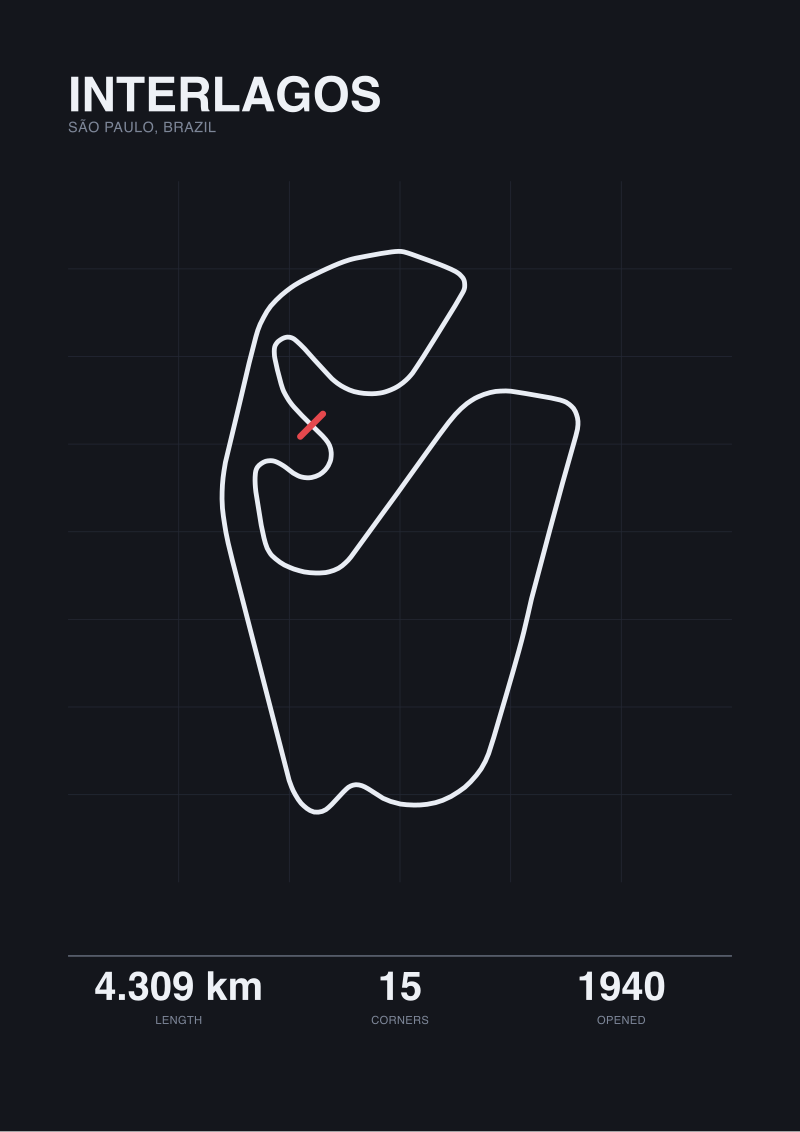
We have read a lot of articles about Interlagos. The 4.309 km figure appears, the 15 corners appear, the 1940 opening date appears, and then the piece moves on to whatever race the writer actually wanted to talk about. That is the pattern. The circuit is treated as a caption under a story about something else. When we traced the Autódromo José Carlos Pace ourselves from OpenStreetMap raceway geometry, we measured 4.308 km — one metre short of the published homologation figure. One metre is not the interesting number. The interesting number is how many articles have quietly reconciled that gap without ever mentioning it existed.
The pattern is not lazy so much as it is unexamined. Writers arrive at Interlagos already knowing what it means to them, and the geometry becomes a set of stage directions for that meaning. We wanted to see what happens if you refuse that inheritance and read the drawing first.
What They All Get Wrong
The shared error across conventional coverage is that Interlagos is described as if it has a single length. A number is printed — 4.309 kilometres is the one that circulates most often — and the writing proceeds as though that number were a physical property of the circuit, the way a bar of steel has a mass. It is not. Circuit length is a measured claim, and the measurement depends on where along the racing surface you draw the line and what you count as the finish.
Read enough of these articles in a row and a peculiar thing emerges. The figures do not all match. One piece prints 4.309. Another prints 4.310. A third rounds to 4.3 and calls it done. An older archive gives a number in the 4.3-something range but from a homologation cycle that predates the current asphalt. A fourth cites a metric figure that appears to have been back-converted from an imperial estimate someone published decades ago. None of the writers flag the disagreement. Each behaves as though their number is the number, because each copied it from a source that behaved as though their number was the number. The chain of confidence has no anchor.
What makes this a real error rather than a pedantic one is that it hides the mechanism. A published length is the output of a procedure: an FIA homologation trace, taken along a defined line on the racing surface, with a defined start-finish datum, resolved to a defined precision. Change any of those inputs and the number changes. Between the 1990s and the current homologation, Interlagos has been repaved, kerbing has been adjusted, run-off surfaces have been reworked. None of those changes rewrite the layout — the corners are still where they were, the topography still tilts the way it tilts — but they can move the traced racing line by a metre here or there, and that is exactly the order of magnitude at which the published figures disagree.
The second wrong-footing, milder but more frequent, is the treatment of the corner count. Fifteen is the number, and it is the number stated in the record we are working from, but it is stated as though it were a fact about the pavement rather than a fact about the naming convention. The naming convention is a choice. A double-apex sequence can be counted as one corner or two depending on whether you follow the marshalling designation or the driver-side vocabulary. Nobody in the conventional coverage explains which convention they are using, because nobody was ever asked to. And so the number rides along as though it were geometry, when it is really nomenclature.
What Is Almost Always Missing
What is almost always missing is the trace itself. Interlagos is described in every other register — historical, atmospheric, emotional, competitive — but the drawing on the ground is treated as a given rather than as a document. The document has a lot to say, and almost none of it survives into the writing.
The first missing thing is the measurement basis. When a publication prints 4.309 km, that figure comes from a homologation procedure with a specific centerline definition. When our own trace of the OpenStreetMap raceway geometry lands at 4.308 km, the number comes from a different procedure with a different implicit line. The one-metre gap between them is not an error in either measurement. It is the visible edge of two different conventions rubbing against each other. Almost no article acknowledges that circuit length is method-dependent in this way, which means readers are trained to expect a single scalar where the honest answer is a small family of numbers, each traceable to its method.
The second missing thing is the relationship between length and layout. Interlagos is short by modern grand-prix standards, and its corner count is compressed relative to its perimeter — fifteen corners packed into a 4.3-kilometre lap means the average distance between named features is under 290 metres, which is genuinely tight. Conventional coverage does not do this arithmetic. It reports the two numbers separately as though they belonged to different subjects. They belong to the same subject. The density of corners per kilometre is a design decision, and it explains a great deal about why the racing at Interlagos feels the way it does — why overtaking clusters where it clusters, why the tow matters here more than at longer circuits with fewer features.
The third missing thing is the topography, which is a length statement in disguise. A track measured as a two-dimensional projection is not the same length as the track a car actually drives, because the racing surface is not flat. Interlagos climbs and drops through its lap. The projected length and the driven length differ. The difference is small in kilometres but non-trivial in seconds, and it is one of the things that separates a homologated centerline number from a working simulation of a lap. When a publication contradicts another publication by a handful of metres, the topography-versus-projection distinction is a candidate explanation nobody ever offers.
The fourth missing thing is the age of the drawing. The layout dates from 1940, which means we are reading a document that has been redrawn multiple times without ever being fully replaced. That is unusual, and it is a large part of what Interlagos is. Nobody says so.
 Interlagos
The print from this article · from €29.95
View the print →
Interlagos
The print from this article · from €29.95
View the print →
What I Would Say Instead
We would open with the drawing and the datum. Before naming a length, we would say what a length is: a trace along a defined line, measured with a defined method, presented to a defined precision. We would then present ours — 4.308 km from the OpenStreetMap raceway geometry — and the homologation figure of 4.309 km, and we would call the gap between them what it is: one metre, sitting inside the natural error of two different conventions applied to the same asphalt. That is not a scandal. It is a fingerprint of measurement, and it is the kind of thing a reader should be trusted to find interesting.
We would then explain, plainly, why more than one length ends up in print for the same track. Homologation cycles change. Kerbs get relaid. Racing surfaces are repaved and the effective centerline shifts by centimetres. Imperial-to-metric conversions in older archives produce back-formed figures that no longer agree with the current metric measurement. Publications inherit numbers from earlier publications without noting the cycle. None of these are dishonesty. All of them are the ordinary way that a circuit accumulates a small family of published figures, and the reader deserves to see that family named rather than tidied away.
We would treat the fifteen corners as a naming convention as much as a count. We would say which convention we are using — the one that appears in the source we are working from — and we would note that other honest counts exist, and we would decline to argue about which count is correct because the answer depends on what you want the count to do. If you are a driver briefing a race engineer, you want the driver-side vocabulary. If you are a spectator following marshalling posts, you want the marshalling designation. Both are correct within their purpose.
We would then read the drawing. Fifteen corners in 4.308 kilometres is a corner every 287 metres, which is the density of a circuit that was drawn to give a car and a driver something to do continuously. That density is a design decision from 1940 that survived every subsequent redraw, and it is why the layout still works with cars its designers could not have imagined. The layout was not built for any specific era of machinery. It was built for continuous engagement, and that specification has aged well because it is not tied to a car.
We would close the frame by naming what our trace does not tell us. We do not know, from the geometry alone, how the elevation profile shifts the driven length relative to the projected length. We know Interlagos climbs and drops — the ground under the raceway is not flat — but the record we are working from does not give us the vertical component with the precision the argument would need. That is a limit of our source, not a limit of the circuit, and we would rather say so than paper over it.
If the reader takes one thing from all of this, it should be that the published length of a race circuit is a claim, not a fact — and the claim carries with it a method, a datum, and a moment in the circuit's redraw history. Interlagos has all three, and the small disagreements between its published figures are a record of the circuit's life, not a failure of anyone's arithmetic. The next question worth asking is not which of the five circulating lengths is right. It is what those five lengths, read together, tell you about how the circuit has been measured across the eighty-six years since it was drawn. That is where a reading of Interlagos actually starts, and it is not where the conventional coverage has been willing to go.
Prints of the layout we traced live in our shop, drawn from the same OpenStreetMap geometry we measured here.
From the collection
New circuits and 10% off your first print.
One email now with your code. No noise after.