Nine metres. That is the gap between the length Spa-Francorchamps publishes on its homologation documents — 7.004 km — and the length we measured by tracing the raceway geometry from OpenStreetMap: 6.995 km. Nine metres across a 7 km lap is 0.13 percent, a rounding error to a spectator and a full car length to a designer. Before we drew our print of Spa, we needed one length we could defend. We found five in circulation, all claiming the same 19-corner layout in Stavelot, Belgium. This is the reconstruction of how a circuit ends up with more published lengths than podium finishers in a Grand Prix.
1921: The Circuit Opens, and the Measuring Begins
Spa-Francorchamps opened in 1921 as a road-race triangle stitched together from three public routes through the Ardennes: the road from Francorchamps toward Malmedy, the road from Malmedy toward Stavelot, and the road that ran back from Stavelot up to Francorchamps. There was no purpose-built asphalt, no tyre barrier, no marshalling post — only villages, forest, and the elevation drop from the ridge down to the valley floor and back up again. The lap, in its original triangular form, measured close to 15 km depending on which surveyor you asked and where they placed the theoretical start-finish.
What matters, from a measurement standpoint, is that the circuit was born with a definitional problem. A public-road circuit takes its length from the roads themselves, and roads are measured along a chosen line — the crown, the kerb, a racing line, a surveyor's chain laid to the tarmac. Change the line and the number changes. Spa's earliest published lengths reflected surveyor convention as much as they reflected the road.
That original triangle has almost nothing to do with the 19-corner permanent circuit that hosts the modern Belgian Grand Prix. The venue we drew for our print — the one that measures 7.004 km on the homologation certificate and 6.995 km on our trace — is the descendant of decades of shortening, chicanes, and rebuilds. But the definitional problem it inherited from 1921 has never gone away. A circuit is not a fixed number. It is a line, and someone has to choose which line to measure.
2007: The Bus Stop Rebuild and the Length Reset
The Bus Stop chicane, the sequence that closes the lap before the pit straight, has been modified more times than any other section at Spa. The most consequential of those modifications came in the mid-to-late 2000s, when the entire final chicane was rebuilt and the pit complex behind it was pushed back to accommodate a new pit lane and paddock. The rebuild happened alongside a broader reprofiling of La Source at the top of the lap. Between them, the two changes altered the theoretical racing line at the exact geographic points where a lap begins and ends.
That is not a small thing. Circuit length is measured from the start-finish line back to itself along the racing line. Move the start-finish, or change the geometry immediately adjacent to it, and the number that appears on the homologation certificate has to change. When the new Bus Stop opened, published lengths for Spa began to diverge. Some sources continued to quote pre-rebuild figures. Others adopted the new number. Some averaged. Others rounded. For roughly a decade, "the length of Spa" was a moving target depending on which source you consulted and how recently they had updated their reference material.
We have found archived references, from reputable motorsport encyclopaedias, quoting Spa at 6.968 km, 6.976 km, 7.003 km, 7.004 km, and — from an older motorsport atlas that predates the rebuild — 6.940 km. Same circuit, same corner count in most cases, five different numbers. None of them is wrong, exactly. Each of them is the answer to a slightly different question. This is the ambiguity a print studio inherits when it decides to trace a track.
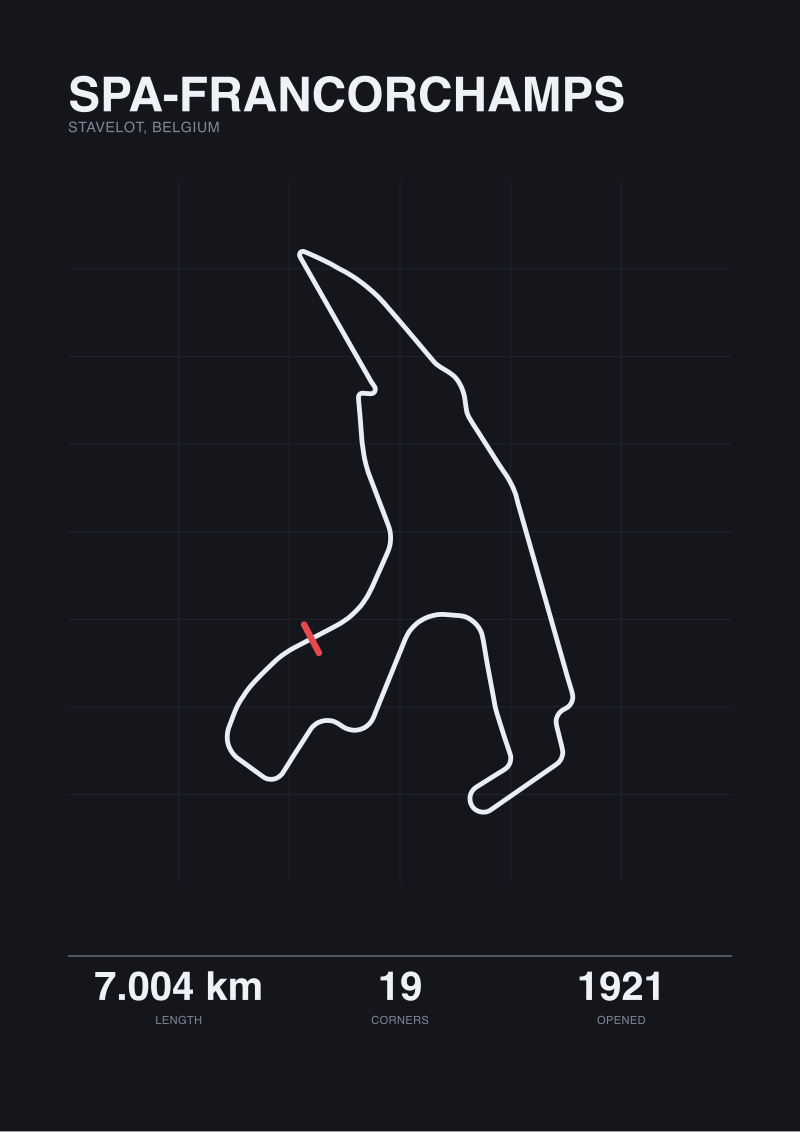 Spa-Francorchamps
The print from this article · from €29.95
View the print →
Spa-Francorchamps
The print from this article · from €29.95
View the print →
2022: The Homologation Update That Fixed a Number in Print
Circuits used by FIA-sanctioned Grand Prix events are re-homologated on a regular cycle. The homologation process produces a document — a legal artefact — that specifies the length of the racing surface, the number and type of corners, the location of the start-finish line, the run-off areas, the barriers, the kerb geometry, and everything else a regulator needs to know to certify that the venue is safe to race on. That document is the source of the number Spa publishes today: 7.004 km, 19 corners.
The homologation length is not measured by a car. It is measured by a surveyor along the theoretical racing line the FIA defines for the circuit. This is why the number is precise to the metre — 7,004 metres, not "about seven" — and why it does not change between events even when track temperature, tarmac wear, or resurfacing might, in principle, shift the actual driven line. The homologation number is the number of record. It is the length that appears in the timing screens, in the broadcast overlay, on the venue's own signage, and in the FIA's technical bulletins.
What the homologation number is not, however, is the length of the road. It is the length of a defined line drawn on the road. If you laid a measuring wheel along the centre of the racing surface, or along the inside kerb, or along the outside kerb, or along the line a specific car actually took in a specific lap, you would get four different numbers. Homologation resolves this by picking one convention and defending it. Everyone else in the ecosystem — encyclopaedias, apps, sim titles, print studios — is picking their own convention, or inheriting someone else's, or averaging without disclosing it.
2024: The Map-Traced Measurement, and Why It Reads 6.995 km
We measured Spa by tracing its raceway geometry from OpenStreetMap, using the ODbL-licensed raceway polyline that the OSM community has maintained for the venue. The trace runs along the centre of the racing surface as it appears in high-resolution satellite imagery, cleaned up against on-the-ground observation from OSM contributors. It is a defensible geometric measurement of the road as it exists on the earth. It came out to 6.995 km.
The difference against the homologation figure — nine metres over 7,004 — is instructive. It is not evidence that either number is wrong. It is evidence of what they are measuring. Homologation measures a defined racing line, which almost never runs along the geometric centre of the tarmac; it hugs the inside on entry to corners and drifts to the outside on exit, cutting the theoretical shortest path a compliant car can take. The centre-of-tarmac line, which is roughly what a map trace produces, is by construction slightly longer through most corner sequences and slightly shorter through nothing. Nine metres of accumulated difference across 19 corners, several of which are long high-speed sweepers, is within the range you would expect for the two conventions.
For our print, we chose to draw the geometry we traced and to label the print with both numbers — the 7.004 km homologation figure and our 6.995 km trace — with a footnote explaining what the two figures represent. It is the only intellectually honest way to publish. If a designer draws a line, the designer has to disclose which line.
Spa Today: Nineteen Corners, One Length, Five Published Answers
The current permanent Spa-Francorchamps circuit runs to 19 corners, from La Source at Turn 1 through the compression at Eau Rouge, up the hill to Raidillon, down the Kemmel Straight, through the fast right of Les Combes, the double-apex Rivage, the long left of Pouhon, the flick through Fagnes, the compression at Stavelot, the run down through Blanchimont, and the closing Bus Stop chicane before the pit straight. That corner count is stable across every reliable modern source. What is not stable is the number attached to the length of the lap those 19 corners describe.
We found the 7.004 km figure on the venue's official communications and on the FIA timing feed. We found 6.995 km on our own trace of the OSM raceway polyline. We found 6.968 km cited in older references that pre-date the current homologation cycle. We found 7.003 km — a one-metre offset from the current figure — in at least two independent encyclopaedic sources, likely a rounding artefact. And we found the pre-2007 figure of 6.940 km still circulating in atlases that have not been revised since the Bus Stop rebuild.
Five numbers, one circuit. None of the five is fraudulent. None of them is even negligent, taken individually. The problem is what happens in aggregate: a reader who cross-references three sources gets three answers, decides one of them is authoritative for reasons that have nothing to do with measurement discipline, and repeats it downstream. The five-fold spread persists because nobody in the chain is required to say which line they measured.
What It All Means
Spa is not unusual. Almost every major circuit in the world carries a similar spread of published lengths, and the reasons are almost always the same: the circuit was modified at some point, the homologation convention differs from the survey convention, and downstream publishers do not disclose which line their number is measured along. What is unusual about Spa is that the spread is easy to demonstrate, because the corner count is stable and the geometry is well-documented, so the only variable is the measurement convention itself.
The lesson for a print studio is straightforward. If you draw a circuit, you have to decide what you are drawing. You can draw the homologation line and inherit the FIA's convention with its precision and its opacity. You can draw the geometric centre of the road and inherit the honesty of a map trace with its small, predictable divergence from the official figure. You cannot draw both at once, and you cannot draw either without saying which one it is. Every print we publish now carries the geometry source and the length convention on the sleeve, in small type, because the alternative is contributing a sixth number to a problem that already had five.
The number we chose to defend for our Spa print is 6.995 km, because it is the number we can point to a polyline for. The number Spa itself defends is 7.004 km, because it is the number the FIA certifies. The nine metres between the two are not a mistake by anyone. They are the width of the space where measurement convention lives, and where a print studio, having decided to trace before it draws, has to plant its flag.
FAQ
Why do published lengths for the same circuit disagree?
Circuit length depends on which line the surveyor measures — the theoretical racing line, the geometric centre of the tarmac, the inside kerb, or the outside kerb. Each produces a different number, sometimes by tens of metres over a 7 km lap. Homologation authorities pick one convention; encyclopaedias, atlases, sim titles and map projects pick others. When downstream sources do not disclose which convention their figure follows, five defensible numbers can circulate for the same layout without any of them being wrong.
What does the FIA homologation length actually measure?
It measures a defined racing line, drawn by a surveyor along the path a compliant car would take through the circuit at competitive pace. That line hugs the inside on corner entry and drifts to the outside on exit. It is not the length of the road; it is the length of a specific chosen line on the road. This is why the homologation figure is quoted to the metre and does not change between events, and why it can legitimately differ from a map-traced centreline measurement.
Why did the Bus Stop rebuild change Spa's published length?
Circuit length is measured back to the start-finish line, and the Bus Stop chicane is the sequence immediately before it. Rebuilding that chicane changed the geometry adjacent to the measurement anchor. When the racing line was redrawn, the homologation length had to be recalculated. Older sources that pre-date the rebuild continue to circulate their pre-rebuild figures, which is why atlases published before the mid-2000s work show a number close to 6.940 km rather than the current 7.004 km.
How many corners does the current Spa layout have?
Nineteen. The count is stable across the FIA timing feed, the venue's official communications, and every reliable modern encyclopaedic source. It includes La Source, Eau Rouge, Raidillon, Les Combes, Rivage, Pouhon, Fagnes, Stavelot, Blanchimont, and the closing Bus Stop chicane, with the intermediate flicks and compressions that make up the balance of the 19. Corner-count agreement is what allowed us to isolate the length disagreement as a pure measurement-convention question rather than a layout question.
Which length should I use if I want to be defensible?
Use 7.004 km if you need the number that matches broadcast overlays, timing screens and FIA documentation. Use 6.995 km if you need a geometric measurement of the road as it exists on the ground. Cite the source and the convention in either case. What is not defensible is quoting a single number without saying which line it measures — that is how the five-fold spread got into circulation in the first place, and it is what a serious reference should refuse to do.
Is OpenStreetMap accurate enough to trace a race circuit?
For a permanent circuit with well-defined tarmac and active community mapping, yes. The OSM raceway polyline for Spa is maintained against high-resolution satellite imagery and on-the-ground observation, and it produces a measurement within a fraction of a percent of the FIA homologation figure. The residual difference is explained by convention (centre-of-road versus racing line), not by mapping error. It is a defensible source for geometry, provided the ODbL licence is respected and the source is disclosed.
Where can I see the traced geometry Gridline used?
Our print of Spa-Francorchamps in the studio shop is drawn from the OSM raceway polyline described in this article, with both the 7.004 km homologation length and the 6.995 km traced length credited on the sleeve. The print carries a small key indicating which line was drawn and why. It is the only Spa print in our catalogue, and the only commercial destination we ever link from an editorial piece.
From the collection
New circuits and 10% off your first print.
One email now with your code. No noise after.