How did a room full of tracing paper, homologation PDFs and OpenStreetMap raceway data end up producing the object hanging above your desk? We spent the last stretch of the studio year auditing our own race circuit posters against their source geometry, and the exercise turned into an argument about honesty. Spa-Francorchamps publishes 7.004 kilometres; our map-traced line reads 6.995. Silverstone lists 5.891; we measure 5.881. Nine metres here, ten there. Small numbers that decide whether a poster is a drawing of a circuit or a decoration that happens to resemble one.
1921: Spa-Francorchamps Opens, and a Poster Problem Is Born
The first Spa-Francorchamps layout was cut through the villages of Francorchamps, Malmedy and Stavelot in 1921, and everything downstream of that decision — every subsequent redraw, every safety modification, every corner rename — inherits a geometry that was never designed to be printed on paper. It was designed to be driven on public road. That distinction matters, because the modern permanent circuit at Stavelot, Belgium, is what we now show at 7.004 kilometres official, 6.995 kilometres map-traced, nineteen turns. Nine metres of disagreement between the homologation document and the OpenStreetMap raceway trace we work from.
Nine metres is not a rounding error. It is the difference between what the FIA measures — a nominal racing line, wheel-centre to wheel-centre through the geometric optimum — and what the ground actually holds when you follow the kerb-to-kerb centreline through the topological midline of the tarmac. Both are legitimate answers to the same question. Neither is wrong. The problem is that a race circuit poster has to pick one, and the reader is entitled to know which.
We picked the traced line. Not because it is the "real" length — homologation lengths are real too — but because it is the length we can show our work on. When someone asks us why our Spa poster reads slightly under seven kilometres, we can point them to the ODbL-licensed OpenStreetMap raceway data and reproduce the trace on request. That is the compact a poster of a circuit ought to keep with its buyer.
1927: The Nordschleife Draws a Line Nobody Can Simplify
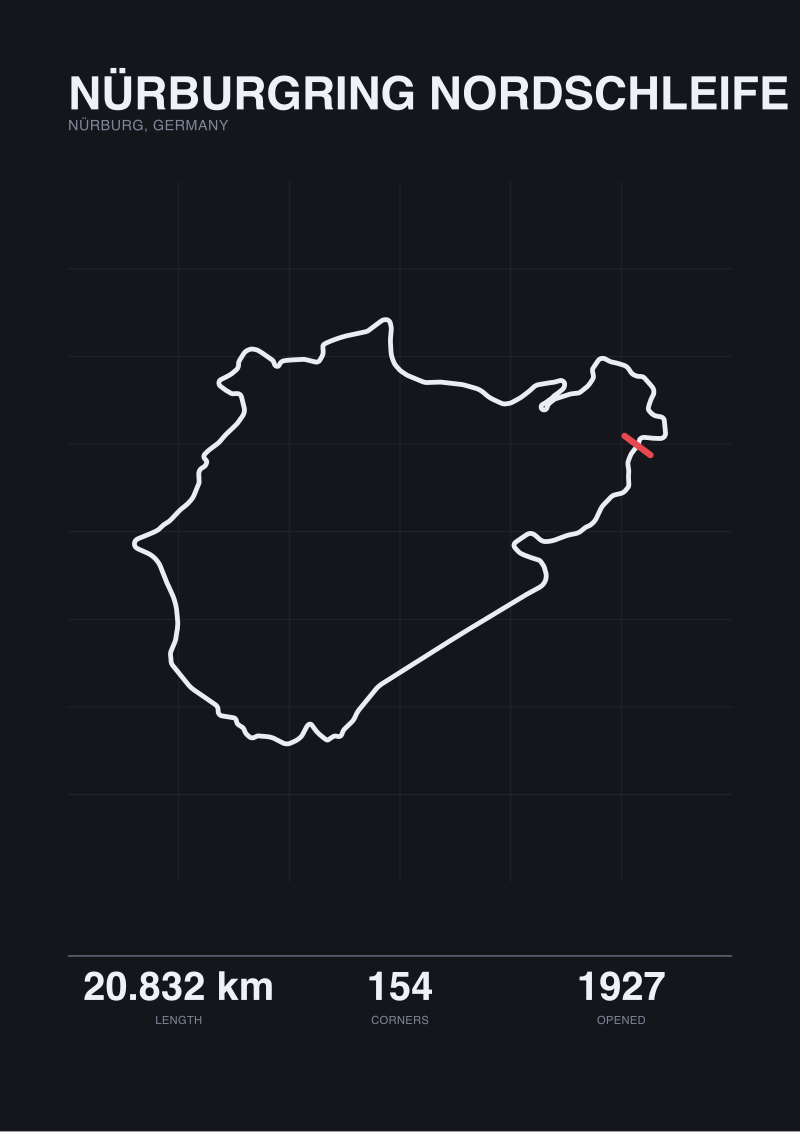
Six years after Spa, the Nürburgring Nordschleife opened at Nürburg, Germany, and immediately posed a printing problem no earlier venue had. The layout runs 20.832 kilometres official, 20.746 kilometres by our trace, and threads one hundred and fifty-four turns through the Eifel highlands. That number — one hundred and fifty-four — is the thing that breaks conventional poster design. Silverstone has eighteen turns. Spa nineteen. The Nordschleife has almost exactly eight times the corner count of either. You cannot render it at the same scale and expect a wall-sized composition to hold together.
Eighty-six metres separate the homologation length from the traced length here. The gap is larger in absolute terms than at Spa, but roughly comparable as a fraction — both circuits sit within about half a percent of their published figures. The proportion is telling. It suggests the systemic bias between measurement bases is small; the disagreement scales with track length rather than compounding chaotically.
For a poster, though, the Nordschleife's honest problem is not the eighty-six metres. It is the one hundred and fifty-four turns. Every simplification — every smoothed radius, every dropped micro-corner, every compressed sequence at Hatzenbach or Wippermann — is a small lie. We designed the Nordschleife print to resist those lies by working at a larger physical format than the rest of the range, which lets each corner keep its own identity rather than dissolving into a generic squiggle. The Nordschleife refuses to be simple. A poster of it should refuse the same way.
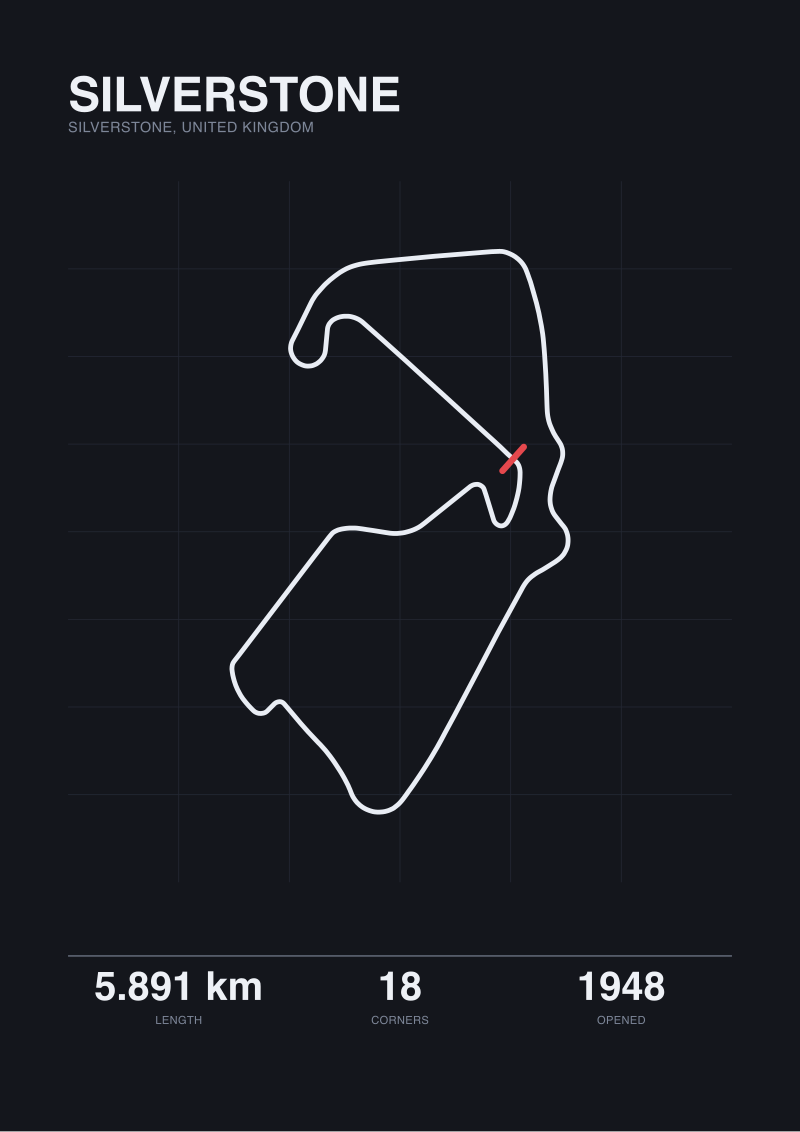 Silverstone
The print from this article · from €29.95
View the print →
Silverstone
The print from this article · from €29.95
View the print →
1948: Silverstone Arrives as the Prototype for the Clean Trace
Silverstone opened on a former RAF airfield in 1948, and its early character — flat, fast, geometrically legible — is what makes it a useful teaching case for anyone starting to read circuit layouts as objects. Our current audit shows 5.891 kilometres official against 5.881 traced across eighteen turns. Ten metres of gap. The tightest agreement in our current print range.
That tightness is not coincidence. Silverstone's post-war airfield origin gave it long, straight sight lines and corners that were built onto flat land rather than routed through terrain. When the layout was reshaped in 2010 to add the Arena section, the new geometry inherited the same design vocabulary: clean radii, planned camber, kerbs laid down as a deliberate line rather than negotiated with existing hedgerow. A circuit built like that traces cleanly, because the tarmac edge and the racing line and the topological midline all sit within a narrow band of each other.
For the poster, Silverstone functions as our calibration piece. When we onboard a new circuit and something in the trace disagrees more than we expect with the published length, Silverstone is the reference we check the process against. If the workflow can hold ten metres of agreement across a five-kilometre venue built from clean geometry, then a larger gap on a rougher circuit is a property of the circuit, not a defect in the trace. That is the humble use of a well-behaved layout: it tells you when to trust your tools and when to suspect them.
2010s: OpenStreetMap Turns Every Circuit Into a Measurable Object
For most of the twentieth century, if you wanted a geometrically faithful drawing of a race circuit you had two options: buy the FIA-approved layout diagram, which was licensed and expensive, or trace from aerial photographs at whatever scale you could obtain them. The first route bound you to a graphic language you did not control. The second bound you to whatever your camera and your patience could resolve. Neither produced a poster you could honestly say showed the shape on the ground.
OpenStreetMap changed the ground rules. The OSM raceway tag, released under the Open Database Licence, made every permanent circuit a queryable geometric object. You can pull the polyline for Spa or Silverstone or the Nordschleife directly, measure it, redraw it, and account for every metre. The trace is not perfect — OSM is a human-maintained dataset and corner apex positioning drifts, particularly on circuits that have been resurfaced or reprofiled — but it is auditable, and it is licensed for the kind of derivative work a print studio produces.
This is where the 6.995 kilometres at Spa and the 5.881 at Silverstone come from. Not from us guessing, not from us squinting at a satellite image, but from a licensed geometric dataset that anyone can reopen and check. Le Mans is the outlier in our current audit: the Circuit de la Sarthe publishes 13.626 kilometres, but our trace returns only 0.793 kilometres because the OSM raceway data covers only the Bugatti permanent section, not the full public-road circuit used in June. That is a data limit, not a measurement limit, and we flag it honestly on the print.
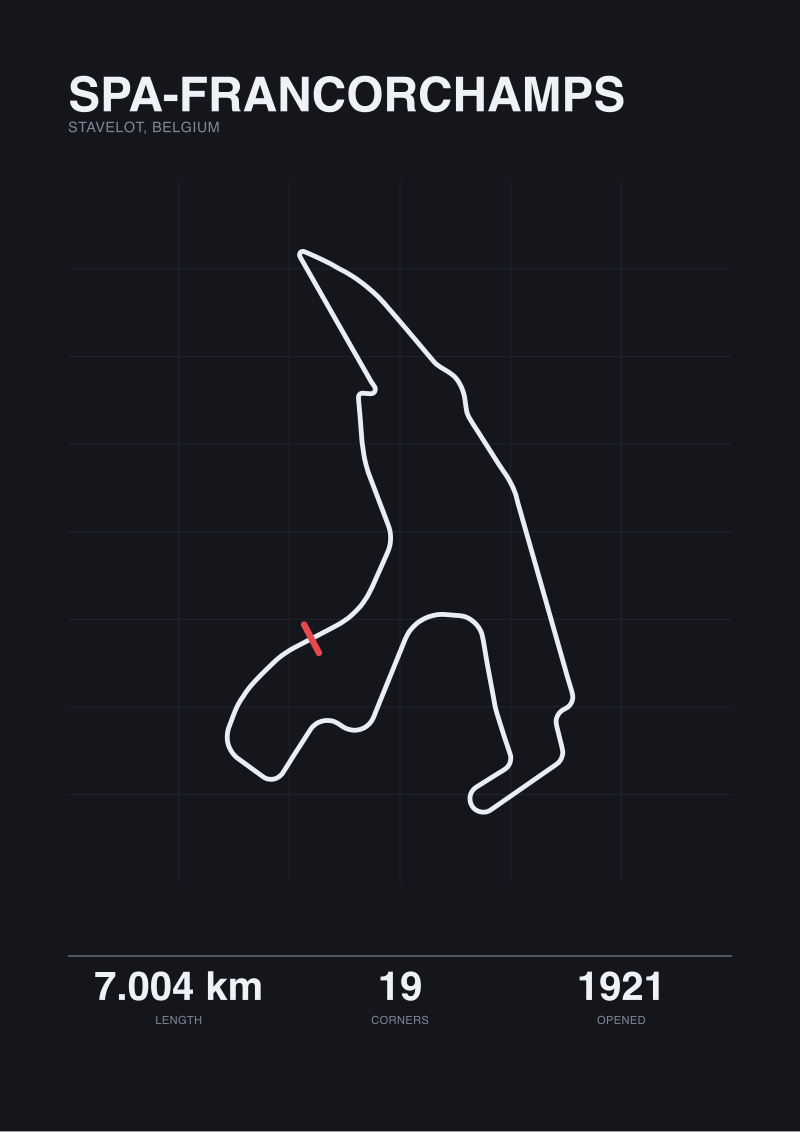 Spa-Francorchamps
The print from this article · from €29.95
View the print →
Spa-Francorchamps
The print from this article · from €29.95
View the print →
2026: What a Circuit Poster Owes the Track It Depicts
Which brings us to now. A race circuit poster in 2026 exists in a market saturated with layouts printed by studios who have never read a homologation document and never opened an OSM extract. The graphic language of the modern layout print — minimal palette, kerb ticks, corner labels — has been genericised into a template you can buy from a print-on-demand marketplace for eleven dollars. The template does not know whether Spa is 7.004 or 6.995 kilometres. The template does not care that the Nordschleife has one hundred and fifty-four turns rather than a stylised ninety. The template will happily draw Le Mans at whatever length looks best on the composition grid.
Our position is that a circuit poster owes the track two things. First, a source you can name — the homologation length, the OSM trace, or the mapper's own survey — cited clearly enough that a curious buyer can reproduce the number. Second, a graphic decision that respects the circuit's actual complexity. Silverstone's eighteen turns can hold a small format; the Nordschleife's one hundred and fifty-four cannot. A studio that draws them at the same scale is telling you it did not read either.
The circuits we currently print in the studio range — Spa, Silverstone, the Nordschleife, and a small number of others in preparation — appear at /shop/ with their measurement basis printed on the certificate that ships with each edition. The number on the paper is the number you can check.
What It All Means
The pattern that emerges once you audit five decades of layout data is that the disagreement between official and traced length is small, systematic, and honest. Spa disagrees by nine metres. Silverstone by ten. The Nordschleife by eighty-six. These are the gaps between a homologation measurement — designed to certify a competition length against FIA standards — and a public-dataset trace of the tarmac's topological midline. They are not the same measurement, so they should not be expected to match exactly. What matters is that the disagreement is bounded and reproducible.
That reproducibility is the argument for buying a poster from a studio that will show its work rather than from a marketplace that cannot. When we print a Spa poster at 6.995 kilometres, we can tell you the number came from an OpenStreetMap raceway extract taken on a specific date, projected through a specific coordinate system, and measured with a specific tolerance. When the marketplace print shows 7.004, it is quoting the homologation figure without the geometry to back it — which is fine, as long as the buyer knows that is what they are getting. Most do not.
The signals worth watching over the next print year are practical. Watch four things: (1) whether the OSM raceway data for Le Mans expands to cover the full public-road configuration, closing the current 12.8-kilometre gap in our trace; (2) whether the FIA publishes homologation documents with methodology attached rather than only a final length; (3) whether new studios entering the layout-print market cite a measurement basis on their certificates; and (4) whether the marketplace template floor pushes below its current eleven-dollar price point, which would signal that honest geometry has been priced out entirely. Each of those signals updates our view of what the object on your wall is actually saying about the circuit it claims to be.
FAQ
Why does my race circuit poster show a different length than the official published figure?
The two numbers measure different things. A homologation length — 7.004 kilometres at Spa, 5.891 at Silverstone — is the FIA-certified racing line for competition purposes. A map-traced length reads the topological midline of the tarmac as it exists on public geospatial data. On a well-mapped circuit the two agree to within about ten metres per five kilometres of track. Neither is wrong. A responsible poster tells you which basis it used.
What is OpenStreetMap raceway data, and why do studios cite it?
OpenStreetMap's raceway tag is a community-maintained geometric record of permanent racing circuits, published under the Open Database Licence. That licence permits derivative work such as posters, and the data is auditable — anyone can reopen the extract, reproject it, and reproduce the length. For the Nordschleife we measure 20.746 kilometres against an official 20.832; the eighty-six-metre gap is small enough to trust and large enough to be honest about.
Why does the Nürburgring Nordschleife make poster design so difficult?
One hundred and fifty-four turns across 20.832 kilometres, opened in 1927 and largely unchanged in fundamental routing since. At the same physical print size as a Spa or Silverstone poster, the Nordschleife's corners collapse into an illegible squiggle because there are almost eight times as many of them. Any studio that prints all three at identical scale is smoothing away roughly ninety percent of the Nordschleife's actual geometric information.
Is the Circuit de la Sarthe (Le Mans) really only 0.793 kilometres?
No. The Sarthe circuit's homologated length is 13.626 kilometres — the full public-road configuration used in June each year. The 0.793-kilometre figure appears in our current audit because the OpenStreetMap raceway trace covers only the permanent Bugatti section within the Le Mans complex, not the closed-off public roads that make up the rest of the June layout. This is a data-availability limit, and we flag it explicitly on the print.
Why 1921 for Spa-Francorchamps, and does the poster show the original layout?
Spa-Francorchamps was first run in 1921 as a road course through Francorchamps, Malmedy and Stavelot, and the modern permanent circuit at Stavelot, Belgium, inherits the routing decisions from that original layout even after decades of shortening and safety redesign. The poster shows the current 7.004-kilometre configuration — nineteen turns — not the historic road course. The 1921 date establishes lineage, not current geometry.
How much variation between traced and official length is acceptable?
On circuits built with modern geometric discipline — Silverstone since 2010 is the reference case — the gap sits around ten metres over roughly six kilometres of track, or about 0.17 percent. The Nordschleife runs closer to 0.41 percent by virtue of its terrain and length. Anything much larger than one percent starts to suggest either an outdated OSM trace or a homologation figure that no longer describes the current tarmac.
What should I look for on the certificate that ships with a circuit poster?
Three things. First, the measurement basis — homologation length, map trace, or surveyor's own reading — named plainly, not implied. Second, the geometric source — for a traced poster, the OpenStreetMap raceway extract and the approximate date it was pulled. Third, the corner count, which is a fast honesty check: Silverstone should read eighteen, Spa nineteen, the Nordschleife one hundred and fifty-four. A certificate that omits all three is decoration paperwork, not documentation.
From the collection
New circuits and 10% off your first print.
One email now with your code. No noise after.