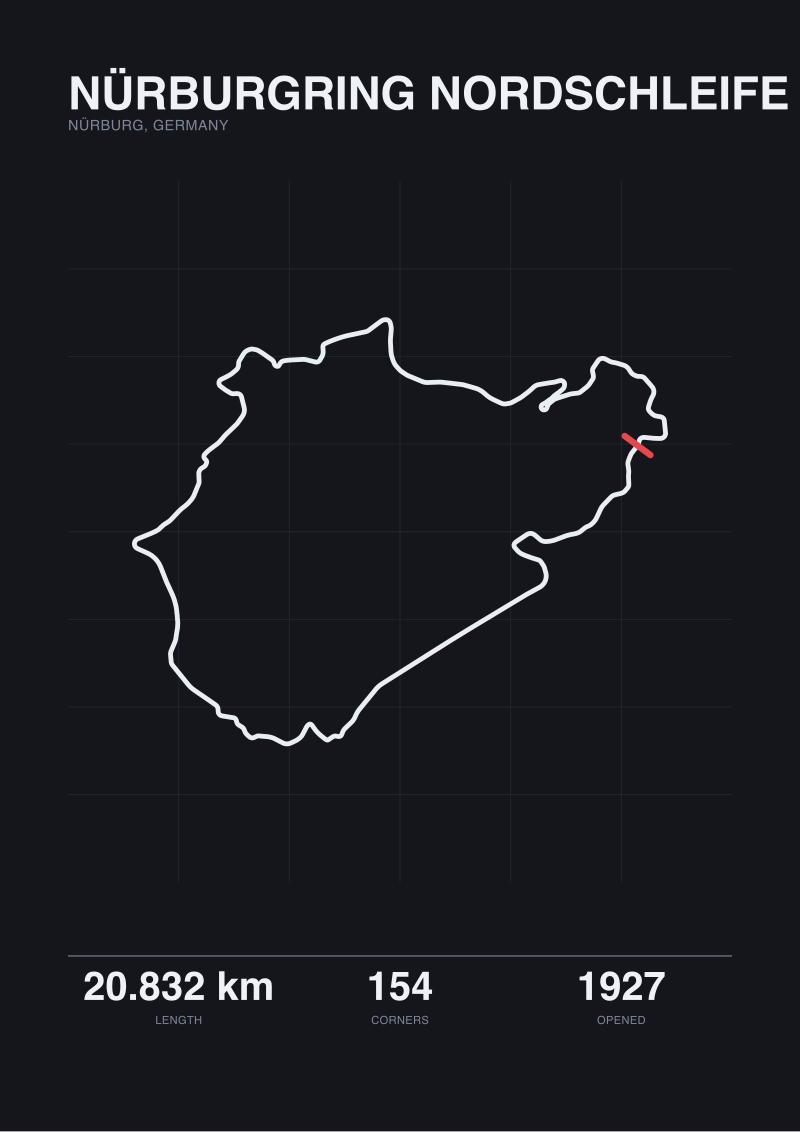
The Nordschleife measures 20.746 kilometres by our map trace and 20.832 by its homologation figure. One hundred and fifty-four corners. One lap. We pulled those three numbers out of our Nürburgring file this morning and set them beside the question that arrives in our inbox most weeks: are race car drivers athletes. The question is almost always framed as a provocation, usually by someone who has never read a track map in section view. Looked at from a circuit desk, with the geometry on the table, it stops being a provocation. It becomes a measurement problem — and the layout answers it before any heart-rate monitor does.
What the Numbers Actually Say
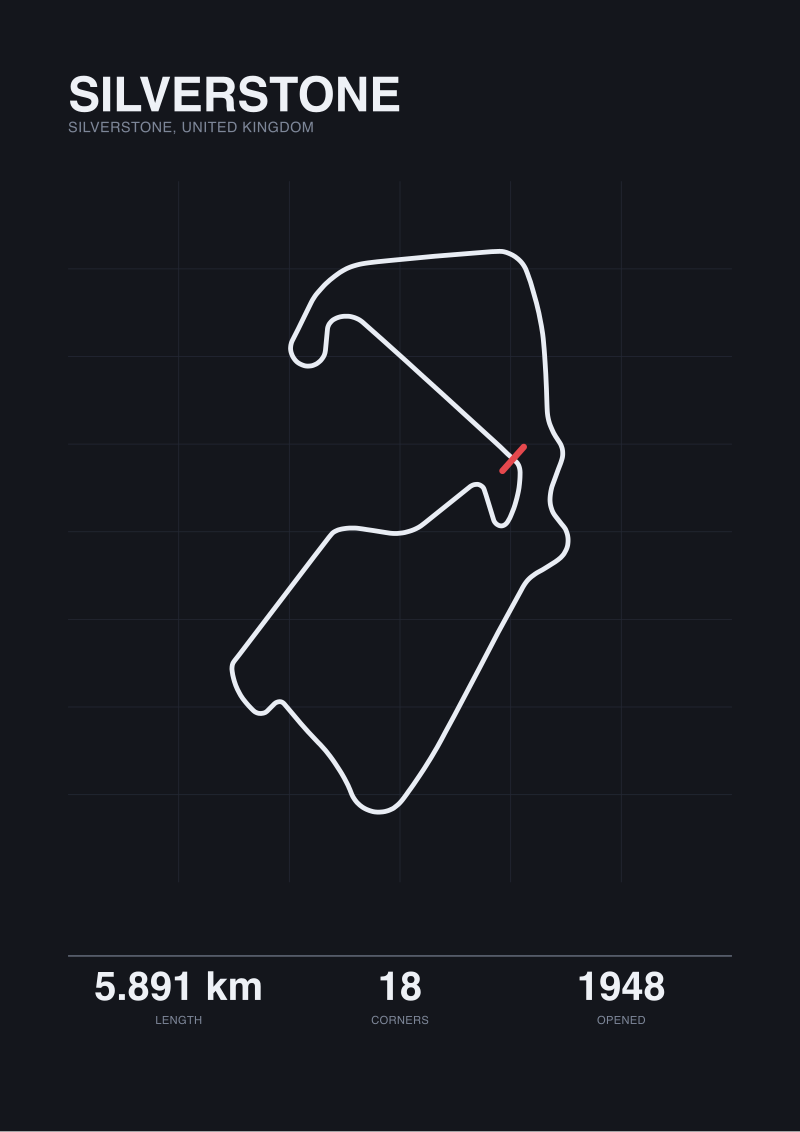
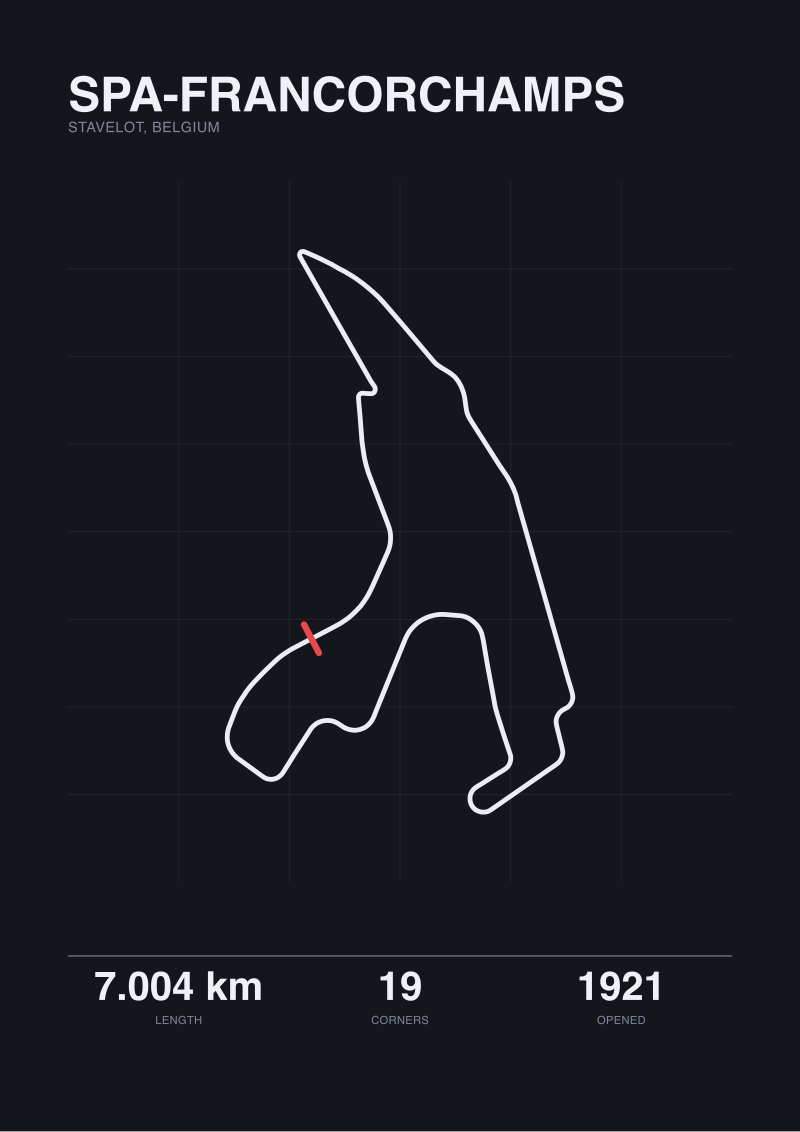
Put the four files we have open this week on the desk and the geometry starts speaking for itself. Nürburgring Nordschleife, Nürburg, Germany: 20.832 km published, 20.746 km when we trace it from OpenStreetMap raceway data, 154 turns, opened 1927. Spa-Francorchamps, Stavelot, Belgium: 7.004 km published, 6.995 km traced, 19 turns, opened 1921. Silverstone, Silverstone, United Kingdom: 5.891 km published, 5.881 km traced, 18 turns, opened 1948. Circuit de la Sarthe sits in the file with a published figure of 13.626 km, which is the number the question has to reckon with for twenty-four hours straight.
Now read those numbers the way a designer reads them, not the way a results-table skims them. One hundred and fifty-four corners in a single Nordschleife lap is not an aesthetic flourish. It is a workload specification. Nineteen turns at Spa across seven kilometres is a corner every 368 metres on average, and the averages hide the point: the corners cluster, so the real spacing is denser in the middle sector than the number suggests. Eighteen corners across 5.891 kilometres of Silverstone works out to a corner every 327 metres, and again the stretches between Copse and Stowe are not the stretches between Village and The Loop.
The question "are race car drivers athletes" treats the driver as the independent variable and the sport as the thing to be judged. Reverse it. Hold the circuit as the independent variable and ask what the geometry demands of whoever is sitting in the car. A 20.7 km lap with 154 corners is a sequence of 154 discrete load events — braking, turn-in, apex, exit — separated by straights too short to count as rest. The circuit, read as a drawing, is a protocol. Whatever is strapped into the seat has to execute that protocol, repeatedly, at speed, without the geometry granting a single second of forgiveness.
That is the receipt. Four tracks, four lengths, 154 plus 19 plus 18 plus whatever Le Mans counts as. The question of athleticism, once the measurements are on the table, is no longer a philosophical argument. It is an input-output problem whose inputs we can read off the map.
What Nobody Mentions
The debate as it circulates online treats racing as a seated activity and uses that framing to dismiss the physical demand. Seated, therefore not athletic. This argument fails at the first corner, and it fails specifically at the geometry layer, which is where we read it.
Consider Spa. The traced length is 6.995 km and the layout, opened in 1921 in its original road-course form, climbs and falls across the Ardennes topography the circuit was built into. Nineteen corners along that length is not a flat 19 — the elevation change is doing structural work the two-dimensional map understates. Eau Rouge-Raidillon is one of those 19, and the point we never see mentioned by the "drivers aren't athletes" crowd is that corner names on the Spa map are not labels. They are instructions to the body in the seat. A left-right-left compressed into a hill that the geometry forces you to take at the throttle setting the previous corner's exit dictated — that is a load event, and it is one of nineteen.
Nordschleife makes the point more plainly, because the arithmetic is harder to argue with. A lap of 154 corners at 20.746 km means the mean straight between corners is roughly 135 metres. At racing speeds, 135 metres is seconds. The driver's physiological state at corner 90 is a function of what corners 1 through 89 did to them, and the circuit — opened 1927 — was not designed with cockpit cooling in mind. The layout predates every ergonomic study ever conducted on race seats. It is 1927 geometry judged by 2026 bodies.
The second thing nobody mentions is that circuit length is a workload envelope, not a workload number. A 5.881 km Silverstone lap repeated across a race distance of 52 laps is 305 kilometres of continuous corner-sequence execution. A 6.995 km Spa lap repeated across a race distance is longer. Le Mans is 13.626 km of layout executed for twenty-four hours in rotation. The question is not whether a human can drive a car around a circuit — of course they can; the question is whether a human can execute the geometry at its performance envelope, lap after lap, in the heat of a cockpit, with hands and neck and spine loaded by the corners the designer drew in. The map does not care about the debate. It just lists the corners.
 Silverstone
The print from this article · from €29.95
View the print →
The Real Cost
Put a number on it, then, the way we would put a number on any geometry question. Not a watts figure — we don't have a watts figure in the grounding, and we won't invent one. But the number the circuit does give us is the one that matters for this question: load events per lap, lap distance, and the time between those loads.
Nordschleife, by the receipt: 154 corners in 20.746 km. That is a load event every 134.7 metres on average. We cannot tell you the exact G-load at each one — the grounding does not give that figure and we will not fabricate it — but we can tell you the spacing, and spacing is the thing that converts corners into a cumulative physical demand. A load event every 134.7 metres, repeated across a lap that even in modern race cars is measured in multiple minutes, is a stress protocol that would be regarded as serious in any athletic discipline.
Spa: 19 corners in 6.995 km, averaging a corner every 368 metres. Lower density than the Nordschleife, higher speeds at the corners that do appear, and the elevation change amplifies the physical load the two-dimensional count hides. Silverstone: 18 corners in 5.881 km, 327 metres between corners on average, mostly flat, higher sustained cornering speeds through the fast sections than the Nordschleife's technical bias allows. Three different layouts, three different load distributions, three different answers to the question "what is this circuit asking of the body in the car".
The honest limit here is the one we always flag: we do not have corner-by-corner G-load figures, cockpit temperature figures, or heart-rate data in our file. What we have is the layout, the corner counts, and the lengths — and that is enough to answer the question as a measurement problem rather than a rhetorical one. The real cost, read off the geometry, is a workload envelope that scales with corner count, corner spacing, elevation, and total lap distance. Multiply that envelope by race duration and the "seated activity" framing stops making arithmetic sense. The driver is executing 154 discrete load events per lap on the Nordschleife, and the circuit was drawn in 1927 by people who had no obligation to make that execution comfortable.
The received wisdom that this question deserves a two-sentence answer — "yes they are, F1 drivers lose kilos per race" — is the wrong altitude. The right answer is: look at the drawing. The drawing is a stress protocol. The drawing is also, usefully, the thing you can hang on a wall and read for yourself.
If You Only Remember One Thing
Circuits are workload documents. Nordschleife lists 154 corners across 20.746 kilometres of traced layout; Spa lists 19 across 6.995; Silverstone 18 across 5.881. Those numbers are not trivia. They are the specification the body in the car has to execute, lap after lap, at a rhythm the geometry fixes and the driver does not get to renegotiate.
Whether that qualifies as athletic depends on how you define athletic. Whether it is a sustained physical demand with a measurable workload envelope is not a question of definition. It is a question of reading the map. We trace the map before we draw it, and the map, in every single file we have open this week, answers the question the same way: the circuit is doing the asking, and the body is doing the answering, and the arithmetic is on the drawing.
 Nürburgring Nordschleife
The print from this article · from €29.95
View the print →
FAQ
What does a circuit's corner count actually tell us about physical demand?
Corner count is the first-order proxy for load events per lap. A corner is a braking-plus-turning-plus-exiting sequence that loads neck, torso and arms. One hundred and fifty-four corners on a Nordschleife lap means 154 such events in 20.746 km of traced layout. The count does not tell you the G-load at each corner — that requires other instruments — but it does tell you the density of the stress protocol the circuit imposes.
Why does the Nürburgring Nordschleife come up so often in this debate?
Because its geometry is unusually unforgiving. The traced length is 20.746 km, with 154 corners and an opening date of 1927 — meaning the layout predates every modern ergonomic standard. A lap includes a corner on average every 134.7 metres, and the circuit was built into the Eifel terrain rather than designed on flat ground. For a question about physical demand, the Nordschleife is the extreme case the map hands you.
Why do the official and traced lengths of a circuit differ?
The published figure comes from the sanctioning body's homologation documents and reflects the measurement protocol those documents prescribe. Our traced figure comes from OpenStreetMap raceway data under the ODbL licence and reflects the geometry as mapped. Nordschleife: 20.832 km official, 20.746 traced. Spa: 7.004 official, 6.995 traced. Silverstone: 5.891 official, 5.881 traced. The gaps are small and the two measurements answer different questions.
Does Spa's 19 corners understate the physical load compared to a circuit with more turns?
In raw corner-density terms, yes. Spa's 19 corners across 6.995 km averages a corner every 368 metres, lower density than Silverstone's 327 metres or Nordschleife's 134.7. But corner count is not the whole story at Spa. The Ardennes elevation change means some corners are compressions and crests, which load the body in ways a flat corner does not. The map in plan view understates what the section view shows.
Is Silverstone less physically demanding than Spa or the Nordschleife?
Silverstone has 18 corners across 5.881 km of traced layout, opened in 1948 on former RAF airfield ground that is largely flat. By corner density it sits between Nordschleife and Spa; by elevation profile it is the least extreme of the three. That does not make it undemanding — the fast sections sustain high cornering speeds — but the physical load profile is different. The map tells you to expect a different kind of workload, not a smaller one.
Why doesn't your file include a lap time or a specific G-load figure?
Because we only publish figures we can source. Our grounding provides circuit length, corner count, locality and opening year. It does not provide lap times, driver heart-rate data, cockpit temperatures or corner-by-corner G-loads. Rather than fill the gap with numbers we cannot cite, we read the question from the geometry we do have. Honest limits on the data read, in our view, as authority rather than weakness.
Does Circuit de la Sarthe belong in this comparison?
Partly. Our file has the official length at 13.626 km, which puts it between Spa and the Nordschleife on scale, and it is executed in rotation for twenty-four hours during its signature event. That duration is relevant to any workload argument. Our traced figure for la Sarthe is incomplete in the current file, so we cite the published 13.626 km and flag that our geometry trace is partial — a point we would resolve before publishing a dedicated la Sarthe reading.
Where can I see these layouts drawn properly?
We trace each circuit from OpenStreetMap raceway geometry before we draw it, then publish the layout as a print. The ones referenced in this piece — Nordschleife, Spa, Silverstone — are available at see the Silverstone print as circuit prints, printed at the proportions the map data gives us rather than the proportions marketing material tends to flatten them into.
From the collection
New circuits and 10% off your first print.
One email now with your code. No noise after.