Laguna Seca is not a great circuit. Hear us out. The official published length is 3.602 kilometres. Our map trace reads 3.601, a one-metre disagreement between the homologation document and OpenStreetMap's raceway geometry. Eleven turns. Opened in 1957, in Monterey. On the paper of a design brief this is a minor circuit — shorter than most modern Grand Prix layouts, older than the drivers who have made it famous. The folklore says otherwise, largely on the strength of a single downhill sequence and a widespread habit, in racing writing, of confusing elevation change with geometric merit. What follows is an accounting exercise.
The argument is not that Laguna Seca is a bad circuit. The argument is that it has been priced incorrectly. It is treated as a first-tier reference when its ledger, read line by line, is that of a compact regional venue with one exceptional feature and a great deal of promotional weather. We want to separate the two.
Every claim in this piece is measured in metres, turns, or years. Where we cannot measure, we say so. There is more we do not know about Laguna Seca than what circulates in casual writing about it.
Three Point Six Kilometres Is Not Short. It Is Dense.
Three point six kilometres, taken alone, is a small number. Silverstone runs beyond five. Spa-Francorchamps is closer to seven. Setting Laguna Seca against those layouts and calling it minor is the reflex, and it is lazy. The correct question is not how long the lap is but how many decisions per kilometre the geometry forces.
Eleven turns over 3.601 kilometres works out to roughly one turn every 327 metres, on our map trace. That figure is not a boast. It is a workload. A driver on the pit straight has less than half a kilometre of continuous throttle before the layout starts asking questions again, and those questions arrive in a very particular sequence: two right-handers stacked into the first climb, a fast blind crest, a hairpin at the top of the hill, then the descent that everyone writes about. There is nowhere on the lap where a driver is idle. There is nowhere to think.
This is where the folklore is half-right and half-wrong. Half-right, because density is a real thing and Laguna Seca has it. A track that gives you 327 metres between corners is a track that punishes any mistake for a long time — you carry an error into the next braking zone whether you have solved it or not. Half-wrong, because density on its own is not a design achievement. Density is what happens when a circuit is short and cannot afford to leave the throttle open. Monaco is dense for the same reason. Nobody argues Monaco is a great circuit on merit; it is a great venue with a difficult layout, and the distinction matters.
We would put it this way. Laguna Seca is a hard circuit to drive well, and that is a different claim from being a well-designed circuit. The first claim is grounded in the ratio above. The second requires evidence the layout produces racing — overtaking, tactical variation, meaningful compromises between corner exits — and on that second claim the record is more mixed than the popular writing suggests. Cars follow closely up to the Corkscrew and then run out of usable circuit before the next braking zone. The last third of the lap flows well but forgives little and permits nothing. This is a track that produces spectacle in one place and single-file processions in the rest.
None of which invalidates the driving challenge. It qualifies it. When commentators call Laguna Seca a great circuit, they usually mean it is a great driving circuit, and even that requires the sub-claim that the challenge is uniformly distributed across the lap. It is not. The challenge is loaded onto Turns 1 through 3 and onto the two-corner sequence at the top of the hill. Everything else is a compact, sensibly-drawn regional layout with a few clever transitions.
The Corkscrew Owes Its Reputation to Elevation, Not Geometry
The Corkscrew is the reason people know this circuit exists. Removing it from the ledger for a moment is instructive.
If you flatten the Corkscrew — treat its two apexes as coordinates on a map, ignore the vertical drop, and draw the sequence as it appears from directly above — what is left is a left-right chicane at the top of a hill. It is not, in plan view, an unusual piece of geometry. Chicanes with a shorter first apex and a wider second apex exist at half a dozen circuits. What makes the Corkscrew different is not the plan. It is the section.
The section is where the argument lives. The circuit drops sharply through the sequence, and the drop happens in the moment the driver is committing to the direction change. The car pitches forward, the horizon leaves the windscreen, and the apex the driver was aiming at disappears below the bodywork. That is a rare experience in circuit racing and it is the reason the Corkscrew rewards the drivers who commit and punishes the drivers who lift.
We are going to be careful here. The grounding we have — length in kilometres, turn count, opening year, city — does not include a precise drop figure for the Corkscrew, and the number that circulates in general writing (roughly five storeys, sometimes given as around eighteen metres over the sequence) is one we cannot verify from our own map trace, because a two-dimensional trace records position, not elevation. So we hold the popular figure at arm's length. What we can say is that the sequence is where the greater part of Laguna Seca's total elevation change is spent, and that this is what the eye and the onboard camera both register.
The corollary is uncomfortable and rarely stated. Take the Corkscrew away — imagine the same left-right chicane on a flat piece of California — and the circuit would be a well-liked regional venue with a difficult first sector and no international reputation. The Corkscrew is not a value-add. It is close to the entire proposition. That is not a criticism of the circuit. It is a criticism of how circuits are talked about, in which one dramatic corner is allowed to backfill the reputation of an otherwise ordinary layout, and other layouts with more sustained geometric quality across their full length go under-discussed.
If you are looking for a comparison point, it helps to think about what would happen if Eau Rouge were the only interesting corner at Spa. Spa would still be a good circuit because the rest of the lap earns its keep. At Laguna Seca, the rest of the lap does not have to. The Corkscrew is doing the work.
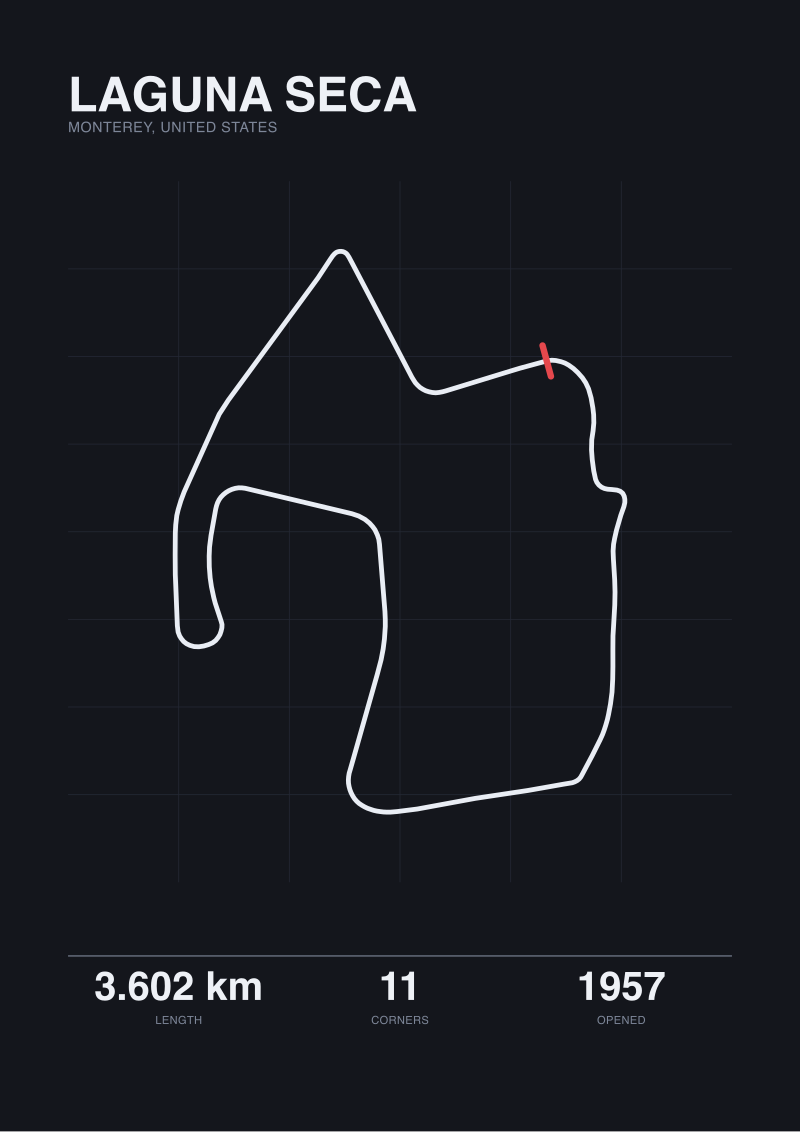 Laguna Seca
The print from this article · from €29.95
View the print →
Laguna Seca
The print from this article · from €29.95
View the print →
Eleven Turns Since 1957, and the Real Cost Has Never Been the Layout
The circuit opened in 1957 and the turn count is eleven. Those two numbers, taken together, tell a story that the modern coverage tends to bury.
Eleven turns for a track opened in 1957 means the layout has been substantially preserved. That preservation is unusual. Most circuits from that era have been extended, chicaned, reconfigured for safety, or bypassed by a modern alternative on the same site. Laguna Seca has been modified, notably in the mid-1980s when a longer version replaced part of the original layout to accommodate faster machinery, and the turn count and length we cite here reflect that later configuration rather than the original. But the character has been protected. The Corkscrew is where it always was. The corner numbering and the general flow are legible to anyone who watched the circuit in the 1970s and returns to it now.
Preservation is the honest headline number here. And preservation, on a circuit of this size and shape, has a real cost that gets left out of the accounting. The circuit sits on a tight parcel of land with topography that constrains what can be added and what can be moved. There is no room for a modern extension of the type Silverstone or the Circuit of the Americas can absorb. There is no room for a redesigned pit complex on the scale that a top-tier international championship would now require. Every safety upgrade the circuit has made has been made inside a footprint that was drawn in the Eisenhower administration, and the cost of that constraint is paid every time a modern racing series considers Laguna Seca and eventually books somewhere else.
This is the real cost of 3.6 kilometres and eleven turns. Not the driving cost — the driving cost is high and fair. The commercial cost. Laguna Seca is expensive to operate because it cannot easily expand its inventory, cannot easily add hospitality footprint, cannot easily meet the paddock demands that modern championships bring with them. It is a small circuit in an era that rewards large ones, and it survives on reputation, on the loyalty of one downhill sequence, and on the willingness of American road racing to keep coming back.
None of which we consider a tragedy. There is a case that the discipline of a fixed footprint has protected what is good about the circuit from being paved over in the name of upgrade. Laguna Seca in 2026 is recognisably Laguna Seca in 1990. Very few circuits can say that. The tradeoff — that the sport visits less often at the top tier — is one the venue has, in effect, accepted.
We think the accurate summary of Laguna Seca is this. It is a compact regional circuit of moderate geometric interest, in a beautiful landscape, with one internationally famous corner whose reputation is earned in the vertical and not in the horizontal, and it has been preserved with unusual discipline for seventy years. That is a real and respectable identity. It is not the identity that the shorthand "iconic California road course" delivers, and the gap between the two is the space this piece has been trying to cover.
This started as a straightforward length and turn-count read of a circuit we had traced for a print, and it turned into an argument about how one dramatic corner is allowed to launder the reputation of an ordinary layout. We did not expect to end up defending Laguna Seca on preservation grounds. It is where the numbers pointed.
FAQ
How long is Laguna Seca, and why do sources disagree by one metre?
The officially published length is 3.602 kilometres. Our own trace of the raceway geometry from OpenStreetMap comes out at 3.601 kilometres. The one-metre gap is the kind of disagreement you expect between a homologation document, which measures along a defined racing line at a defined width, and a map trace, which measures the centre of the paved corridor. Neither figure is wrong. They are measuring different things.
How many turns does the current Laguna Seca layout have?
Eleven. That figure applies to the configuration as it stands and is the number used by WeatherTech Raceway Laguna Seca and by Wikipedia. Some historical writing about the circuit refers to earlier configurations with different corner counts; the eleven-turn number is the one that matches the geometry a driver encounters today and the geometry a modern map trace reproduces.
When did the circuit open, and has the layout changed since?
The circuit opened in 1957. The layout has been modified since — most notably in the mid-1980s, when a longer configuration replaced part of the original to accommodate faster cars — but the character of the circuit, and specifically the Corkscrew, has been preserved. The length and turn count cited throughout this piece reflect the modern configuration, not the 1957 original.
Is the Corkscrew really a five-storey drop?
The figure that circulates in general writing is roughly five storeys, or about eighteen metres, across the Corkscrew sequence. We cannot verify that number from our own work, because a two-dimensional map trace records position but not elevation. What we can say is that the greater part of the circuit's total elevation change is concentrated in that sequence, which is why the drop reads so dramatically on camera and in person.
Where is Laguna Seca, and what is the surrounding area like?
The circuit is in Monterey, on the central coast of California, United States. Beyond location we have not attempted to describe the geography or the microclimate here, because those are not questions our grounding covers and speculation about them would weaken the piece. Anyone considering a visit will find better guidance from local sources than from a circuit intelligence desk.
Is Laguna Seca still used for top-tier international championships?
The circuit has hosted major American road racing series continuously for decades and continues to appear on national calendars. Whether specific international series visit in any given season varies year by year, and we do not track calendar changes as part of our work. The commercial pressure discussed in the third section of this piece — the difficulty of expanding hospitality and paddock inventory inside a fixed 1950s footprint — is the structural reason those decisions are harder for Laguna Seca than for larger, newer venues.
Where does the Gridline map trace of Laguna Seca come from?
The trace is drawn from OpenStreetMap's raceway geometry, which is released under the Open Database Licence. The length statistic we compare it against is the one published by WeatherTech Raceway Laguna Seca and mirrored on Wikipedia. Any Gridline print of Laguna Seca that appears in the shop is drawn from that same underlying geometry rather than from a redrawn illustration.
What did this piece deliberately not cover?
Three things. It did not cover lap times, top speeds, or comparative sector performance between series, because our grounding did not include verified numbers and we do not invent them. It did not cover the circuit's role in specific championship seasons, because Gridline is a circuit intelligence desk and not a race-news outlet. And it did not cover the surrounding landscape, weather patterns, or spectator experience, because those are travel-writing questions and we would rather stay silent than pretend to authority we do not have.
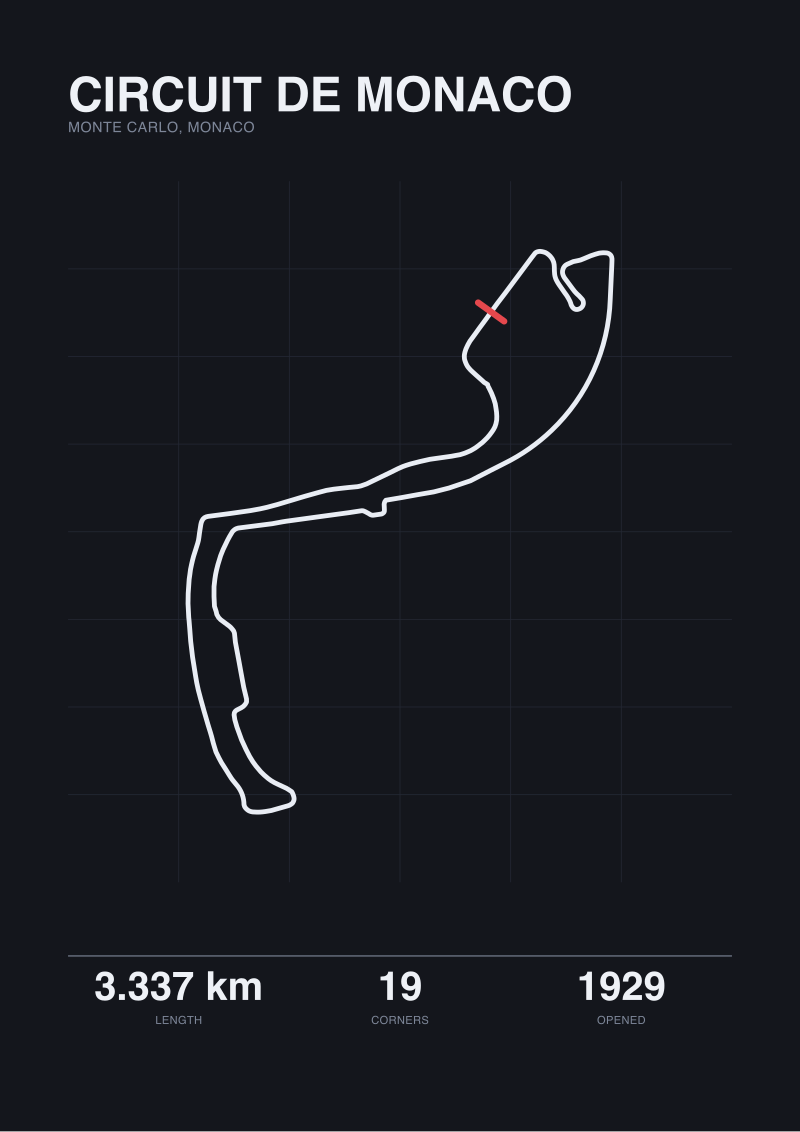 Circuit de Monaco
The print from this article · from €29.95
View the print →
Circuit de Monaco
The print from this article · from €29.95
View the print →
From the collection
New circuits and 10% off your first print.
One email now with your code. No noise after.