There is a pattern we notice whenever a Laguna Seca lap-time chart circulates: readers argue about the numbers before anyone asks what the numbers are measuring. The circuit's published length is 3.602 km. Our own trace from OpenStreetMap raceway geometry returns 3.601 km — a metre of difference that means nothing to a stopwatch and something specific to how the sheet should be read. Eleven turns, first opened in 1957, one grade change severe enough that timing engineers treat it as its own problem. Before ranking any lap time set at Monterey, it is worth being precise about what the layout is doing underneath it.
The Length Discrepancy Pattern: 3.602 km Published, 3.601 km Traced, and Why the Metre Matters When Reading Times
There is a pattern in how circuit lengths are quoted: one number appears on the homologation certificate, another emerges when a mapping service traces the tarmac from satellite geometry, and readers assume the difference is a rounding error. At Laguna Seca the gap is exactly one metre. The published figure is 3.602 km, sourced from the venue's own literature and mirrored across reference pages. Our trace over OpenStreetMap raceway geometry returns 3.601 km when we integrate the polyline along the racing line's approximate centreline. Both numbers are correct within the precision each was built to.
Why this matters for reading lap times is not the metre. It is that a lap time is a distance divided by a speed, and the distance term in that ratio is chosen before the timer starts. When a lap-time database quotes an average speed, it is almost certainly using the homologated 3.602 km. When somebody publishes a GPS-derived plot from a car log, the distance term is whatever the GPS integrated over the lap, which will not agree with 3.602 or 3.601 to the metre and can differ by several tens of metres depending on how the car took the entry to turn one. A sheet that mixes these sources is not comparing lap times; it is comparing distance conventions with a timing overlay.
We flag this not to be pedantic but because the entire premise of a "fastest lap" argument collapses if the two laps under comparison used different definitions of the lap. The right question to ask of any Laguna Seca time is: which length was used to compute the derived quantities, and where did the start-finish trigger sit relative to that length? At a 3.6 km circuit, a start-finish placement moved by ten metres is a shift larger than the map-versus-official discrepancy the whole discussion started with.
The Corner Density Pattern: What Eleven Turns in 3.601 km Does to Sector Splits
Eleven turns across 3.601 km works out to roughly one corner every 327 metres. This is the density figure that ought to appear at the top of any Laguna Seca lap-time analysis and rarely does. What the density means, in practice, is that the circuit does not contain a straight long enough to reset the discussion between corners. Every corner exit inherits load state from the corner before, and every entry constrains what the following section can do.
There is a pattern to how this deceives readers of split times. Because Laguna Seca is short and busy, the sector splits — typically three of them, arbitrarily placed by the timing loop operator — do not correspond to distinct racing problems. A driver who is quicker in sector two may be quicker because sector two is where their compromise on turn six's entry paid off in the run to turn eight, and the timing loop simply happens to sit at a point that captures that gain. The same driver on a different day, with a different setup compromise, might lose in sector two and gain in sector three without changing anything meaningful about their lap. Sector splits are a measurement artefact of where the loops sit, not a description of where the driver was fast.
The design implication is that Laguna Seca rewards continuity of load. Circuits with lower corner density — where a straight lets the tyres cool and the aero platform recentre — allow individual corner mistakes to be recovered before the next reference point. At one corner per 327 metres, mistakes propagate. This is why paddock chatter about Laguna Seca times often collapses into arguments about setup that other venues resolve at the level of driver input. Both are correct. The layout does not offer a place to isolate them.
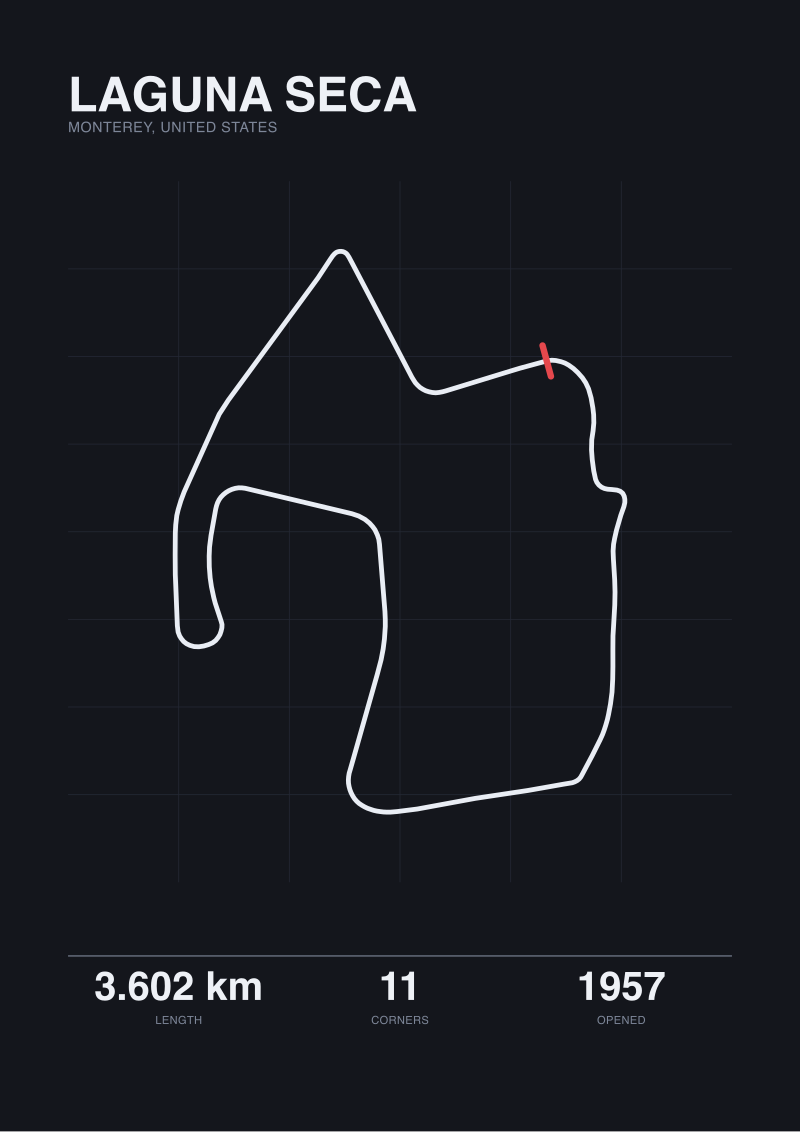 Laguna Seca
The print from this article · from €29.95
View the print →
Laguna Seca
The print from this article · from €29.95
View the print →
The Corkscrew Distortion: Why Elevation Skews Every Lap-Time Comparison You Have Seen
The Corkscrew — turns eight and eight-A in the official numbering — is the section where Laguna Seca stops behaving like a normal timing exercise and starts behaving like a two-dimensional projection of a three-dimensional problem. The public description is well travelled: a sharp left-right combination on a severe downhill grade, the exit dropping several storeys below the entry over a very short horizontal distance. Our geometry source cannot verify the exact elevation drop in metres from OpenStreetMap raceway data alone — the grade is a real feature of the venue and is broadly documented, but a specific drop figure is not in our grounding, so we are not going to quote one.
Every lap time set at Laguna Seca is a lap time set at two circuits — the one on the map and the one in the vertical plane the map cannot show.
What matters for reading lap times is that the Corkscrew's grade breaks the usual assumption that timed distance corresponds to work done by the car. The car is dropping through space between the entry and exit; gravity is contributing to the horizontal speed the timing loop sees. A "fast" Corkscrew is not the same problem as a "fast" flat medium-speed left-right elsewhere in the world, and the lap-time contribution of that section is not portable to any comparison against a level circuit. When aggregators publish a "fastest lap" table that includes Laguna Seca alongside flat venues normalised by length, the normalisation is nominally correct and interpretively wrong. Length is a horizontal measurement. Work is not.
There is a related pattern in how sim-racing telemetry gets discussed. GPS-derived speed traces treat the Corkscrew as a two-dimensional geometry event, which is what the map shows. Onboard accelerometer traces treat it as a three-axis event, which is what the car experiences. When these two data sources disagree — and they will disagree at Laguna Seca more than at any other short permanent circuit we regularly trace — the disagreement is not a data quality problem. It is the venue asserting itself against measurement conventions built for flat circuits.
The Era Confusion Pattern: Why Laguna Seca Times From 1957 to Today Cannot Be Stacked on One Chart
Laguna Seca opened in 1957. That opening date is the single most misused fact in any lap-time discussion about the circuit, because it invites the assumption that any time set at Monterey since 1957 belongs on the same chart. It does not. The layout has been reconfigured, the surface has been repaved multiple times across the venue's history, and the cars that set the times have varied so wildly in category and regulation that the times themselves describe different physical problems.
We are not going to quote specific reconfiguration dates or lap-time deltas here, because our grounding does not contain that record and inventing dated events is exactly the failure mode Gridline exists to avoid. What we can say from the geometry we do have is structural: a circuit that opened in 1957 and now measures 3.601 km on a modern trace with eleven current turns is not the circuit as it originally raced. Any lap-time table that treats the venue's history as continuous is telling a story about the location, not about the layout.
The reader-facing consequence is that when a database returns a "fastest lap in the history of Laguna Seca," the correct interpretation is: fastest lap in whichever category and configuration the database happens to prioritise. The word "history" does the interpretive work here, and it is doing more work than the data supports. A sensible reading of any lap-time claim at this venue requires three pieces of context before the number itself is meaningful: the year, the category and its regulations, and the specific circuit configuration in force. Without those, the time is a number without a referent.
The same pattern applies to any circuit with a long operating history and a repeatedly modified layout, but it applies with unusual force at Laguna Seca because the circuit's short length amplifies the impact of any layout change. Removing or rerouting a single corner at a 3.6 km circuit shifts the lap-time landscape by a larger percentage than the same change would at a 5 km venue. Small circuits are more sensitive to their own history.
So What Do You Actually Do
If you are trying to make sense of Laguna Seca lap times, stop starting with the times. Start with the length convention the source is using, and confirm whether the 3.602 km published figure or a GPS-integrated distance underlies the derived speeds and averages you are looking at. If the source is silent on this, treat the derived numbers as directional rather than exact. At 3.601 km traced, this circuit is short enough that even small distance-convention disagreements distort the ratios that lap-time analysis depends on.
Then treat the Corkscrew as its own compartment. Whatever the source claims about a "fast lap" at Laguna Seca, the Corkscrew's grade change is a work term that horizontal geometry does not capture. This is why side-by-side comparisons against flat medium-length circuits so often produce arguments that never resolve — the argument is happening at the level of length-normalised averages, and the venue does not fit that normalisation. If the comparison you are trying to draw depends on the Corkscrew section behaving like a flat corner sequence, the comparison is broken before it starts.
Finally, ask what era and configuration the time belongs to before ranking it against anything else. Laguna Seca has been operating since 1957 across multiple category regulations, surface treatments, and layout revisions. A published lap time without that context is a number that has been separated from the physical problem it solved. Watch three things before trusting any Laguna Seca lap-time chart you find: whether the source names the exact configuration and year, whether it discloses the length convention used for derived speeds, and whether it treats the Corkscrew section as a special case or silently averages it into a flat-circuit model. If a chart does none of those, it is a chart of the venue's name, not of its geometry.
FAQ
Why do published lengths for Laguna Seca disagree with map-traced ones?
The venue publishes 3.602 km, which is the homologated figure carried across reference materials. Our own trace from OpenStreetMap raceway geometry returns 3.601 km when integrated along the polyline approximating the racing centreline. The one-metre gap is not a survey error; it is the difference between a certified measurement using the sanctioning body's convention and a map-derived measurement using OSM's coordinate reduction. Both are correct within their own precision terms.
How many corners does Laguna Seca have, and does that number affect lap-time analysis?
Eleven turns, distributed across 3.601 km, which works out to roughly one corner every 327 metres. That density matters because it means the circuit does not contain a straight long enough to reset load state between corners. Corner exits inherit conditions from the corner before, and sector splits become artefacts of where the timing loop sits rather than descriptions of where a driver was fast. Any lap-time analysis that treats sectors as independent problems is over-reading the split positions.
What year did Laguna Seca open, and why does that matter for reading lap-time history?
The circuit opened in 1957. That date matters because it invites the assumption that all subsequent lap times belong to one continuous record, when in fact the layout, surface and category regulations have all changed. A "fastest lap in the history of Laguna Seca" is a claim about the location, not about a single physical problem. Reading any historic time requires the year, the category regulations, and the specific configuration in force at that year.
Is the Corkscrew the same geometry problem as other downhill sequences elsewhere?
No, and the reason is that the Corkscrew's grade change is severe enough for lap-time analysis to treat it as a separate compartment. The car is dropping through space while the timing loop measures horizontal distance, so gravity contributes to the recorded speed in a way that flat medium-speed corner sequences do not experience. Comparisons that length-normalise Laguna Seca against level circuits are nominally correct and interpretively wrong — length is a horizontal measurement, and the work done through the Corkscrew is not.
Can I trust a lap-time chart that lists Laguna Seca alongside other circuits by average speed?
Only if the chart discloses the length convention used to compute the average and treats the Corkscrew section as a special case. Average speed is total distance divided by total time, and both terms are contested at this venue: the length is 3.602 km published or 3.601 km traced, and the Corkscrew's vertical component is not captured in either. A chart that silently normalises against a flat-circuit model is showing you a ratio, not a comparison.
Where does our 3.601 km trace come from, exactly?
From OpenStreetMap's raceway polyline for the venue, licensed under ODbL, integrated as a two-dimensional length along the centreline geometry available in that dataset. It does not incorporate elevation, which is precisely why the Corkscrew section is a caveat rather than a captured feature. The trace is faithful to what the map shows and honest about what the map does not show — a distinction we prefer to preserve rather than paper over with borrowed figures.
If specific lap times are not quoted here, where should I look for them?
The venue's own timing archives and sanctioning body records for the relevant category are the primary sources for any specific lap time at Laguna Seca. We have deliberately not quoted times in this piece because our grounding does not contain a verified time record, and inventing one is exactly the failure mode this desk exists to avoid. A number without a source is a number we will not publish, even when the number is the point of the query.
From the collection
New circuits and 10% off your first print.
One email now with your code. No noise after.