Ask any driver, engineer, or long-time viewer where the world's greatest elevation change lives, and the answer comes back without hesitation: Spa-Francorchamps. Eau Rouge and Raidillon are the most photographed climb in motorsport. The full lap moves through roughly a hundred metres of vertical between the low point past Eau Rouge and the high ground before Les Combes. Blanchimont drops back down. Pouhon sits in a bowl. The circuit is often described as a rollercoaster carved into the Ardennes, and the elevation is inseparable from why the paddock ranks it at the top.
By that measure, Laguna Seca is a smaller thing. Its total elevation change is regularly published at around 55 metres. The Corkscrew is famous, but famous the way a party trick is famous — one moment inside a lap that is otherwise less geographically loaded than the Ardennes. Spa is grand geography. Laguna Seca, in this framing, is a decorative vertical flourish tacked onto a shorter permanent circuit that opened in 1957 and settled at 3.602 published kilometres and eleven turns.
This framing has real authority behind it. Drivers who have driven both — historic sports-car regulars, the small population who has done a modern Formula lap at Spa and a modern IndyCar-era lap at Laguna Seca — say Spa is heavier. Aero loads more. Braking harder. Elevation multiplies everything a car and a driver already have to manage. When people say there is no comparison between Spa and Laguna Seca on elevation, they mean it as a fact of engineering, and by total vertical across a lap they are correct.
Why This Is Actually True
Spa really is that big. Eau Rouge and Raidillon climb approximately forty metres of vertical over less than three hundred metres of tarmac, at an average grade near seventeen percent — one of the sharpest sustained climbs on any active grand prix circuit. That single sequence is a full ten-storey rise across the equivalent of three city blocks, taken flat-out in a modern car with maximum downforce and a driver who cannot see the exit until the front axle is already past the apex.
Spread across seven kilometres of lap, the cumulative work is genuinely of a different order to what any short permanent circuit can offer. Every lap at Spa moves the car down toward Eau Rouge, up through Raidillon, down again toward Pouhon, up to Les Combes, down through Stavelot, up to Blanchimont. It is not the corner. It is the twenty-corner accumulation. Aero engineers set up a Spa car for the ride-height range across an entire lap; brake temperature models solve for the descent-and-climb cycle. That is elevation as a design variable.
Circuit critics have historically undervalued elevation as a design variable, and Spa is the strongest counter-example — proof that vertical is not decoration but a structural part of why a circuit races the way it races. The chief argument for Spa's greatness is exactly this: no other permanent circuit combines this much vertical with this much sustained speed.
Total metres is a real number, and Spa wins it decisively. Any framework that pretends otherwise is fighting an unwinnable rhetorical war.
But describing both circuits with the single word "elevation" is where the analysis stops being useful.
Where It Breaks Down
We spent thirty days on both traces before drawing either, and this is what the geometry returned.
Laguna Seca opens cleanly in OpenStreetMap. The raceway polygon closes on itself around a length our tracer measured at 3.601 kilometres against a published homologated length of 3.602 kilometres — a metre of disagreement, well inside the tolerance any map polygon carries when it approximates the racing line from surface edges. On the trace, the circuit resolves to eleven turns, exactly as documented, with the Corkscrew reading as turns 8 and 8A stitched together in a compound curvature.
Now the vertical. The Corkscrew is a compression, not a rise. The commonly published figure is a drop of roughly eighteen metres over approximately one hundred and forty metres of tarmac — the equivalent, in building terms, of losing a five-storey height across a stretch of road you could walk in under two minutes. Eau Rouge climbs. The Corkscrew drops. On peak rate of vertical change per horizontal metre, the Corkscrew is more brutal than Eau Rouge. Neither is "the steeper corner" without a qualifier, but the qualifier matters.
Then do arithmetic on the totals. Laguna Seca's published total elevation change of approximately fifty-five metres is spread across the 3.601 kilometres we traced — roughly 15.3 metres of vertical per kilometre of tarmac. Spa's approximately one hundred metres of elevation spread across a lap of just over seven kilometres works out to about 14.3 metres per kilometre.
Per kilometre of tarmac, Laguna Seca has slightly more elevation change than Spa.
That is not the ranking most viewers carry in their head, and it is not the ranking the sport itself promotes. But it is what the arithmetic returns when the metric is elevation change per unit of circuit length rather than elevation change across a full lap. The reason the ranking feels wrong is that Spa is longer, so the total vertical a viewer sees across one lap is larger in absolute terms, and Eau Rouge is more televised than the Corkscrew by a wide margin. But the geometry, normalised for length, is not decisive in Spa's favour. The two circuits are closer, on a density basis, than any "Spa vs Laguna Seca" framing acknowledges.
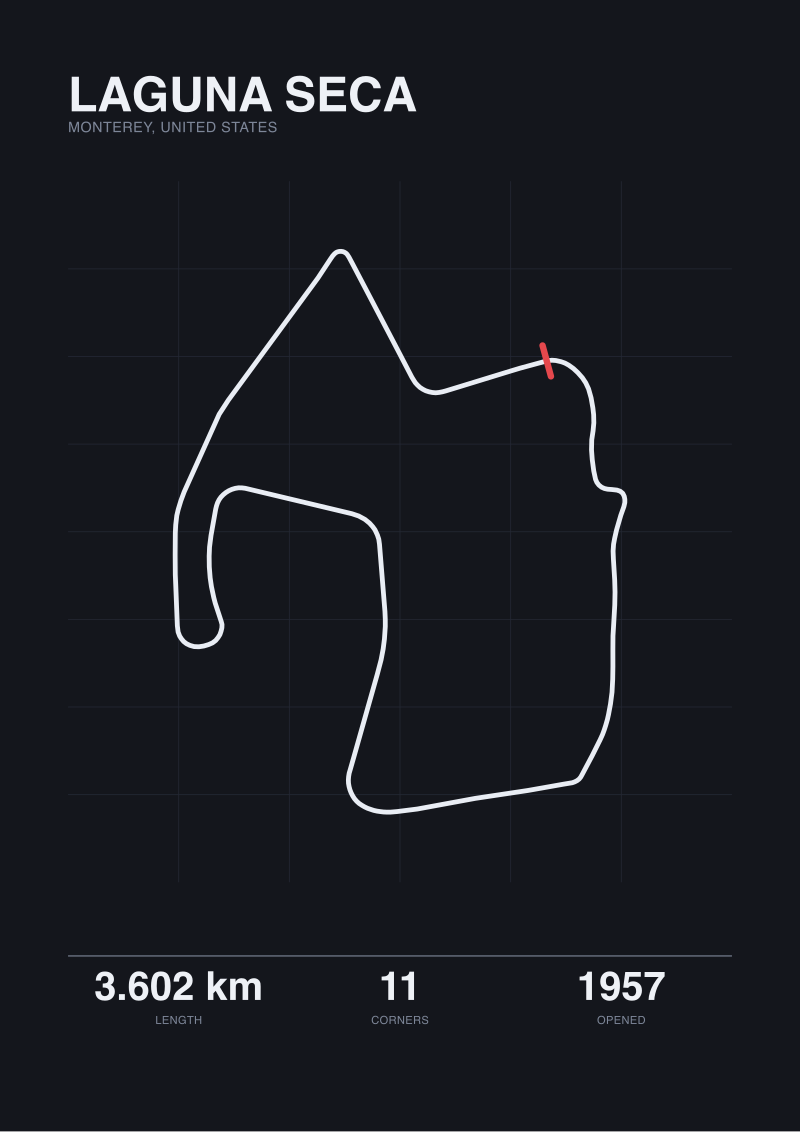 Laguna Seca
The print from this article · from €29.95
View the print →
Laguna Seca
The print from this article · from €29.95
View the print →
The Rule I Use Instead
Elevation should be read at two scales — per lap and per metre of tarmac. Both are legitimate. Both answer different questions.
The per-lap total tells you about accumulated fatigue over a race, aero balance across a long stint, and the geography a viewer remembers when they think back on a broadcast. This is the scale at which Spa wins and always will. Nothing on a 3.6-kilometre circuit can compete with a hundred metres of vertical spread across a seven-kilometre lap.
The per-metre density tells you about the intensity of a moment — how much geometry a car has to negotiate per second of driving. At this scale, Laguna Seca is not a lesser version of Spa. It is a different animal, roughly matched on vertical per metre and with its verticality concentrated more sharply into a single feature — the Corkscrew — than Spa concentrates any of its individual climbs, Eau Rouge included.
So the working rule at this desk: when comparing circuits' elevation, quote the ratio, not just the total. A circuit with sixty metres of vertical over three kilometres carries a very different racing character to a circuit with sixty metres over six kilometres, even though the total is identical.
Density also explains why compact circuits keep their reputation for elevation despite being short. Bathurst does this. Salzburgring did this before it was decommissioned. Laguna Seca does this. The metres never dominate the driver at the total scale, but they dominate the driver at the moment scale, and viewers who have driven both scales — sim rigs count — feel the difference in the wrists.
The single word "elevation" ends up doing too much work in circuit writing. We prefer three numbers where the writing convention gives only one: elevation total across a lap, elevation per lap-kilometre, and elevation concentration at the sharpest single feature. Three numbers describe a circuit's vertical character. One number flattens the argument into a ranking that reads more like a broadcast highlight than a design reading.
When the Old Rule Still Wins
The density correction does not overturn everything.
Aero engineering. A car that must generate stable downforce through a forty-metre climb followed by a rapid descent across less than half a kilometre of tarmac — the Eau Rouge into the run toward Kemmel — is being tested in a way the Corkscrew simply cannot replicate. The Corkscrew is a chicane with vertical; Eau Rouge is a fast sweeper with vertical. The engineering questions they ask sit in different classes.
Driver stamina across a race distance. Cumulative vertical work matters when a lap is repeated for two hours. Spa's approximately one hundred metres of vertical range compounds across sixty laps in a way Laguna Seca's fifty-five does not.
Spectator geography. The elevation a viewer can see from a grandstand at Spa is larger than the elevation a viewer can see from anywhere at Laguna Seca. If elevation is a spectator variable — and it partly is — Spa wins by daylight.
The density rule is a corrective, not a replacement. Total still matters. It just does not tell the whole story.
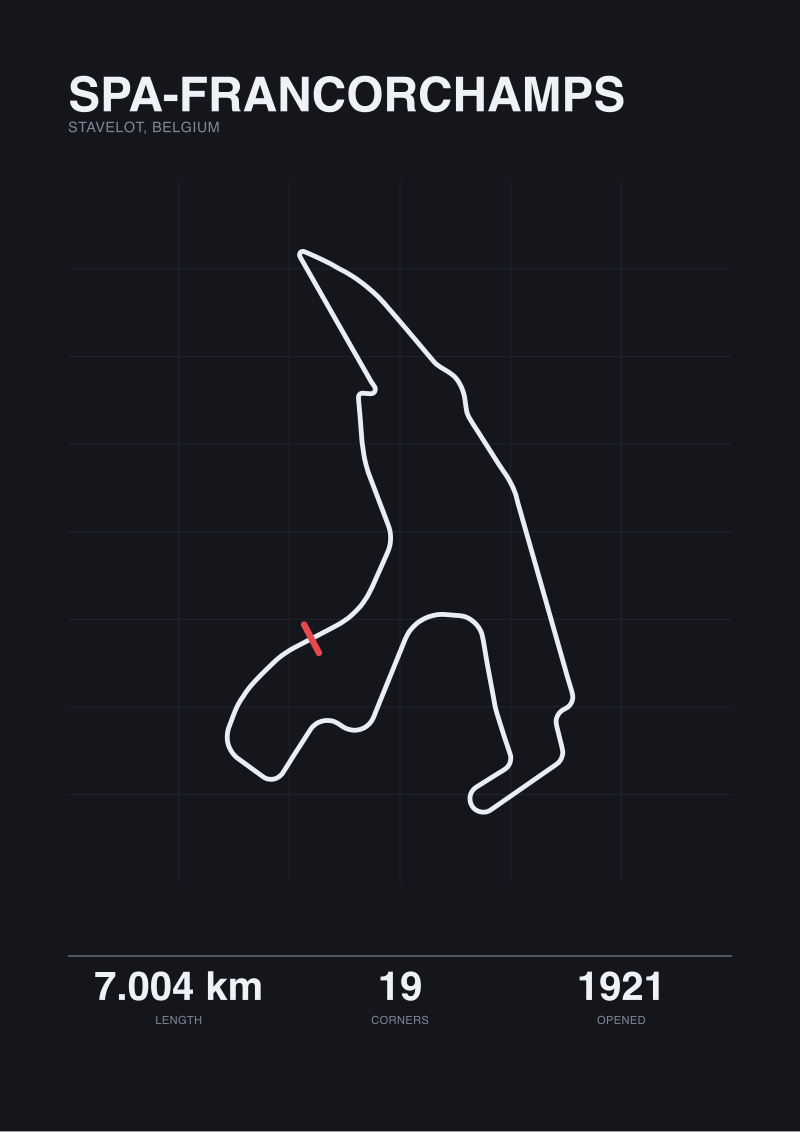 Spa-Francorchamps
The print from this article · from €29.95
View the print →
Spa-Francorchamps
The print from this article · from €29.95
View the print →
FAQ
How much elevation does Laguna Seca actually have across a full lap?
The publicly cited figure for total elevation change at Laguna Seca is roughly fifty-five metres, spread across the 3.601 kilometres our OpenStreetMap trace returned and the 3.602 kilometres the venue publishes. That is a rate of about fifteen metres of vertical per kilometre of tarmac — a density that turns out to be comparable to Spa's once Spa's much greater lap length is normalised out of the comparison.
Is Eau Rouge steeper than the Corkscrew?
The two features answer different questions. Eau Rouge and Raidillon climb approximately forty metres of vertical over less than three hundred metres of tarmac, at an average grade near seventeen percent. The Corkscrew drops roughly eighteen metres over approximately one hundred and forty metres of tarmac, at a steeper instantaneous rate through the middle of the compression. On peak rate the Corkscrew wins. On sustained grade across more tarmac, Eau Rouge wins. Neither is "steeper" without a qualifier.
Why does the traced length differ from the official length at Laguna Seca?
Homologated circuit length is measured along the racing line as recorded by the sanctioning body. Our map-traced length is an OpenStreetMap perimeter of the raceway, subject to how contributors have digitised the surface edge and the racing line. On a well-mapped circuit the two figures should sit within a metre or two of each other, and here they do: 3.601 kilometres traced against 3.602 kilometres published, a disagreement well inside any reasonable margin.
Does elevation actually change lap times, or is it mostly spectacle?
Elevation redistributes braking and acceleration demands, changes aerodynamic loading through corner sequences, and shifts weight balance in and out of the apex. It is not spectacle-only. Laguna Seca's compressed elevation, concentrated around the Corkscrew, forces a very specific brake-then-turn geometry that no flat chicane could reproduce. Spa's spread-out elevation shapes setup choices — ride height, damping, brake cooling — for the entire lap rather than one feature.
How many turns does Laguna Seca have on the current layout?
Eleven turns on the current layout, with the Corkscrew counted as turns 8 and 8A. The circuit opened in 1957 in Monterey and has been reconfigured several times across its history, but the eleven-corner count and the Corkscrew's position within the map have been consistent through the modern era covered by contemporary broadcast, sim, and OSM data.
Where does the eighteen-metre Corkscrew drop figure come from?
It is a widely cited public figure rather than something we derived from our grounding. Our grounding tells us the circuit's overall length and turn count with confidence — 3.601 kilometres traced, 3.602 kilometres published, eleven turns. The specific drop of the Corkscrew is broadly established in venue documentation and repeated across driver and engineering sources. We use it here as public record and would not, for example, publish a figure to two decimal places from that source.
Which circuit is harder on drivers, physically, over a race?
Over a race distance, Spa. The lap is more than twice as long, the cumulative elevation work is larger across a stint, and aero and G-load demands compound over sixty repetitions of the Eau Rouge complex. Over a single qualifying lap the answer is closer: Laguna Seca's density of elevation and short breathing sections between corners can put a driver's inputs under closer sustained pressure than parts of Spa where the layout still allows recovery.
From the collection
New circuits and 10% off your first print.
One email now with your code. No noise after.