Two things are true at once. The Nürburgring Nordschleife carries 154 turns across 20.746 km of map-traced tarmac, and almost none of them are what a circuit designer would call great corners. Spa-Francorchamps carries 19 turns across 6.995 km, and at least four of them are studied by every track engineer working today. The gap is not scale. It is geometry — specifically, the ratio of what a corner demands from a car to what its surrounding metres will allow. There is a pattern that shows up every time a corner earns that word, and it is measurable in radius, gradient and sequence.
The Radius Illusion: Why Corner Speed Is Not the Metric
There is a pattern in how corners get ranked in public discussion: the fast ones win. This is the wrong instrument.
The steady-state cornering speed of a car on a flat, constant-radius arc reduces to a single equation. Lateral grip must equal centripetal demand, so v equals the square root of μ multiplied by g multiplied by r. Take a modern grand prix tyre at a coefficient of friction of roughly 1.5, gravity at 9.81 m/s², and run three radii. At r = 100 m, v resolves to 38.36 m/s, or 138 km/h. At r = 200 m, v climbs to 54.25 m/s, 195 km/h. At r = 400 m, v reaches 76.72 m/s, 276 km/h. Doubling the radius does not double the speed, because the relationship is a square root. It adds roughly 41 per cent. The metric is deceptive on its own terms.
What this equation cannot see is everything the corner does that is not a flat, constant-radius arc. It cannot see the throttle position at which the driver is forced to lift, because that depends on what the exit connects to. It cannot see whether the surface loads or unloads the tyre through the arc. It cannot see how far the corner sits from the previous braking zone, or from the next one. A 400 m-radius arc that dumps into a 900 m straight is a different corner from a 400 m-radius arc that dumps into a hairpin at 80 km/h, even though the equation returns the same v.
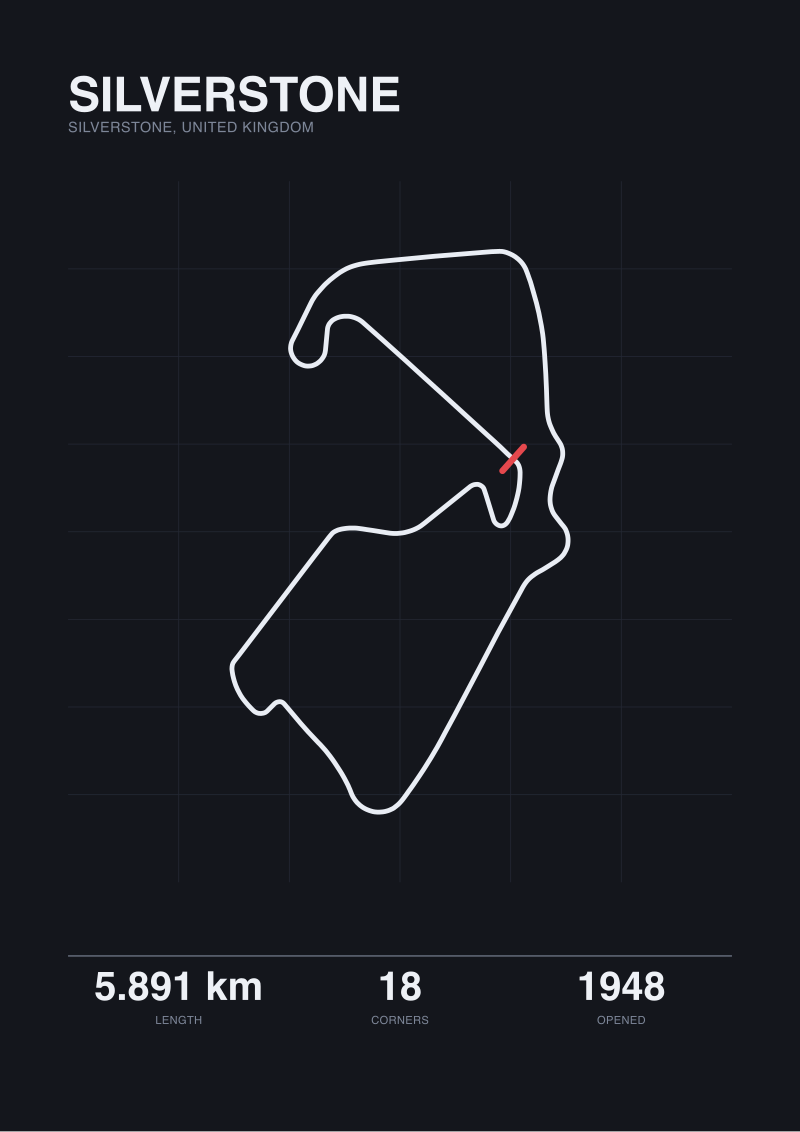
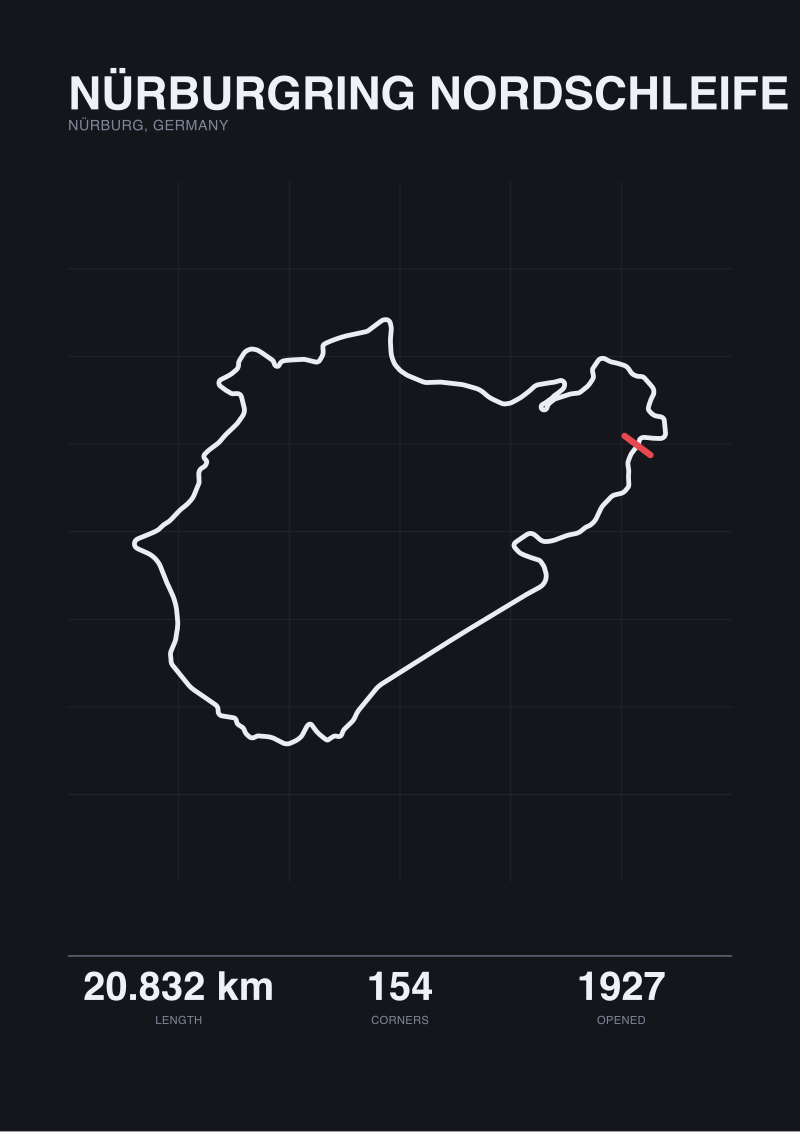
The Nordschleife makes this point by accumulation. Divide 20,746 m of traced circuit by its 154 turns and the mean corner-to-corner spacing is 134.7 m — closer to a rally stage's rhythm than to a permanent racing facility's design brief. Most of those turns are geometric events rather than racing events: kinks the road takes because a 1927 forestry route bent around a hill, then a rock, then a stream. They exist. They do not test anything the previous ten metres did not already test. Spa, by contrast, spaces its 19 turns across 6,995 m at a mean of 368.2 m per turn. Silverstone hits 326.7 m per turn across 5,881 m and 18 turns. When a corner has room to matter on either side of the apex, it can be designed to matter.
The Elevation Multiplier: What a Gradient Does to a Radius
There is a pattern in how the most-studied corners in racing announce themselves on a section drawing rather than on a plan view: they change altitude inside the arc.
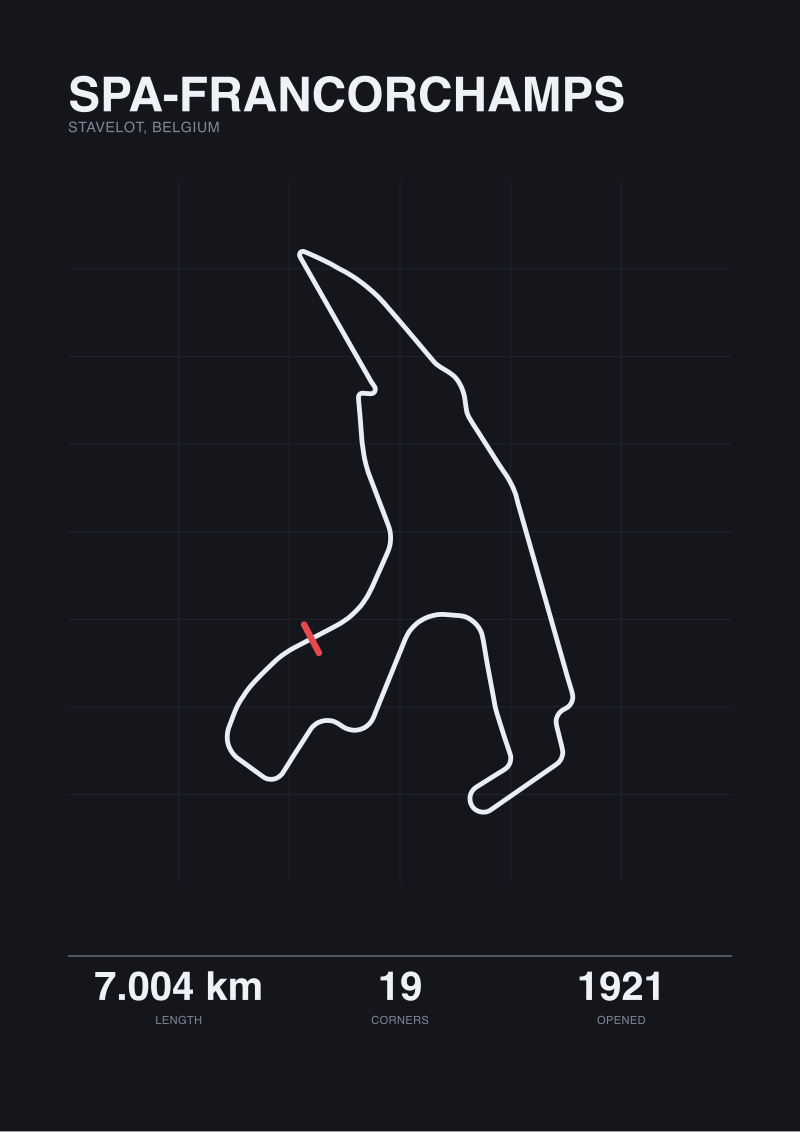
Take the corner sequence at Spa that runs from Eau Rouge across the compression at the base of the valley and up through Raidillon. The plan-view radius is not extreme. What makes the geometry violent is the vertical component. As a car crosses the compression at the bottom, its trajectory momentarily follows a concave arc in the vertical plane, and the road pushes back with more force than gravity alone requires. The formula is the same one used in the horizontal case, rotated 90 degrees. Additional normal load per unit mass equals v² divided by the vertical radius of the compression. Run a car through at 280 km/h — 77.78 m/s — over a compression with a vertical radius on the order of 200 m, and the additional load resolves to 6,049 divided by 1,962, which is roughly 3.08 g on top of the 1 g the car already carries at rest. Total instantaneous vertical load: on the order of 4 g. The tyre contact patch is briefly asked to carry four times the car's weight, and it does, because the geometry temporarily gives it that capacity.
Then the exit inverts the geometry. The road rises through Raidillon, which is convex in the vertical plane. Convex vertical arcs unload the tyre — the same equation, negative sign. If the driver is still asking for the same lateral acceleration on the way up as on the way in, the tyre is being asked to do it with less contact-patch force. The corner is not just a corner; it is a load transient, and its difficulty is a function of how quickly the load returns to nominal after the compression.
Silverstone's Copse offers the contrast. Copse is a fast single-apex right-hander with modest camber and no significant elevation change. The steady-state equation covers most of what happens there. The corner is difficult because the entry speed is high and the exit runs into another high-speed sequence, but the geometry does not multiply the load. It is a pure lateral event. Both corners are notable. Only one of them is a load transient. That distinction is what the elevation multiplier picks out, and it is invisible on a track map that only shows plan view.
A great corner is not a place where a car goes fast; it is a place where the geometry temporarily changes what the tyre is physically capable of.
 Silverstone
The print from this article · from €29.95
View the print →
Silverstone
The print from this article · from €29.95
View the print →
The Compromise Corner: Entry, Apex and Exit Fighting Each Other
There is a pattern in how corners that reward decades of study fail to have a single correct line: they force the driver to trade one phase against another.
Every corner has three phases the tyre has to survive. Entry, where longitudinal braking load transfers to lateral load. Apex, where the lateral load peaks and the arc is tightest. Exit, where lateral load releases and longitudinal traction takes over for acceleration onto whatever comes next. In a simple corner — a well-shaped hairpin, a constant-radius medium-speed right-hander — these three phases are separable. The driver optimises each in turn. The line is close to unique.
A compromise corner refuses this separation. Its geometry is arranged so that the fastest entry produces the slowest exit, and the fastest exit requires an entry line that sacrifices apex speed. The classic case is a corner whose radius tightens toward the exit — a decreasing-radius arc — that dumps into a long straight. Enter it on the geometric ideal for maximum apex speed, and the car runs wide on exit because the radius has closed under it. Enter it on a tighter line to prepare the exit, and the apex speed drops. There is no single optimum, only a family of solutions across which the driver trades. Whichever solution is chosen is auditable against lap time, so the compromise never resolves into orthodoxy.
The Silverstone sequence known as Maggotts, Becketts and Chapel is the textbook example, and its geometry is a matter of public record. It is a chain of three linked direction changes, and each apex constrains the entry angle available to the next. Optimising the first apex costs you the second. Optimising the middle apex compromises both the first and the third. The car spends nearly the entire sequence in a state of load transfer rather than steady-state cornering, and the tyre is asked to accept lateral force in one direction, release it, and accept it in the opposite direction, three times in a row. The section reads on a map as an S-curve. What it actually is, in load terms, is a controlled oscillation with no rest phase.
Compare this to a Nordschleife turn taken in isolation. The Karussell is a heavily banked, tight-radius left-hander whose banking allows a higher speed than the plan-view radius would predict. It is a fine corner. It is not a compromise corner, because the geometry does not force a trade — the driver simply commits to the banking and rides it. The corner has one difficulty, and it is throttle discipline through the exit rise. The Silverstone sequence has three difficulties simultaneously, and they are not independent. That interdependence is what the word compromise is measuring.
The Rhythm Pattern: Corners That Only Work in Sequence
There is a pattern in the corners that never appear on their own in a highlights reel: they cannot be understood without the corner before them and the corner after them.
Isolated corners have isolated readings. A great sequence has a rhythm that is the sum of intervals — braking, direction change, throttle release, direction change again — where the intervals are as important as the events. This is where corner-per-metre density stops being a curiosity and becomes a design tool. At Spa's 368.2 m per turn, and Silverstone's 326.7, sequences have room to breathe between events. A driver has time to settle the car before the next input. At the Nordschleife's 134.7 m per turn, the events run together, but because most of them are low-order geometric kinks rather than deliberately designed load transients, the density produces a stream of small demands rather than a rhythm of large ones.
The Circuit de la Sarthe presents a different case. Its official length is 13.626 km, which is closer to Nordschleife territory than to Spa's. Yet its most-analysed segment, the run through the Porsche Curves, is a rhythm section — a linked sequence where each corner's exit line dictates the next corner's entry angle. The reason Sarthe's Porsche Curves get named while most Nordschleife turns do not is that the sequence was designed to be a sequence. Its geometry was arranged deliberately in the 1970s to test cars over a specific chain of load transfers rather than to route a road through a landscape. Deliberate sequencing produces rhythm. Accidental sequencing produces density.
The engineering test for this is simple. If you can remove any single corner from a sequence without changing the character of what remains, the corners are neighbours, not a sequence. If removing one corner breaks the geometry of the two on either side of it — because the exit angle of the first no longer matches the entry angle of the third — then the corners are members of a designed rhythm. Maggotts, Becketts and Chapel fails the removal test in the strong sense. Spa's Pouhon-to-Fagnes region fails it. The mid-Nordschleife stretch through the forest passes it easily, because removing any single kink produces a slightly straighter forest road and nothing else.
 Nürburgring Nordschleife
The print from this article · from €29.95
View the print →
Nürburgring Nordschleife
The print from this article · from €29.95
View the print →
So What Do You Actually Do
If the point of this reading is to change how a circuit map is looked at, then the first move is to stop counting turns as if the count meant something on its own. A 154-turn circuit is not seven times more of a test than a 19-turn one. Divide length by turns to get the mean spacing, and read the spacing as a first proxy for whether the layout has room for corners to be designed rather than merely present. The 134.7 m mean at the Nordschleife and the 368.2 m mean at Spa are not two values on the same axis. They describe two different categories of racing surface.
The second move is to look for the vertical dimension before the horizontal one. If a track map is available only in plan view, it is hiding the corners that do the most physical work. A plan view of Spa cannot show what happens at the base of Eau Rouge. A plan view of the Nordschleife cannot show which of its 154 turns crest a rise and which drop into a compression. Any serious reading of a circuit needs a section drawing alongside the plan, and any comparison between circuits that leans only on plan-view geometry is comparing shadows.
The third move is to apply the removal test to any sequence that is being called great. If the middle corner comes out without breaking the neighbours, the sequence is a series of corners in proximity. If the middle corner comes out and the geometry collapses, the sequence is a designed rhythm, and the corners are not the point — the intervals between them are. That distinction, between corners and rhythms, is what most public writing about circuits misses, and it is what the four measurements at the top of this piece — 20.746, 13.626, 6.995 and 5.881 — start to make visible once they are read as densities rather than as sizes.
From the collection
New circuits and 10% off your first print.
One email now with your code. No noise after.