The shortest path through a corner is the inside kerb. The fastest path is not. That single sentence is the entire argument of racing-line theory, and almost every explanation of it we have read buries the geometry under driver anecdotes. We want to do the opposite. We traced Spa-Francorchamps at 6.995 km against its 7.004 km homologation figure, Silverstone at 5.881 km against 5.891, and the Nürburgring Nordschleife at 20.746 km against 20.832, and the gap between those numbers is where the racing line lives.
Those gaps are small — nine metres at Spa, ten at Silverstone, eighty-six across the Nordschleife's twenty kilometres — and they are not measurement error. They are the difference between a track as an object and a track as a path. The rest of this piece unpacks that difference the way you would read a technical drawing: with metres, with corner counts, with the geometry the layout is built on rather than the folklore layered on top.
What a Corner Actually Is, Geometrically
A corner, on paper, is a curve joining two straights. On a track map it looks like an arc. In practice it is almost never a single arc. Read any homologated circuit at high enough zoom and the curve resolves into a sequence of shorter arcs of varying radii, tangent to each other, tangent at each end to the straights that feed and follow the corner. That sequence is what a designer draws and what a driver has to interpret.
The reason a corner is not one arc is that a car cannot instantly begin cornering at its maximum lateral grip and then instantly stop. Lateral load builds and releases through the tyres, the chassis, the aero platform. A constant-radius arc would force a step change in lateral acceleration at both ends. Real curves are eased in and eased out. The engineering term for that easing is a transition curve; on a road it is often a clothoid, on a race circuit it is whatever the surveyor and the FIA safety envelope agreed to.
None of that geometry is visible from the grandstand. It is visible on the map. When we trace Silverstone from OpenStreetMap raceway data — the same dataset, under ODbL, that most open cartographic tools sit on — the eighteen numbered turns of the Grand Prix layout decompose into far more than eighteen arcs. Some named corners are single geometric curves. Copse, more or less, is one. Others are sequences: Maggotts–Becketts–Chapel is publicly counted as three corners on the FIA schematic but is, geometrically, a compound of five direction changes packed into roughly ten seconds of driving. The published turn count is a naming convention. The geometry is what the tyre feels.
Spa's nineteen homologated corners work the same way. La Source is one arc. Eau Rouge–Raidillon is a name given to what, in metres, is a compression followed by a left-right-left triplet across a rising gradient. The Nordschleife's 154-turn count, quoted by the operator itself, is only possible because the count treats every distinct change of direction, however small, as a separate corner. On a circuit that opened in 1927 and threads through the Eifel forest for over twenty kilometres, that granularity is honest. It also tells you why racing-line theory built on the Nordschleife looks nothing like racing-line theory built on Silverstone.
The Three Points That Define the Line: Turn-In, Apex, Exit
Every racing-line diagram ever printed uses the same three points. Turn-in, apex, exit. They are the corners of the triangle the driver draws through the corner. The interesting question is not what they are called but where they sit, and why.
Turn-in is the last point on the entry straight at which the driver commits steering angle. Move it earlier and the car begins arcing before it needs to, tightening the whole corner and forcing an early apex. Move it later and the driver spends the entry braking straight and rotates the car on a tighter, later arc. The choice is not free: turn-in point is dictated by the corner's exit demands, which is why racing-line theory reads a corner backwards from where the car must be pointing at the exit.
Apex is the point at which the car is closest to the inside edge. It is not, in a well-driven corner, the geometric middle of the arc. On any corner that opens onto a long straight — Silverstone's Stowe onto the Hangar Straight, Spa's exit of the bus stop onto the pit straight — the apex is deliberately late. The car reaches the inside kerb after the middle of the corner, having already rotated. This lets the driver unwind steering and open the throttle earlier, trading a slightly slower minimum speed for a much higher exit velocity carried through the following straight.
Exit is where steering returns to zero and the car is fully committed to acceleration. In geometric terms it is the point at which the outer edge of the car's path becomes tangent to the outside edge of the track. In practical terms it is the metre of track at which the driver stops thinking about the corner and starts thinking about the next braking point.
These three points, together, describe a single arc whose radius is larger than the radius of any physical part of the tarmac between them. That is the crucial insight the term "racing line" is trying to name. The driver is not tracing the track. The driver is inscribing a wider arc through the track's geometry.
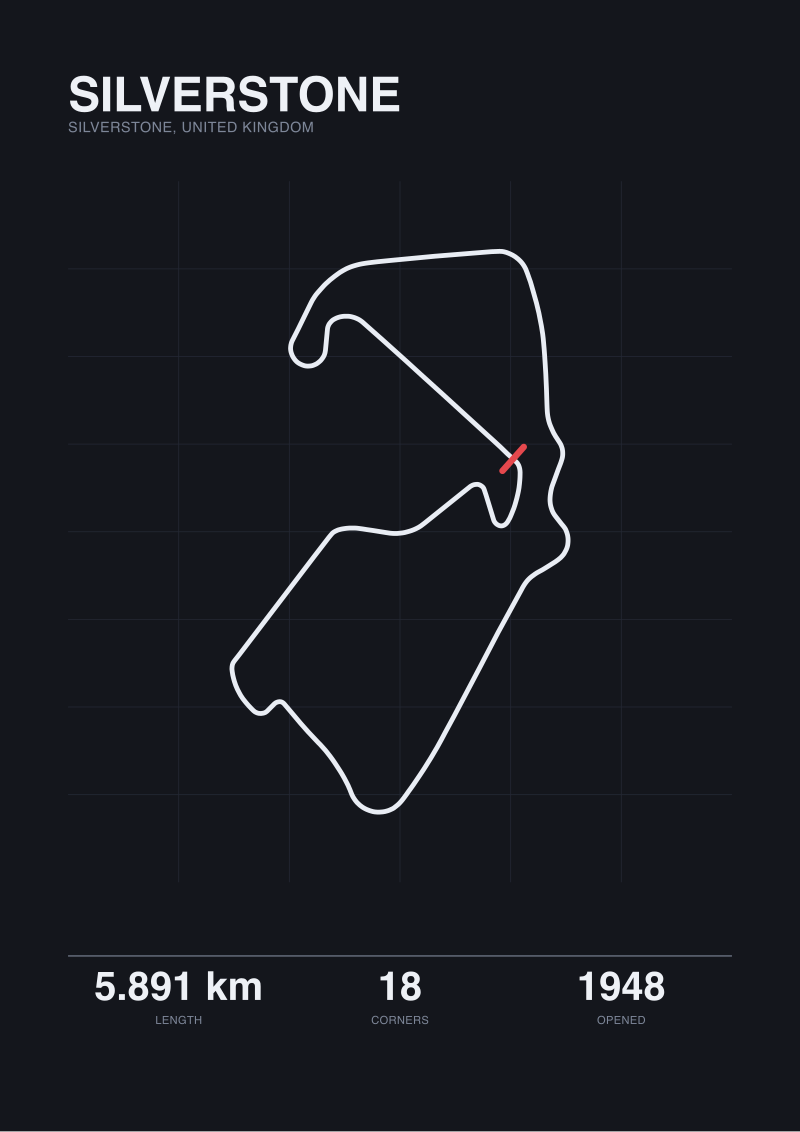 Silverstone
The print from this article · from €29.95
View the print →
Silverstone
The print from this article · from €29.95
View the print →
Why Radius Beats Distance: The Physics the Map Hides
The maximum speed a car can carry through a corner is set, at first order, by the equation v = √(μgR). Grip coefficient, gravitational acceleration, radius of the arc. Grip is a property of the tyre and the surface. Gravity is fixed. Radius is the only term the driver controls, and radius is chosen when the racing line is chosen.
Taking the inside kerb through a corner minimises the length of path. It also minimises the radius of the path, because the inside edge of a corner is, almost by definition, the tightest arc available. Under the square-root relationship above, shrinking the radius forces a proportional square-root reduction in maximum cornering speed. On a medium-radius corner with a long exit straight, that reduction lasts for the entire following straight. The metres saved on the inside kerb are given back, with interest, by every second of straight-line running at reduced entry velocity.
The wider arc — outside-inside-outside, in the textbook shorthand — is longer in metres than the inside line. It is also larger in radius, sometimes dramatically so. For a corner where the physical track radius is, say, forty metres at the inside edge, the racing-line radius can be sixty or more, depending on track width. The maximum cornering speed under our equation rises with the square root of that ratio: √(60/40) ≈ 1.22. Twenty-two per cent more speed through the corner. Two or three metres of extra path length. The trade is not close.
This is the calculation the map cannot show you. When you look at Silverstone on paper and see 5.891 kilometres, you are looking at the FIA-homologated length of the centre line of the circuit — the geometric middle of the tarmac. The map-traced 5.881 km we measured from OSM data is essentially the same line, taken from open cartographic geometry rather than survey documents. Neither figure describes the path a car actually takes on a fast lap. The racing line is longer than both, because the racing line spends most of the lap on the outside of the tarmac and only briefly touches the inside at apex points. The homologated length is a description of the object. The racing line is a description of the use.
Reading the Line at Spa, Silverstone and the Nordschleife
Three circuits, three geometric problems, three different answers to what the racing line looks like when you draw it.
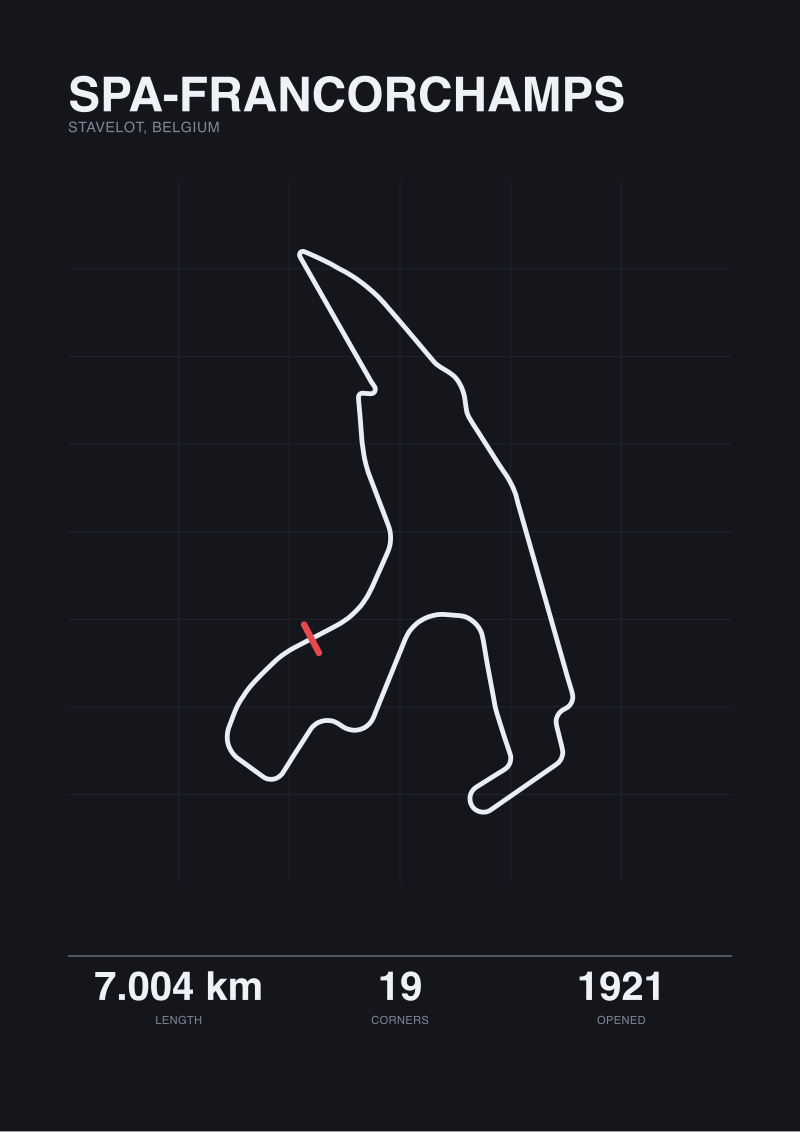
Spa's 6.995 km, seven kilometres in essence, contains nineteen turns spread thinly across a forest-and-hillside site outside Stavelot. Most of the lap is straight or near-straight. The corners are consequential precisely because they are few, and because several of them — Eau Rouge–Raidillon, Pouhon, Blanchimont — are taken flat or near-flat in modern machinery, which collapses the classic three-point line into something more like a single continuous compromise across a compound curve. On corners like these the "apex" is not a point on the inside kerb but a target on the exit, and the driver's real problem is not radius maximisation but gradient management: the track rises and falls under the car through the entire complex.
Silverstone is the opposite kind of geometry. 5.881 km traced, eighteen turns, laid out on a former airfield with generously wide tarmac and only mild elevation change. The line here is closer to the textbook because the physics is closer to two-dimensional. Copse, Stowe, Club, Vale — each is a medium-radius corner leading to a longer straight, which is exactly the geometry that most rewards the late-apex, outside-inside-outside line. The lap works if you get the exits right, and getting the exits right is a matter of radius selection at turn-in.
The Nordschleife breaks the framework. 20.746 km traced against the 20.832 km published length, 154 turns, opened in 1927 to a design philosophy that pre-dates modern racing geometry by decades. The line at the Nordschleife is not a sequence of applied three-point corners. It is a rolling compromise across curvature that never fully settles. Many "corners" on the 154-count are so shallow they function as radius adjustments to the straight itself; a handful are proper stand-alone corners with clear turn-in, apex and exit. The rest is negotiation. This is why the Nordschleife rewards memorisation over technique in a way permanent grand-prix circuits do not, and why the eighty-six-metre gap between its traced length and its published length is proportionally the smallest of our three cases — the layout is so long that no single measurement decision moves the total much, even when almost every metre of it is a curve.
Set the three side by side and the pattern is clear. Spa's racing line is dominated by elevation. Silverstone's is dominated by exit-radius optimisation. The Nordschleife's is dominated by memory. All three are the same underlying physics — v = √(μgR), applied thousands of times per lap — but the geometry of the site decides which term of the equation the driver spends the lap fighting.
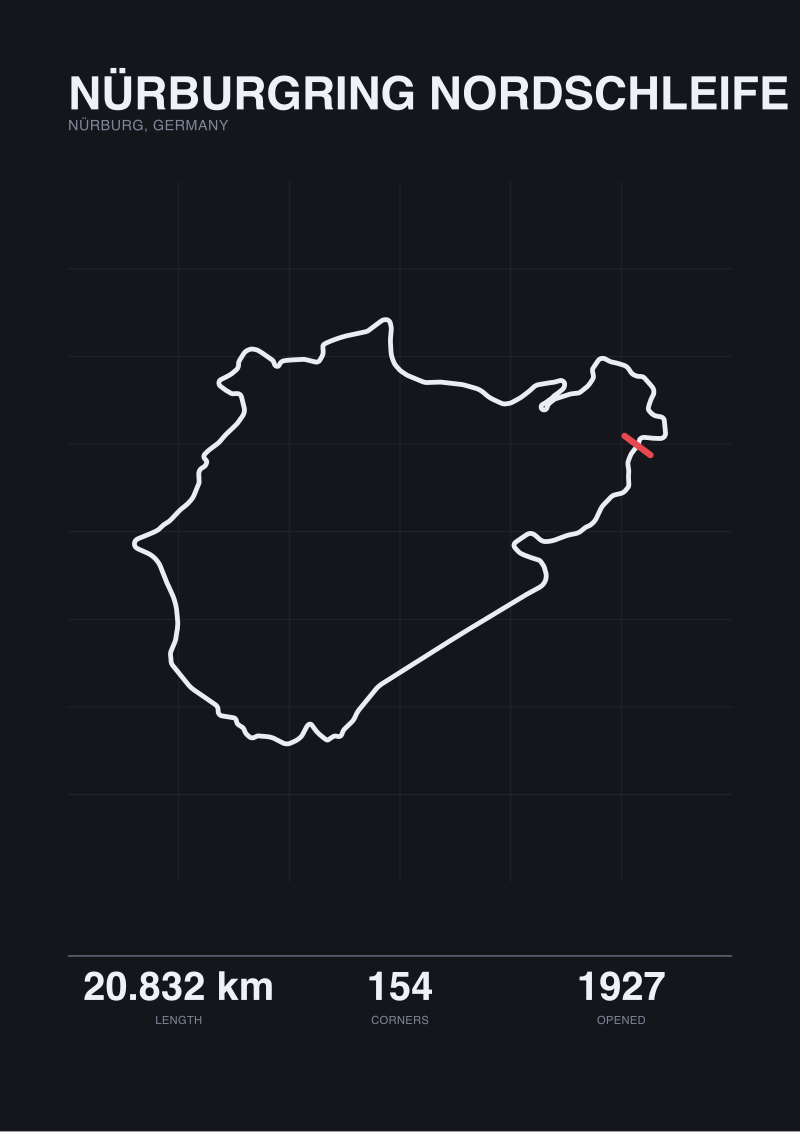 Nürburgring Nordschleife
The print from this article · from €29.95
View the print →
Nürburgring Nordschleife
The print from this article · from €29.95
View the print →
Where the Textbook Line Breaks Down
The outside-inside-outside line is not a law. It is the solution to a specific optimisation problem: single corner, uniform grip, constant conditions, one entry and one exit, no traffic. Real circuits satisfy those assumptions almost nowhere.
Where the textbook line breaks down first is at corner sequences. Maggotts–Becketts–Chapel at Silverstone is a compound where a late apex at Maggotts loads the car in the wrong direction for a good entry at Becketts. The optimal line through the sequence is not the concatenation of three individual optimal lines. It is a compromise that under-uses each corner in isolation to over-perform across the whole complex. The same applies to Spa's Les Combes triple and to almost every S-curve on the Nordschleife.
It breaks down again where the surface is not uniform. A patch of low-grip tarmac on the geometric ideal line forces the driver off it, sometimes for the entire corner. Kerb usage changes the effective radius by moving the inside edge outward. Wet weather redraws the map: the fastest wet line is often noticeably wider than the dry line because standing water accumulates on the dry racing line itself, where rubber has laid a low-friction film.
And it breaks down entirely in traffic. Overtaking requires giving up the ideal line, and defending requires giving it up first. In race conditions the racing line is a reference the driver deviates from deliberately, in exchange for track position or tyre life or a strategic gap. The textbook version of the line is what you drive when nothing is happening. The interesting version is what you drive when everything is.
The honest way to read a track map, then, is not to look for a single racing line drawn onto the tarmac. It is to see the tarmac as a field of possible lines, most of them slower than the ideal, some of them faster in specific conditions, and to understand that a driver's job is to select from that field in real time. The geometry sets the outer limit. The corner defines the physics. The line is the choice made under both.
That is the layer of the track that our studio traces from open map data before drawing it as a print. The prints, arranged by circuit at see the Silverstone print, show the object. This piece is about the use.
Which brings us to the question this article does not answer. We have described the racing line as geometry. We have not described it as psychology — as the sequence of decisions a driver makes under braking, under load, under someone else's mirror. The geometry sets the ceiling on what is possible through a corner. Everything above the tarmac is where the real work of racing begins, and that is not where this piece ends.
FAQ
Is the racing line always outside-inside-outside?
As a default, on an isolated corner opening onto a straight, yes — that geometry maximises corner radius and therefore corner speed under v = √(μgR). But the default is a starting point, not a rule. In corner sequences, on compound curves like Silverstone's Maggotts–Becketts–Chapel, and under changing grip conditions, the optimal line deviates from the textbook. The three-point line is the answer to a single-corner problem; most real corners are not single-corner problems.
Why do published circuit lengths and map-traced lengths disagree?
Published lengths are homologation figures, surveyed and lodged with the sanctioning body. Map-traced lengths, in our case, come from OpenStreetMap raceway geometry under ODbL. The two use different measurement bases — centre-line assumptions, survey precision, mapping tolerance — and the small residual gap is the difference between the two methods, not an error in either. Spa published is 7.004 km; our trace is 6.995. Silverstone published is 5.891; our trace is 5.881.
Does the Nordschleife really have 154 corners?
By the operator's own count, yes. That figure treats every distinguishable change of direction, however slight, as a corner. Under a stricter definition that only counts standalone corners with clear turn-in, apex and exit, the count would be much lower. The 154 figure is honest for a 20.746 km layout opened in 1927 and threaded through Eifel terrain; it also explains why racing-line theory developed on modern permanent circuits does not transfer cleanly to it.
What does "late apex" actually mean in metres?
It means the point of closest approach to the inside kerb sits after the geometric mid-point of the corner arc, sometimes by several metres. The exact offset depends on corner radius, exit-straight length, and the trade the driver is making between minimum speed and exit speed. On a Silverstone-type medium-radius corner opening onto a long straight, a deliberately late apex costs a small amount of minimum corner speed and pays back with a higher velocity carried down the following straight.
Why is the fastest wet line different from the dry line?
Because rubber laid down on the dry racing line by hundreds of cars forms a film that becomes especially low-friction when wet, and because standing water tends to collect exactly where the tarmac is smoothest — which is the dry line itself. The wet line is therefore drawn to the side of the dry line, using unrubbered tarmac that offers more mechanical grip. The geometry of the corner has not changed; the surface has.
Does the racing line matter in a race, or only in qualifying?
It matters in both, but differently. In qualifying, with no traffic, the driver's job is close to the pure single-corner optimisation problem, and the racing line is a target to hit precisely. In a race, the line is a reference to deviate from — for overtaking, for defending, for managing tyre life or fuel. Ignoring the line entirely costs lap time; following it slavishly in traffic costs positions. Race drivers spend most of a lap slightly off the ideal line by design.
How wide is the racing-line arc compared to the physical corner radius?
It depends on track width and corner geometry. On a corner where the physical inside radius is roughly forty metres and the tarmac is wide enough to permit a proper outside-inside-outside path, the effective racing-line radius can reach sixty metres or more. Under v = √(μgR), that ratio translates to roughly a 22 per cent higher maximum cornering speed. This is the calculation that makes the longer path faster and is the reason inside-kerb lines lose lap time.
From the collection
New circuits and 10% off your first print.
One email now with your code. No noise after.