How does a circuit that opened in 1948 end up with two of the most talked-about banked corners in modern single-seater racing? Zandvoort measures 4.259 kilometres by its published homologation and 4.253 kilometres when we trace it against OpenStreetMap raceway data — a six-metre discrepancy that hints at where the layout has been redrawn against its own footprint. Fourteen turns, two of them now banked steeply enough to change how the car loads its tyres through the apex rather than fight lateral grip laterally. The banking was not a stylistic decision. It was the answer to a question the circuit had been asking since the sport walked away from it in 1985.
1948: A Dune-Sided Circuit Opens Between the North Sea and the Village
The site was not chosen by a designer with a clean sheet. The circuit was traced along wartime service roads laid through the dunes on the seaward edge of the Dutch village of Zandvoort, and the first race was held there in 1948. The layout inherited from those service roads is why the modern track still bends the way it does — the topography was set before the racing was, and the racing had to negotiate with it.
That inheritance produced a circuit with two qualities that would define its next seven decades. First, the elevation change was real. The dunes rise and fall along the western flank of the layout, and a lap of Zandvoort climbs and drops in a way that most flat coastal circuits do not. Second, the corner sequences ran in a rhythm that favoured cars that could rotate on entry — sweeping right-handers that opened onto short straights, then folded back on themselves. The named corners on the original layout, Tarzan chief among them, entered racing vocabulary because they rewarded a specific kind of commitment on turn-in.
None of this was banked in any meaningful sense. The original Zandvoort was a road-course layout with camber that followed the drainage requirements of the terrain rather than any deliberate loading of the tyre. The 4.259 kilometres of the modern published length is close to, but not identical to, the length the 1948 circuit ran. The lineage is direct. The measurements are not.
1985: Formula 1 Leaves Zandvoort, and the Layout Stops Evolving for Modern Cars
The last Formula 1 Dutch Grand Prix of the twentieth century was run at Zandvoort in 1985. The reasons for the sport's departure were financial and political — a combination of local objections to noise, a struggling promoter, and a Formula 1 commercial machine that was already consolidating around larger venues. What matters for the geometry is what happened next: the circuit did not stand still, but it also did not grow into the era of ground-effect single-seaters that came after it.
Through the late 1980s and 1990s, Zandvoort was shortened. Sections of the outer loop were removed. The track became a club and touring-car venue, hosting national series and endurance events that did not stress the layout the way Formula 1 would. When the circuit was restored to a length close to its original in the late 1990s and 2000s, the restoration was faithful to the historic footprint rather than adaptive to the cars that had appeared in the intervening decades.
This is the design problem the circuit carried into the 2010s. The corner sequences that had produced good racing in 1975 — where cars still slid, where drivers could carry differential lines through a sweeper — were the same sequences, unchanged in radius or camber. The cars had changed profoundly. Aerodynamic performance now depended on staying planted, and staying planted meant that following another car through a fast right-hander became a matter of losing downforce in dirty air. Overtaking opportunities that had existed in an earlier era had been engineered out of the sport, not out of the track.
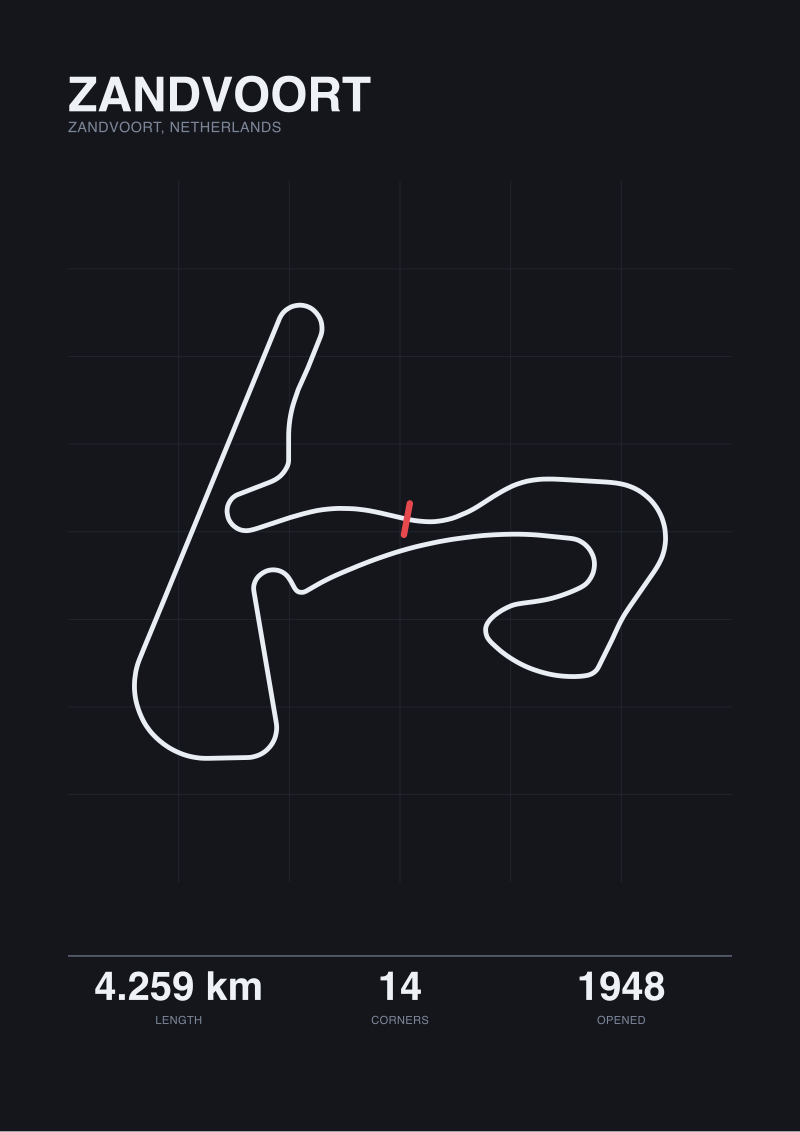 Zandvoort
The print from this article · from €29.95
View the print →
Zandvoort
The print from this article · from €29.95
View the print →
May 2019: The Dutch Grand Prix Is Announced — With a Geometry Problem Attached
On 14 May 2019, the return of the Dutch Grand Prix to Zandvoort was formally announced, with the first race scheduled for the 2020 season. The commercial case had been building for two years around a Dutch driver whose championship results had made a home race economically viable for the first time since the sport left. The sporting case was more complicated. Formula 1 in 2019 was in the middle of a public conversation about overtaking difficulty, dirty-air sensitivity, and the tendency of processional races to occur on circuits with medium-speed sweepers and few heavy braking zones. Zandvoort, in its 2019 form, was exactly such a circuit.
The organisers had a homologation problem and a racing-quality problem at once. The homologation problem was that FIA Grade 1 required specific run-off geometry and barrier treatments that the historic layout did not meet in several places. The racing-quality problem was that even if the layout were homologated as it stood, the on-track product would risk being the kind of race that reinforced every complaint being made about the sport's ability to entertain.
The published length in the 2019 documentation was 4.259 kilometres. Our own trace against OpenStreetMap raceway data reads 4.253 kilometres — the two numbers agree to within six metres, which is what you would expect from a survey based on centerline geometry versus a survey based on drainage-line polylines. What the numbers do not tell you is what needed to change inside that length. The circuit did not need to be longer. It needed corners that would let two cars run different lines at the same time.
2020: Dromo Redraws Hugenholtz and the Final Turn as Banked Corners
The commission for the redesign went to Dromo, the Italian circuit design firm led by Jarno Zaffelli, and the intervention was targeted rather than sweeping. The historic layout was preserved. Two corners were rebuilt with substantial banking. This was the design decision that made the return viable, and it is the reason "banked corners at Zandvoort" is now a recognisable phrase in racing.
The first rebuilt corner was Hugenholtz, the tight right-hander at Turn 3 that follows the descent from Tarzan. In its rebuilt form the corner is banked at approximately 19 degrees. The second was the final turn, the Arie Luyendyk bocht, which sweeps onto the pit straight and was rebuilt at approximately 18 degrees of banking. Both figures put Zandvoort's banking beyond anything on a permanent road-course circuit in Europe — closer, in geometry terms, to the banked oval turns familiar from American speedway racing than to the mild banking of Estoril or the Nordschleife's Karussell.
The engineering purpose was specific. On a flat corner, lateral grip and the tyre's contact patch are in direct competition — the car generates cornering force by asking the tyre to work sideways. On a banked corner, some of the cornering load is converted into vertical load on the tyre, which the tyre handles more efficiently. The practical consequence is that cars can carry more speed through the apex without asking the tyre for more sideways work, which in turn means a following car does not lose its aerodynamic platform in the same way. The banking, put plainly, buys the trailing car a chance to stay close enough to attempt an overtake into the next braking zone. That was the geometry the circuit needed and had never had.
September 2021: The First Grand Prix on the New Banking
The 2020 race was cancelled because of the pandemic, and the first Formula 1 Grand Prix on the rebuilt layout was run on 5 September 2021. What the paddock saw that weekend was a circuit that behaved differently from any road course previously on the calendar. Cars were reaching the apex of the Arie Luyendyk bocht with speeds that made the exit onto the pit straight a genuinely long acceleration event, and the entry into Hugenholtz was rewarding drivers who could commit early to the descending line off Tarzan.
The racing that emerged was not a solved problem. Overtaking at Zandvoort remained hard by the standards of a modern permanent circuit, because the layout is short, narrow, and the sequences between the banked corners remain the same technical sweepers they were in 1985. What the banking did was change the character of the following car through the two rebuilt corners specifically. A car in dirty air could hold on through Hugenholtz in a way it could not through a flat corner of comparable radius, and the exit onto the pit straight from Turn 14 opened a slipstream window that had not existed in the previous geometry.
The six-metre gap between our traced 4.253 kilometres and the published 4.259 kilometres becomes intelligible in this context. Rebuilding two corners with banking of the profiles described here changes the racing line, and the racing line is what a homologation length measures. The map data reflects the physical footprint of the tarmac. The published length reflects the line a car is expected to take through it. Both are correct. They are answering different questions.
What It All Means
Zandvoort's banking is a case study in what circuit design can and cannot do. It cannot make a short, narrow circuit into a long, wide one. It cannot reverse the aerodynamic realities that make modern single-seaters difficult to follow through medium-speed sweepers. What it can do — what Dromo's intervention actually did — is address a specific failure mode at two specific corners by changing the way vertical and lateral load are distributed on the tyre through the apex.
That is a smaller claim than the marketing around the 2021 return suggested. It is also a more interesting one. The banking at Hugenholtz and the Arie Luyendyk bocht is not there to make Zandvoort dramatic. It is there because the alternative was a circuit that would have produced processional races on a schedule that could not afford them. The geometry solves a commercial problem by solving an aerodynamic one, and it does both by asking the tyre to do less work sideways and more work downward.
The lesson generalises. When a historic circuit returns to a series that has moved on without it, the question is not whether to preserve the layout. The question is which specific corners are failing in the modern context, and whether banking, camber, or radius changes can be applied narrowly enough that the character of the circuit survives the intervention. Zandvoort in 2021 is the argument that the answer can be yes. The circuit that opened in 1948 is still there, in its footprint and in most of its corners. What changed is the two turns where the geometry had to change for the racing to work.
FAQ
How steep is the banking at Zandvoort's Hugenholtz corner?
The Turn 3 Hugenholtz corner was rebuilt by Dromo in 2020 with banking of approximately 19 degrees. That figure places it well beyond the banking on any other permanent road-course circuit currently on the Formula 1 calendar and closer in profile to the banked turns of American oval racing. The steep angle converts a portion of the cornering load into vertical load on the tyre rather than lateral load, which is the specific mechanism that lets the car carry more apex speed.
What is the banking angle of Zandvoort's final turn?
The final turn — officially named the Arie Luyendyk bocht after the Dutch racing driver — is banked at approximately 18 degrees in its rebuilt form. It sweeps onto the pit straight and was reprofiled specifically to allow a trailing car to carry speed through the exit and open a slipstream window down the following straight. The geometry addresses one of the reasons overtaking had become nearly impossible on the pre-2020 layout.
Why does Zandvoort have banked corners in the first place?
The banking was added by circuit designer Dromo, led by Jarno Zaffelli, when the circuit was rebuilt ahead of the Dutch Grand Prix return. The purpose was engineering rather than aesthetic. Formula 1 cars in the late 2010s were highly sensitive to dirty air through medium-speed corners, and the historic Zandvoort layout offered few overtaking opportunities. Banking at two key corners lets following cars maintain grip and stay close enough to attempt a move.
When did banking get added to Zandvoort?
The rebuild took place in 2020 in preparation for the return of the Dutch Grand Prix, which had been formally announced in May 2019. The first race on the reprofiled layout was originally scheduled for 2020 but was cancelled due to the pandemic, so the banking made its Formula 1 debut on 5 September 2021. The rest of the circuit's historic footprint, including corners such as Tarzan, was preserved.
How long is the modern Zandvoort circuit?
The published homologation length is 4.259 kilometres. When we trace the circuit against OpenStreetMap raceway data, we measure 4.253 kilometres — a six-metre difference that reflects the distinction between the physical tarmac footprint and the expected racing line through it. Both numbers are correct answers to different questions. The homologated figure is the one used for official session data such as lap distances and pit-lane calculations.
How many corners does Zandvoort have?
The current layout has 14 numbered turns, of which two are the steeply banked corners rebuilt in 2020 — Turn 3 (Hugenholtz) and Turn 14 (Arie Luyendyk bocht). The remaining twelve corners retain the character of the historic circuit as it evolved through its post-war life. The relatively low corner count for the 4.259-kilometre length is one reason the layout produces the fast average speeds that made addressing overtaking through geometry so necessary.
Was Zandvoort's original 1948 layout also banked?
No. The 1948 circuit was traced along wartime service roads through the dunes, and its camber followed the drainage needs of the terrain rather than any deliberate design intent to load the tyre vertically. Any banking on the historic layout was incidental. The steep, engineered banking at Hugenholtz and the final turn is entirely a product of the 2020 Dromo rebuild and did not exist in any earlier iteration of the circuit.
From the collection
New circuits and 10% off your first print.
One email now with your code. No noise after.