The Nürburgring Nordschleife, as homologation documents list it, is 20.832 kilometres long and contains 154 turns. On many afternoons, a visitor can hand over a card at the public-access barrier, buy a single lap, and drive all 20.832 of them. That is not a track day. There is no instructor, no helmet rule beyond the obvious, no corporate wrapper around the experience. The circuit becomes, for the duration of one lap, a toll road priced by distance. If every great track worked that way, this piece would be shorter. None of the other three in our grounding do. Four circuits, four different answers to the same question.
What the Numbers Actually Say
Our grounding sheet names four circuits, each with a published length, a map-traced length, a turn count where available, and an opening year. Those numbers are the receipt. Read them in order.
Nordschleife: 20.832 km official, 20.746 km traced from OpenStreetMap raceway data, 154 turns, opened in 1927. The gap between official and traced — 86 metres — is the usual signature of how homologation documents compute length (survey-grade, measured along a specific line) versus how we trace it from map geometry. The circuit has existed, in some form of its current configuration, for ninety-nine years. It sits near Nürburg, in the Eifel. The access model, as a matter of broadly established public record, is Touristenfahrten: paid, timed sessions during which the loop is operated as a public toll road rather than a competition venue. A driver with a road-legal vehicle and the posted ticket can enter.
Circuit de la Sarthe: 13.626 km official. Our map-traced figure in the grounding is 0.793 km, which is not the full lap — that discrepancy is itself the story. The traced data corresponds to the portion of the circuit that OpenStreetMap classifies as dedicated raceway. The rest of La Sarthe is not classified as raceway because, for most of the year, it is not. The Mulsanne straight and the sections that run through Les Hunaudières are the D338 and other départementale roads under the ordinary jurisdiction of the French road authority. They are tarmac. They are open. They are also where regular French drivers go to the supermarket.
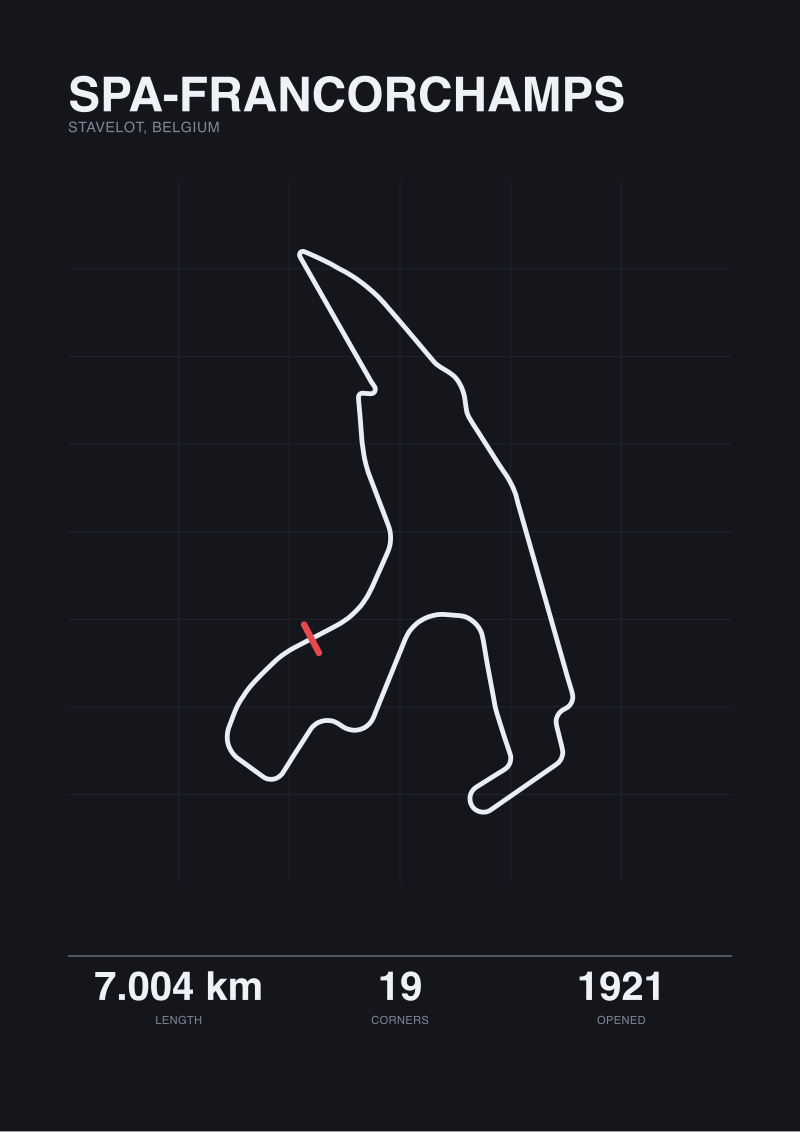
Spa-Francorchamps: 7.004 km official, 6.995 km traced, 19 turns, opened in 1921. A nine-metre gap between measurement methods, a hundred and five years of history, situated at Stavelot. Spa is a permanent circuit in the strict sense — purpose-built asphalt that is not shared with road traffic. Public access, where it exists, is scheduled: organised sessions, structured conditions, a published calendar.
Silverstone: 5.891 km official, 5.881 km traced, 18 turns, opened in 1948. The newest of the four by two decades. A ten-metre gap between the two length figures. Also permanent, also purpose-built, also not a road.
Four circuits. Two of them opened before the Second World War, one between the wars, one after. One of them is a toll road for a few hours most days. One of them is a public highway for most of the year. Two of them are closed to private use except through structured programmes.
What Nobody Mentions
The phrase "open to the public" collapses four very different legal and practical realities into one. The Nordschleife version is the version most readers imagine: a barrier, a ticket, a lap. It is also the atypical case. The reason the Nordschleife works this way at all is historical. When the circuit opened in 1927, the Eifel region accepted its construction partly on the understanding that it would function as a public road during periods of non-competition — a toll road, yes, but a public one. That nineteen-twenties legal compromise is why 2026 visitors can drive the Green Hell at all. Remove the 1927 arrangement and no modern planning authority would ever permit a 20.832-kilometre, 154-turn public toll road through a forested nature district. The access is a historical artefact that has survived into the present because nobody has had the political interest in killing it.
La Sarthe is the inverse. The circuit is not public because of a compromise — it is public because, for most days of the year, it simply is the road network. The racing configuration overlays the ordinary road grid for one weekend each June (and a handful of test days). The rest of the year, drivers on the D338 between the Tertre Rouge junction and Mulsanne are not accessing a circuit. They are driving on a départementale that happens to form, when closed to civilian traffic and equipped with safety furniture, part of the longest circuit in top-flight motorsport. The Dunlop Curve, the Porsche Curves and the pit complex — these sit on dedicated raceway. The straights do not. This is why our map trace returns 0.793 km rather than 13.626 km: OpenStreetMap tags the pit-and-complex section as raceway and the Mulsanne as public highway, which is correct.
Spa and Silverstone sit in the third category. Both are permanent circuits with no public-road component and no Nordschleife-style tourist-driving tradition. Both operate access programmes — organised sessions on published calendars, usually requiring prior booking, usually in a controlled format. Neither is a case of handing over cash at a barrier. The structural difference matters: the Nordschleife's model is paid access to a venue that is temporarily a road; Spa and Silverstone's models are scheduled access to a venue that is temporarily yours. The paperwork, the pre-briefing and the vehicle requirements all follow from that distinction.
The thing that collapses in a casual answer to "are tracks open to the public" is this spectrum. Four circuits, four categories. The honest answer requires naming which one you mean.
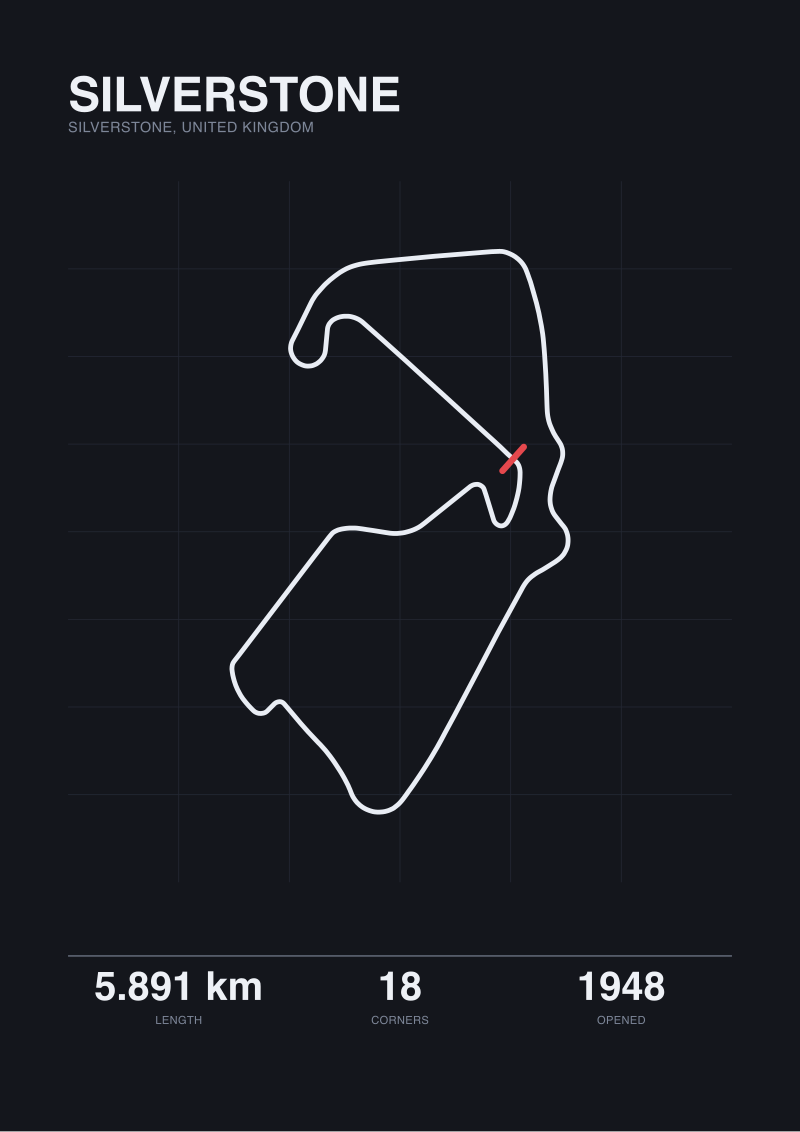 Silverstone
The print from this article · from €29.95
View the print →
Silverstone
The print from this article · from €29.95
View the print →
The Real Cost
If "cost" means the ticket price, we do not know the current figure for any of the four circuits, and we are not going to invent one. Prices for Nordschleife Touristenfahrten laps, Spa and Silverstone experience programmes, and the various informal costs of simply driving the D338 at the French speed limit all move season to season. What our grounding tells us is not the fee but the distance — and distance is what sets the real cost structure.
The Nordschleife is 20.832 kilometres per lap. A visitor is buying, in essence, twenty kilometres of exposure to one of the most consequential pieces of road in Europe. The 154-turn count is the second half of that calculation. Over 20.832 km, that averages a corner every 135 metres — a density that leaves almost no straight-line recovery between events. The real cost of a Nordschleife lap is not the ticket. It is the fact that any mechanical or driving error occurs twenty kilometres from the exit gate, on a surface where the next vehicle may be anything from a slow saloon to a scheduled industry test. Insurance for the Nordschleife is a specialist product precisely because of that geometry. The circuit's length is not the attraction's generosity; it is also the exposure.
Spa's 7.004 km and 19 turns describe a different cost profile. The lap is a third of the Nordschleife's length, with far fewer corners, but the corners are faster and the geometry less forgiving in a specific way: between Les Combes, Pouhon and Blanchimont, Spa punishes misjudgement at speeds where road-car tyres are already past the shoulder of their performance envelope. A session on Spa is cheaper per minute of concentration than a Nordschleife lap, but denser.
Silverstone's 5.891 km and 18 turns put the circuit on roughly the same scale as Spa, but the geometry is flatter and the escape runs are generally more generous. The real cost at Silverstone — again, not the fee — is time: because access is structured, the operational overhead of attending a session is higher than the overhead of handing a card to a barrier operator.
La Sarthe is the one circuit where the real cost of "driving" it is zero and the real cost of experiencing it is total. Driving the D338 at the posted speed limit is free and legal and tells you nothing. Experiencing the Mulsanne as a circuit — which is to say, closed, cleared, instrumented — is not something a member of the public buys. It is something a race entry buys, through a different process entirely. The circuit is open to the public in the most literal sense and closed to the public in the most meaningful one.
If You Only Remember One Thing
The phrase "open to the public" is doing more work than it should. It covers a 1927 toll-road exception at Nürburg, a départementale that is a circuit for one weekend of the year at Le Mans, and two permanent venues at Stavelot and Silverstone whose access is bookable but not casual.
Of the four circuits in our grounding, exactly one — the Nordschleife — lets a private driver pay a per-lap fee and drive the full homologated layout under something resembling ordinary road conditions. One — Sarthe — can be legally driven on its public-road sections every day of the year, but what you are driving is not the circuit, it is the road underneath it. And two — Spa and Silverstone — have access, but on their own terms and their own calendar. If you want to drive one of them, pick the one, and let the geometry of that circuit, not the ambiguity of the phrase, decide what you are buying.
---
If you want the shape of these layouts to live somewhere other than a browser tab, our studio draws each of them from the same map geometry we trace in these pieces, available at /shop/.
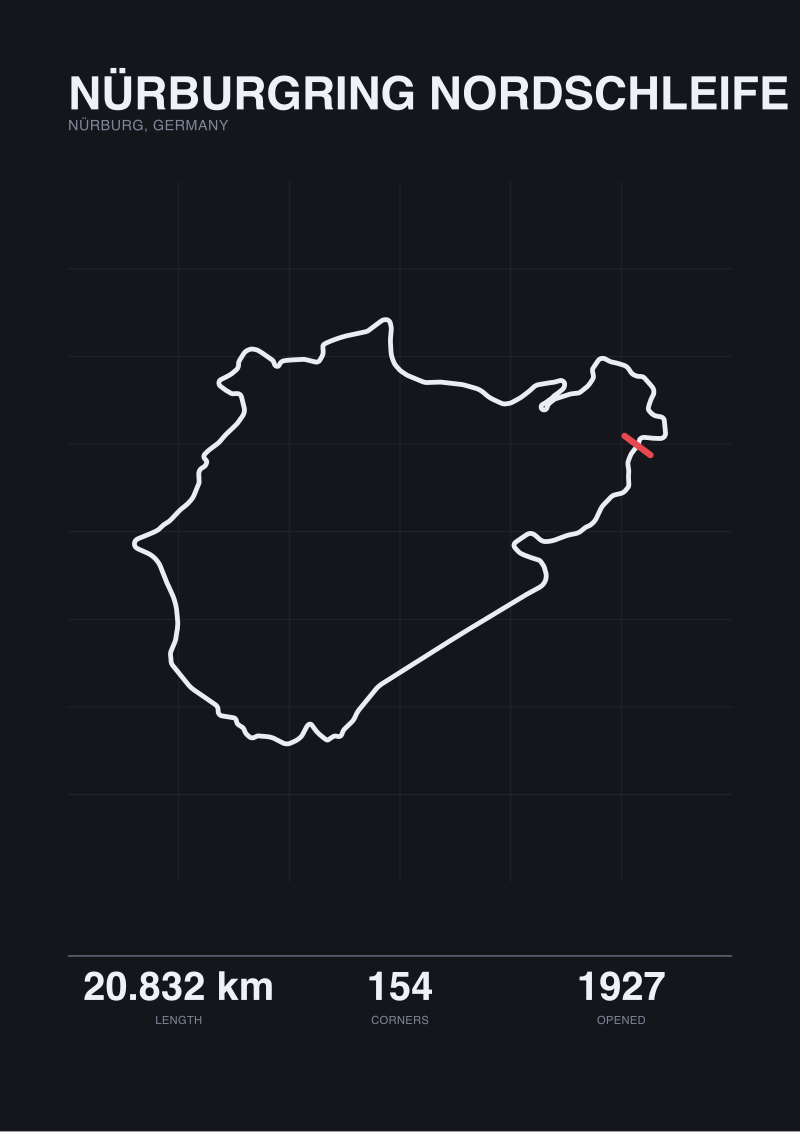 Nürburgring Nordschleife
The print from this article · from €29.95
View the print →
Nürburgring Nordschleife
The print from this article · from €29.95
View the print →
FAQ
Can anyone drive the Nordschleife without special qualifications?
During Touristenfahrten sessions, access is open to drivers holding a valid road licence and operating a road-legal vehicle that meets the circuit's published rules. There is no formal instructor requirement and no competition licence check. What that permissiveness buys you is a 20.832-kilometre loop with 154 turns and mixed traffic — which is a different kind of difficulty than a controlled track day, and the reason most first-time visitors are over-matched by the circuit rather than the paperwork.
Is the Le Mans circuit really a public road?
Yes, but only in part. Our map trace shows 0.793 km of dedicated raceway inside a 13.626 km official lap. The remainder — including the Mulsanne straight along the D338 — is ordinary French départementale under the normal road code. For most of the year those sections are regulated at road-legal speeds like any other rural highway. The race-only configuration exists for one weekend of competition and the surrounding test days.
Why does the Nordschleife's official length differ from map data?
The grounding gives 20.832 km from Wikipedia / Nürburgring Nordschleife as the official figure, and 20.746 km from our OpenStreetMap raceway trace. The 86-metre gap is characteristic: homologation documents measure along a surveyed racing line with instruments calibrated to the governing body's rules, while map traces follow the centreline of the mapped carriageway. Neither number is wrong. They answer two different questions about the same loop.
Can the public drive at Spa-Francorchamps?
Spa, at Stavelot in Belgium, is a permanent 7.004 km circuit with 19 turns, opened in 1921. It is not a public road and there is no equivalent of the Nordschleife's barrier-and-ticket model. Access for private drivers exists through scheduled programmes on the circuit's own calendar — organised sessions, usually with prior booking and defined conditions. In practical terms, you can drive Spa, but you plan it in advance rather than deciding on the morning.
What about Silverstone?
Silverstone, opened in 1948 in the United Kingdom, measures 5.891 km over 18 turns and is also a purpose-built permanent circuit without public-road sections. Private driving on the full layout happens through organised experience programmes rather than casual admission. The operational posture is closer to Spa than to the Nordschleife: structured, calendared, booking-based access rather than show-up-and-pay.
Does a map-traced length ever match the official length exactly?
Rarely. Across the four circuits in our grounding, the gap between official and traced lengths ranges from 9 metres at Spa to 86 metres at the Nordschleife, plus the much larger gap at Sarthe caused by partial-raceway classification rather than measurement drift. Different data sources, different survey methods, and sometimes different reference lines produce different kilometre totals. The honest practice is to name which figure you are using and why.
Is driving the Nordschleife on a Touristenfahrten lap the same as a race?
No. The sessions share a physical circuit — the full 20.832 km, 154-turn loop — but almost nothing else. During public access the circuit operates under modified rules closer to a toll road than a competition venue, with mixed vehicles, no formal timing of your lap on the official clock, and the normal expectation of road-vehicle behaviour. A race entry is a wholly separate process with licensing, scrutineering and competition formats that are not available to a casual visitor.
Are there great circuits beyond these four that work like the Nordschleife?
A handful. The Nordschleife's model — a long permanent loop operated as paid public access during defined sessions — is unusual in top-tier motorsport, and the four circuits in our grounding each represent a different access pattern rather than variants of one. Characterising other circuits outside our grounding is beyond this piece; the honest answer is that the Nordschleife is less a template than an exception that has survived because of its particular interwar origins.
From the collection
New circuits and 10% off your first print.
One email now with your code. No noise after.