There is a pattern we keep seeing on studio walls and in client briefs: a race course poster is treated as a silhouette exercise, not a drawing. The layout is stripped to a ribbon, sized for a frame, and captioned with a name and a year. Nothing on the sheet answers the questions a circuit actually poses — where the length figure came from, why Spa-Francorchamps traces at 6.995 km when its homologation says 7.004, why the Nordschleife's 154 turns is a claim about counting method as much as geometry. Before we draw, we read; this piece is about what that reading changes.
The Silhouette Trap: Why Most Race Course Posters Read as Decoration, Not Drawing
The pattern is easy to describe: strip the circuit to a black outline on a coloured field, add the name in a sans-serif face, add the year of the opening lap or the year of a memorable race, and print. The result reads at four metres as a decorative object. It stops reading at closer distances because there is nothing else on the sheet to read.
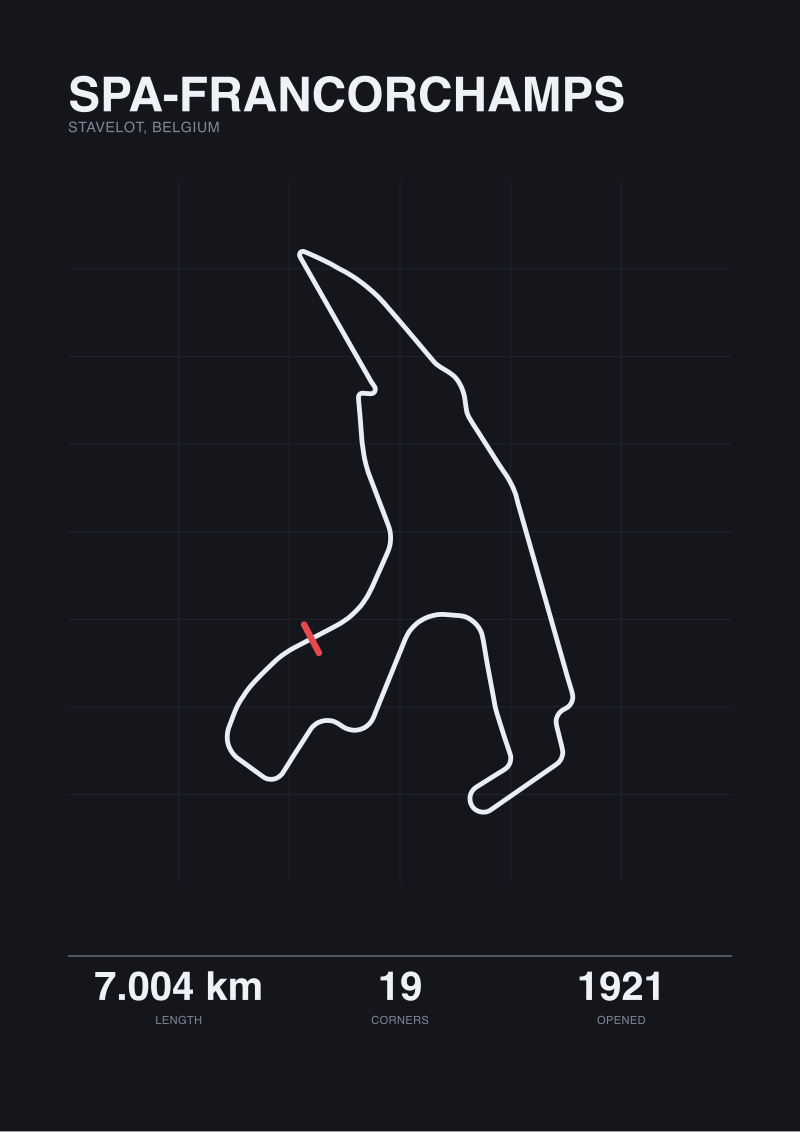
We keep the outline; the outline is not the problem. The problem is that a circuit is not a shape — it is a set of decisions made against a landscape, and the shape is the residue of those decisions. Spa-Francorchamps as a silhouette is a lopsided rectangle with two long straights and a knuckle in the top-left corner. Spa-Francorchamps as a drawing shows the knuckle is the Eau Rouge–Raidillon complex, that the top edge is the Kemmel straight running uphill through the forest above Stavelot, that the return leg cuts back down through Pouhon and Blanchimont at a gradient the silhouette hides completely. The silhouette lies by omission. The drawing tells the truth by inclusion.
The commercial pressure runs the other way. Silhouette posters are cheap to produce, easy to license, and print well at any size because they contain almost no data. The trade is legibility from across a room in exchange for meaning at reading distance. That trade might be fair for a graphic-design object; it is not fair for a circuit print, because the buyer who wants a circuit on their wall almost always wants it for reasons the silhouette cannot honour. They walked Eau Rouge. They watched a stint at Arnage. They cycled a lap of the Nordschleife on a Touristenfahrten Sunday. The silhouette gives them back the outline of the memory and nothing of the terrain it happened on.
The fix is not more decoration. The fix is what any studio drafting a technical plate would do first: name the source, name the metric, name the measurement basis. That is the ground on which the rest of the sheet stands.
The Measurement Problem: When 20.832 km and 20.746 km Describe the Same Track
Every circuit worth printing has two lengths. There is the official published length, which is the number the sanctioning body attaches to the venue for the purposes of homologation, timing and record keeping. And there is the map-traced length, which is what you get when you take the raceway centreline from open geographic data — in our case OpenStreetMap under the ODbL licence — and measure its arc from start-finish around and back to start-finish.
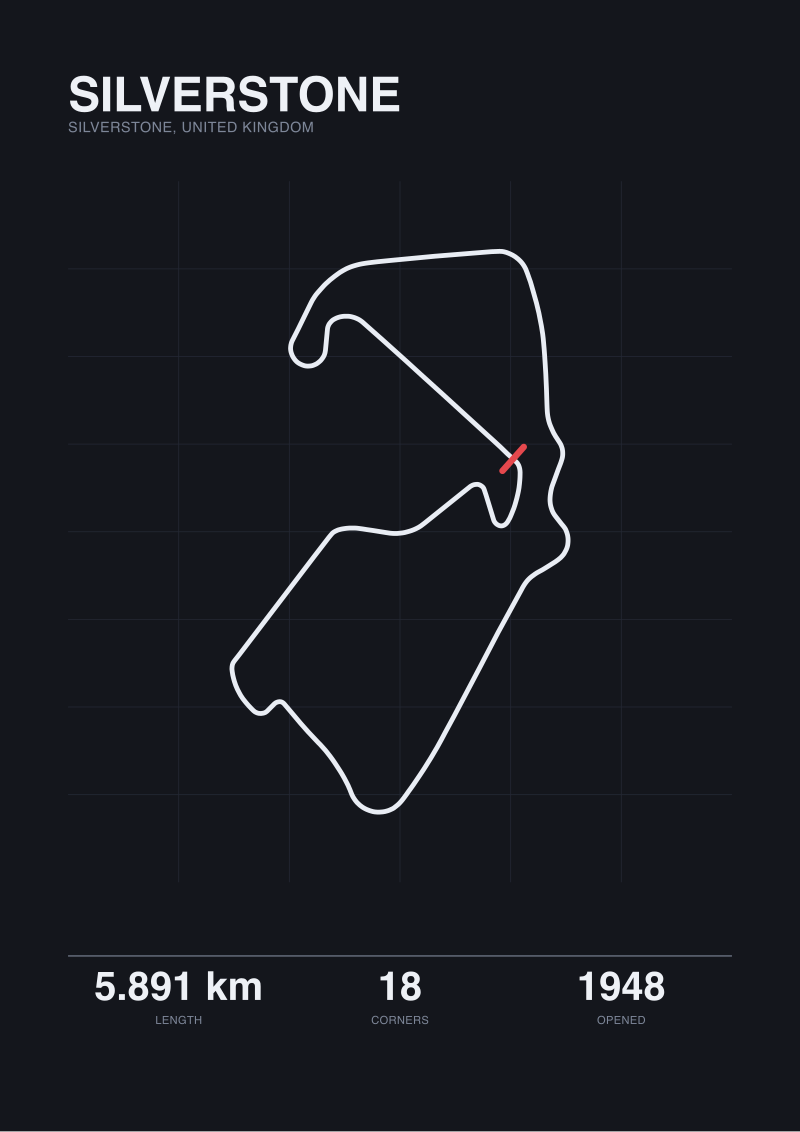
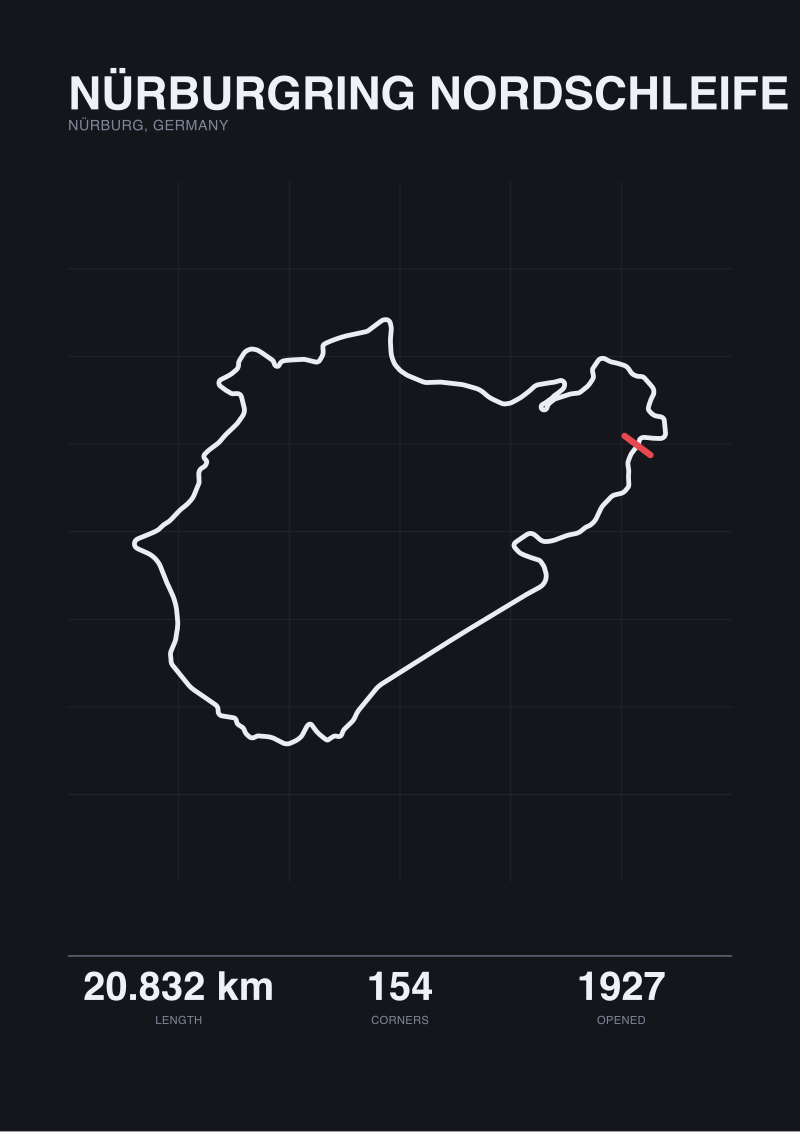
The two numbers disagree in ways that are consistent enough to be a pattern rather than an error. Silverstone publishes 5.891 km; our trace comes out at 5.881 km. Spa-Francorchamps publishes 7.004 km; our trace reads 6.995 km. Nürburgring Nordschleife publishes 20.832 km; our trace reads 20.746 km. In every case the traced number is slightly shorter than the official one, and the delta grows with track length: ten metres at Silverstone, nine at Spa, eighty-six over the twenty-one kilometres of the Nordschleife. This is not a scandal. It is the difference between a line drawn along a road on a map and a line surveyed along the racing line, kerb geometry and pit-entry conventions of the actual circuit.
A circuit print that does not tell you which of its two lengths you are looking at is showing you a shape and calling it a measurement.
The Circuit de la Sarthe is where the pattern breaks in a way worth naming out loud. Its official length is 13.626 km. Its map-traced length in our current OSM extract comes out at 0.793 km — which is not a shorter Le Mans but an incomplete raceway tag in the open data, because Sarthe borrows public roads that are only closed and re-tagged for one week a year. The honest response is not to publish 0.793 km as if it meant anything. The honest response is to say: for Sarthe, we cannot ground the length in our traced geometry the way we can for Spa or the Nordschleife, and we treat the official 13.626 km as the number the sheet is built around.
This is what we mean when we say a race course poster should carry a legend. The legend is not decoration; it is the two-line disclosure of which number the drawing is scaled from, and where the geometry underneath it came from. Anything less asks the buyer to take the shape on faith, which is precisely the kind of unearned authority that made silhouette posters feel thin in the first place.
 Silverstone
The print from this article · from €29.95
View the print →
Silverstone
The print from this article · from €29.95
View the print →
The Corner-Count Illusion: What 154 Turns and 18 Turns Have in Common
The turn count is the second number that gets casually printed on race course posters, and it is the number that most rewards a reading. Silverstone is homologated at 18 turns. Spa-Francorchamps at 19. The Nürburgring Nordschleife at 154. To a buyer glancing at the sheet, the implication is that the Nordschleife has roughly eight and a half times as many corners as Silverstone. That is not what the numbers are telling you.
The three counts are made against different definitions. A modern permanent circuit is numbered by its sanctioning body, and each numbered corner is a distinct decision the driver makes — brake, downshift, apex, unwind. Silverstone's 18 corners map to 18 named or numbered turns on the FIA circuit diagram: Abbey, Farm, Village, The Loop, Aintree, Wellington Straight, Brooklands, Luffield, Copse, Maggotts, Becketts, Chapel, Hangar Straight, Stowe, Vale, Club, and the transitions between them. Spa's 19 corners work the same way; the number tracks the driver's workload lap by lap, which is why it stays stable across decades even as run-off is redesigned around it.
The Nordschleife's 154 is a different accounting entirely. Opened in 1927 and left substantially in its original alignment, the 20.832 km lap threads through the Eifel landscape following contours that were never smoothed into a corner-count-friendly geometry. The 154 figure is a count of every direction change tight enough to name — Hatzenbach's succession of flicks, Wehrseifen's plunge, the Karussell's banked concrete, the Foxhole, the Karussell again — and it holds up because there is no shorter honest number. If you counted Silverstone by that same standard, treating each kerb-to-kerb direction change as a turn, you would get closer to thirty. If you counted the Nordschleife by Silverstone's standard, treating only the classroom-braking-zone corners as turns, you would get closer to seventy.
The number on the poster, in other words, is a claim about counting method as much as it is a claim about geometry. A print worth framing puts the two next to each other: the official homologated count, and where relevant a note that the count reflects a specific accounting convention. It stops treating "154" and "18" as scalars on the same axis. It treats them as what they are, which is two ways of describing what a driver's hands and feet actually do in a lap.
The Provenance Pattern: Why Source Data Is the Only Honest Legend
The pattern that ties the first three together is provenance. Silhouette posters carry no provenance because they carry no data — the outline is not sourced from anything except a designer's eye tracing over a satellite image. The moment a print starts to carry measurements, it inherits a responsibility to say where the measurements came from.
Our own convention, when we plate a circuit, is a two-source legend at the foot of the drawing. The first source is the statistical one — for Spa-Francorchamps that is the Wikipedia article on Circuit de Spa-Francorchamps, which is where the 7.004 km homologated length, the 19 turns and the 1921 opening year all come from; for Silverstone it is the Wikipedia Silverstone Circuit article, and for the Nürburgring Nordschleife it is the Wikipedia Nürburgring Nordschleife article. These are the numbers a scrutineer would recognise. The second source is the geometric one — the raceway centreline pulled from OpenStreetMap under the Open Database Licence, which is where the traced 6.995 km, 5.881 km and 20.746 km figures come from. Those are the numbers our drafting table produced.
Putting both on the sheet does two things. It tells the buyer which line they are looking at, and it earns the studio the right to say the sheet is drawn rather than sketched. When we cannot honour that standard — as with Sarthe, where the OSM raceway tag is incomplete because the circuit lives on public road for fifty-one weeks of the year — we say so on the plate rather than making up the geometry the sheet cannot support. Honest limits read as authority, and buyers who care about circuits notice the honesty before they notice anything else.
This is also where the studio's own commercial answer lives. We print the four layouts discussed here — the Nordschleife at 20.832 km published against 20.746 km traced, Spa-Francorchamps at 7.004 against 6.995, Silverstone at 5.891 against 5.881, and the Circuit de la Sarthe scaled from the official 13.626 km — as circuit prints in the studio shop, each carrying its own two-source legend. That is the only commercial destination this piece points to, and the reason it points there is the reason the piece exists at all: a race course poster is worth framing when it is a drawing, and a drawing is what you get when the geometry, the length and the corner count are all traceable to somewhere a reader can go and check.
If you are commissioning or buying a circuit print — from us or from anyone — the four things to look for on the sheet are the same four things we spent this piece unpacking. Whether the outline is presented as a shape or as a drawing. Whether the length is labelled as the official homologated figure or the map-traced one, and whether the difference is acknowledged. Whether the corner count is treated as a scalar or as a claim about counting method. And whether the sheet carries a legend that names its statistical source and its geometric source separately. A print that answers those four cleanly is a plate. A print that dodges them is a silhouette in a nicer frame, and the wall it hangs on will eventually notice the difference.
 Spa-Francorchamps
The print from this article · from €29.95
View the print →
Spa-Francorchamps
The print from this article · from €29.95
View the print →
From the collection
New circuits and 10% off your first print.
One email now with your code. No noise after.