There is a pattern we keep running into whenever we sit down to trace a circuit before printing it. A track has an official length, printed on the homologation certificate and repeated in every broadcast graphic. It has a map-traced length, which is what you get when you follow the raceway centreline through OpenStreetMap and add the segments up. And it has a third length, the one nobody quotes, which is whatever the cars actually drive on a given lap. For Interlagos in São Paulo, opened 1940, the first two numbers are 4.309 km and 4.308 km. One metre apart. That gap is the whole article.
The Pattern: Every Circuit Has More Than One Length
We started noticing it around the third or fourth print. Someone would ask, casually, how long a track was, and the honest answer required a small pause. There is what the sanctioning body has stamped on the paperwork. There is what the drawing itself measures, once you actually run a measuring tool along its centreline. And there is what a car will cover when it drives around, which depends on what line it takes and whether it clips the kerbs the way the designer intended or the way the stewards will tolerate. Three numbers, sometimes all within a few metres of each other, sometimes not.
The first number is a legal fact. It exists because a governing body needed a definite value to write down, in metres, so that lap records and championship regulations could refer to something specific. It gets frozen on a certificate and repeated forever, whether or not the tarmac has been resurfaced since, whether or not a kerb has been moved, whether or not one of the run-off areas has been paved in a way that quietly changes the effective radius of a corner. It is a number that carries the authority of a signature, and that authority is more useful than precision.
The second number is a drawing fact. It is what happens when someone traces the raceway as a geometric object. In our studio we do it because we have to: before a print can exist as a print, the circuit has to exist as a clean path, corner by corner, at a defined line weight. That line has a length. It is not the same measurement exercise the sanctioning body did, and there is no reason it should produce the same answer to the metre. The wonder is not that these two numbers disagree — it is that, most of the time, they very nearly do not.
The third number is the racing fact, and it is the one nobody publishes, because there is no single value to publish. Every driver takes a slightly different line. Every lap of every session traces a slightly different path. There is no canonical racing length. The broadcast graphic that flashes a distance number on screen when a car crosses the line is quoting the first number and calling it the truth. It is a useful lie.
What Interlagos Is Actually Quoted As
Autódromo José Carlos Pace, which everyone still calls Interlagos, is quoted at 4.309 km. That figure is what shows up on the homologation paperwork and in the reference works, and it is the length the venue itself uses when it describes the current layout. Fifteen turns, opened in 1940, on the southern edge of São Paulo, on land whose name — between the lakes — described the geography before the geography was mostly built over. It is a short circuit by modern permanent-track standards. It runs anticlockwise, which is unusual and matters more for the drivers' necks than for the geometry.
The 4.309 figure is the number a broadcaster will use to compute a driver's total race distance. It is the number a lap record refers to. It is the number a merchandise page will print alongside a diagram of the layout. When a magazine says a corner is at "kilometre 3.1" of the lap, the denominator in that fraction is 4.309. It is doing a great deal of work for a value that arrived in the world as a compromise between the geometry of the tarmac and the measuring conventions of a certifying body.
Our own trace of the same circuit, done from OpenStreetMap raceway data under the ODbL, adds up to 4.308 km. Fifteen turns is not something the trace produces — that is a naming convention imposed by the venue, based on which curvature changes count as corners and which count as bends inside a corner — but the length is a number the trace produces directly. Take the centreline of the raceway polygon, sample it densely, sum the segment lengths, and the result is 4.308 km. Rounded to the nearest metre, the two numbers stand a metre apart.
That is a small enough gap that it deserves to be treated as agreement rather than contradiction. It is also large enough that pretending it is not there would be dishonest. The metre is real. Something produced it.
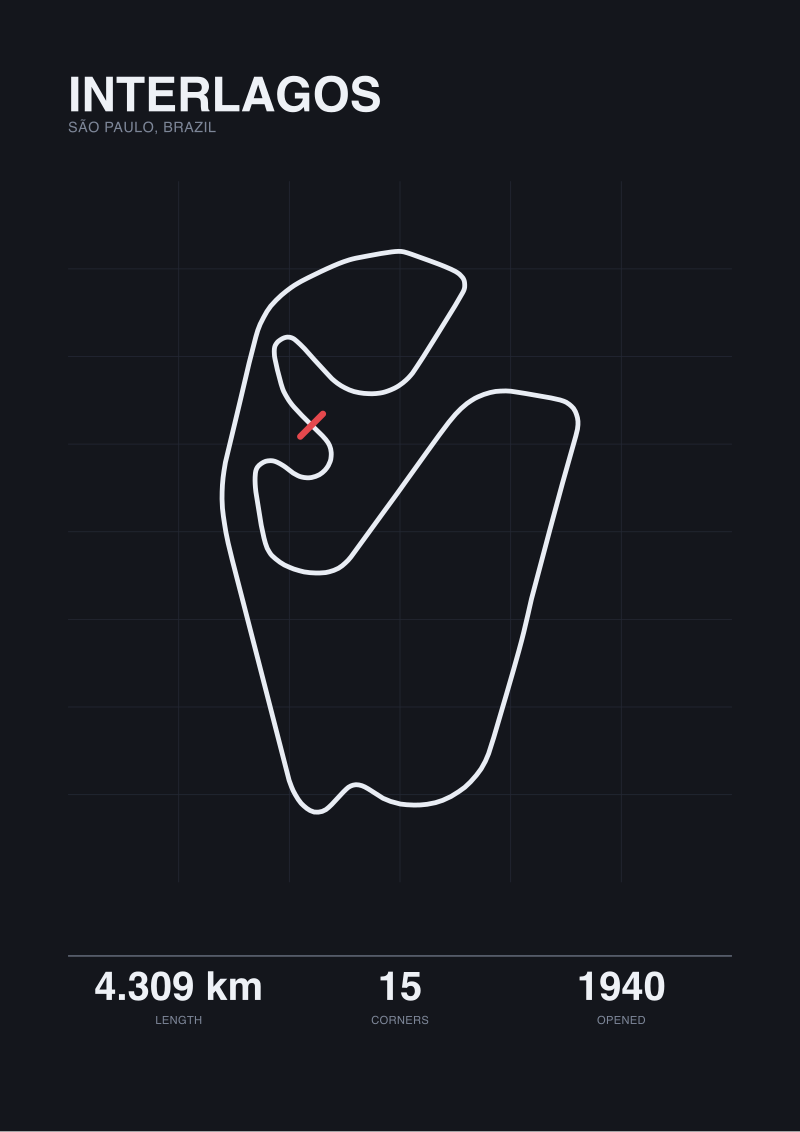 Interlagos
The print from this article · from €29.95
View the print →
Interlagos
The print from this article · from €29.95
View the print →
The One-Metre Gap Between Homologation and Map Trace
The first thing to understand about the metre is that we cannot prove where it came from. We know what our number measures — the centreline of the mapped raceway, treated as a smooth path. We know, in the general case, what a homologation length measures: it is defined against a specific reference line, usually one metre inside a designated edge of the track, sometimes with corner cuts and shortcuts explicitly excluded, and it is measured using survey equipment on the ground rather than by tracing a digital map. Those two definitions are close cousins. They are not identical twins.
Take a fast, wide corner and consider the difference. The mapped centreline splits the tarmac down the middle regardless of racing line. The homologation reference sits at a fixed offset from the inside edge. On a long constant-radius sweep, the difference in arc length between those two references can be a metre or more without either being wrong. Interlagos has more than one such corner. It also has kerbs and rumble strips whose inclusion or exclusion from the mapped polygon could shift the traced centreline by a small amount inward or outward. None of these effects is large. Added together across the full lap, one metre of net disagreement is a plausible residual, not a mystery.
A metre of disagreement between two honest measurements is not an error to reconcile — it is a receipt showing that two different people asked two different questions of the same tarmac.
The second thing to understand is that even if the two numbers were being computed from the same reference, they would probably still not match to the nearest metre. Our source is a public map maintained by contributors, at a resolution that is astonishing for what it is but not equivalent to a survey-grade cadastral record. The homologation number is anchored to an on-site measurement done by people with certified equipment and a legal reason to be precise. Both are correct within their tolerances. The tolerances are just not the same tolerance.
What matters for a print — and, we would argue, for the reader who wants to understand the circuit — is that the two numbers are close enough to be describing the same object. If they were seventy metres apart, we would have a problem. One metre means the map and the certificate broadly agree that Interlagos is 4.308 km of tarmac give or take a rounding decision. When we quote the traced figure on a print, we mark it as traced. When we cite the official figure in prose, we mark it as official. The reader is trusted to hold both in their head.
Why the Third Number Never Shows Up in the Broadcast Graphic
The third length — what a car actually covers on a lap — is the length nobody quotes, and the reason is that there is no defensible single value. Take a car through Interlagos on the ideal geometric line, cutting to the apex of every corner at the exact inside kerb and running to the exit kerb on every exit, and you have driven a shorter path than the mapped centreline. Take the same car on a defensive line, holding the outside through the fast Curva do Sol section to protect a position, and you have driven a longer path. Neither of those distances is 4.309 km. Both belong to the same lap.
This is not a technicality. On a lap of 4.3 km, the difference between the tightest available line and a wider defensive one can be several metres per corner. Multiply by fifteen turns and the racing-line distance and the defensive-line distance can differ by a noticeable margin over a full lap. Neither of those totals is what the broadcaster writes down. The broadcaster writes down 4.309 km, times the number of laps, and calls that the race distance. It is not really the race distance in a metrological sense. It is the reference distance, used for scoring, and everyone has agreed to pretend it is the same thing.
The pretence is defensible. Any sport that needs to award championship points at the end of the afternoon needs a fixed distance to reason about. Freezing the length at homologation gives you that fixed distance, and freezing it means the number does not drift from lap to lap or race to race. But it is worth being clear-eyed about what has been given up in exchange for that stability. The distance quoted alongside a lap time is not the distance the tyres saw. It is the distance the paperwork saw.
For the reader who studies circuits as objects, this matters in a specific way. It means that when you compare two circuits by their published lengths, you are comparing their homologation certificates, not their tarmac. It means that when you use lap time and length to compute an average speed, you are computing an average that lives partly in an office. And it means that the honest thing to do, when quoting a length in a print or an article, is to say which of the three numbers you are quoting and to trust the reader to know why the distinction is worth making.
Interlagos is 4.309 km officially. It is 4.308 km when we trace it. It is something else, slightly different, on every lap that has ever been driven around it. All three statements are true, and the fact that they very nearly agree is not a coincidence — it is what happens when a certification body, a mapping community, and a race car are all trying, in their own registers, to be honest about the same piece of ground.
FAQ
What is the official length of Interlagos?
The circuit is quoted at 4.309 km on its current homologation, and that is the figure the venue itself uses and the number broadcasters cite when computing race distance. The layout has fifteen turns and the venue, formally Autódromo José Carlos Pace, opened in 1940 on the southern edge of São Paulo. The 4.309 km value is a legal reference measurement made on the ground, not a value derived from a map, and it is the number that anchors lap records and championship regulations.
Why does the map-traced length come out to 4.308 km instead?
Because it is answering a slightly different question. Our figure of 4.308 km is the summed length of the raceway centreline as it exists in OpenStreetMap raceway data under the ODbL, sampled densely and totalled. The homologation number is anchored to a specific reference line, typically at a fixed offset from a designated edge, and measured using survey equipment on site. Two honest measurements against slightly different references will almost never produce identical results, and one metre of residual disagreement over 4.3 km is well within what those methodological differences can explain.
Which of the two Interlagos lengths should I trust?
Both, for different purposes. If you are quoting the circuit in a context that touches on lap records, race distance, or the current homologation, the correct value is 4.309 km, because that is the legally anchored figure other numbers refer to. If you are describing a printed diagram or working from a geometric drawing, the correct value is whatever your traced line measures — for us, 4.308 km. The mistake is quoting one and pretending it authorises the other.
How many corners does Interlagos have?
The current layout is described as having fifteen turns. That count is a naming convention rather than a purely geometric fact: it reflects which curvature changes are treated as distinct corners by the venue and which are bundled into the same named section. A pure geometric trace of the raceway does not, by itself, produce the number fifteen; it produces a continuous path whose curvature rises and falls. The fifteen-turn count is layered on top of that path by convention.
Why does the length a car actually drives differ from the published length?
Because a car does not follow the reference line the published length was measured against. On a tight racing line, apexes are clipped and exits shortened; on a defensive or wet-weather line, the car runs wider and covers more ground. The published 4.309 km figure is a reference distance used for scoring purposes, not a per-lap measurement of what any specific car covered. It stays constant so that championship arithmetic stays consistent from lap to lap and race to race.
Has Interlagos always been 4.309 km long?
No. The circuit opened in 1940 with a substantially longer layout than what is used today, and it has been reconfigured across its history. The 4.309 km figure refers to the current layout, which is what is used in modern top-level racing and what our map trace corresponds to. Historical lengths belong to historical layouts and should not be compared directly to the current homologation figure without noting which configuration is being discussed.
Does the one-metre gap matter for anything practical?
For race organisation, no. For a broadcaster or a timing system, no. For anyone comparing lap times or computing average speeds using the official length, the gap is well inside the noise. It matters for one thing specifically: knowing, when you cite a number, what that number is a measurement of. A print that quotes 4.308 km is telling the reader something honest about the drawing in front of them. A regulation that quotes 4.309 km is telling the reader something honest about the paperwork. Confusing the two is where mistakes creep in.
Where does the geometry data behind your Interlagos trace come from?
The layout geometry we work from is drawn from OpenStreetMap raceway data, which is published under the Open Database License and maintained by a large community of contributors. The circuit's headline statistics — the 4.309 km official length, the fifteen-turn count, the 1940 opening date, and the formal name Autódromo José Carlos Pace — come from Wikipedia and the venue's own published references. We keep the two sources separate on purpose, so that a geometric claim and a stat-sheet claim can be checked against different lineages.
From the collection
New circuits and 10% off your first print.
One email now with your code. No noise after.