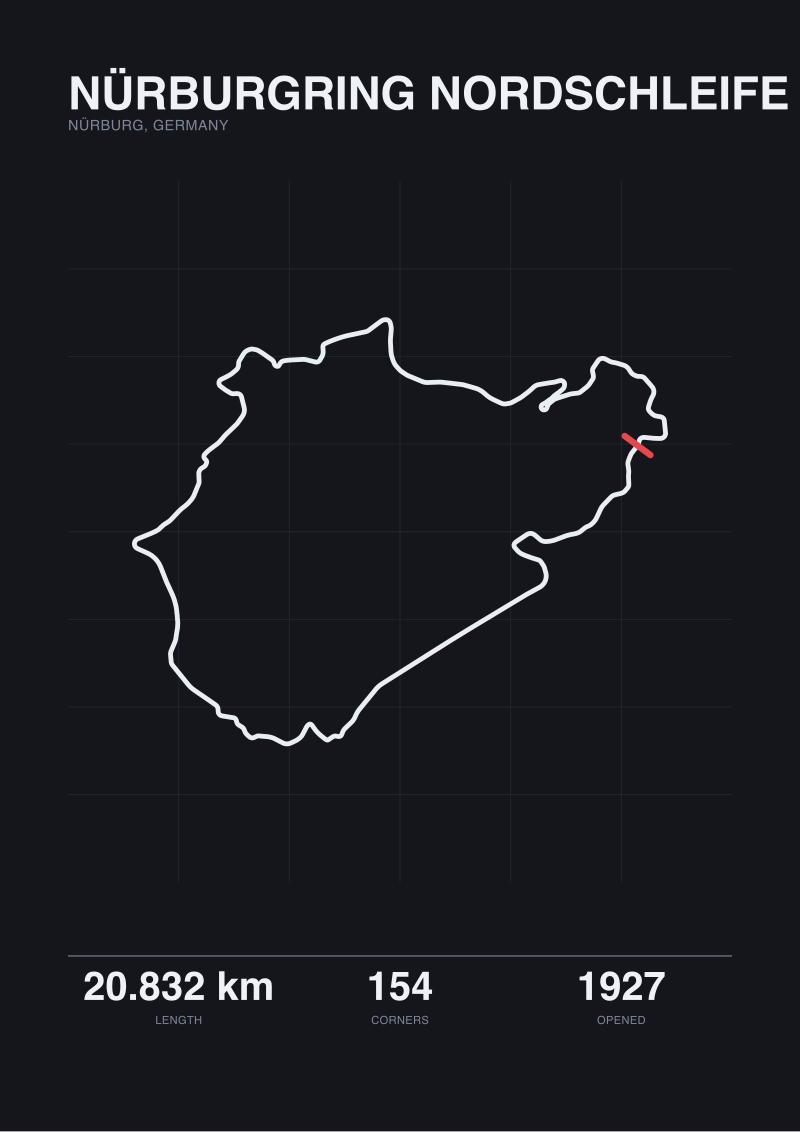
20.832 kilometres is the published length of the Nürburgring Nordschleife. Our own trace of the raceway from OpenStreetMap data returns 20.746 — a gap of 86 metres across a single lap of the longest active circuit in our grounding set. That gap is the entire subject of a track width calculator: not the distance a car travels, but the distance a measuring line travels, and the uncomfortable fact that there is no single correct line to measure. Before any calculator returns a number, somebody has already decided where across the tarmac the line is drawn. The question is which decision, and whose.
The honest answer to "how wide is this track" is "wide where". Three readers walk into this question with three different problems. One wants a print. One wants to understand a sector of a lap they are about to drive. One wants to compare the Spa of 1921 to the Spa of today. Each of them types the same words into the same calculator, and each of them should receive a slightly different number. What follows is a walkthrough of all three.
Scenario 1: The Print Buyer Choosing a Scale
Imagine a reader who has decided to put Spa-Francorchamps on a wall. They have measured the wall. They know they want the circuit printed so that the overall shape fills a defined rectangle, with the published 7.004-kilometre length used as the dimensional anchor. They then open a track width calculator, enter Spa, and expect a number that tells them how thick the tarmac ribbon should be rendered at their chosen print scale.
Here is where the measuring line matters. Our map-traced length for Spa, pulled from the OpenStreetMap raceway polyline, returns 6.995 kilometres against a 7.004 published figure — a nine-metre gap across the entire circuit. That gap is not an error in either source. It is the signature of two different measuring conventions. The published length almost certainly follows the racing surface along a homologated reference line defined by the sanctioning body. The map trace follows whichever path the OpenStreetMap contributor digitised the raceway along, which in practice is a geometric centreline of the mapped feature. Nine metres across seven kilometres is roughly one part in eight hundred.
For the print buyer this is more consequential than it sounds. If the calculator derives its track width from the published length and then renders the ribbon along the traced centreline, the ribbon will not quite close on itself, or will drift from the OSM feature it was traced from. If the calculator derives width from the trace length and the trace alone, the printed scale will be internally consistent but will read as 6.995 km on any ruler held to the paper — not 7.004. Neither is wrong. Both decisions must be stated.
Silverstone makes the same point at a slightly smaller magnitude: 5.891 kilometres published, 5.881 traced, a ten-metre discrepancy. The Nordschleife makes it loudly: 20.832 against 20.746, an 86-metre separation. At gallery-grade print scales these differences live inside the width of a drawn line. At architectural-poster scales they do not. The print buyer who notices this is asking the right question. The honest calculator answers it by returning both numbers and naming the measurement basis for each. The one shop we will mention here, our own at /shop/, resolves it by publishing the traced length as the governing figure, because the print must agree with itself before it agrees with anybody else.
Scenario 2: The Track-Day Driver Reading a Sector
Picture a different reader. They have an entry at a two-day driver training event, and they are trying to decode a sector they keep losing time in. They do not want the whole lap length. They want the length and width of a specific stretch of asphalt between two reference points. They open the same calculator, draw a bounding box around their problem corner complex, and press compute.
The Sarthe entry in our grounding set is a demonstration of what this returns in practice. The Circuit de la Sarthe has a published full-circuit length of 13.626 kilometres. The map-traced length in our data returns 0.793 kilometres. That is not a mistake in the trace; it is a trace of a defined segment of the raceway feature, not the full circuit — most likely a mapped section rather than the complete loop. For the full-lap reader this is useless. For the sector reader it is exactly the right unit of answer.
What a track width calculator actually returns when fed a sub-circuit polyline is a length along a chosen reference line between two chosen endpoints. The length is only as good as the three decisions behind it: where the start cut is placed on the asphalt, where the end cut is placed, and which lateral position across the tarmac the reference line sits on. Move the start cut ten metres earlier and the number climbs by ten metres. Move the reference line from the inside kerb to the outside kerb through a long sweeping corner and the number climbs considerably more, because the outer line travels a longer arc.
The track-day reader is better served by a calculator that lets them specify these three cuts explicitly than one that returns a single opaque length. Width, in that reading, is not a separate variable from length; it is the choice of lateral position that makes a length honest or dishonest. The 793-metre Sarthe trace in our grounding set is a reminder that short lengths can be measurement artefacts of what was cut, not of what the car drove.
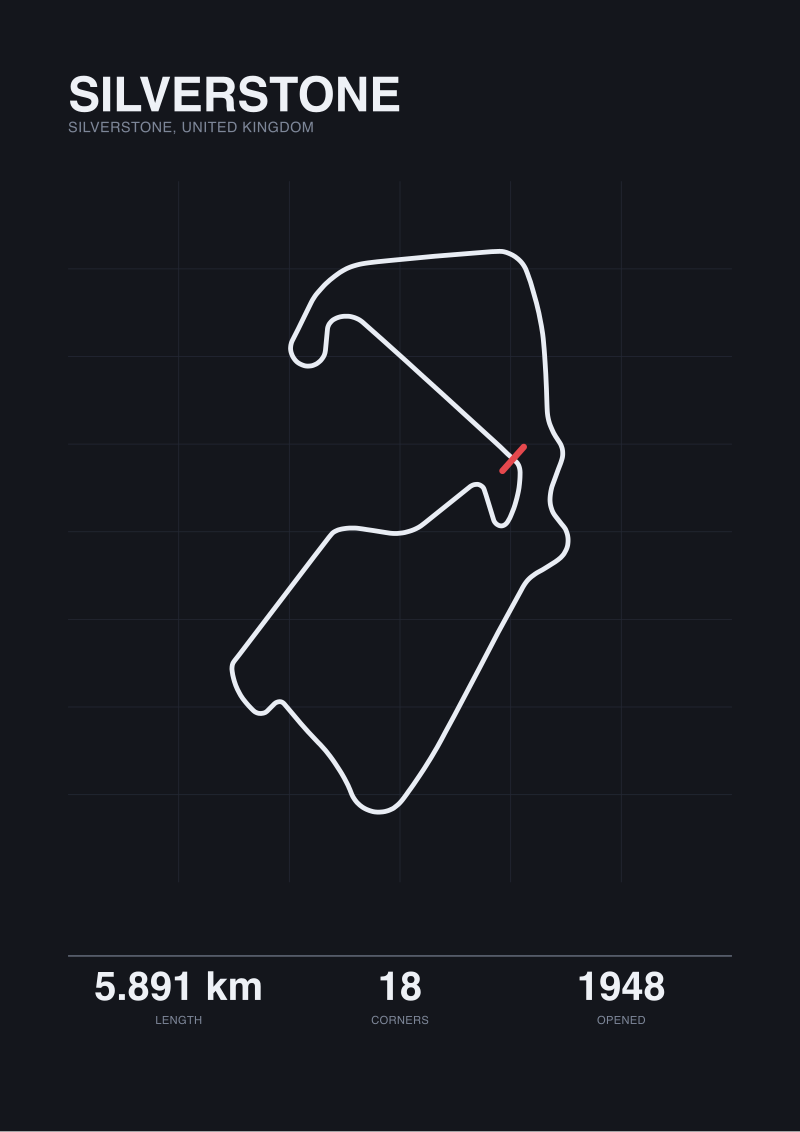 Silverstone
The print from this article · from €29.95
View the print →
Scenario 3: The Historian Comparing a Circuit Across Eras
Now a third reader. They are writing something about how circuits have changed, and they want to compare like figures. Spa-Francorchamps opened in 1921. The Nordschleife opened in 1927. Silverstone opened in 1948. Those years anchor the question but do not answer it, because the 7.004 kilometres we have for Spa today bears almost no relation to the public-road layout that opened a century ago, and the Nordschleife has shed length and corner count several times since 1927.
A track width calculator used for historical comparison is a dangerous instrument unless it refuses to average across eras. The honest version of this reader's question is not "how long was Spa", but "how long was the specific configuration of Spa that was in use in a specific period, as measured by the convention that period used". That is three variables, and dropping any of them produces a number that looks precise and reads as misleading.
Our grounding carries only present-day lengths: 7.004 published for Spa, 5.891 for Silverstone, 20.832 for the Nordschleife, with map-traced counterparts at 6.995, 5.881 and 20.746. We cannot responsibly cite 1921 Spa, 1948 Silverstone, or 1927 Nordschleife lengths against those numbers; the research needed to do so sits outside the grounding, and inventing figures to fill the gap would corrupt the comparison the historian wanted in the first place. The useful service a track width calculator can offer this reader is not a historical number it does not have, but a plainly labelled present-day figure with the measurement basis stated, so that any older figure the historian later finds can be compared against it with the right caveats attached.
The corner count tells the same story. Spa stands at 19 turns in our data. Silverstone at 18. The Nordschleife at 154. These counts, like the lengths, are current-configuration counts, not historical ones. For an across-era comparison they are a starting point, not an answer.
What All Three Share
Three readers, three uses, one underlying mechanism. In every case the calculator is doing the same operation: integrating a length along a chosen polyline across a chosen interval. The variation between scenarios is entirely in the choices behind the operation — which polyline, which interval, which lateral position on the asphalt. The 86-metre Nordschleife gap, the ten-metre Silverstone gap, the nine-metre Spa gap, and the 793-metre Sarthe segment are not four different kinds of problem. They are four presentations of the same single problem, which is that measurement is a decision stack and the stack is almost never shown.
The published length is one stack: a sanctioning body's homologation convention, applied to a defined racing surface, along a specified reference line. The map-traced length is another stack: a volunteer-mapped feature in a public geographic database, measured along whichever path the digitising contributor placed. Neither stack is more real than the other, and the difference between them is not noise. It is signal about where the two conventions disagree.
A calculator that returns one number without naming its stack is not wrong; it is incomplete. The right question to ask of any track measurement tool is not "is this accurate" but "accurate against which reference". Once that question is answered, every other decision — print scale, sector cut, era comparison — becomes a straightforward application of the same arithmetic to a clearly stated basis.
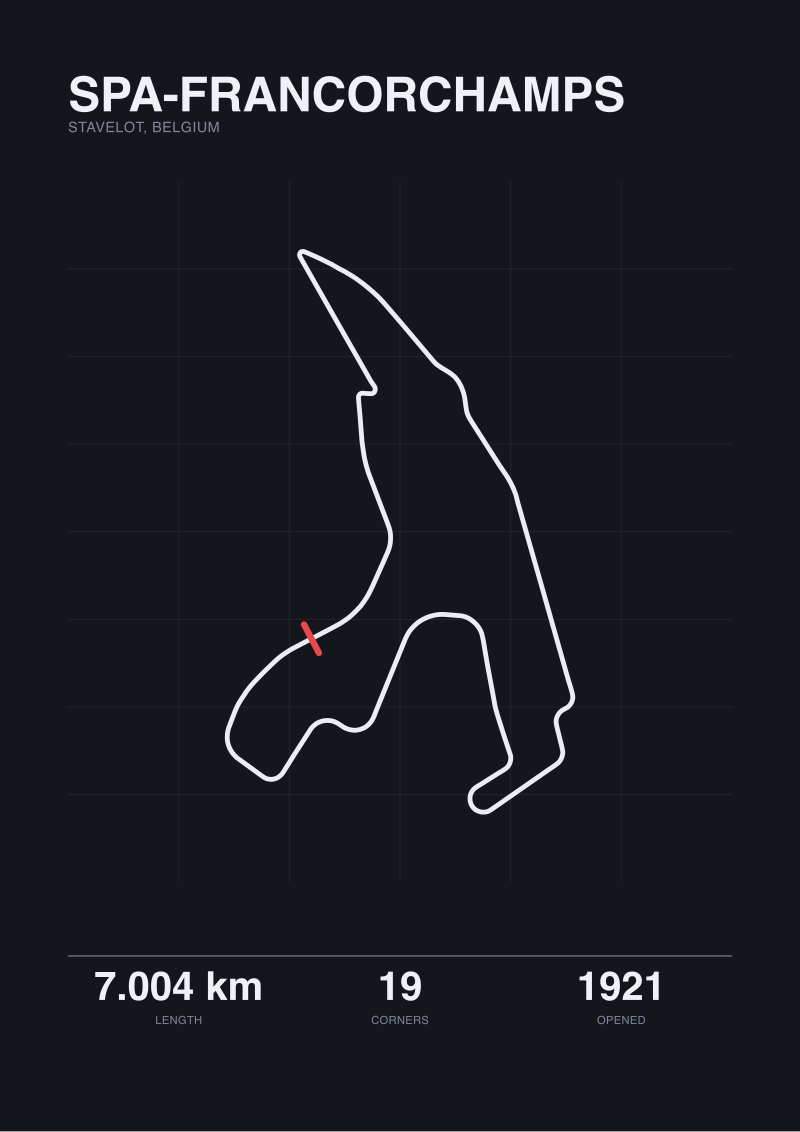 Spa-Francorchamps
The print from this article · from €29.95
View the print →
Which Scenario Is You
Read your use case against these three before you trust any number the tool returns. If you are rendering a circuit for print, your governing figure is the one that agrees with the geometry you are drawing, not the one from the record book — and your calculator should return the traced length and the published length side by side so you can choose. If you are preparing for a session on a specific stretch of a specific circuit, your calculator should let you place your own start and end cuts and let you specify where across the tarmac the reference line sits, because the single-number answer will mislead you otherwise. If you are writing comparative history, your calculator should refuse to average across configurations and should force you to specify which era you mean, or decline the question.
If none of these three cases fits, the useful next move is to describe your use case in the three decisions above: which polyline, which interval, which lateral line. The answer the calculator should return follows directly from those three. Nine metres across Spa, ten across Silverstone, 86 across the Nordschleife. That is the gap between measuring and the thing measured. A good calculator shows you both. A bad one picks one and does not tell you which.
FAQ
What does a track width calculator actually compute?
It computes a length along a chosen polyline on the circuit between a chosen start point and a chosen end point. "Width" in this context is less a separate variable than a choice of where across the tarmac the measuring line sits. Move the line toward the inside of a corner and the length drops; move it toward the outside and the length rises. The number returned is the integral of that chosen path, not a property of the circuit itself.
Why does the published length of a circuit differ from a map-traced length?
Because they measure along different reference lines. A published length — 7.004 kilometres for Spa, 5.891 for Silverstone, 20.832 for the Nordschleife — follows a homologated line defined by the sanctioning body on the racing surface. A map-traced length follows the polyline a contributor drew into OpenStreetMap for the raceway feature. The gaps in our grounding — nine, ten, and 86 metres respectively — are the direct consequence of those two conventions not agreeing by convention.
Is one measurement more correct than the other?
Neither is more correct in absolute terms. They answer different questions. The published figure answers "what is the length of the homologated racing surface along the official reference line". The traced figure answers "what is the length of the mapped feature along its digitised centreline". A print, a sector readout and a historical comparison each need one of these more than the other, and the right tool makes the basis explicit rather than hiding it.
Why did the Circuit de la Sarthe return only 0.793 kilometres in your trace when its published length is 13.626?
Because the trace in our grounding set is of a defined segment of the raceway feature, not the full circuit. It is a correct number for the polyline that was measured and the wrong number for anyone expecting a full-lap figure. This is the general risk with sub-circuit measurements: a short length can be an artefact of where the start and end cuts were placed, not of what a car would drive across a full lap.
Can I use a track width calculator for historical comparison across eras?
With great caution and only if the tool refuses to average across configurations. Spa opened in 1921, the Nordschleife in 1927, Silverstone in 1948, and each has carried several different configurations over the decades. Our grounding set contains present-day figures only, so a responsible calculator will clearly label its lengths as current-configuration measurements rather than historical ones, and will leave older figures to be compared against them with the appropriate caveats.
How much do these measurement gaps matter at print scale?
It depends on the print scale. At gallery-poster sizes the nine- and ten-metre discrepancies at Spa and Silverstone live inside the width of a drawn line and are invisible. The 86-metre Nordschleife gap is harder to hide and starts to show if the governing length and the traced centreline are not reconciled before rendering. The practical rule is to pick one basis — traced or published — and let every element of the print, including any scale bar, agree with it internally.
Should I trust a tool that returns a single number without naming the measurement basis?
Treat it as incomplete rather than wrong. A single-number answer is useful shorthand but it is one of several defensible figures for the same circuit. Before relying on it for anything consequential — a print you are paying to produce, a sector plan for a track day, a comparison in a piece of writing — confirm which reference line and which interval the number comes from. If the tool cannot tell you, the number is a starting point, not an answer.
From the collection
New circuits and 10% off your first print.
One email now with your code. No noise after.