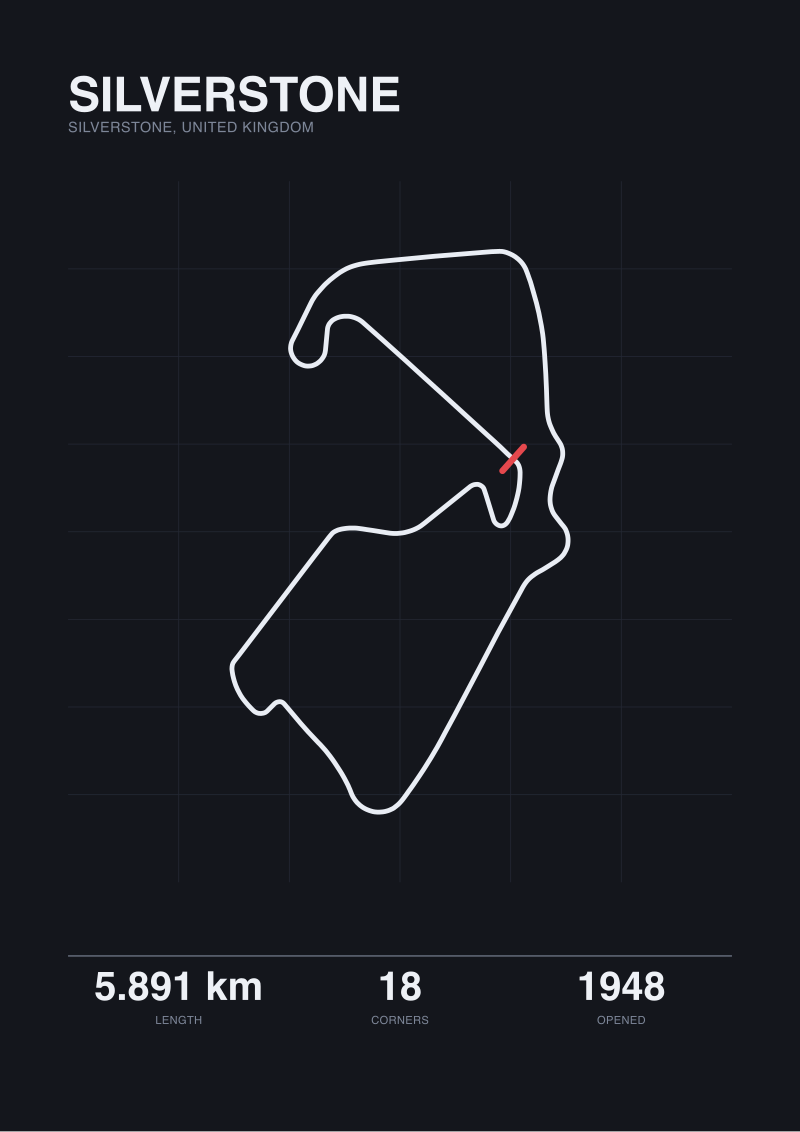
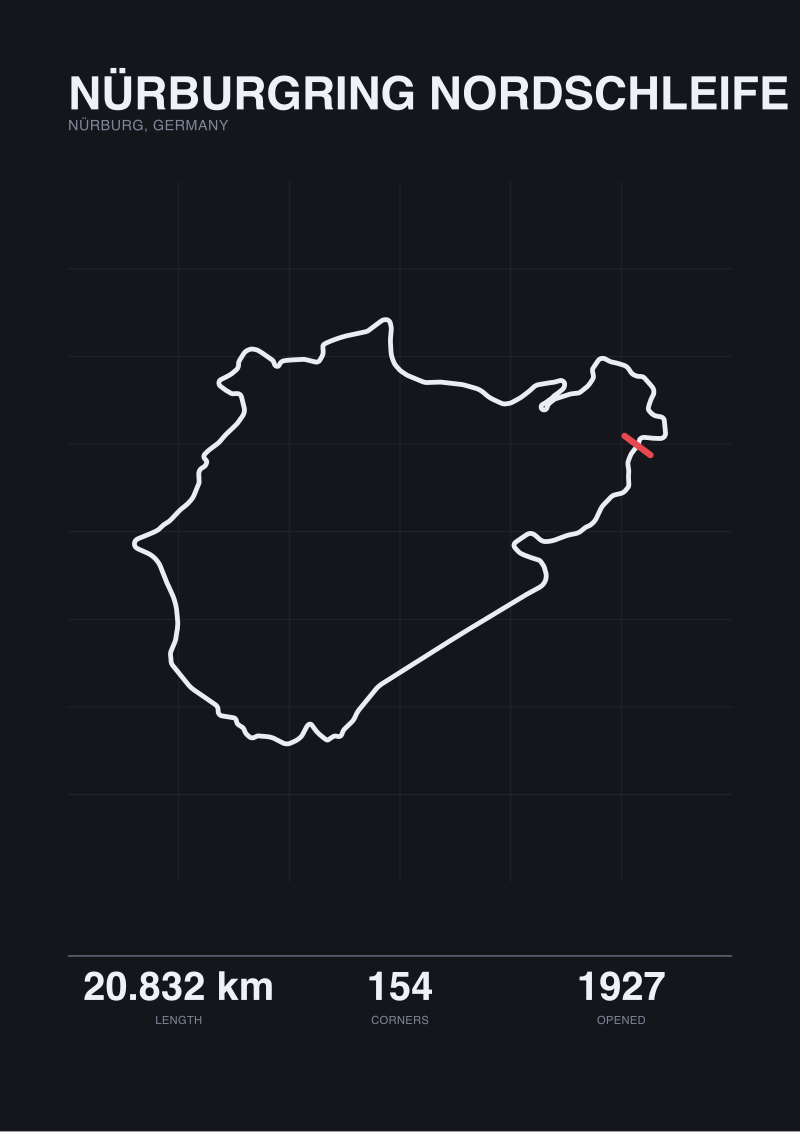
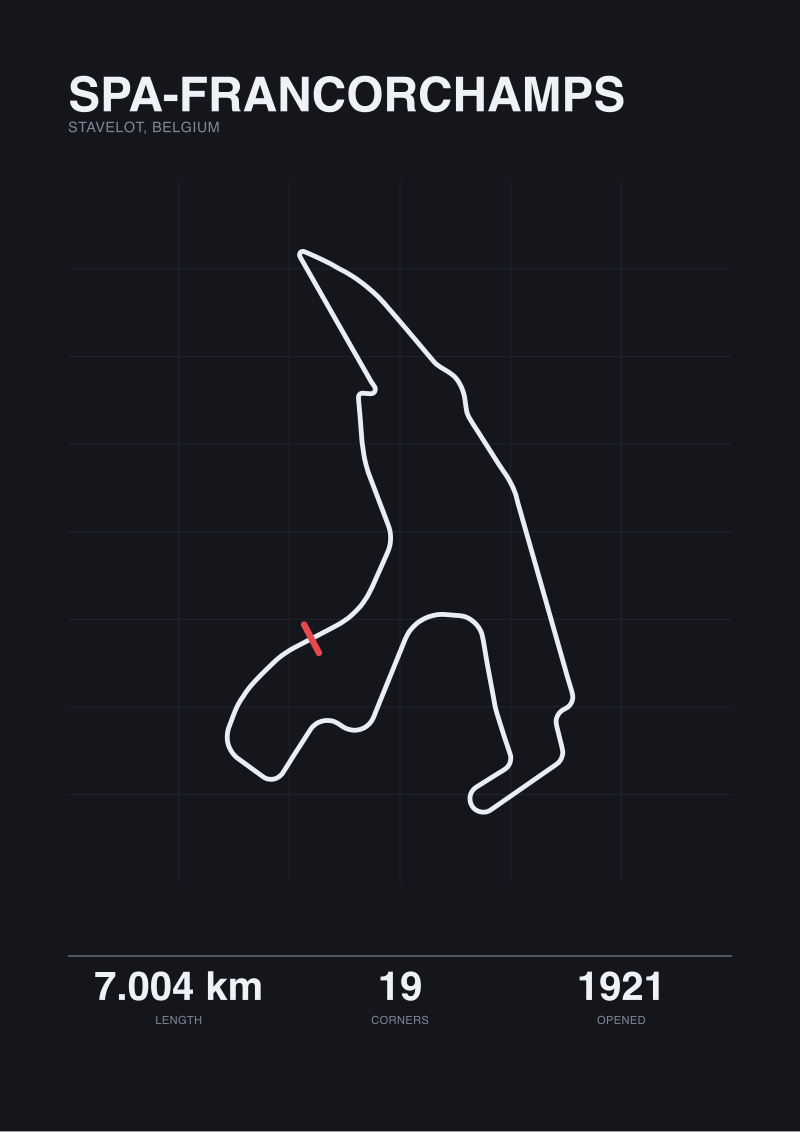
Nürburgring Nordschleife: 20.746 kilometres traced from OpenStreetMap raceway data against a published length of 20.832, 154 corners. Roughly one turn every 135 metres. Silverstone: 5.881 kilometres traced, 18 turns — 327 metres between corners. Spa-Francorchamps: 6.995 kilometres traced, 19 turns — 368 metres. The Tilke debate — the recurring complaint that modern Formula 1 circuits feel interchangeable — is usually argued in the language of atmosphere and heritage. Read at the metre level, it becomes a geometry argument. The older reference set places corners closer together, at inconsistent radii, on ground that refuses to be flat. The newer permanent-circuit template, as a rule, does not.
The Constant-Radius Corner Reflex
The pattern we keep seeing in modern permanent circuits is the constant-radius corner: a turn whose arc holds a single sweep from entry to exit, engineered to a template a car of a given aerodynamic profile can take at a predictable, stable speed. It is a tidy solution to a design brief. It also makes one corner look and drive like the next.
Set that against what our trace of the Nordschleife shows. 154 corners across 20.746 kilometres, and no two of them are cut from the same block. The Karussell is a banked concrete gutter whose radius is set by a quarry road that predates the racing surface. The Fuchsröhre falls and then rises through a compression whose corner does not so much have a radius as an argument with the terrain. The circuit opened in 1927; its geometry was drawn to a country road logic that had not yet met the template. That is why 154 corners in 20.746 kilometres is not a headline figure but an explanation. The density means the driver is never released from decision-making, and the inconsistency means each decision is fresh.
Spa's 19 turns in 6.995 kilometres are a smaller sample of the same principle. Eau Rouge into Raidillon is not a corner but a sequence of load changes: a left, a compression, a right that climbs. The radius on the way up is not the radius on the way down. Pouhon is a long left that tightens. The circuit opened in 1921 as a road course through the Ardennes; the corners were located by where the roads already turned. Silverstone at 5.881 kilometres and 18 turns is younger — opened 1948 on a former airfield — but Maggotts-Becketts-Chapel is a rapid-fire sequence of direction changes at different radii, a shape a modern template does not naturally produce because the template is not asked to.
The reflex we are describing is a reflex, not a rule. A designer working to homologation constraints and to a paddock geometry that must fit a service road system will reach for the constant-radius corner because it satisfies the brief with the fewest arguments. That reflex is what a lot of the Tilke debate is actually complaining about, even when it uses the language of soul.
Runoff That Removes the Consequence
The second pattern is subtler and it is not about the corner itself. It is about what happens if the corner is missed. Modern permanent circuits are built with wide asphalt runoff on the outside of most fast corners. The reason is safety and it is a good reason. The consequence is that the geometry of the corner is no longer the whole geometry of the corner. The whole geometry is the corner plus the runoff, and the runoff flattens the penalty for taking the corner wrong.
At Spa, the outside of Eau Rouge for decades was a wall and a bank. Miss the compression and the incident was terminal. At Silverstone, Copse on the outside is gravel and barrier at a distance that does not forgive a slide. At the Nordschleife, the outside of almost every corner for 20.746 kilometres is Armco or trees or a drop. The geometry there is the same as it always was; what makes those corners read as difficult on a track map is that the map does not show the runoff, because there effectively is none.
This is where the Tilke complaint slides from geometry into environment and back into geometry. A corner engineered on flat ground with a fifty-metre asphalt outfield is not the same corner as one engineered on a hillside with a barrier at the road edge, even if the arc traced on paper is identical. The driver's line, the commit point, the recovery window — these are all functions of what the runoff allows. When the runoff is generous, the optimal line converges on the geometric ideal, and the geometric ideal at a constant-radius corner is a single line. When the runoff punishes, the optimal line depends on what the driver believes they can survive, and different drivers survive different lines. That divergence is what onlookers read as character.
A corner with fifty metres of asphalt outfield is not the same corner as one with a barrier at the road edge, even if the arc on paper is identical.
 Silverstone
The print from this article · from €29.95
View the print →
Silverstone
The print from this article · from €29.95
View the print →
Flat Sites, Flattened Layouts
The third pattern is topographic. A permanent circuit built on a level greenfield site has, by default, no elevation change. Elevation must be added deliberately, at cost, in the form of engineered banking, artificial hills, and drainage-integrated grade changes. It gets added, but modestly, because dirt is expensive and the FIA templates do not require it.
The older reference set was not built on greenfield sites. Spa runs through the Ardennes; the circuit descends from La Source, drops into Eau Rouge, climbs the Raidillon and continues along ridge and valley. The elevation is not a design flourish. It is the terrain the road was already crossing when the circuit was routed in 1921. The Nordschleife is more extreme: 20.832 kilometres of published length weaving through the Eifel range, with the circuit's high and low points separated by enough grade to change the corner dynamics repeatedly around a single lap. Silverstone, on a former airfield in Northamptonshire, is flatter — the site was chosen precisely because it was flat enough for wartime aviation — but even Silverstone carries subtle grade at Maggotts and Stowe that is not part of a purely modern template.
Elevation matters because it does two things a flat layout cannot. It changes the weight on the tyres through a corner, which means the corner's grip envelope shifts across its length. And it changes the driver's sightline into the corner, which means the corner cannot be memorised as a shape on a map; it has to be read from the car. Both effects widen the range of possible driving solutions. Both are absent, or diluted, on a site where the elevation exists mainly to satisfy a rendering.
The Tilke debate rarely names this directly. It usually gestures at it with the word flat, which is doing a lot of work. What the word means, in geometry terms, is that the vertical component of the layout is close to zero and therefore the tyre load through each corner is close to constant, and therefore each corner has one obvious answer, and therefore each corner looks like every other corner where the answer is also obvious.
The Straight-Then-Hairpin Rhythm
The fourth pattern is rhythmic. A recurring building block of the modern permanent-circuit template is the long straight terminating in a heavy-braking, tight-radius corner. It exists because it produces overtaking under DRS and because it is a legible unit for television. Repeated across a lap, and repeated across circuits, it establishes a rhythm the viewer starts to recognise regardless of which country the circuit is in.
Now do the arithmetic on the older set. Silverstone's 5.881 kilometres divided by 18 turns is 327 metres between corners on average. Spa's 6.995 divided by 19 is 368 metres. Those numbers include the long straights — the Kemmel at Spa, the Hangar Straight at Silverstone — which means the average between corners in the twisty portions is considerably lower. The rhythm is not straight-then-hairpin. It is corner-into-corner with occasional respite. The Nordschleife pushes this to its limit: 135 metres between corners on average, across 20.746 kilometres. There is no rhythm at the Nordschleife because there is no repeating unit; the circuit does not settle into a pattern the driver or the viewer can pre-load.
The straight-then-hairpin template is not wrong. It is a design choice that solves specific problems: it creates overtaking, it fits a paddock and a pit lane, it is cost-controllable, and it works on the flat sites that are available at scale. What it does not do is generate the density of corner-into-corner sequencing that the older reference set produces almost incidentally as a consequence of having been drawn on top of pre-existing road geometry. When you strip the argument of atmosphere and heritage, what remains of the Tilke complaint is largely this: the rhythm has become predictable, and predictability at circuit scale reads as sameness.
Note the caveat. Silverstone was purpose-built on an airfield in 1948; it is not an inherited road course. Its rhythm variety comes from a period of design in which corner density and radius variation were still part of the brief, not from ancient topography. Which means the pattern is not modern versus historic. It is template versus non-template. A circuit designed today could be drawn against the template if the brief asked for it.
 Nürburgring Nordschleife
The print from this article · from €29.95
View the print →
Nürburgring Nordschleife
The print from this article · from €29.95
View the print →
So What Do You Actually Do
If you are reading a new circuit — a launch, a renovation, a proposal — and you want to know whether it will feel interchangeable before the first car turns a lap, look at four things at the metre level. First, the corner radii: count how many of them are visibly constant across the arc versus visibly variable, and note whether the variable ones are compound sequences or one-off exceptions. Second, the runoff: measure the width of the outside asphalt at the fast corners and ask what the penalty for a mistake actually is. Third, the elevation: compare the site's high and low points, and note where along the lap the grade changes fall relative to the corners. Fourth, the rhythm: divide the length by the corner count, then divide the twisty portion by its own corner count, and see how far the average corner-to-corner distance departs from a straight-then-hairpin template. None of these individually decides the argument. Together they describe what the circuit is likely to be before anyone races on it.
The honest position, from a studio that traces circuits from map data before drawing them, is that the Tilke debate is only partly about Tilke. It is about the constraints the modern permanent-circuit brief now carries: safety runoff requirements that flatten the corner-plus-outfield geometry, greenfield sites that flatten the elevation, homologation templates that pull radii toward the constant, and commercial requirements that ask for one legible overtaking straight per lap. Any designer working to that brief will produce circuits that resemble each other, because the brief is what they resemble. If you have a Nordschleife-scale print at the wall you can see the alternative in one glance — that is what our shop at /shop/ traces, at the metre level, from the same OpenStreetMap data the numbers in this piece come from.
None of this settles whether a modern circuit can be made to feel different without dismantling the brief that produced it. That is the harder question, and it is where the debate actually starts. What geometry constraints could a designer relax — runoff width, site selection, radius templates, straight lengths — and which of them would the sanctioning body, the promoter, and the insurer allow? The Tilke debate has been arguing about the symptom for twenty years. The next argument, the one worth having, is about which of the constraints is actually load-bearing.
From the collection
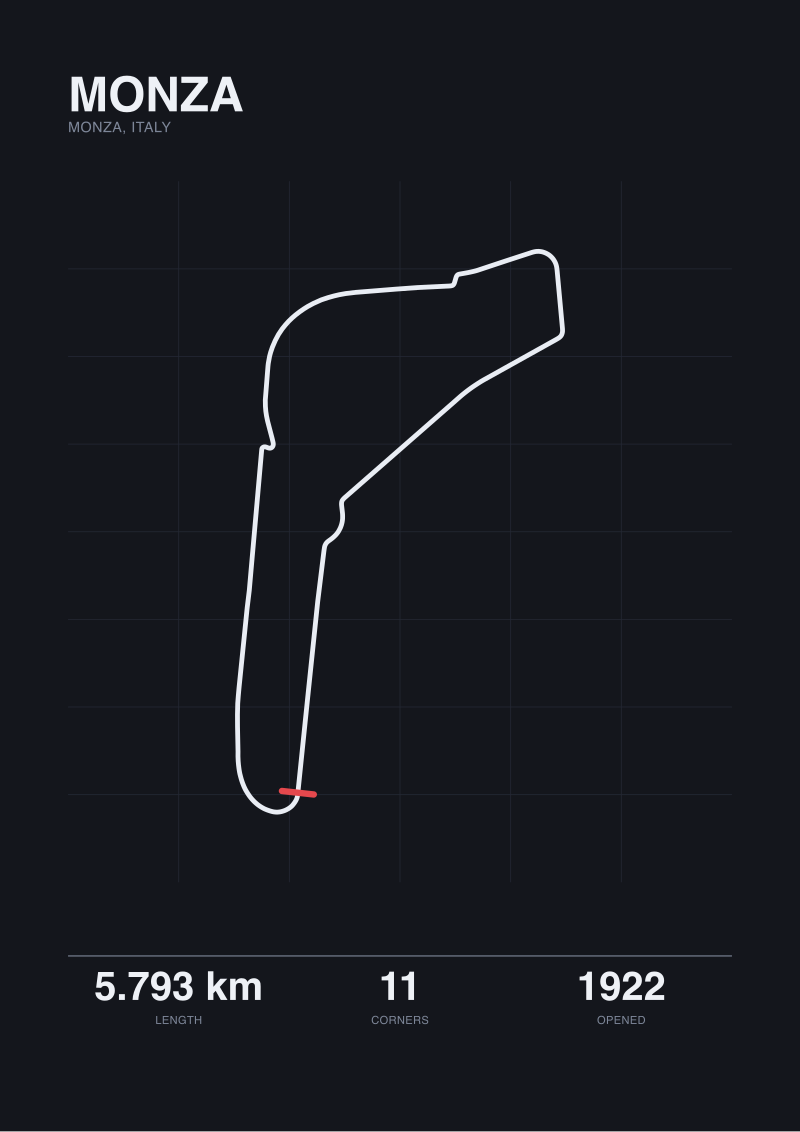
New circuits and 10% off your first print.
One email now with your code. No noise after.