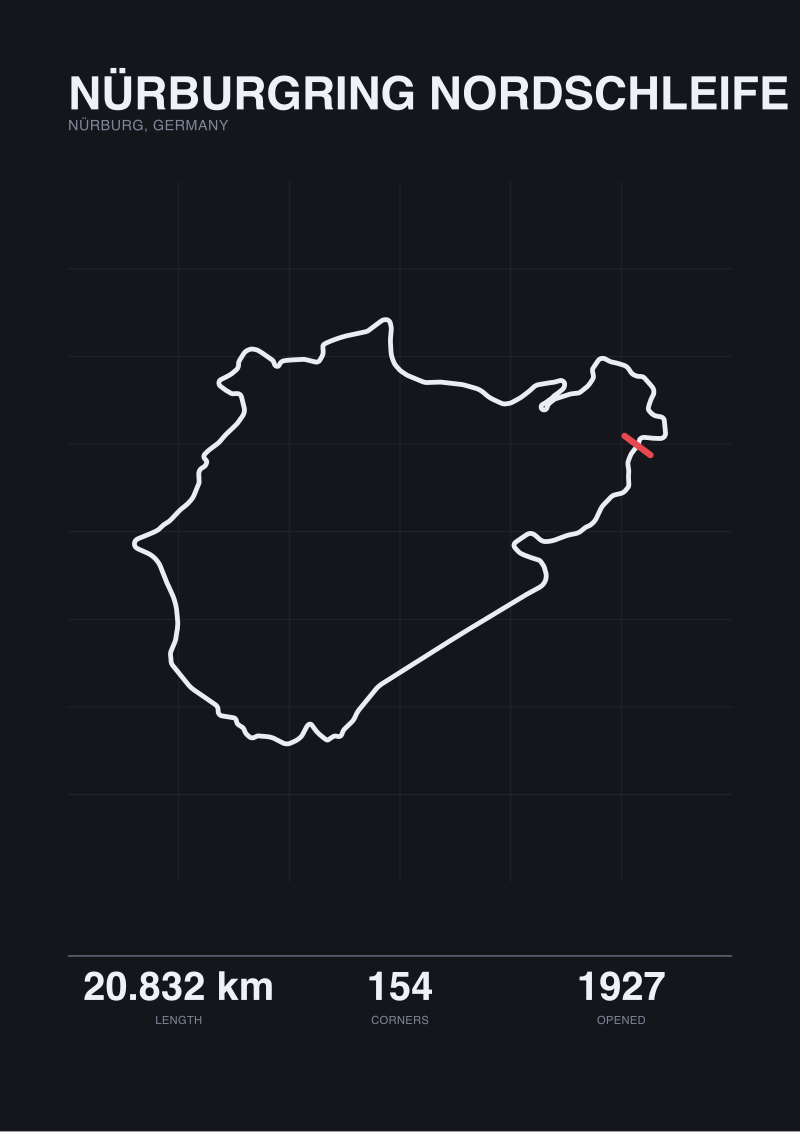
We have read a great many articles on the oldest race circuits still in use, and they arrive at roughly the same shortlist: Spa-Francorchamps in 1921, the Nürburgring Nordschleife in 1927, Silverstone in 1948, the public-road stretches of the Circuit de la Sarthe reaching back further still. The list is not the problem. The reading of it is. These pieces treat "still in use" as a binary — open or closed, alive or dead — when the interesting question is what, precisely, is still in use. A 20.832 km published length at the Nordschleife against a 20.746 km map-traced figure is not a rounding error. It is a clue about what continuity actually means on a circuit that has been rebuilt in place for nearly a century.
What They All Get Wrong
The first error is arithmetic. The pieces cite a single length figure and treat it as authoritative. On the four circuits above, the numbers do not sit still. The Nürburgring Nordschleife's official 20.832 km sits 86 metres above our 20.746 km map trace. Spa-Francorchamps publishes 7.004 km; the raceway centreline we traced from OpenStreetMap comes to 6.995 km — a nine-metre gap. Silverstone: 5.891 km published against 5.881 km traced, ten metres apart. These are not measurement failures. They are two different measurements of two different things — a homologation document that includes the racing surface as defined by the FIA, and a geometric trace of the alignment as drawn on the map. The conventional articles quote one number and call the matter settled. It is not settled. The gap is the interesting part.
The second error is temporal. "Opened 1921" is written as though the current circuit is what opened in 1921. Spa's original layout ran roughly 14 kilometres over public roads between Francorchamps, Malmedy and Stavelot. Its 2026 configuration is 7.004 km on a purpose-built alignment that only preserves fragments — Eau Rouge, the run down to Stavelot corner — of the original road course. The date of first race is preserved. The geometry is not. The same reading error applies to the Nordschleife: opened 1927, yes, but the surface, the corner profiles, the safety furniture and even certain corner alignments have been reworked so many times that the circuit racing today shares its property line with 1927, not its section drawings.
The third error is scope. The Circuit de la Sarthe is nearly always cited as one of the oldest, and the published 13.626 km figure is repeated without comment. Our own map trace returns 0.793 km — because Sarthe is not a permanent circuit. Most of its length is departmental road that closes for two weekends a year. The OpenStreetMap raceway tag applies only to the permanent stub near the Bugatti section. The conventional article never explains why the traced figure and the published figure sit two orders of magnitude apart. It doesn't notice.
What Is Almost Always Missing
What is missing, above all, is method. No conventional piece explains how a circuit is measured. Homologation length is a survey measurement taken along a defined reference line at a defined offset from a kerb, using instruments and procedures set by the sanctioning body. Map-traced length is the geometric length of the raceway polyline as digitised on OpenStreetMap under its ODbL licence, and the trace follows the visual centre of the surface, not the racing line and not the homologation reference. GPS lengths taken from telemetry are a third number, following the racing line and therefore always shorter than either. The pieces we have read report a length. They do not report which of these three numbers it is. On a 20.832 km circuit, the choice can move the figure by 100 metres. On a 7 km circuit, ten metres. The reader has no way to tell whether two circuits are being compared on the same basis.
The second missing layer is the distinction between the raceway and the property. Silverstone opened in 1948 on a decommissioned RAF airfield. The property line has moved very little since. The raceway alignment has been redrawn several times — the Arena complex, the Wing pit building, the reworked Abbey — and the current 18-corner, 5.891 km configuration is not the perimeter track that ran between the wartime runways. Age of the site is one measurement. Age of the geometry is another. The conventional article collapses the two.
The third missing layer is corner count as a continuity metric. The Nordschleife has 154 turns. That figure almost never appears in the shortlists, and where it does, it is treated as a curiosity rather than a diagnostic. Corner count is what separates a rebuilt-in-place road course from a modern circuit designed on a computer. Spa carries 19 corners across its 7.004 km — a corner every 369 metres. Silverstone carries 18 across 5.891 km — a corner every 327 metres. The Nordschleife carries 154 across 20.832 km — one every 135 metres. That density is a fossil of an era when circuits followed the terrain instead of overwriting it, and it is the single most direct measurable trace that survives from the 1927 layout, more durable than the tarmac and more diagnostic than the opening year. The conventional piece leaves it off the table.
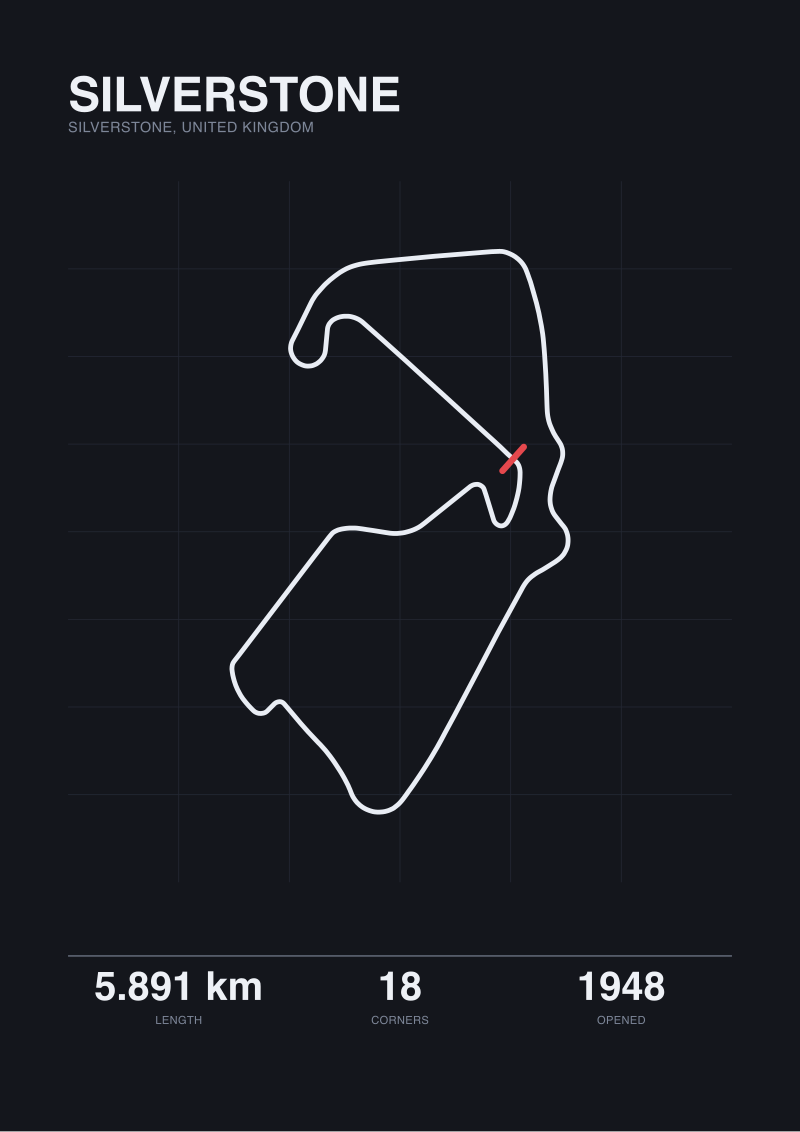 Silverstone
The print from this article · from €29.95
View the print →
Silverstone
The print from this article · from €29.95
View the print →
What I Would Say Instead
We would rewrite the question. The interesting property of an old circuit is not whether it is still open, but which of its properties have survived, and by what measurement. Age of the site, age of the geometry, age of the racing surface, and age of the corner sequence are four different clocks, and they run at very different rates. Any serious reading of Spa-Francorchamps has to distinguish the 1921 site (still active), the 1921 geometry (mostly gone), the 1921 corner sequence (fragmentary), and the 1921 racing surface (replaced many times over). The circuit is 105 years old on one clock and considerably younger on the others. This is not a rhetorical flourish. It changes which corners you point at when you say "this is what has lasted." At Spa, what has lasted is Eau Rouge — not as tarmac, but as gradient and radius. At the Nordschleife, what has lasted is the corner density: 154 turns across a 20.832 km loop still delivered by a course that follows the Eifel hills more than it defies them. At Silverstone, what has lasted is the property line and a set of corner names; the geometry between them has been redrawn twice since 1990. At Sarthe, what has lasted is the road network — the circuit is old because the roads that host it were there long before the race was.
We would also insist on stating the measurement basis, every time. When we quote 7.004 km at Spa, we would flag that our own map trace returns 6.995 km, and that the nine-metre gap is the difference between an FIA homologation line and a geometric centreline of the drawn raceway. It is a small number and a meaningful one. On a circuit with 19 corners, nine metres is roughly the width of the pit entry. It is not lost data. It is the space between two ways of describing the same object. The Nordschleife's 86 metres of discrepancy — over a course whose corner count alone tells you that no single geometric definition can capture it cleanly — is the most honest possible admission that "one number" was never enough.
This is why we trace before we draw. When we prepare a print of Spa or the Nordschleife for the studio's shop, the drawing is built from the OpenStreetMap raceway geometry, and the length that appears next to the layout is our traced figure, not the homologation figure, with the delta noted so the buyer knows which measurement they are looking at. We do this because a track print is not a poster of a name; it is a record of a shape, and shapes have to be measured before they can be honoured.
Read this way, the shortlist stops being a list. It becomes a small set of case studies in what continuity actually looks like when it is asked to hold up under measurement. That reframing implies the next question, and it is not "which circuit is oldest." It is: over the last hundred years, which corners on which circuits have moved the least — measured against archival survey drawings, not against opening dates — and what does the survival pattern tell us about which geometries the sport was built to protect. That is the work that begins where the shortlist ends.
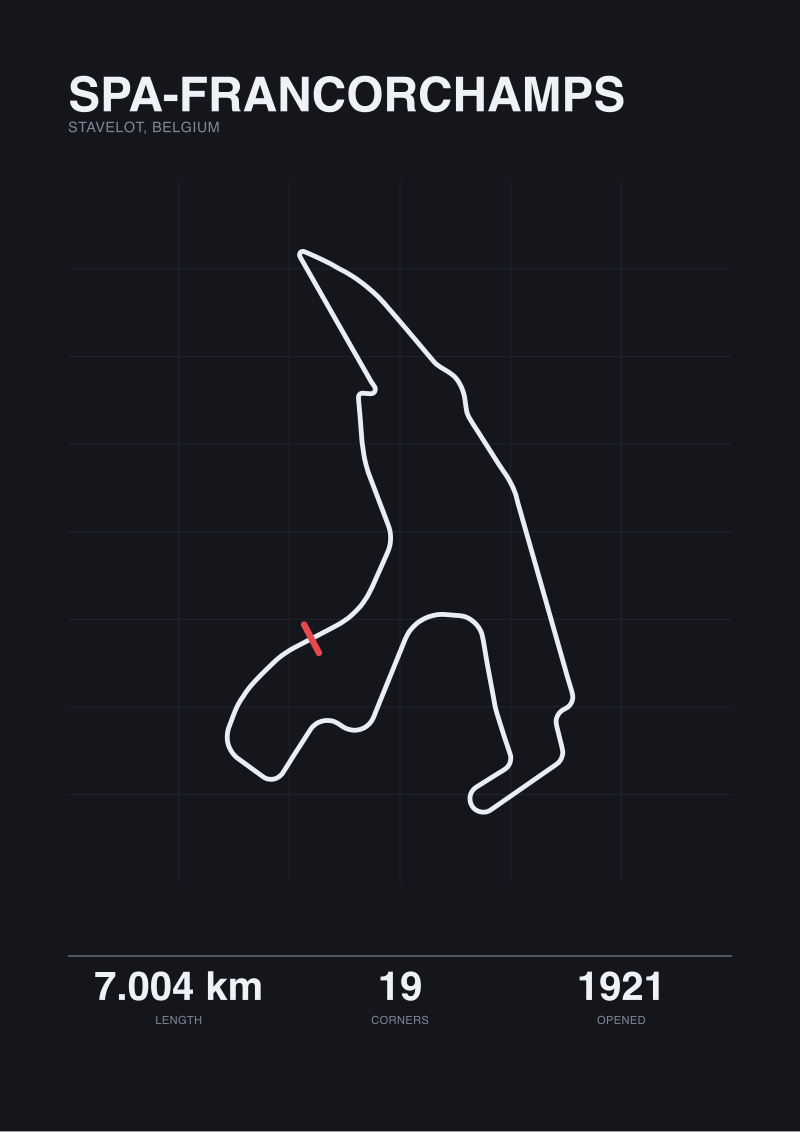 Spa-Francorchamps
The print from this article · from €29.95
View the print →
Spa-Francorchamps
The print from this article · from €29.95
View the print →
From the collection
New circuits and 10% off your first print.
One email now with your code. No noise after.