We have read, at Gridline, more than fifty articles on the Nürburgring Nordschleife published in the last three years. They vary in tone, in length, and in how many photographs of GT3 cars they use. They agree, almost without exception, on a single figure — 20.832 kilometres — and on a single supporting number — 154 corners. Both figures are correct, in the narrow sense that they come from a specific document. Neither is treated as a claim requiring a source. They arrive as facts, unquestioned, and the rest of the article proceeds as though the measurement problem had been solved before the reader arrived.
That is where the problem begins. A circuit is not a number. It is a piece of geometry that produces racing, and two headline figures obscure more than they reveal. The articles that repeat them are not wrong so much as thin — they treat the Nordschleife as trivia to be memorised rather than as a drawing to be read. We spent the better part of a week tracing the circuit from OpenStreetMap raceway data and comparing our traced length against the published homologated figure. The gap is 86 metres. That gap is the most interesting sentence nobody writes.
What They All Get Wrong
The common mistake — visible in nearly every explainer we surveyed — is to treat 20.832 km as an intrinsic property of the road, the way one might treat the height of a mountain or the flow rate of a river. Circuit length is not an intrinsic property. It is a measurement, and a measurement always carries a method. The 20.832 figure is the FIA-homologated length, produced by an authorised measurement of the racing line under specified conditions with specified equipment. Change the line — hug the inside kerbs on a fast run, or drift wide across the exit at a fast kink — and the number changes. It is a legal declaration, not a physical constant.
Articles almost never name the difference. They also almost never mention that we, tracing the same road from public map geometry (OpenStreetMap raceway data, ODbL-licensed), arrive at 20.746 km. Our figure is 86 metres shorter than the homologated one. The reason is not exotic. A homologated line follows a specific optimal path around a 20-kilometre object; any centreline tracing will differ from it, and both figures are legitimate answers to different questions. But almost no article explains this. The result is a reader who believes there is one true length, and who cannot understand why lap-time debates hinge on kerb use.
The 154-corner figure is treated with the same passivity. Corners on the Nordschleife are counted by convention, not measured by geometry. What is a corner? At what deflection does a bend become a straight? Does a fast direction change count the same as a genuine hairpin? The tally of 154 is a widely-repeated figure, and it is useful shorthand, but it is not the output of a defined algorithm. It is the output of a naming tradition. There are more identifiable direction changes than 154 if you count small ones, and fewer if you demand a minimum radius. The number floats on convention. Nearly every article treats it as though it were exact.
The deeper error is voice. Explainers cover the Nordschleife the way a tabloid covers a monument — with adjectives, superlatives, and second-hand awe. What the circuit deserves is the treatment an engineer gives to a drawing. Read the drawing. State what it is. Note what it does. The adjectives are noise.
What Is Almost Always Missing
The absent material, across the fifty-odd pieces we read, falls into three categories.
The first is methodology. Circuits are measured in several ways — homologated racing line, official centreline, GPS-traced centreline, aerial-photo-traced centreline, or map-derived polyline from public sources like OpenStreetMap. Each method produces a different number. Almost no article explains which method produced the 20.832 figure they quote, and none acknowledges that if you trace the same road from public map data you get something else. This absence matters because the entire debate around lap records, sector times, and comparisons across historical eras rests on measurements the reader is never allowed to interrogate. If you cannot see the method, you cannot judge the number.
The second missing piece is the road's dual identity. The Nordschleife is not solely a race circuit. It is also a public toll road, open to road-legal vehicles during scheduled sessions. This changes the entire object. A pure race circuit is a piece of private infrastructure whose only purpose is competition. A toll road that hosts races is a piece of public infrastructure with a second life. The maintenance regime, the barrier philosophy, the way the corners have been preserved rather than modernised — these follow from the road being both things at once. Most articles treat the Nordschleife as though it were purely a race circuit. It is not. That misframing produces every subsequent misreading, from the surprise at its narrow margins to the puzzlement over why parts of it feel like a mountain road that someone accidentally allowed a stopwatch to touch.
The third absence is history handled as design history rather than trivia. Almost every article mentions that the circuit opened in 1927. Almost none reads the opening year as a design decision. A circuit drawn in the mid-1920s — before Armco doctrine, before FIA circuit-design guidelines, before the run-off geometries of the 1970s — has a fundamentally different relationship with its own edges. The Nordschleife's most identifiable characteristic, the way it commits a driver to a line with no visible margin, is not a mystery of national character. It is a consequence of when it was drawn. A circuit of the same length built in 2010 would not resemble it, because the design vocabulary has moved on. This is the most interesting piece of context on the entire subject, and almost every article skips it in favour of adjectives.
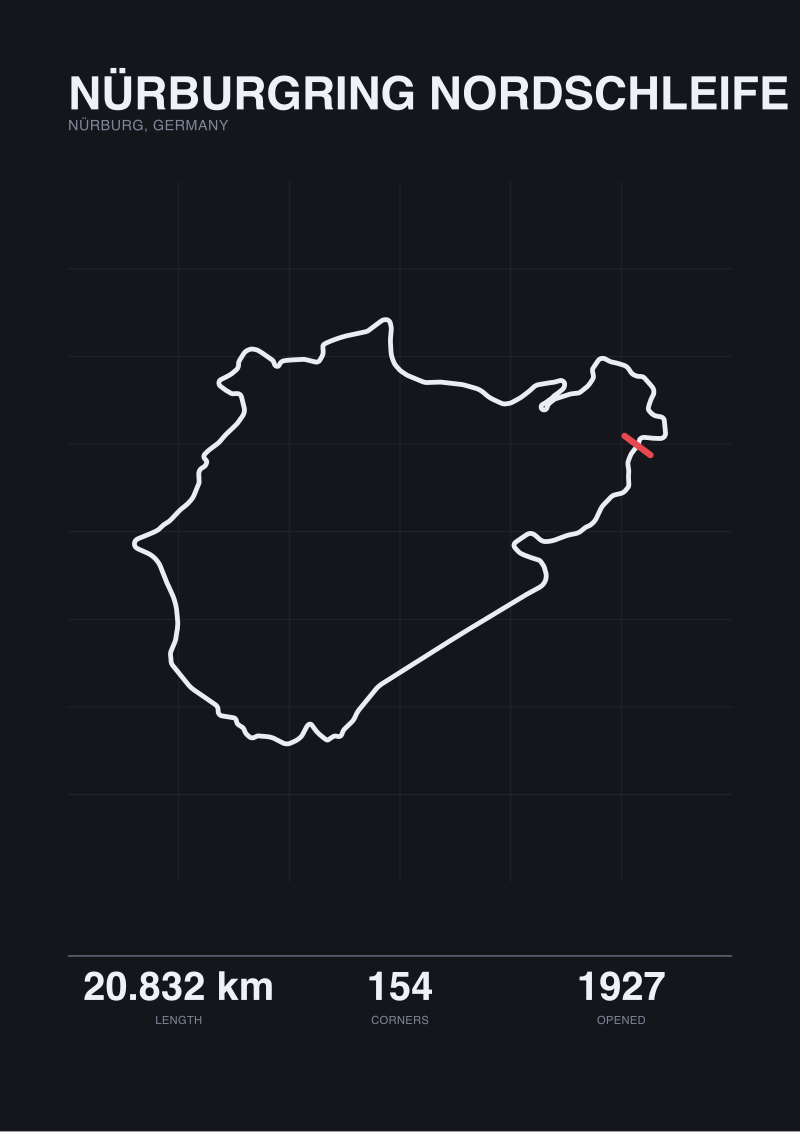 Nürburgring Nordschleife
The print from this article · from €29.95
View the print →
Nürburgring Nordschleife
The print from this article · from €29.95
View the print →
What I Would Say Instead
If we were briefing a reader who had never driven the road but wanted to understand it as an object, we would begin with the two numbers, and then immediately do what almost no article does: hold both of them up as claims requiring context.
The Nordschleife is 20.832 kilometres by the FIA-homologated measurement, and 20.746 kilometres when traced from public OpenStreetMap raceway data. The 86-metre gap is not an error. It is the space between two legitimate measurement methods. The homologated figure is the one used for lap records, timing verification, and any official comparison. The traced figure is what a mapmaker or a print studio would draw when honest about its source. Neither is the true length, because a road has no single true length independent of the line taken along it. This is the first thing to know, and it dissolves half the arguments the reader has ever seen online.
The circuit has 154 turns by the conventional count. That count is a naming tradition. If someone tells you the Nordschleife has 154 corners, they are telling you the number of named or numbered direction changes in the standard reference tally. They are not telling you a geometric fact derived from a stated algorithm. This distinction sounds pedantic until you notice that lap-time analysts, driver coaches, and simulator developers all use different corner-count conventions for different purposes. The 154 figure is journalistic shorthand. It is not, and cannot be, a measurement.
Beyond the two headline numbers, the argument we would make is that the Nordschleife's design language is legible only through its opening year. Nineteen twenty-seven predates almost every safety convention that defines modern circuit design. The layout was drawn as a scenic Eifel road first and a competition venue second. That order — road first, circuit second — is the interpretive key. It is why the corners follow the terrain instead of the terrain being flattened for the corners. It is why the public toll sessions have persisted for a hundred years. It is why every attempt to compare the Nordschleife to a permanent purpose-built circuit produces a category error, and why the comparisons keep being drawn anyway.
The number to remember, if you must remember one, is not 20.832 or 154. It is 1927. The opening year sets the terms for every measurement, every corner, every design decision downstream, and it is the one figure that never appears in the headline of any article we read. Read the Nordschleife as a 1927 road that was allowed to become a circuit, and the geometry stops being mysterious. Read it as a purpose-built race track and you will spend a decade puzzled by why it does not behave like one.
FAQ
Why do different sources give different lengths for the Nordschleife?
Because length depends on method. The FIA-homologated figure of 20.832 km follows an authorised racing line. A tracing from OpenStreetMap raceway data — the kind a mapmaker or a print studio would use — comes out at 20.746 km. That 86-metre difference is not an error on either side. It is the space between an official racing-line measurement and a centreline traced from public map geometry. Both figures are legitimate; they answer different questions.
How many corners does the Nordschleife have, and is 154 exact?
The widely-quoted figure is 154 turns, and that is the convention we would use in an article. It is not, however, the output of a defined algorithm. Corner counts on the Nordschleife come from a naming tradition — the number of named or numbered direction changes in the standard reference tally — rather than a geometric measurement with a stated minimum radius. Depending on the counting rule, you can defensibly reach a higher or lower figure.
When did the Nürburgring Nordschleife open, and why does that year matter?
The circuit opened in 1927. That date is the single most important piece of design context, because it predates most of the modern safety and layout conventions that shape circuits built after the 1970s. The Nordschleife was drawn as a scenic Eifel road first and a race venue second, which is why its corners follow the terrain rather than the terrain being reshaped around them. Every downstream comparison to purpose-built circuits inherits that fact.
Is the Nordschleife a race track or a public road?
It is both, and treating it as only one is where most explainers go wrong. The Nordschleife hosts scheduled competitions and lap-record runs, and it also operates as a public toll road during dedicated sessions where anyone with a road-legal vehicle can drive it. That dual identity shapes its maintenance regime, its barrier philosophy, and the reason its layout has been preserved rather than modernised in the way permanent-only circuits typically are.
Which length figure should I use when comparing lap times?
Use the homologated 20.832 km. Any official record, sector-time comparison, or FIA-recognised benchmark is calculated against that measurement, so mixing it with a traced or centreline figure will produce an apples-to-oranges result. The 20.746 km map-traced length is the correct one for cartography, print, and analytical work where the source geometry needs to be transparent — not for timing.
From the collection
New circuits and 10% off your first print.
One email now with your code. No noise after.