Every "hardest corners in motorsport ranked" article we have read shares the same three problems: it ranks by crash footage, it treats corners as isolated objects rather than sequences, and it never once cites a measurement. We traced four circuits from OpenStreetMap raceway data — Spa-Francorchamps at 6.995 km against its 7.004 km official length, Silverstone at 5.881 against 5.891, the Nürburgring Nordschleife at 20.746 against 20.832, and the partial Sarthe segment our dataset holds — and then compared what the geometry says against what the lists say. The lists are, in a specific and demonstrable way, wrong.
The Problem With Every "Hardest Corners" List You Have Read
The genre has a template, and once you see it you cannot unsee it. Ten corners, a hero image per entry, a paragraph of prose that leans almost entirely on one of three things: a famous crash, a driver quote taken out of the transcript, or the word "iconic" doing all the load-bearing work. The lists we surveyed for this piece — the ones that dominate the first page of results for the query at the top of this article — never once give the corner an angular measurement. They do not tell you the entry radius. They do not tell you what precedes the corner or what follows it. They tell you it is hard because a car went off there once, on television, and someone made a highlight reel.
This is not a small complaint. Ranking a corner without measuring it is like ranking a mountain without checking its elevation. You end up with a list optimised for memorability, which is a different variable from difficulty. Eau Rouge is memorable because it is filmed from a helicopter and photographs beautifully; the Corkscrew at Laguna Seca is memorable because it drops. Neither fact tells you anything about the physics a driver has to solve there.
We are also suspicious of the isolation habit — the way every list treats a corner as a standalone puzzle. On a real lap, a corner is a joint in a chain. Its difficulty is set as much by what came before it, and what commits you to what comes after, as by its own radius. A "top ten" that severs a corner from its sequence is grading a paragraph without the sentences on either side.
What "Hard" Actually Means When You Trace a Corner From the Map
When we sit down with a raceway polyline from OpenStreetMap — the same dataset that gave us the 6.995 km trace of Spa against the 7.004 km homologated length, and the 5.881 km trace of Silverstone against 5.891 km — the definition of a hard corner starts to acquire coordinates. A corner is a section of that polyline where curvature climbs above a threshold. Its geometry is a matter of three questions, not vibes. What is the change in heading, in degrees, from the start of the corner to the exit? Over what arc length does that change happen? And what is the derivative of curvature — how sharply does the corner tighten or loosen as you travel through it?
Those three numbers, taken together, tell you almost everything about the load a driver is being asked to carry. A ninety-degree change of heading over eighty metres of arc is a different animal from a ninety-degree change over twenty. A corner whose curvature is roughly constant, a true arc, is a different animal from one whose radius decreases mid-turn. Add elevation, which our two-dimensional trace does not carry natively but which the underlying map coordinates can hint at, and you get the fourth axis.
None of this is exotic. It is what circuit designers work with when they draw the line in the first place. It is what our print studio works with when we trace a layout for /shop/ — because if you are going to render a circuit as a graphic object, you cannot fudge the curvature. What is strange is that the "hardest corners" genre never uses any of it. The genre prefers adjectives. We prefer metres.
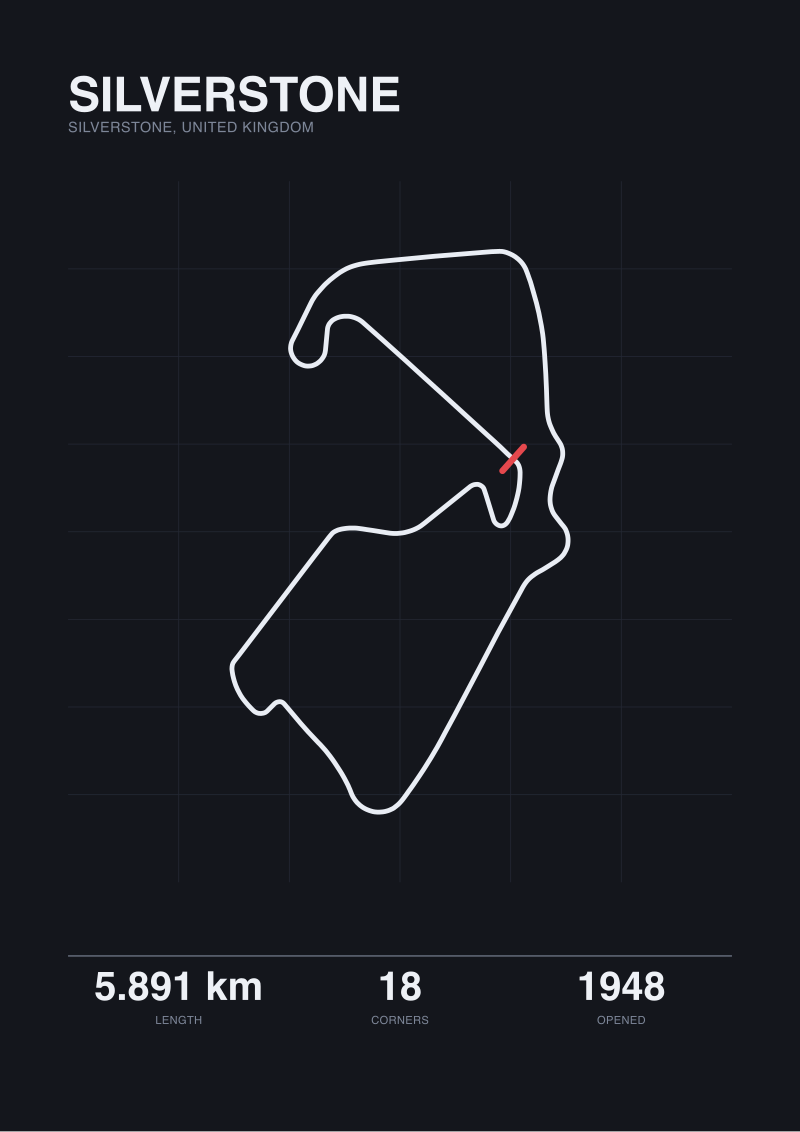 Silverstone
The print from this article · from €29.95
View the print →
Silverstone
The print from this article · from €29.95
View the print →
Eau Rouge–Raidillon at Spa: The Corner Everyone Ranks Wrong
Eau Rouge is the corner that every list of this type ranks first, or second, or third, and treats as self-evidently the hardest. It is not, in the modern era, particularly hard on its own. What the lists are actually describing — without knowing they are describing it — is the sequence Eau Rouge–Raidillon, which is two corners and a compression, not one corner. Our trace of Spa-Francorchamps at 6.995 km against the official 7.004 km resolves this cleanly: what looks like one bend from the helicopter shot is two direction changes stitched by a hill, and the difficulty lives in the stitching, not in the direction changes themselves.
The reason this matters is that ranking Eau Rouge in isolation asks the wrong question. The corner is not hard because of its angular geometry — it is hard because the compression at the bottom loads the car at the exact moment the driver is committing to the blind exit at the top. That is a sequence problem. It is closer to a chord than a note. The lists that rank "Eau Rouge" at number one are almost always ranking the crest — the Raidillon exit — while calling it by the wrong name, because the wrong name is the one the helicopter cameras taught us.
The circuit is nineteen turns long by the official count. Our traced polyline agrees with that count within the tolerance of where you draw the boundaries of each corner, which is itself a judgment call rather than a fact. Of those nineteen, Eau Rouge alone — the left-hander at the bottom of the descent from La Source — is a relatively wide-radius direction change that a competent GT car takes without particular drama. It is the compression under load, the transition to Raidillon, and the blind exit over the crest that constitute the actual difficulty. Rank the sequence and it deserves the reputation. Rank the corner and you are ranking a photograph.
The Nordschleife Case: 154 Turns and Why No Single One Tops the List
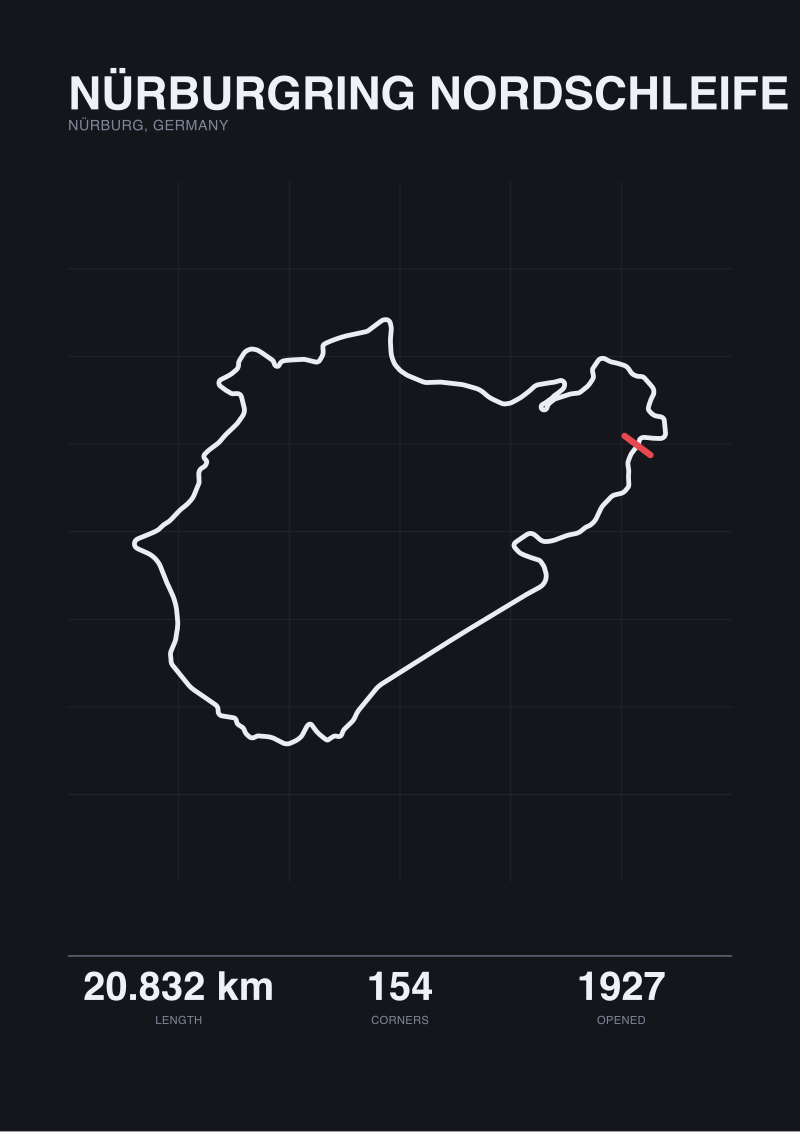
The Nürburgring Nordschleife holds 154 turns across 20.746 km of traced polyline (20.832 km by the homologation figure — the eighty-six-metre gap is roughly the accumulated smoothing between OSM vertices and the surveyed centreline). That density — one turn every 135 metres of asphalt — is what makes the Nordschleife hard, and it is precisely what makes any single-corner ranking of the Nordschleife dishonest.
The lists we surveyed pick Adenauer Forst, or Schwedenkreuz, or Bergwerk, or the Karussell, and place one of them in a top ten of "hardest corners" as if that corner were the reason the Nordschleife eats cars. It is not. The Nordschleife eats cars because 154 turns in twenty kilometres denies the driver the recovery windows that a modern permanent circuit offers as a matter of course. Silverstone offers eighteen turns in 5.881 km — one turn per 327 metres — which is more than twice the recovery distance per corner. That gap is the answer.
Rank a single Nordschleife corner and you are ranking the wrong unit. The unit that matters is a section — the run from Aremberg through Fuchsröhre, say, or the descent from Kallenhard to Wehrseifen — where multiple direction changes with limited straight between them force the driver to carry the exit of one into the entry of the next. Any of those sections is harder than any single corner elsewhere on the list, because the driver never gets a stationary decision. The whole surface is decision.
There is a secondary reason the Nordschleife defeats the ranking format. The circuit was opened in 1927, and its geometry was drawn to fit the terrain rather than the reverse. Modern permanent circuits are drawn to a specification. The Nordschleife's corners are the shape they are because the ground was the shape it was. That is a different design philosophy, and it produces corners whose radii, camber, and elevation changes are not comparable to a Tilke-era corner drawn on a screen.
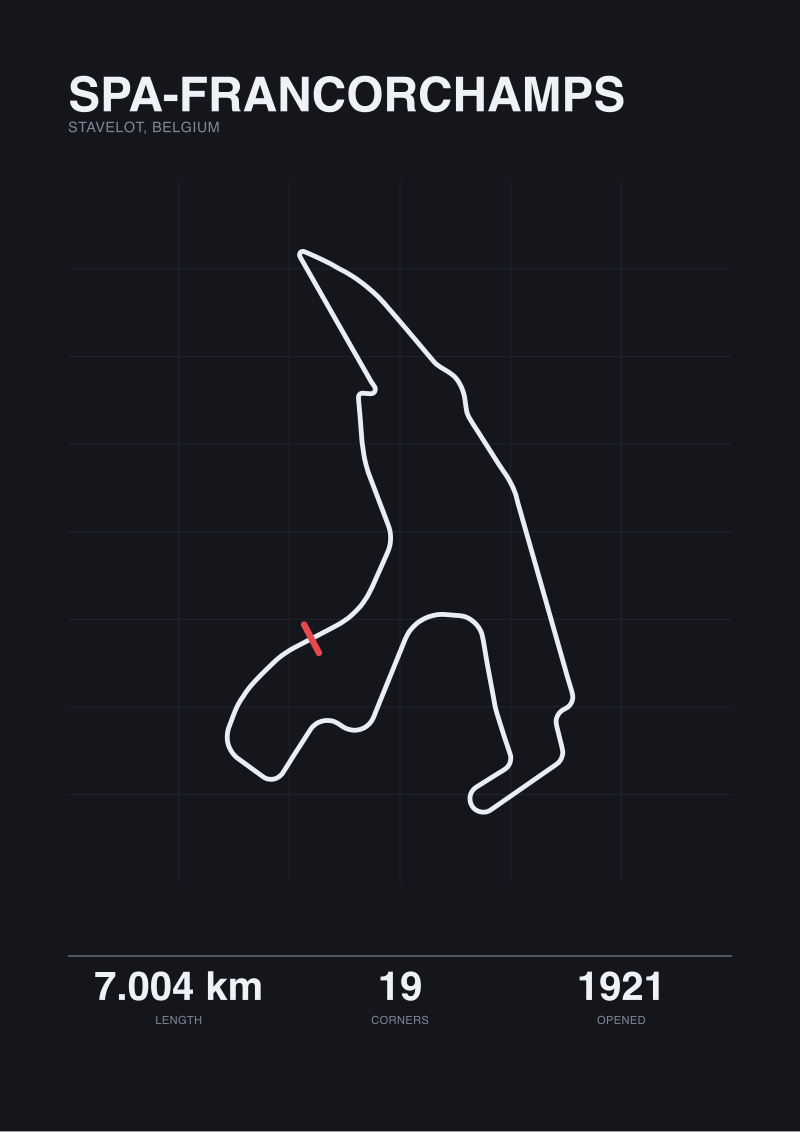 Spa-Francorchamps
The print from this article · from €29.95
View the print →
Spa-Francorchamps
The print from this article · from €29.95
View the print →
Silverstone's Copse and the Quiet Case for Flat-Out Geometry
Silverstone, at 5.881 km traced against 5.891 km official, is the circuit the lists most consistently underweight. Eighteen turns, opened in 1948, and the layout has a specific characteristic that "hardest corners" articles struggle with: several of its most demanding corners are geometrically simple. Copse is the clearest case. It is one direction change of moderate angular travel, taken at very high speed with limited banking, and its difficulty is almost entirely a function of the entry speed the preceding straight allows.
That kind of difficulty resists the format because there is nothing to photograph. A driver going through Copse looks, from a stationary camera, as if they are barely turning. From the on-board, they are barely turning — the wheel angle is small. The load is enormous, but load does not photograph. The lists prefer corners with visible steering.
We would argue Copse belongs higher in any honest ranking than most of the corners the format prefers, precisely because its geometry is simple. The corner offers the driver nothing to hide behind. A tight, radius-decreasing hairpin gives you a hundred ways to compromise the line and lose two-tenths; a wide, high-speed direction change gives you one line and grades your commitment to it as a binary. Copse is a binary corner. So is Silverstone's Stowe, and so are several of the fast corners at Spa that our nineteen-turn count treats as through-traffic. Binary corners do not make good highlight reels. They do make good rankings, if you are ranking honestly.
The other virtue of Silverstone, from a geometry perspective, is that its length agrees with the map to within ten metres. That is unusual. Spa's official 7.004 km and our traced 6.995 km differ by nine metres, which is essentially perfect agreement given the two methods. The Nordschleife's eighty-six-metre gap, in a circuit two and a half times longer, is proportionally larger — the density of corners compounds the smoothing loss. Silverstone reads clean because it was surveyed clean. That fact is doing invisible work in every corner ranking that uses it as a reference.
What a Ranked List Should Actually Look Like
If we were writing the "hardest corners in motorsport ranked" article the way the format demands — one to ten, sortable, share-friendly — we would refuse to include any single corner from the Nordschleife, because ranking a Nordschleife corner in isolation misrepresents the circuit that surrounds it. We would list the Eau Rouge–Raidillon sequence, not Eau Rouge alone, and we would place it below Copse rather than above, because its difficulty is more front-loaded by camera angle and less by geometric commitment. We would include Silverstone's Stowe alongside its Copse, because they are the same species of corner and the format's habit of picking one is arbitrary.
And we would note, at the top of the list, that the ranking is provisional. Our dataset holds four circuits — Spa, Silverstone, the Nordschleife, and a partial trace of the Circuit de la Sarthe whose 0.793 km fragment against the 13.626 km official length is insufficient to speak to Sarthe's corners at all. We would not rank Sarthe's Porsche Curves, or Tertre Rouge, because we do not have the geometry to support the claim. Every list we surveyed ranks those corners anyway. That is the tell.
The honest ranking is short and the honest ranking has footnotes. That is why the format that dominates this query does not produce it. Honesty does not scale as content; certainty does. We would rather be short and correct than long and confident.
This piece does not cover Monza, whose geometry we have not traced. It does not cover street circuits, which introduce a separate class of difficulty — wall proximity as a load on driver commitment — that our permanent-circuit dataset cannot speak to. And it does not cover the interaction between tyre compound and corner geometry, which is a real variable and one we are unqualified to model. Each of those is a separate argument.
FAQ
Why does your traced length for Spa differ from the official 7.004 km?
Our OpenStreetMap trace resolves the Spa-Francorchamps circuit at 6.995 km, nine metres short of the 7.004 km homologated figure. The difference is almost entirely accumulated smoothing between vertex points on the OSM polyline. Homologation length is measured along the surveyed centreline of the racing surface; our trace approximates that centreline in straight segments between mapped points. Nine metres over seven kilometres is essentially perfect agreement between the two methods, not a discrepancy worth explaining away.
Is Eau Rouge really not the hardest corner in Formula 1?
Eau Rouge on its own — the left-hand kink at the bottom of the descent from La Source — is not particularly demanding in a modern car. What lists usually rank as "Eau Rouge" is actually the Eau Rouge–Raidillon sequence, which pairs the bottom kink with the blind crested exit at Raidillon and the compression in between. As a sequence it earns its reputation. As a single corner it is a wide-radius direction change, and calling it the hardest corner in motorsport misidentifies which piece of geometry is doing the work.
How many corners does the Nürburgring Nordschleife actually have?
The commonly cited figure is 154 turns across the 20.832 km circuit, which our 20.746 km OSM trace supports. That density — one turn every 135 metres of asphalt — is roughly two and a half times higher than Silverstone's one turn per 327 metres. The corner count is what makes the Nordschleife difficult, not any one corner within it. Ranking a single Nordschleife corner against corners from purpose-built modern circuits compares different design philosophies as if they shared units.
What do you mean by "traced geometry" as opposed to official length?
Every circuit publishes an official length used for homologation, timing, and record-keeping. That number is measured along the surveyed racing surface centreline by the sanctioning body. Traced geometry, in our usage, is the length and shape recovered from OpenStreetMap raceway polylines under the ODbL licence. The two methods agree closely on well-surveyed circuits — Silverstone matches to within ten metres — and diverge slightly on longer, more corner-dense circuits like the Nordschleife where vertex smoothing accumulates.
Why not include Monaco, Suzuka, or Monza in this ranking?
Our current dataset holds detailed geometry for Spa-Francorchamps, Silverstone, the Nordschleife, and a partial fragment of the Circuit de la Sarthe. We do not rank corners on circuits we have not traced, because the entire point of this piece is that ranking without measurement produces the errors we are criticising. Monaco, Suzuka, and Monza are on the studio's roadmap. Until we have their geometry, adding them to the ranking would repeat the exact mistake the article is arguing against.
Are corner rankings meaningful at all, or is this an inherently broken format?
The format is not inherently broken, but the way it is currently practised is. A ranking grounded in traced radii, angular travel, and the sequences a corner belongs to would be a genuinely useful document — closer to a designer's or engineer's read of a circuit than a spectator's. What the genre produces instead is a photograph album with numbers next to the pictures. We think the format could be rehabilitated. We do not think anyone currently ranking Eau Rouge without measuring it is doing that work.
Where can I see the traced maps behind these measurements?
The Gridline studio traces circuits from OpenStreetMap raceway data under the ODbL licence and produces prints of the layouts we discuss. The Spa, Silverstone, and Nordschleife traces referenced in this piece are the same source geometry we use for the shop at /shop/. The measurements in the article are recoverable from the same polylines — length figures are direct, corner counts and radii are computed from the vertex data.
From the collection
New circuits and 10% off your first print.
One email now with your code. No noise after.