The Nürburgring Nordschleife opened in 1927. Spa-Francorchamps in 1921. Silverstone in 1948. Between them they hold most of the intellectual weight of the last century of European motor racing, and not one of them, in its original form, had what a modern circuit designer would recognise as a runoff area. Gravel traps, controlled asphalt runoff, tyre-barrier arrays, catch fencing — all of that is later engineering, layered on top of geometry that was drawn when the assumption was that if you left the track, you were going to hit something soon. This piece is a flowchart. We will ask three questions about a corner. Each answer will route you toward a different runoff decision. At the end there is a table.
Question 1: Does the runoff need to stop the car, or just slow it down?
This is the question most amateur commentary on circuit safety collapses. "Gravel is safer than asphalt" and "asphalt is safer than gravel" are both category errors — they answer a question the corner has not been asked yet. The first question is whether the runoff exists to arrest the car (retention), or exists to bleed speed so a barrier does the arresting under manageable conditions (deceleration).
The distinction matters because gravel and asphalt do genuinely opposite things. Gravel is an uncontrolled decelerator: the driver stops steering, stops braking meaningfully, and the surface does the work. Asphalt is a controlled decelerator: the driver keeps braking, keeps steering, keeps agency. Which one belongs at a corner depends entirely on what sits past the runoff.
If Yes — the corner has a hard wall or a public road 40 metres past the tarmac edge
You need retention. The car must stop, and it must stop reliably, because the alternative is impact at high delta. The historical answer is gravel, and gravel is still valid here for cars where it works. The modern answer is gravel *plus* a tyre-and-conveyor-belt or TecPro barrier at the far edge — the gravel bleeds most of the energy, the barrier absorbs the residual. Neither element does the job alone. Asphalt runoff in this scenario is only viable if the runoff is wide enough that the driver can brake to a stop before the wall, which at high-speed corners often means over 100 metres of clean tarmac. That real estate does not exist at circuits like Spa's original Eau Rouge context, or anywhere on the Nordschleife.
If No — there is generous open space or a soft catch fencing arrangement past the runoff
You do not need retention. You need deceleration and driver agency. Asphalt is the correct answer, because asphalt lets the driver do what they are already good at — braking and steering — instead of removing that agency at the exact moment they need it most. Wide asphalt runoff is what most modern permanent circuits look like today, not because gravel failed, but because at corners with sufficient space, asphalt lets a mistake be managed rather than arrested.
Question 2: Will open-wheel or prototype cars — anything with a flat, ground-effect floor — race here?
Why this question exists at all is the single most under-explained fact in circuit safety discourse. Modern F1 cars, LMP and LMH prototypes, and increasingly some Formula 2 and Formula 3 designs, generate downforce partly through a flat underbody. That flat floor, when it enters a gravel trap at speed and at an angle, does something a road car does not do: it compresses the gravel beneath it into a wedge, and the wedge launches the car. The car ceases to be a decelerating object and becomes an aerodynamic projectile.
This is not a hypothetical. It has been observed enough times in the last two decades that FIA Grade 1 circuit design has quietly moved away from gravel at the highest-speed corners of tracks that host these cars.
If Yes — the corner will see flat-floor cars
Gravel becomes a hazard, not a safety feature. The runoff of choice at these corners is asphalt, sometimes with a gravel bed installed further out (past the asphalt) as a secondary decelerator for cars that get through the tarmac zone. Silverstone's high-speed corners are the reference here — the geometry we traced runs 5.881 kilometres and hosts everything from F1 to touring cars, and the runoff arrangements at Copse and Stowe reflect the flat-floor problem more than they reflect any romantic attachment to gravel.
If No — the corner sees only tin-tops, GTs, motorcycles, or historic cars
Gravel behaves as designed. Deceleration is predictable, retention is high, launch risk is absent. Motorcycle-primary circuits in particular tend to favour gravel because a rider sliding at 200 km/h across smooth asphalt is worse off than one sliding into a gravel bed — the friction profile is closer to what the rider's leathers are designed to handle, and the gravel absorbs the tumble rather than propelling it. Any argument that "gravel is universally obsolete" ignores this half of motor sport.
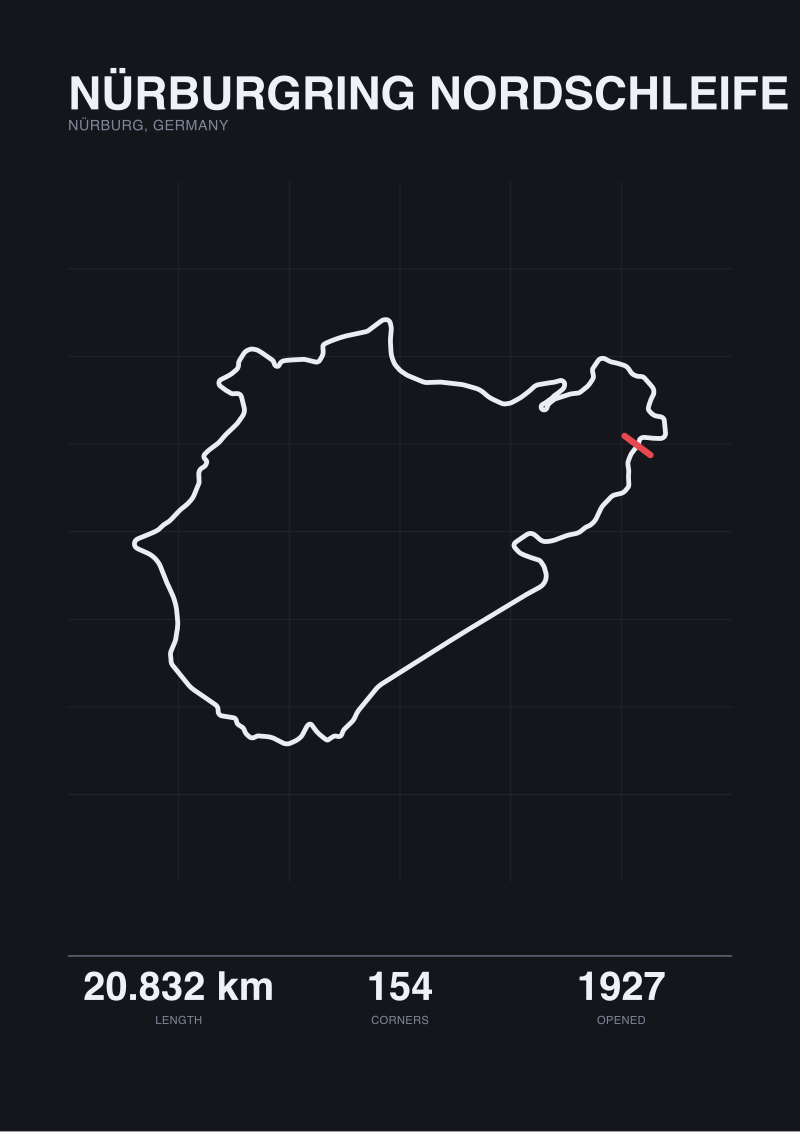 Nürburgring Nordschleife
The print from this article · from €29.95
View the print →
Nürburgring Nordschleife
The print from this article · from €29.95
View the print →
Question 3: Should a driver who runs off be able to rejoin the racing lap?
The third question is not really a safety question. It is a sporting philosophy question wearing a safety costume, and pretending otherwise is what has made the "gravel vs asphalt" debate so unproductive in the paddock press. Asphalt runoff is forgiving. Gravel is not. If the sporting position of the event is that a mistake should end your race, gravel enforces that position mechanically. If the sporting position is that a mistake should be punished by lost time but not by termination, asphalt is the mechanism that permits the softer punishment.
Neither position is safer than the other. Both are choices dressed as engineering.
If Yes — mistakes should be recoverable, and the sport favours continuation
Asphalt runoff, almost certainly with painted white-line demarcation to define track limits, and increasingly with physical deterrents installed to make abusing the runoff for pace unprofitable — sausage kerbs, high-friction strips, exit kerbs designed to unsettle a car that has crossed the line without earning the right to. The trend in modern F1 circuit design is precisely this: asphalt runoff plus punitive kerbing, so the runoff is soft physically but hard sportingly.
If No — a mistake should end the racing lap and be punished in full
Gravel, or asphalt into a proximate barrier. The endurance-racing constituency, and much of the traditionalist audience, argues this position on principle. It is a coherent position. It just should not be dressed as being about driver survival, because it is not.
If You Answered Everything
| Q1 (must stop car?) | Q2 (flat-floor cars?) | Q3 (rejoin allowed?) | Recommendation |
|---|---|---|---|
| Yes | Yes | Yes | Asphalt runoff into tyre-and-TecPro barrier; no gravel. Wide asphalt lets the driver brake and rejoin. |
| Yes | Yes | No | Asphalt runoff into proximate barrier; no gravel. The barrier does the sporting punishment. |
| Yes | No | Yes | Short asphalt zone into gravel bed into barrier. Multi-layer, flat-floor risk absent. |
| Yes | No | No | Classic gravel trap into tyre barrier. The 1980s standard, still correct for GT and endurance corners. |
| No | Yes | Yes | Wide asphalt runoff, punitive exit kerbing, no gravel. Modern F1 default. |
| No | Yes | No | Wide asphalt runoff into hard sporting deterrent (deep kerb or sausage kerb array). |
| No | No | Yes | Asphalt runoff with short gravel bed at outer edge. Multi-discipline compromise. |
| No | No | No | Gravel of moderate depth. The touring-car and endurance-corner classic, unchanged since the 1970s. |
None of these recommendations invents a solution — every combination in the table exists somewhere on a working circuit right now. The exercise is not to design a new runoff. It is to notice that different corners on the same circuit are answering different questions, and the runoff you see is the record of which answer the designer chose.
The forward question is not gravel versus asphalt. It is who gets to decide, corner by corner, whether a mistake ends the race or merely costs time — and whether that decision belongs to the circuit designer, the sanctioning body, or the philosophy of the discipline running that weekend. That is where the next argument starts, and it is not where this piece ends.
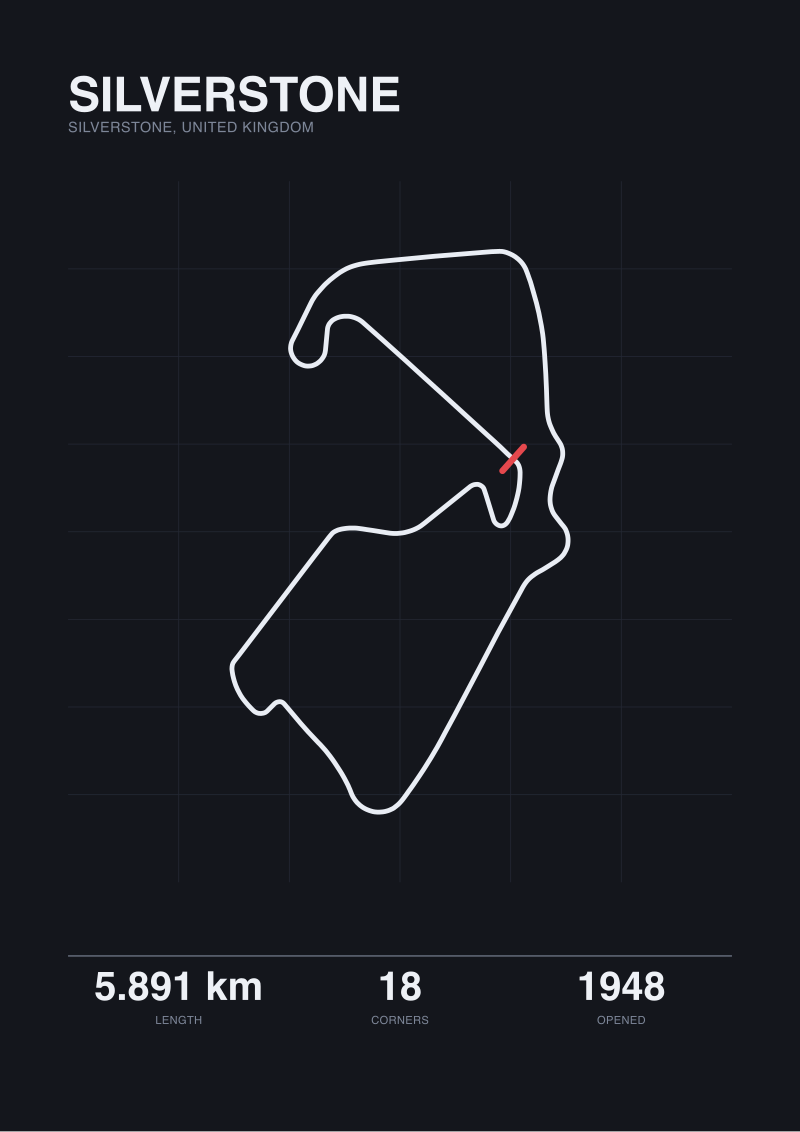 Silverstone
The print from this article · from €29.95
View the print →
Silverstone
The print from this article · from €29.95
View the print →
FAQ
Why do circuits like the Nordschleife not meet modern runoff standards?
The Nürburgring Nordschleife opened in 1927 and runs 20.746 kilometres by our traced measurement (20.832 kilometres by the circuit's own published figure) across 154 turns. It was drawn when runoff areas as a design category did not exist; the surrounding terrain — forest, embankments, Armco — was the boundary. It does not hold an FIA Grade 1 licence for top-tier single-seater racing. What safety modification has happened has been retrofitted piecemeal at specific corners, not applied uniformly.
Did asphalt runoff replace gravel because gravel was proven dangerous?
Not straightforwardly. Asphalt runoff spread through top-tier permanent circuits partly because of the launch problem with flat-floor cars, partly because it gave the driver continued agency at high speed, and partly because it allowed circuits to host multiple disciplines with different runoff needs on the same tarmac. Gravel was not "wrong". It stopped being the correct answer at specific corners that saw specific kinds of cars.
Why do gravel traps launch F1 cars but not touring cars?
Modern open-wheel and prototype cars run flat underbodies for ground-effect aerodynamics. When one enters a gravel bed at an angle, the gravel compresses under the flat floor and generates a lifting wedge that can rotate the car upward. Touring cars, GTs and road-based machinery have underbody clearance, exhaust routing and structural elements that break up any wedge before it forms. The physics is specific to the floor design, not to the speed.
Is the introduction of exit kerbs and sausage kerbs a safety measure?
Mostly it is a sporting measure. Asphalt runoff removes the natural penalty for running wide — the driver keeps their lap time, sometimes gains it. Sausage kerbs and aggressive exit strips restore a cost to abusing the runoff by unsettling the car mechanically. They are sometimes framed as safety features, but the operative logic is enforcement of track limits, not driver survival. Some of these installations have themselves been criticised for injury risk.
Why do motorcycle circuits often keep gravel where car circuits remove it?
A rider ejected at high speed slides. Asphalt at 200 km/h destroys leathers faster than gravel destroys the rider tumbling through it, and asphalt offers no controlled deceleration to a sliding body. Gravel absorbs the tumble, decelerates the rider under friction their equipment is engineered for, and reduces the distance travelled before contact with any barrier. The two disciplines are protecting different physics with the same real estate.
Do modern permanent circuits still install any new gravel traps?
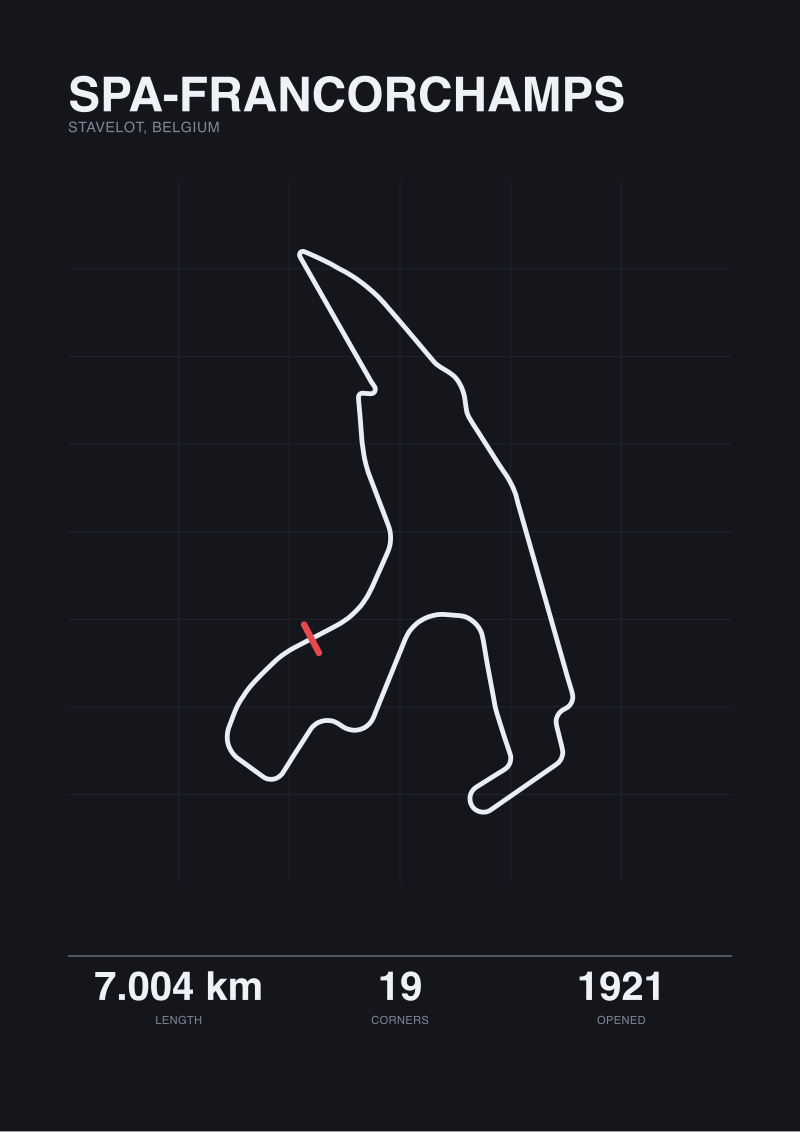
Yes, particularly at corners where retention matters, where the runoff will not receive flat-floor cars, or where a specific discipline hosted at the venue prefers gravel behaviour. Spa-Francorchamps at 6.995 kilometres by our trace, with 19 turns, is a circuit that has repeatedly revisited the gravel-versus-asphalt question at individual corners and answered it differently depending on what the corner sees. The answer at one corner is not the answer at all of them.
What is the actual purpose of a gravel trap, then, if not to stop the car?
To bleed speed under uncontrolled deceleration so that a barrier further out — tyre wall, TecPro, catch fencing — completes the arrest under conditions the barrier is designed for. The gravel does the middle third of the work. Treating the gravel as the full stopping solution is what produced the mid-1990s designs that later required modification. The gravel and the barrier are one system, and the debate about the surface is incoherent without the barrier in the same frame.
From the collection
New circuits and 10% off your first print.
One email now with your code. No noise after.