How did the corners we know become the corners we know?
We trace circuits before we draw them, and every trace runs across places where the geometry has stopped being neutral. A corner is only a corner until the day it decides something. Then it becomes a date. What follows is a timeline of five such places, read in order, with the metres of the surrounding track quoted where we have measured them and the official figures cited where our own map-trace does not agree with published homologation. The argument this timeline makes is simple. Danger, in circuit design, is not a property of the corner. It is a property of the corner and the car and the run-off and the year, held together. When one changes, the corner changes with it — even when the paint does not move.
June 1955: The Pit-Straight Approach at the Circuit de la Sarthe
The Circuit de la Sarthe is 13.626 kilometres by the homologated figure the race uses. Our own trace of it, drawn from OpenStreetMap raceway data, currently returns a defective read of well under a kilometre — a known artefact of how public-road sections are tagged around Le Mans, and the reason we quote the official length here without dressing it up. What matters for this entry is not the total, but the last few hundred metres of it: the run out of Maison Blanche, along the pit straight, past pit entry.
In June 1955, that run had no barrier separating cars from spectators and no separated pit lane. Cars decelerating to hand over to their pit crew shared the racing surface with cars still at full speed. The collision that put Pierre Levegh's Mercedes 300 SLR into the crowd occurred inside that hundred-metre compression. It killed more than eighty spectators and the driver.
The corner itself, as a shape, did nothing wrong. What the geometry could not absorb was the closing speed differential of mid-1950s prototypes and the physical proximity of the audience to the racing line. Motor sport did not respond to Le Mans 1955 by moving the pit straight. It responded by rewriting what a pit straight was allowed to look like. Every separated pit lane in every homologated circuit today is a descendant of that rewrite.
June 1966: The Masta Kink at the Fourteen-Kilometre Spa
The Spa-Francorchamps we trace today is 7.004 kilometres by the official figure and 6.995 by our map-trace, over 19 named turns, at Stavelot in Belgium. It has been that length since 1979. In June 1966 it was more than twice that — a 14-kilometre public-road loop that ran out through Malmedy and back past Masta, a small hamlet whose name attached itself to a fifth-gear left-right flick between two houses. The Masta Kink was, by geometry, a straight interrupted by two brief steering inputs. It was taken at speeds that made those two inputs a full-commitment decision.
On lap one of the 1966 Belgian Grand Prix, a sudden rainstorm hit the far side of the loop while the first section was still dry. Jackie Stewart's BRM aquaplaned at Masta, hit a telegraph pole and a woodshed, and came to rest with him trapped inside the cockpit, soaked in fuel that would not have needed much to ignite. He was cut out by two other drivers using a spanner borrowed from a spectator. There were no marshals, no ambulance, no medical facility within reach that could be called a facility.
Stewart survived. What did not survive that afternoon was the assumption that a circuit could be a public road with numbers painted on it. The Masta Kink is not on the map we trace now, because the road it belonged to was cut out of the racing loop in 1979. The corner is gone. The argument about it is why the modern shape exists.
July 1973: Woodcote and Silverstone's First-Lap Compression
Silverstone, in Silverstone in the United Kingdom, is 5.891 kilometres official and 5.881 by our trace, across 18 named turns, on a layout that opened in 1948 on a decommissioned RAF airfield. Woodcote, in the geometry of the 1970s Silverstone, was the last corner before the pit straight — a long, flat-out right-hander taken close to the physical limit of the tyre.
At the start of the 1973 British Grand Prix, Jody Scheckter lost the rear of his McLaren at Woodcote on the opening lap, spun across the racing line, and triggered a chain-reaction collision that eliminated nine cars and hospitalised Andrea de Adamich with leg injuries that ended his career. There was no chicane at Woodcote. There was nowhere for a car at that speed to go except into other cars.
By 1975, Silverstone had installed a chicane at Woodcote. The corner did not become slower because the drivers had lost their nerve. It became slower because a fast final corner leading directly onto a starting grid produced a compression the geometry could not otherwise absorb during a race start. The chicane era at Woodcote lasted long enough to change how designers thought about the last corner before any pit straight anywhere, and the current Silverstone layout still bears the argument in its shape.
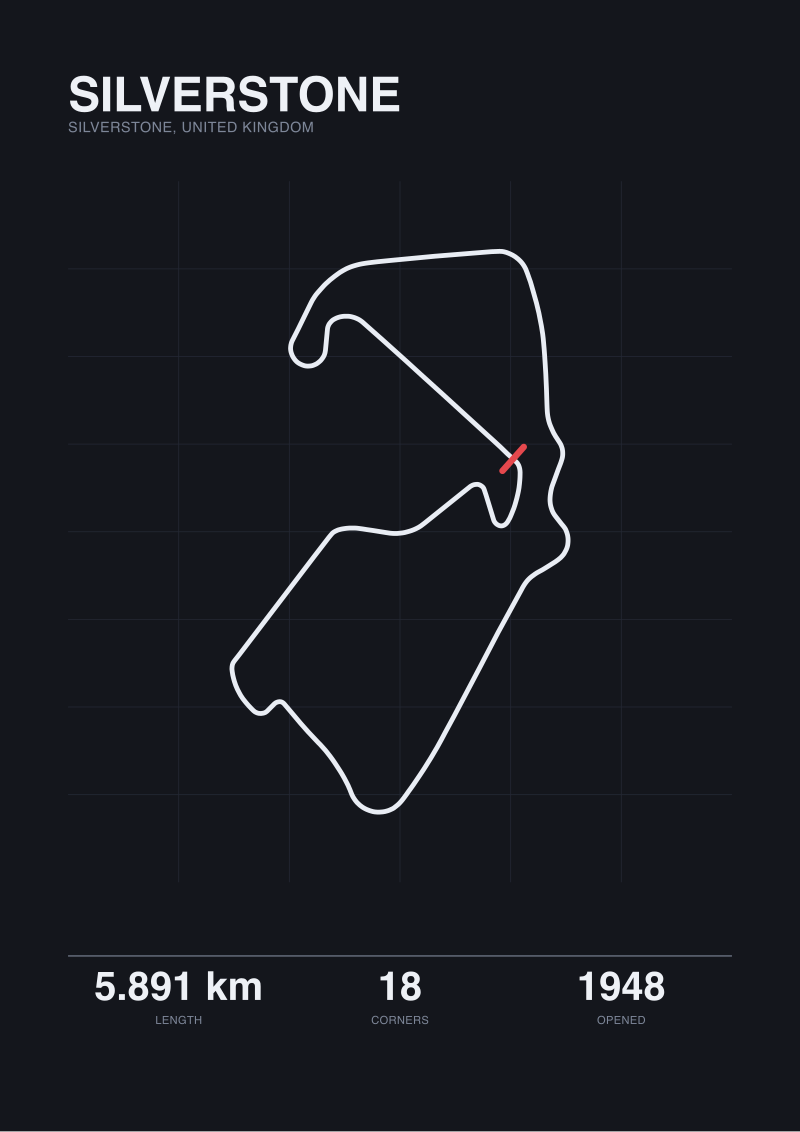 Silverstone
The print from this article · from €29.95
View the print →
Silverstone
The print from this article · from €29.95
View the print →
August 1976: Bergwerk on the Nordschleife
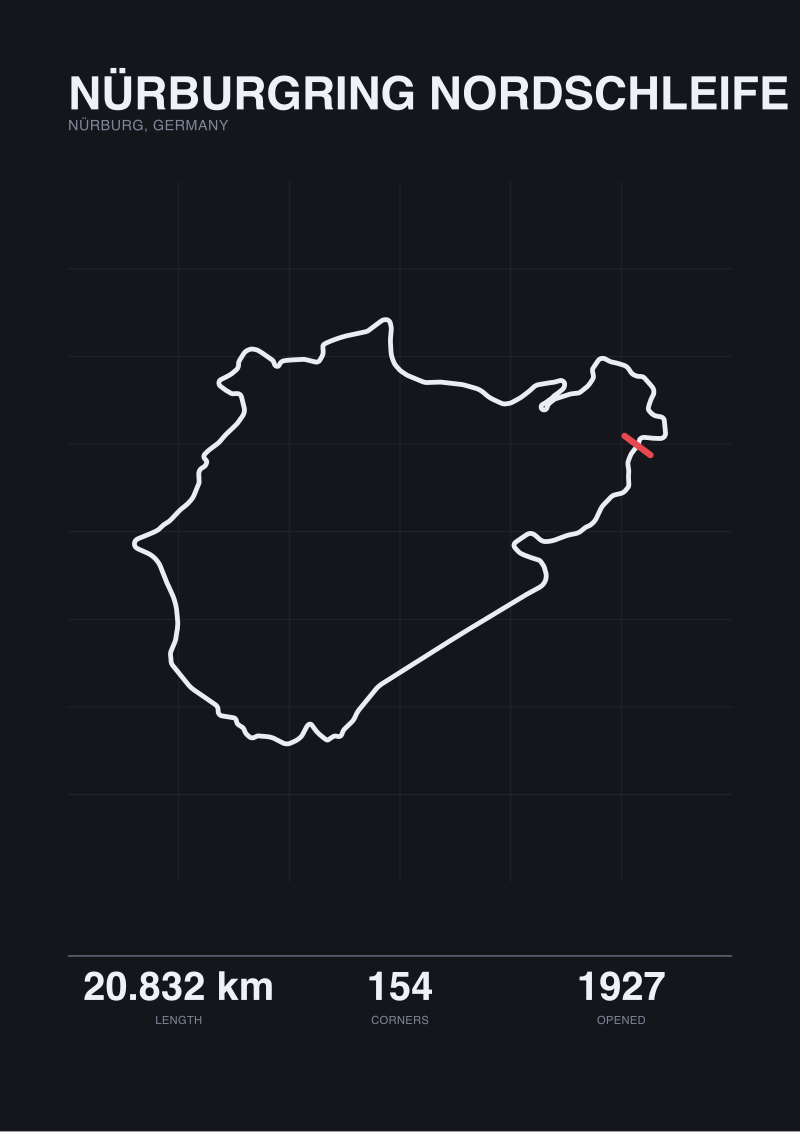
The Nürburgring Nordschleife is 20.832 kilometres by the official figure and 20.746 by our map-trace, over 154 named turns, at Nürburg in Germany, opened in 1927. Any reading of it as a modern circuit has to begin with the honest observation that no such circuit would be built today. It has more corners than most drivers can name, more elevation change than any current Grand Prix venue, and run-off that is measured in metres where a modern circuit would demand tens or hundreds.
Bergwerk is one of those 154 turns. In August 1976, Niki Lauda's Ferrari struck the outside catch fencing there, was collected by two following cars, and burned. Lauda survived because four other drivers stopped, unbuckled him, and pulled him out. The circuit had no medical intervention capacity anywhere near Bergwerk that could have replaced what those four drivers did.
Formula One did not race at the Nordschleife again. The Grand Prix moved to a purpose-built layout inside the Nürburgring complex, and the Nordschleife itself continued as a manufacturer test venue and endurance venue — its 154 turns intact, its official length unchanged, its status inside professional single-seater racing terminated by a corner that had been asking the same question of every car since 1927. The car finally answered it.
August 2019: Raidillon at the Modern Spa
The 7.004-kilometre Spa we trace today is defined, more than by any other feature, by what happens between Turns 2 and 5 — the descent to Eau Rouge, the compression, and the blind rise through Raidillon onto the Kemmel Straight. It is one of the few places on any modern circuit where the geometry itself creates a hazard: a fast, blind, uphill exit that hides whatever has happened just over the crest until the driver is already committed to it.
In August 2019, at the Formula 2 feature race, Anthoine Hubert was killed at Raidillon after his car struck the outside barrier at Eau Rouge, bounced back across the track, and was collected by a following car arriving over the crest at full speed. It was the first fatality at Spa in the modern configuration for many years, and it was not a failure of the run-off or the barriers in a conventional sense. It was a failure to absorb the specific problem of a blind, uphill, compression corner in which a stranded car cannot be seen in time.
Spa has since had the run-off at Raidillon extensively reworked, with an expanded gravel trap and revised barrier lines. The corner, as a shape, is still where it has been since 1921. What has changed is the accepted answer to the question of what has to sit on either side of it.
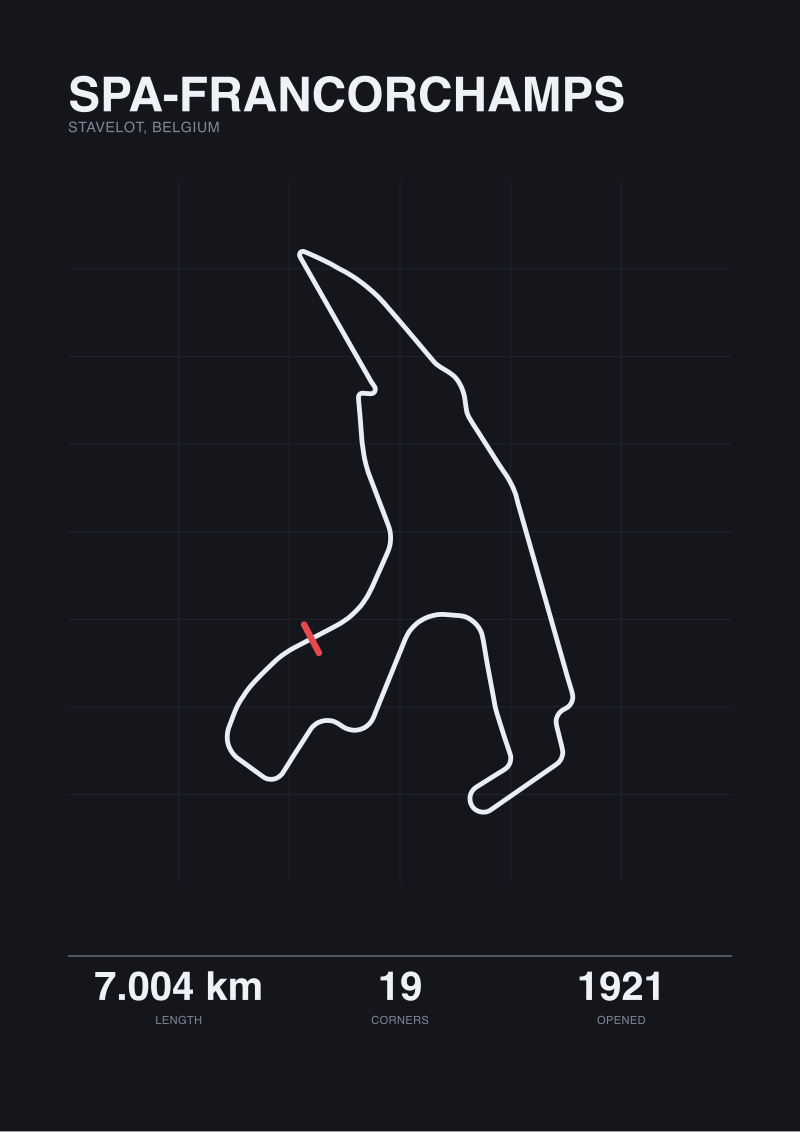 Spa-Francorchamps
The print from this article · from €29.95
View the print →
Spa-Francorchamps
The print from this article · from €29.95
View the print →
What It All Means
Read as a set, these five entries argue against the intuitive definition of a dangerous corner. None of these corners was, in a purely geometric sense, badly designed. The pit straight at the Sarthe was a straight. The Masta Kink was two very small steering inputs. Woodcote was a long, clean radius. Bergwerk is a slow right-hander after a long descent. Raidillon is a fast rise. The shapes themselves have all been raced through cleanly, tens of thousands of times, by drivers and cars that were correctly matched to what the geometry asked of them.
What the timeline actually shows is that a corner becomes dangerous when three things drift out of alignment at once: the closing speed of the fastest car in the field, the physical margin between the racing line and whatever is beyond it, and the sport's willingness to accept the resulting risk as normal. Every date in this piece marks a moment when that alignment broke — and the response, in each case, was to change one of the three variables so the corner could be raced again, or to conclude that no variable could be changed enough and stop racing that corner. The Nordschleife lost Formula One. The 14-kilometre Spa lost most of itself. Silverstone lost the pre-chicane Woodcote. The Sarthe kept its shape but gave up its shared pit surface. Raidillon kept its shape and expanded what sits beside it.
There is a temptation, when we draw these circuits at the studio, to treat the finished layout as an object handed down whole. It is not. Every current line on the map is the outcome of an argument that was, at some point, decided by a specific corner on a specific day. When we print a Spa or a Nordschleife or a Silverstone at the studio shop, we are printing the shape those arguments left behind — not the shape someone drew from scratch.
This piece does not cover the corners that killed drivers in categories below top-flight single-seaters, where the record is thinner and the geometry less standardised. It does not cover the fatalities that occurred on straights and pit lanes rather than at named corners, which are a distinct design conversation. And it does not cover the near-misses — the corners where the alignment came very close to breaking and did not, and where the argument for change was made without the date attached. Each of those is a separate timeline.
FAQ
Why not include a corner from Indianapolis or a modern American oval?
Ovals belong to a different design conversation. The four banked turns of an oval do not vary in geometry between events, and the fatality record there is driven overwhelmingly by wall angle, barrier compliance and closing speed on the straights rather than by the shape of the corner itself. The five entries above were chosen because each represents a moment when a specifically named, non-oval corner forced circuit design to change. Ovals deserve their own timeline, on their own terms.
Is the Nordschleife still legally used for racing today?
Yes. The 20.832-kilometre official layout still runs endurance racing — most visibly the 24 Hours of the Nürburgring — and remains open to the paying public on Touristenfahrten days. What ended in the 1970s was Formula One's willingness to race there. The circuit itself, its 154 corners and its elevation profile, is unchanged in essentials. Manufacturers use it as a road-car development benchmark for exactly the same reason F1 could no longer justify racing on it.
How much shorter is modern Spa than the 1966 Spa Jackie Stewart crashed on?
The current Spa-Francorchamps we trace at 7.004 kilometres official is less than half the length of the 14-plus-kilometre public-road loop that hosted the 1966 Belgian Grand Prix. The modern circuit was cut from a purpose-built section of the original loop in 1979, discarding the long run out to Malmedy and back past Masta. The Masta Kink itself is not part of any current racing layout.
Why does the Circuit de la Sarthe map-trace figure not match the official length?
The Sarthe uses long stretches of public road that are tagged differently in OpenStreetMap than dedicated raceway is, and our current tracing tool produces a defective read on the resulting network. Where the official homologated length of 13.626 kilometres and our trace disagree by that much, we cite the official figure and flag the disagreement openly rather than publish a number we cannot stand behind. This is a tooling limit, not a real disagreement about the geometry.
Has Raidillon at Spa been changed since 2019?
The corner itself — the descent through Eau Rouge and the uphill exit through Raidillon — has the same shape it has had for decades. What has been changed is the environment around it. The gravel trap on the outside of Raidillon has been expanded and the barrier lines revised to give a stranded car more room and to reduce the chance of a following car arriving at full speed on a still-blocked racing line. The design argument is that this specific class of blind uphill compression corner needs more absorption around it than a conventional flat corner does.
Is Woodcote at Silverstone the same corner today as in 1973?
No. The Woodcote that Jody Scheckter lost the rear of in 1973 was the flat-out final corner leading directly onto the pit straight. A chicane was installed there in 1975 in response to the pileup, and the wider layout has been reworked more than once since. The current Silverstone still uses the Woodcote name for a corner in that area, but its speed profile and its position relative to the pit lane are not the same object the 1973 accident happened on.
Why treat the 1955 Le Mans crash as a corner story if it happened on a straight?
Because the geometry that made the crash possible was the transition from the last corner into the pit straight, not the straight itself. The lack of separation between decelerating cars entering the pits and cars still at racing speed was a design decision about the run of asphalt between the final corner and the timing line. Every modern separated pit lane is a redrawing of that specific transition. Treating it as a corner story is more accurate to what the geometry actually decided that day than treating it as a straight-line story.
From the collection
New circuits and 10% off your first print.
One email now with your code. No noise after.