A circuit poster is not a decorative object with a track shape on it. It is a drawing that either respects the geometry of a real place or does not. The reader here does not need to be a designer, but they do need to understand nine terms — because those terms are what separate a Nordschleife print measured at 20.746 km from map data against one that simply prints the 20.832 km number from the homologation certificate and calls it a day. Both look similar at a glance. Only one is a trace.
Circuit Poster
A circuit poster, in our working definition, is a print whose ribbon geometry is drawn from a coordinate source, not sketched from memory of a broadcast overlay. The distinction matters because the two produce visually similar objects at 60 cm across, and only one of them survives being placed next to an actual map of the same site. Most prints on the market are the second kind: a stylised loop that reads as Silverstone or Spa because the reader has seen those loops on television, not because the drawing shares vertices with the tarmac.
The test is measurable. Overlay a real circuit poster on the raceway data from OpenStreetMap and the two ribbons should agree within a millimetre at print scale. A decorative print will drift by ten to twenty metres across a straight, and the drift will be visible without instruments. That drift is what this glossary is about.
Homologation Length
Homologation length is the number the governing body — FIA, ACO, national federation — publishes on the circuit's certification document. It is measured on the racing line, along a specific reference path, and it is the figure that appears in every regulation, every entry list, and every broadcast graphic. Silverstone's homologation length is 5.891 km. Spa-Francorchamps is 7.004 km. The Nürburgring Nordschleife is 20.832 km. Circuit de la Sarthe, the full Le Mans configuration, is 13.626 km.
These numbers are authoritative for competition. They are not, however, measurements of the tarmac's centreline as it exists on a map. Homologation is a legal and sporting quantity, produced by surveying instruments on a defined path with specified allowances. That is why a circuit poster that simply prints the homologation number is claiming precision it did not itself perform. It is quoting a document. A trace has to do its own arithmetic.
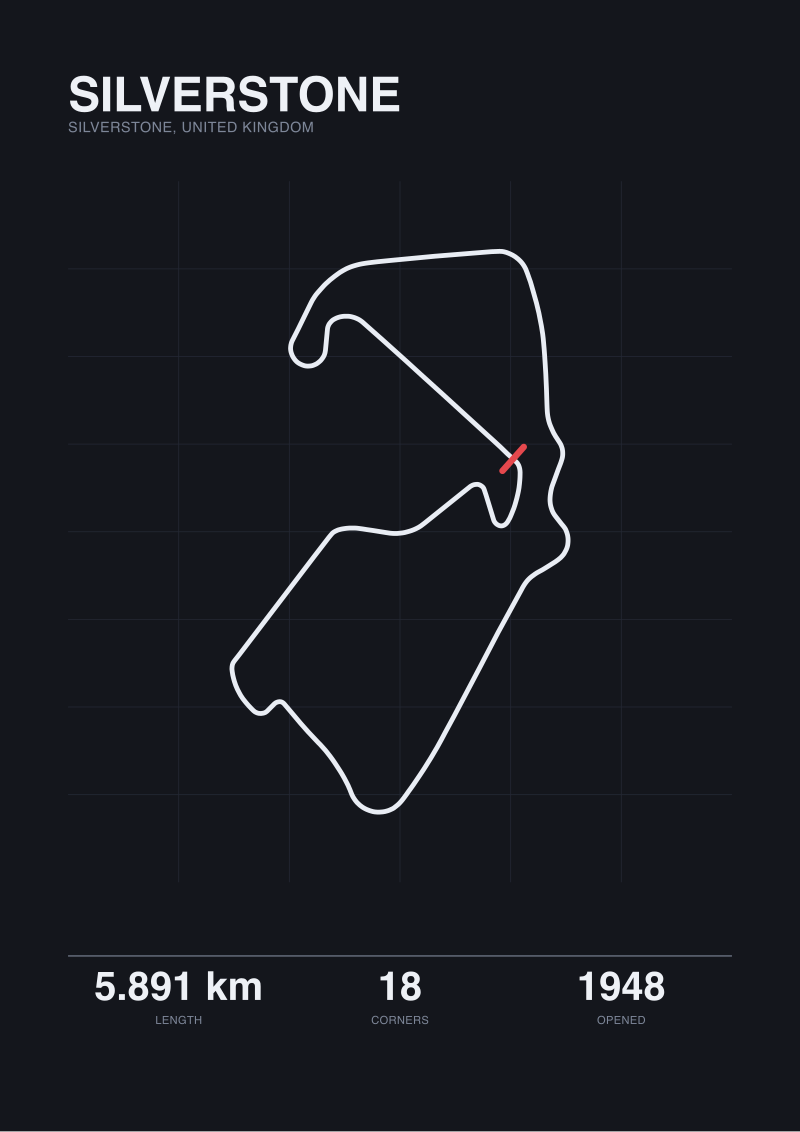 Silverstone
The print from this article · from €29.95
View the print →
Silverstone
The print from this article · from €29.95
View the print →
Map-Traced Length
Map-traced length is what we get when we take the raceway polyline from public map data and measure it end to end. It is a different measurement than homologation because it follows the centreline of the drawn feature, not the racing line, and because the map's vertex density and projection introduce their own small errors. For Silverstone the trace produces 5.881 km against a homologated 5.891 km — a 10 m gap on a 5.9 km circuit, or 0.17 percent. Spa-Francorchamps traces at 6.995 km against a homologated 7.004 km, a 9 m gap.
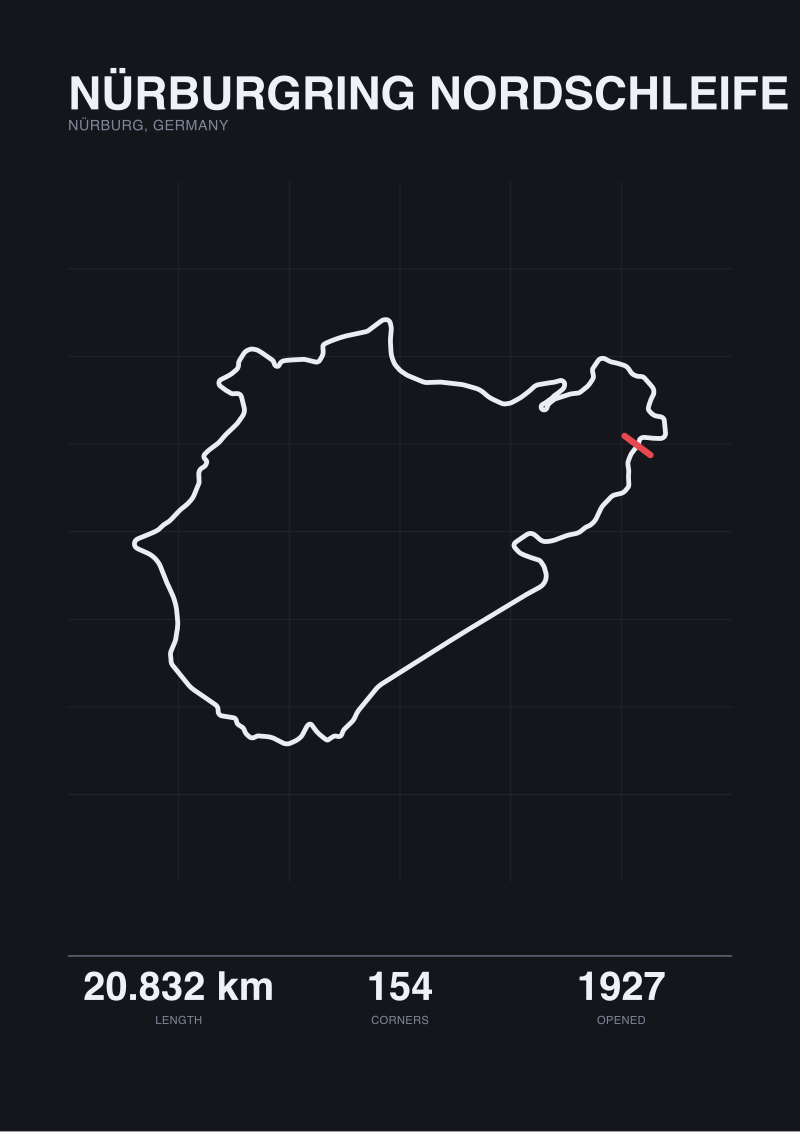
The Nordschleife traces at 20.746 km against a homologated 20.832 km. That is 86 metres over twenty kilometres, or 0.41 percent. These are the disagreements a trace is honest about. A print that lists 20.746 km is telling the buyer what its own geometry actually integrates to. That is the number our own work in the Gridline shop puts on the Nordschleife plate.
Raceway Geometry (OSM)
The geometry source for these traces is OpenStreetMap, specifically features tagged as raceway under the ODbL licence. OSM is not authoritative in the sense a national mapping agency is — it is a volunteer dataset — but for permanent racing circuits it is extraordinarily well surveyed, because circuits are precisely the kind of geometry that attracts obsessive mappers. The Nordschleife's ribbon has been walked, driven, and satellite-checked by dozens of contributors over more than a decade.
The licence matters. ODbL requires attribution and share-alike on derived data, which is why any circuit print derived from OSM has to name its source honestly rather than laundering the geometry. It also means the trace is auditable: anyone with a browser can pull the same raceway polyline, run the same length calculation, and check the number against the print. Homologation figures are not similarly re-derivable by the reader. The trace is falsifiable. That is its virtue.
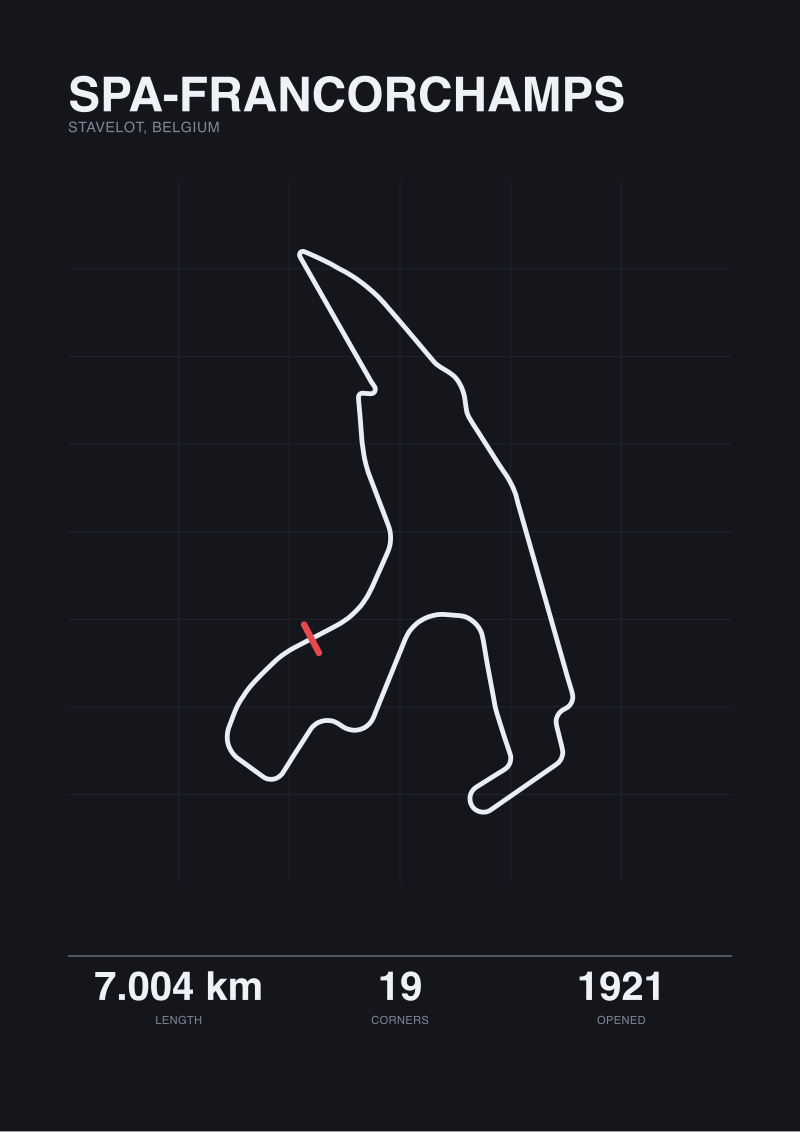 Spa-Francorchamps
The print from this article · from €29.95
View the print →
Spa-Francorchamps
The print from this article · from €29.95
View the print →
Corner Count
Corner count is the tally of distinct turns on the circuit, and it is the layout metric most likely to be quoted casually and defended fiercely. Silverstone's current layout has 18 turns. Spa-Francorchamps has 19. The Nordschleife has 154 — and the 154 figure is itself a convention, because a Nordschleife corner is not always separated from the next by a straight, and different sources partition the same ribbon into different counts.
For circuits with clean sequences of apex and exit, the count is stable. For circuits where the geometry is continuously curved, it becomes an editorial decision. A poster that prints "154 turns" for the Nordschleife is quoting the most widely accepted partitioning; a poster that prints "over 150" is admitting the count is a convention. Both are legitimate. A poster that prints "170" or "73" is either using a private taxonomy without saying so or making the number up. Corner counts are checkable. Ask the source.
Layout Vintage
Layout vintage is the year the circuit's current geometry was fixed, which is not the year the circuit opened. Spa-Francorchamps opened in 1921 and the Nordschleife in 1927 — but neither runs today on the layout it opened with. The modern Spa ribbon dates from a 1979 reconfiguration that cut the old road-course sections; the Nordschleife survived intact but the surrounding Gesamtstrecke did not. Silverstone opened in 1948 and has been re-profiled at least six times, most consequentially in 2010 when the Arena section was added.
For a circuit poster this matters because the geometry drawn is a specific snapshot. A Silverstone print of the pre-2010 layout is a different object than a post-2010 print, and neither is wrong — but which one it is has to be declared. Our convention: name the year of the layout the trace corresponds to, not the year the circuit opened. Opened 1948 is history. Layout 2010 is what the poster actually is.
Section View
Section view is what happens when a circuit is drawn not from above but from the side, showing elevation change along the ribbon. Plan view — the top-down loop — is the default poster geometry, but for circuits with significant vertical relief it hides the actual character of the racing. Spa-Francorchamps' plan is a stretched triangle; its section is a topographic argument, because the Ardennes plateau falls and rises across the ribbon in ways that make the Kemmel and Blanchimont segments read completely differently in elevation than they do from above.
A section-view poster requires an additional data layer: elevation samples along the raceway polyline, usually pulled from public terrain models. The trace becomes two integrations rather than one — horizontal distance and vertical distance — and the resulting drawing rewards the reader who already knows the plan. It is not the poster for someone learning what Spa is. It is the poster for someone who has driven it in a simulator for three hundred hours and wants the geometry told a second way.
Locality Anchor
Locality anchor is the name of the specific place a circuit belongs to, printed on the poster alongside the ribbon. Not the country. The town, the commune, the parish. Silverstone the circuit sits in Silverstone the village in Northamptonshire. Spa-Francorchamps as a circuit is administratively in Stavelot, not Spa — the town of Spa is 15 km north of the ribbon and gives the circuit only its name. The Nordschleife is in Nürburg, a village of about 150 permanent residents whose name is now used globally to mean the circuit rather than the place.
A poster that prints "Belgium" under Spa is treating the circuit as an idea. A poster that prints "Stavelot, Belgium" is treating it as a location. The second is the useful one, because it tells the buyer the ribbon is a real place with a postcode, not a broadcast graphic. It also settles the small fact that many enthusiasts get wrong: Spa-Francorchamps is not in the town of Spa.
Trace Discrepancy
Trace discrepancy is the gap between homologation length and map-traced length, and it is the single most useful diagnostic of a circuit poster's honesty. For well-mapped permanent circuits the gap is small and consistent — Silverstone at 0.17 percent, Spa at 0.13 percent, Nordschleife at 0.41 percent. Those numbers reflect vertex density, racing-line vs centreline, and the small survey allowances baked into homologation figures. They are not errors. They are the different questions the two measurements are answering.
Circuit de la Sarthe is where the diagnostic becomes loud. The homologated Le Mans layout is 13.626 km. Our current OSM trace of the raceway feature integrates to 0.793 km — a fragment, not the full ribbon. That is not a measurement disagreement. It is the map data being incomplete or partitioned across features we have not stitched. A trace that reported 0.793 km as the length of Le Mans would be lying. A trace that reports "Sarthe not yet complete: partial raceway coverage" is telling the buyer what the data actually supports. Both numbers exist in the same table. Only one is a length.
FAQ
How is a circuit poster's length actually verified before it goes to print?
The trace is computed from the raceway polyline in OpenStreetMap, integrated end-to-end, and the resulting figure is compared to the governing body's homologation number. A gap under half a percent — Silverstone at 0.17 percent, Spa at 0.13 percent, Nordschleife at 0.41 percent — is treated as normal disagreement between two different measurements. A gap larger than that triggers a re-check of the source geometry rather than a quiet reprint of the official number.
Why not just print the homologation number and be done with it?
Because that number is a document, not a measurement the print itself performed. A poster that prints 20.832 km for the Nordschleife is quoting the FIA; a poster that prints 20.746 km is reporting what its own drawn geometry integrates to. The two are close for a reason — good survey data — but they are answering different questions. A trace has to report its own arithmetic honestly, or it is not a trace.
What happens when the map data is incomplete, as with Circuit de la Sarthe?
Currently the OSM raceway coverage for the full Le Mans layout integrates to 0.793 km against a homologated 13.626 km. That is a data-completeness gap, not a measurement disagreement. The correct response is to state that the trace is partial and withhold the print rather than fabricate a length. Silence on a number the geometry does not support is more accurate than an invented figure.
Do broadcast track maps count as reliable sources for a trace?
No. Broadcast overlays are stylised for legibility at low resolution and often distort corner radii, straight lengths, and elevation change. They agree with the real geometry at the topology level — the sequence of turns — but not at the metric level. A poster derived from a broadcast graphic will drift ten to twenty metres from the real ribbon across a single straight, which is visible at print scale.
Why does the Nordschleife have 154 turns instead of a round number?
Because 154 is a widely accepted partitioning of a continuously curved ribbon, not a natural count. The Nordschleife has stretches where one corner runs into the next without a straight in between, and the decision to call that one turn or two is editorial. Different reference sources produce counts within a few units of 154. A poster quoting the figure is quoting a convention. A poster quoting a wildly different count is using its own taxonomy without disclosing it.
Does the year on a circuit poster refer to when the circuit opened?
It should refer to the layout vintage — the year the current geometry was fixed — not the opening year. Silverstone opened in 1948 but the current layout dates from the 2010 Arena reconfiguration. Spa-Francorchamps opened in 1921 but the modern ribbon dates from 1979. A poster that prints "1948" or "1921" without qualification is quoting history; a poster that also names the layout year is telling the buyer which geometry is drawn.
Is a section-view poster useful without a plan-view alongside it?
Rarely. A section view — the elevation profile along the ribbon — is a second reading of a circuit the viewer already knows in plan. Spa's plan is a triangle; its section is a topographic argument that only makes sense once the plan is memorised. For a first print of a circuit, plan view is the correct choice. Section view is the poster for the reader who has already spent hours with the plan.
From the collection
New circuits and 10% off your first print.
One email now with your code. No noise after.