Two corners. That is what most readers arrive asking about. The Arrabbiate at Mugello — turns 8 and 9 of fifteen, both right-handers, both taken at the fast end of the gearbox — sit inside a 5.245 km lap and account for roughly 13% of the corner count. The other 87% of the corner budget, and the several hundred metres of straight and rising asphalt that lead into them, is what makes those two corners possible. Read the Arrabbiate in isolation and they look like a fast double-right. Read them in context and they are the reason the rest of the lap is shaped the way it is.
Whether the Arrabbiate are the point of Mugello or the payoff of everything before them depends on where you are sitting. Onboard, they are a two-part heart-rate spike. Standing at the outside of the first one, they are a study in commitment. On a track map, printed and framed, they are the moment the lap draws its arc back toward the start line. We will walk through three ways to read them — the onboard viewer, the trackday driver considering an Italian week, and the reader who bought the layout as an object to study — and what each of those readers is actually seeing.
Scenario 1: The Onboard Viewer
Imagine a reader who has never driven Mugello and never will. Their exposure is helmet cam and TV cam, watched between other things, muted or not. When they type "mugello circuit layout arrabbiata corners" into a search bar, what they want to know is what they are looking at when the camera lifts, the horizon disappears, and the driver does not lift the throttle.
Here is what the onboard view is actually showing. Mugello runs 5.245 km. The Arrabbiate are the eighth and ninth of the fifteen turns. On camera, the moment usually starts one corner earlier, at Savelli — the left that sets up the Arrabbiata approach. From there, the car is pointed uphill and rightward toward the crest, and the driver has to make a decision that most road drivers never make: whether to lift for a right-hander they cannot see the exit of.
The two Arrabbiate are not identical. Arrabbiata 1 (Turn 8) and Arrabbiata 2 (Turn 9) are both taken to the right, both taken fast, and both taken with the track rising and falling around them. The reader watching onboard registers three sensations: a rise into Turn 8, a compression on entry, and then a second, longer commitment through Turn 9 before the layout releases them onto the run toward Scarperia at Turn 10. This is what the name — arrabbiata, literally "angry" in Italian — is measuring. Not the corner's speed as an abstract number. The corner's attitude at the driver.
For this reader, the useful information is: you are watching two connected corners, not one. The camera makes them look like a single event because the driver does not release the throttle between them in a modern race car. Geometrically they are separate corners with separate apexes, connected by a short section of asphalt that changes elevation. When you next watch onboard footage of Mugello, count them: two distinct steering inputs, two distinct apexes, one continuous throttle. That is the visual grammar of an Arrabbiata sequence. It is not the same as a chicane, where the driver lifts. It is not the same as a long single radius, where the car settles. It is a sequence of two committed right-handers taken as one breath.
Scenario 2: The Trackday Driver
Now let us say the reader is a European trackday driver, thirty-something, has driven Portimão and Paul Ricard, is looking at Mugello for an Italian week. They are not asking what the Arrabbiate look like. They are asking what the Arrabbiate cost. For them, the question behind the query is: how much of a lap is spent inside those two corners, and how badly do I have to get them right to leave the day with a car in one piece?
The corner budget is fifteen. The Arrabbiate are two of them. That is 2 of 15, or 13.3%. But the corner budget is a misleading denominator, because corners at Mugello are not equal. San Donato at the end of the pit straight is one corner. Arrabbiata 1 is one corner. They are not the same kind of unit. The trackday driver's real accounting is by risk-adjusted commitment: which corners carry the highest speed at the highest consequence of getting it wrong.
By that accounting, the Arrabbiate are disproportionate. They arrive after the driver has already committed to the entire back section — Casanova, Savelli — and they demand a specific kind of confidence that is not required at any of the slower turns. The commitment is not the speed. The commitment is the geometry: the driver is asking a right-hand cornered car to load, unload, and re-load in quick succession while the track rises and falls beneath them. A trackday driver who has never seen this before will do one of two things on their first out-lap. They will lift where they should not have — losing three seconds of confidence they will not get back that session — or they will not lift where they should have, and will discover the outside kerb of Turn 9 in a way that ends their day.
The practical reading for this scenario: the Arrabbiate reward drivers who have spent laps learning the section before them. Casanova and Savelli are the tuition. If you have not paid it in slower corners, you will pay it at Turn 9. This is what "the layout is a teacher" means at Mugello. The circuit is not asking you to be fast at the Arrabbiate. It is asking you to have earned the right to be fast at them.
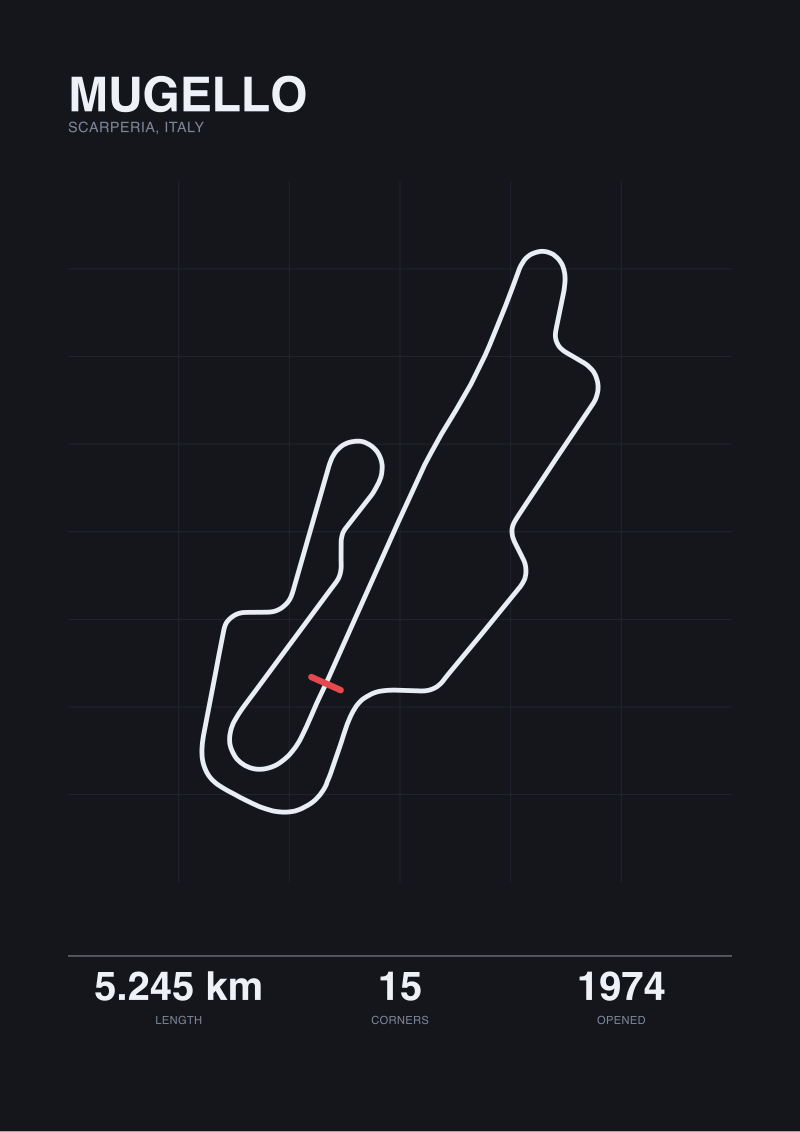 Mugello
The print from this article · from €29.95
View the print →
Mugello
The print from this article · from €29.95
View the print →
Scenario 3: The Layout Student
Picture a third reader. They are not going to drive Mugello. They may not even watch a full race. They collect track maps the way other people collect building plans. They study circuits as objects — designed things, drawn things, geometric arguments. When they read "mugello circuit layout arrabbiata corners", they want to understand the drawing.
Here is what the drawing shows. Mugello is 5.245 km around, opened in 1974, sitting in the hills north of Scarperia in Tuscany. It is fifteen turns, and its shape on the page is an irregular loop with three obvious lobes: the front section from San Donato through Poggio Secco, the middle section through Casanova-Savelli, and the back section that the Arrabbiate open into.
The Arrabbiate sit at the geometric turning point of the lap. Look at a Mugello track map with the pit straight at the bottom. The lap begins by pushing left and out, works its way through the middle third, and reaches its farthest point from the start line just before the Arrabbiate. Turn 8 and Turn 9 are where the layout stops running away from the pits and starts returning to them. This is not incidental. Circuit designers place their fastest connected corners at the point in the lap where the car has the most kinetic budget — after a rising sequence, before a section that can absorb the speed. The Arrabbiate do exactly that job.
For the layout student, the useful reading is: the Arrabbiate are not the loudest corners on the map, but they are the pivot corners. Every metre of the front third is preparation for arriving at the Arrabbiate with speed. Every metre of the back third is preparation for the Bucine right that closes the lap. The map, read as a drawing, is symmetrical around this pivot in a way that is not obvious until you trace it. It is also why the circuit prints of Mugello we produce for the studio's shop at /shop/ are drawn from the pivot outward — because that is how the geometry itself is organised, and printing it any other way would misread the argument the layout is making.
What All Three Share
The onboard viewer, the trackday driver, and the layout student are asking different questions, but their answers converge on the same fact: the Arrabbiate are not independent corners. They are the last two events of a sequence that begins at Casanova, and they are the entry to a return arc that runs to the finish line.
This is why the question "what do the Arrabbiate do" is a better question than "how fast are the Arrabbiate". Speed is a measurement. Function is a reading. All three readers, once they have looked long enough, arrive at the same functional description: the Arrabbiate are the release valve of the lap. The middle third of Mugello is a compression — a set of connected right-handers that ask the driver to keep loading the car. The Arrabbiate are where that compression is released into a rising, falling, committed sequence that finally lets the car settle into the back straight toward Scarperia.
The other shared fact: none of these readings depend on knowing a lap time. Modern race lap times at Mugello are recorded to three decimals, but the Arrabbiate's function in the layout would be the same if a lap took two minutes or four. The corners are a geometric statement, and geometric statements do not have units of speed. They have units of arc, radius, and connection.
Which Scenario Is You
If you watch onboard footage and want to understand what your eyes are registering, you are reading Mugello as a sequence of sensations, and the Arrabbiate are the two-corner heartbeat at the far side of the lap. Watch for the second steering input; that is where the composite ends.
If you are considering driving Mugello, you are reading the Arrabbiate as a bill that is paid earlier in the lap. Spend your first sessions on the section before them, not on them. The commitment you need at Turn 9 is not a technique you learn at Turn 9.
If you study the map for its own sake — because you like circuits the way other people like buildings — you are reading the Arrabbiate as the pivot the whole layout is drawn around. That reading is why the corner names, the elevation, and the sequence matter more than any single lap-time record. Circuits are drawings first. Records are footnotes.
FAQ
What does "Arrabbiata" actually mean in Italian?
The word translates literally as "angry" — arrabbiata is the feminine adjective form. At Mugello it is applied to two connected right-hand corners rather than to a driver's temperament. The naming convention is Italian in origin and matches the studio's practice of using original corner names on all layout references. The plural "Arrabbiate" is the correct form when discussing both corners together, and it is how the circuit's own map labels them.
Which turn numbers are the Arrabbiate at Mugello?
Arrabbiata 1 is Turn 8 and Arrabbiata 2 is Turn 9 out of Mugello's fifteen total turns. They sit in the back half of the lap, after Casanova and Savelli and before Scarperia. Their position — roughly the middle-to-back of the corner sequence — is why they function as the pivot between the front and back sections of the layout. Different session broadcasts sometimes label them differently, but 8 and 9 is the widely used numbering.
How long is the Mugello circuit and how many turns does it have?
Mugello runs 5.245 km per lap with fifteen turns. Both the official published length and the length we get from map-traced OpenStreetMap geometry agree to the third decimal — 5.245 km — which is rarer than it sounds. Many circuits show meaningful differences between homologated length and traced length. At Mugello, official documentation and traced measurement are aligned. The Arrabbiate are two of those fifteen turns and occupy the eighth and ninth positions in sequence.
When did the Mugello circuit open?
The permanent Mugello circuit opened in 1974. Racing in the wider Mugello area predates the permanent layout by decades — road races ran in the hills long before — but the fixed-perimeter circuit we discuss today, the one that hosts modern racing and the one printed on our layout studies, is the 1974 build. The corner names, including the Arrabbiate, belong to that permanent-circuit era. Older Mugello road courses had a different geometry entirely.
Are the two Arrabbiata corners taken flat out?
Whether the Arrabbiate are taken without lifting depends on the car, the tyre, the fuel load and the conditions — not on the layout alone. In modern top-category race cars they are often described as flat or near-flat, but that description is car-specific, not a property of the corners themselves. Slower categories lift. Faster cars lift less. The correct way to read the corners is by their geometry, not by any single class's approach speed.
Where is Mugello located?
Mugello sits in the hills of Scarperia, in the Tuscany region of Italy, north of Florence. The setting matters to the layout because the elevation profile of the surrounding hills is what gives the back section — including the run into and through the Arrabbiate — its characteristic rise and fall. Circuits built on flat ground do not draw this way. The Mugello map is, in part, a map of the terrain it was drawn onto.
Why are corner names in Italian even in English-language coverage?
Corner names at Mugello are Italian because the circuit is Italian and the names were assigned in Italian. Broadcast coverage in English usually preserves them — Arrabbiata, Casanova, Savelli, Bucine — rather than translating, because the names function as proper nouns and translating would break the reference. The studio uses the original names on all layout work for the same reason: a corner's name is part of its identity, and translation is a loss.
Is there a difference between "official" and "map-traced" length at Mugello?
Not at Mugello. The circuit's published length is 5.245 km and the length we get from tracing the raceway geometry on OpenStreetMap data is also 5.245 km. When we produce layout prints, we mark this. Some circuits have a genuine gap between the homologated racing line length and what you can measure from map data — sometimes tens of metres — and when that gap exists we say so. At Mugello it does not exist, which is a small but real fact about the circuit's construction and documentation.
From the collection
New circuits and 10% off your first print.
One email now with your code. No noise after.