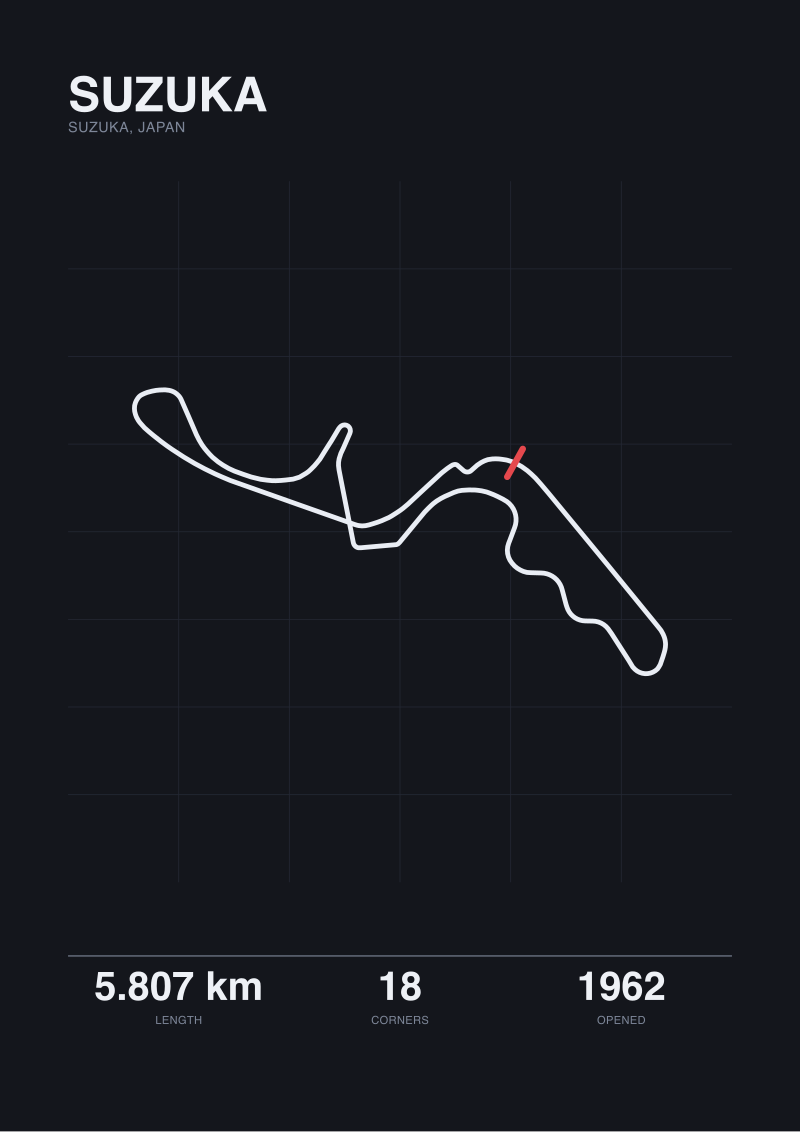
Suzuka is 5.807 kilometres long and has eighteen corners. It is also the only permanent Grand Prix circuit in the world where the track crosses over itself — a design decision made in 1962 that no other major venue has copied in sixty-four years. Both facts are on the record. What is not on the record, or at least not treated as such, is that the crossover is not there to make the circuit interesting to spectators. It is there to solve a specific geometric problem, and the problem is more interesting than the solution.
The Crossover Illusion: What "Figure Eight" Actually Names
The phrase "figure eight" invites a picture that Suzuka does not deliver. Draw an eight on paper and you get two lobes of roughly equal size, joined at a single central pinch. That is a topological description, and the layout at Suzuka is topologically consistent with it: two closed regions of enclosed asphalt, joined by a single crossing where one piece of track passes over another. Trace the raceway from the OpenStreetMap data, though, and the lobes are nothing like matched. The first half of the lap is longer, higher, and organised around long-radius corners. The second half is shorter, lower, and dominated by tighter geometry. What "figure eight" names, at Suzuka, is a crossing — not a symmetry.
We think this distinction is worth pressing because the label has spent sixty-four years being read as if it described balance. It does not. It describes an intersection. When we lay the traced centreline over itself and count the corners named on the public record — the Snake esses climbing away from the start line, the Dunlop curve at the top of the hill, Degner One and Degner Two before the bridge, the Hairpin, Spoon, the long run to 130R, the Casio Triangle chicane back to the pit straight — the eighteen corners the operator publishes distribute unevenly across the two lobes. The upper lobe carries the majority of the direction changes; the lower lobe carries the fastest ones. A designer looking for cornering variety would probably not draw this on purpose. A designer trying to fit 5.807 kilometres of racing track onto a specific piece of land almost certainly would.
The reason the label sticks, we suspect, is that "figure eight" is a description a spectator can hold in their head. It says: this track is unusual, look for the bridge. That works as promotion. It works less well as geometry, because the moment you go looking for the bridge you notice that the bridge is doing something the label does not explain.
The Elevation Nobody Draws Into the Map
A printed track map flattens the terrain. That is the medium doing its job — you cannot render height on a piece of paper without picking a convention, and most track maps pick none, which means the height information is absent. At Suzuka this absence hides most of what the layout is actually doing. The two sections that cross at the bridge are not at the same altitude. They cannot be, or they would intersect at grade, and the circuit would need a level crossing instead of a bridge. The elevation delta at the crossing point is what turns a two-dimensional impossibility — a track crossing itself in plan view — into a three-dimensional engineering problem with a straightforward solution.
Once you accept that the map is missing a dimension, the rest of the layout starts to read differently. The rise out of the pit straight into the first sequence of esses is climbing. The plateau at the top of the hill is exactly that — a plateau. The Degner sequence descends. The bridge sits at the point where the descending section from the upper plateau passes under the section that will, later in the lap, climb back toward the pit complex. In a section drawing, the "figure eight" becomes something closer to a helix with one full turn: the track spirals down, folds back, and spirals up. Draw it in plan and you get a crossing. Draw it in section and you get a ramp with a bridge on it.
We think the elevation is under-discussed because it makes the crossover sound less special. If the bridge is only there because the two crossing sections happen to be at different heights, then the "figure eight" is not a magical geometric conceit. It is a consequence. That is exactly what it is. The circuit was carved into a piece of land that already had the topography to make one section pass under another. The designers took the free height difference and turned it into a bridge, because the alternative was to route the track around the intersection and lose a kilometre of layout.
The bridge exists because the ground was already at two different heights; the "figure eight" is what happens when a designer chooses not to waste that gift.
 Suzuka
The print from this article · from €29.95
View the print →
Suzuka
The print from this article · from €29.95
View the print →
The Sector Symmetry Problem the Layout Was Built to Solve
A long lap on a small footprint is a solved problem: you loop. You take a rectangle of land and you spiral inward, or you fold the track back on itself with hairpins, and you get length by sacrificing the perimeter for the interior. This is how most permanent circuits get to five kilometres on a plot that would otherwise support three. Suzuka does something different, and once you see it, it is difficult to unsee. The upper lobe of the eight and the lower lobe travel in opposite rotational senses. If the upper lobe is being traced clockwise, the lower lobe traces counter-clockwise, and vice versa. The crossover is the topological device that lets a single closed loop change its rotational sense mid-lap without ever running the two directions on the same piece of asphalt.
The consequence, for a racing circuit, is direction balance. A track that only loops in one sense loads one side of the car harder than the other. Drivers wear out one shoulder, tyres wear out one edge, engines lean their fluids in one direction. Purpose-built circuits usually correct for this by including at least one long corner in the opposite sense — a compromise measure. Suzuka corrects for it structurally. Half the lap goes one way, the other half goes the other way, and the crossover is the seam. This is not a claim we are inventing to make the layout sound clever; it is a plain reading of what the geometry does, and it is the reason the layout has never been simplified. If you flatten the eight into a conventional loop, you lose the direction balance, and Suzuka stops being Suzuka.
The eighteen corners are distributed to reinforce this. The upper lobe carries the flowing right-hand sequence that most drivers describe as the character of the circuit; the lower lobe carries the sharper left-hand geometry that gives the closing sector its distinct rhythm. The traced length of 5.807 kilometres is what a plot of land in Suzuka would yield if you took the maximum available layout and refused to give up either direction. Most designers would give up one. This one did not.
The Bridge as a Structural Decision, Not a Spectator Feature
Broadcast coverage frames the bridge as a photo opportunity, and it is one. But treated as a piece of civil engineering, the bridge is the least glamorous element on the site. It is a load-bearing crossing that has to support race-speed traffic on the upper deck, provide clearance for race-speed traffic below, meet whatever safety envelope the sanctioning body requires on both surfaces, and remain serviceable through six decades of Japanese weather. None of that is spectacle. All of it is expensive, and the expense is the point.
If the bridge were not a hard structural requirement, the layout would not have one. Circuits are not built with unnecessary infrastructure — every kerb, every catch fence, every metre of run-off is a maintenance cost against the operator's balance sheet for the lifetime of the venue. The Suzuka bridge exists because removing it means removing the crossing, and removing the crossing means removing the layout. The commitment to the geometry is expressed in the willingness to carry that piece of structure for the working life of the circuit. Every other permanent Grand Prix venue on the current calendar has looked at this trade — added complexity, added cost, added maintenance, for the sake of direction balance — and declined to take it. Sixty-four years of imitators would have been enough to normalise the crossover if it were a cheap trick. It is not a cheap trick.
We would go further. The reason no other permanent Grand Prix circuit has copied the design is not that designers cannot draw a figure eight. They can. The reason is that the land, the budget, and the operational commitment all have to align, and after 1962 the industry moved toward layouts that could be built on flatter, cheaper land with lower ongoing costs. Suzuka is the surviving example of a design tradition that stopped being economically viable roughly the moment it produced its most durable specimen. That is a strange kind of monument, and it is what the bridge really is.
So What Do You Actually Do With a Track Map of Suzuka
If you are reading a track map of Suzuka the way most maps are meant to be read — flat, in plan, corner names labelled — you will get the shape and miss the argument. What we would suggest instead is to trace the centreline once with a fingertip, from the start line back to the start line, and consciously track two things as you go: which rotational sense you are in, and whether you are climbing or descending. Somewhere in the middle of the trace your finger will pass over a piece of asphalt it already passed under, or vice versa. That is the seam. Everything before it is one rotational half of the layout; everything after it is the other.
Then look at the eighteen corners not as a checklist of names but as a distribution. Count how many of them belong to the upper lobe, how many to the lower. The counts will not match — the upper lobe carries more direction changes, the lower lobe carries the faster geometry, and the imbalance is what makes the two halves feel like different circuits stitched together at the bridge. The stitching is the interesting part. It is where the design decision lives. Any of the eighteen corners, taken in isolation, could sit on a different track without much comment. The crossover could not.
We would leave you with the honest limits. We have not addressed the run-off zones or the safety modifications made to the layout since 1962 — those are a separate argument, and the public record on precise dates and dimensions is patchier than the record on the base geometry. We have not addressed the ways the crossover interacts with wind, weather, and the specific microclimate of the Suzuka plain — the OpenStreetMap trace gives us the plan and, indirectly, the height, but not the atmosphere. And we have not addressed the crossover's influence on race craft or overtaking, because our subject is the drawing, not the driving. Each of those is a piece we would want to make separately, from its own sources, with its own measurements. This one was about the metres, and about what the eighteen corners on 5.807 kilometres of asphalt are actually organised to do.
From the collection
New circuits and 10% off your first print.
One email now with your code. No noise after.