The Nürburgring Nordschleife is 20.832 km. That is the official homologated figure. Our own trace of the raceway line in OpenStreetMap came back at 20.746 km — eighty-six metres shorter. Same circuit, two numbers.
Before we get to street circuits, remember that: a permanent circuit measured against itself disagrees by the length of a pit straight. Everything the "street versus permanent" conversation assumes about clean categories starts eroding at the tape measure.
What the Numbers Actually Say
Here is what is on the desk. Four permanent circuits, each with a published length and a measurement we produced ourselves from the OpenStreetMap raceway layer.
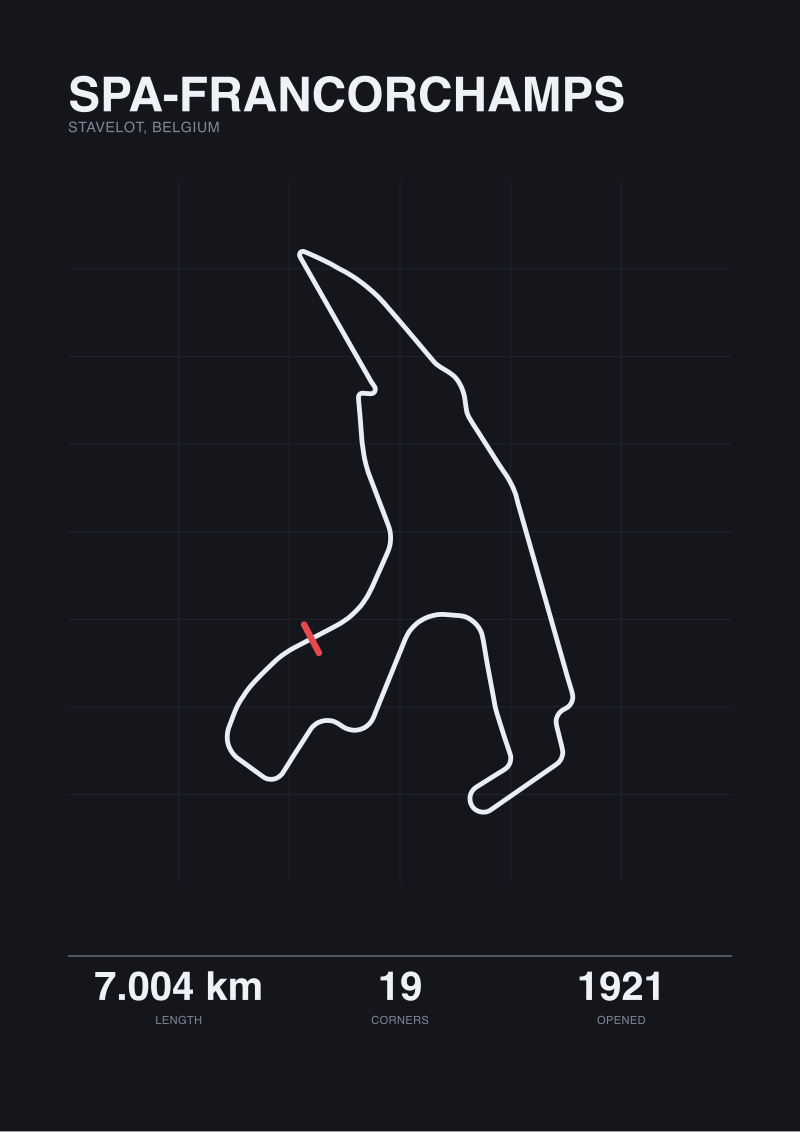
Nürburgring Nordschleife (Nürburg, Germany, opened 1927): 20.832 km official, 20.746 km traced, 154 turns. Circuit de Spa-Francorchamps (Stavelot, Belgium, opened 1921): 7.004 km official, 6.995 km traced, 19 turns. Silverstone (United Kingdom, opened 1948): 5.891 km official, 5.881 km traced, 18 turns. Circuit de la Sarthe: 13.626 km official, 0.793 km traced.
Three of the four traces agree with the official length to within about a tenth of a percent. Spa is off by nine metres. Silverstone by ten. The Nordschleife by eighty-six. These are permanent circuits in the strict sense: land bought, drawn, and tagged as raceway. The open geospatial data knows what they are because they were designed to be legible as tracks.
Then there is the Sarthe. Official length 13.626 km. Traced length 793 metres. The trace missed the circuit by roughly 94 percent. Nothing was miscounted. The Sarthe is a hybrid layout: it borrows public roads that close for the 24 Hours of Le Mans and reopen the following Monday. Only the permanent Bugatti loop registers as raceway in the map. The rest — the Mulsanne straight, the Porsche curves, the run down towards Indianapolis — sits in the map as regular numbered highway because that is what it is for the rest of the year.
This is the first thing the geometry says out loud. There is no shared measurement standard between a permanent circuit and a hybrid or street circuit, because they are not measured against the same surface. A permanent circuit is a bounded artefact — the survey knows where it starts, ends, and diverges into escape roads. A street or hybrid circuit is a race weekend imposed on a road network. What the sanctioning body homologates as 13.626 km is a route the marshals define, not a corridor an engineer draws.
The two most-quoted numbers in circuit discussion — length and turn count — do not mean the same thing on either side of the street/permanent divide. That is not a rounding problem. It is a category problem.
What Nobody Mentions
The folk taxonomy says: permanent circuits are purpose-built, street circuits use public roads, semi-permanent circuits use a bit of both. Useful shorthand, weak framework. The distinction that actually shapes racing is not surface. It is who owns the geometry.
The Nordschleife has 154 corners over 20.832 km. That number is not an accident of terrain. Someone, in 1927, bought and drew the land, then hired engineers to bend the road into whatever shape the topography could carry. Off-camber crests, blind compressions, corners that tighten past the apex, corners that decamber halfway through — these exist because the drawing rights existed. The circuit was designed with the licence to invent geometry.
Spa (7.004 km, 19 turns, opened 1921 in Stavelot) and Silverstone (5.891 km, 18 turns, opened 1948) sit on land under the circuit's direct control. Their corner sequences — Eau Rouge climbing into Raidillon, Copse tightening onto its exit straight — are drawn corners. Someone decided where the apex went. Someone specified the camber.
A street circuit does not draw corners. It inherits them. Whatever pre-existed as a junction between two urban roads becomes, on race weekend, a junction between two urban roads with barriers on it. The corner's geometry was set by traffic engineering: kerb radius sized for delivery trucks, camber sized for stormwater drainage, corner-in speed capped by the block width. The layout designer's job on a street circuit is to choose which junctions to link, not to shape them.
The Sarthe is instructive precisely because it is the borderline case. The Bugatti section is drawn — that is why our trace catches it. The rest is chosen: a route through pre-existing highway that closes for the race. Its Mulsanne straight is famously straight because it was built to be a public road, not a corridor bent to reward slipstream racing.
None of the four numbers in the grounding — 20.832, 13.626, 7.004, 5.891 — tells you this. The lengths are neutral. The ownership of the shape is what makes a circuit drawn or inherited. That distinction survives every conversion between "official" and "traced" and every argument about what belongs in which category.
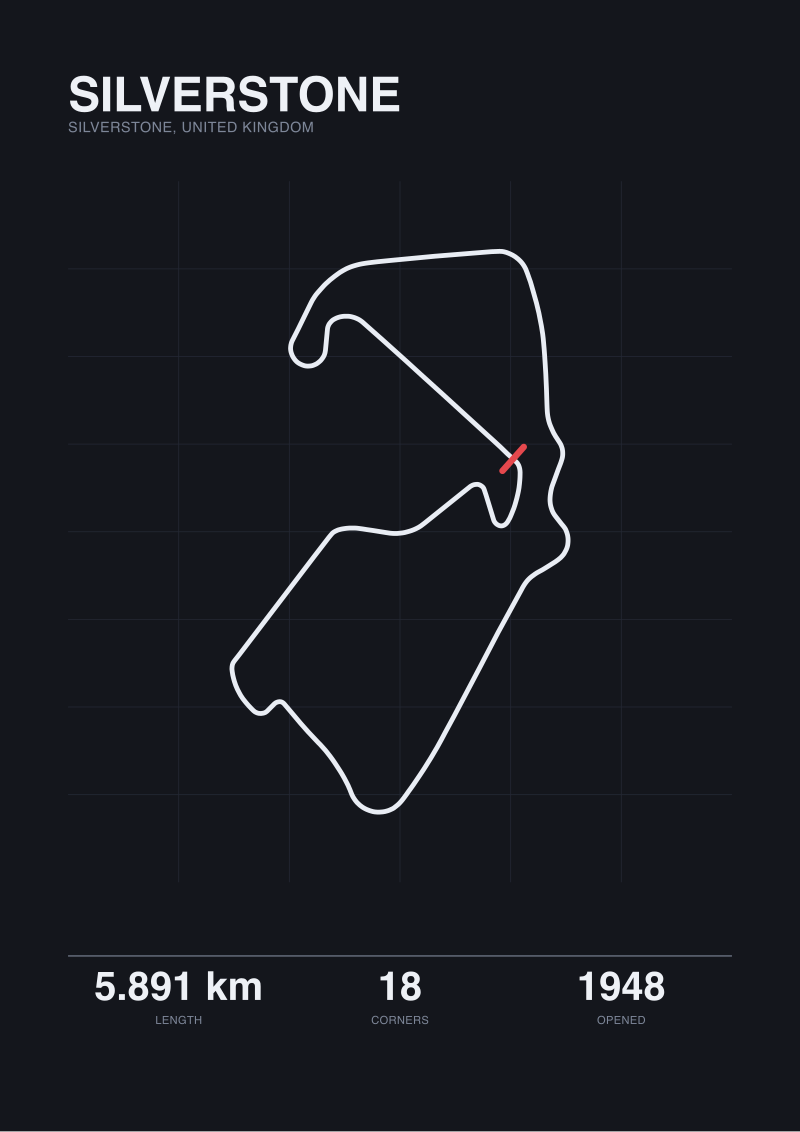 Silverstone
The print from this article · from €29.95
View the print →
Silverstone
The print from this article · from €29.95
View the print →
The Real Cost
Flatten the three cleanly-traced circuits into their corner densities and the drawing-rights argument sharpens.
Spa-Francorchamps: 19 turns across 7.004 km. 2.71 turns per kilometre. Silverstone: 18 turns across 5.891 km. 3.06 turns per kilometre. Nürburgring Nordschleife: 154 turns across 20.832 km. 7.39 turns per kilometre.
The Nordschleife carries more than double the corner density of Silverstone. That is not a length statistic. Silverstone could not add another hundred corners without buying more land or shortening the ones it has. The Nordschleife could — and did — because in 1927 someone drew it that dense on purpose.
The Sarthe we cannot include cleanly. The grounding gives us no turn count and only 0.793 km of tagged raceway to divide into. That absence is itself the receipt. A hybrid circuit's corner density is set by the density of the road network it borrows. If the underlying public road has three roundabouts in ten kilometres, that is the circuit's corner count for ten kilometres. There is no engineer sitting down to decide whether the Porsche curves needed to tighten a little.
What does a street circuit cost, in geometry terms? It costs the ability to design a corner from a blank sheet. Every turn on a street layout is a compromise with the surveyor who came before: the traffic engineer who set the kerb radius, the drainage engineer who set the camber, the city planner who set the block dimensions. The circuit gets what the streets already were.
What does a permanent circuit cost? Land. The Nordschleife's 20.832 km sits on ground the circuit owns outright. Silverstone's 5.891 km sits on land the circuit controls. Spa's 7.004 km winds through Belgian forest under the circuit's control. That capital is the reason the corners can be whatever the drawing said. It is the reason our traces agree with the official numbers to within metres — because the "official" figure and the "map-traced" figure are measuring the same drawn line.
The cost of a permanent circuit is capital. The cost of a street circuit is inheritance. What you pay decides what corners you get.
If You Only Remember One Thing
Street circuits inherit geometry. Permanent circuits draw it. Almost everything the two formats disagree about at the racing-line level — camber, apex placement, corner-entry speed, tyre load through mid-corner — descends from that single distinction.
If you want to see the difference in the same room, look at a traced print of the Nordschleife next to a traced print of any street layout. One is a shape someone chose. The other is a shape someone was allowed to trace. Our own prints of the four circuits above — including the Nordschleife's traced 20.746 km line — are the drawings we work from at the desk, available at /shop/.
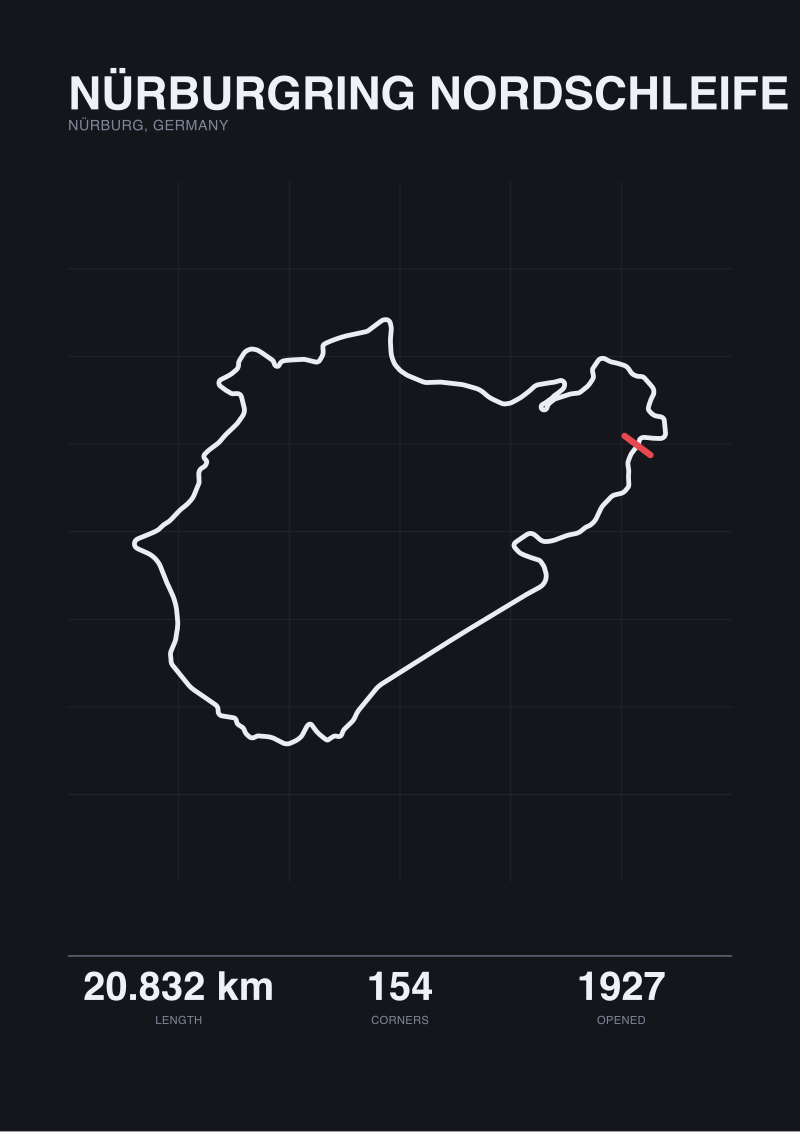 Nürburgring Nordschleife
The print from this article · from €29.95
View the print →
Nürburgring Nordschleife
The print from this article · from €29.95
View the print →
FAQ
Why does the Nürburgring's official length differ from a map-traced one?
The Nordschleife is homologated at 20.832 km; our OpenStreetMap trace comes to 20.746 km. The 86-metre gap is not error — it is measurement basis. The homologated figure follows a defined survey line taken along a specific reference. A map trace follows the raceway polyline as digitised by OSM contributors, which can sit a metre either side of that reference. Small offsets compound over twenty kilometres. The circuit is one drawing; the two measurements are two readings of it.
Why does the Circuit de la Sarthe measure only 0.793 km when the official length is 13.626 km?
Because most of the Sarthe is not raceway in the geospatial-data sense. Only the permanent Bugatti Circuit inside the venue is tagged as such in OpenStreetMap. The rest of the 24 Hours of Le Mans lap runs on public French roads that close for the race and reopen after. Those roads exist in the map as ordinary highway. Our trace captures the drawn part — 793 metres of it — and the remaining 12.833 km sits under a different classification.
Is Silverstone considered a permanent or street circuit?
Permanent. Silverstone opened in 1948 in the United Kingdom, and the circuit owns the land its 5.891 km layout occupies. Our raceway trace of 5.881 km sits within ten metres of the official figure — the signature of a purpose-built venue where the circuit line and the survey line are the same drawing. No public roads are absorbed for race events.
What is a "hybrid" circuit, and how does it differ from a pure street layout?
A hybrid circuit combines a permanent, circuit-owned section with public roads closed for the event. The Sarthe is the clearest example: its Bugatti loop is drawn and owned, the remainder is public road repurposed for the race. A pure street circuit has no permanent section — every metre of it is normal urban roadway when no race is running. Hybrids are visible in geospatial data as a partial raceway trace; pure street circuits register as nothing at all.
How many turns does the Nürburgring Nordschleife have and why does it matter?
The Nordschleife has 154 turns across 20.832 km — 7.39 turns per kilometre, more than double Silverstone's 3.06 turns/km and Spa's 2.71 turns/km. That density is only possible on land the circuit controls. Corner count is a proxy for drawing rights: the more turns per kilometre, the more likely the layout was drawn from a blank sheet rather than inherited from a road grid whose corners were set long before anyone thought about racing on them.
Does racing quality depend on whether a circuit is street or permanent?
Not directly. What racing quality depends on is corner variety — camber changes, apex offsets, elevation shifts, blind entries — and those design freedoms scale with drawing rights. Permanent circuits like Spa (opened 1921, sitting in Belgian forest terrain that supplies elevation for free) can accumulate those freedoms across decades. Street circuits inherit whatever the road already offered. It is not really a quality gap. It is a design-space gap.
Which is older, Spa or the Nürburgring Nordschleife?
Spa is older by six years. Circuit de Spa-Francorchamps opened in 1921 in Stavelot, Belgium; the Nürburgring Nordschleife opened in 1927 in Nürburg, Germany. Silverstone, opened 1948 in the United Kingdom, is the youngest of the three fully-traceable circuits in this piece. All three are older than most of the corner-design vocabulary racing engineers use today, which is one reason their layouts still repay careful reading.
From the collection
New circuits and 10% off your first print.
One email now with your code. No noise after.