For the reader who cares about street circuits as designed objects rather than as television backdrops, Monaco is the one of the three to study first — because it is the only one for which we hold a map trace we drew ourselves, running to 3.319 kilometres across nineteen corners. The obvious objection writes itself: Baku is faster in a straight line, Singapore is longer and newer, and both stage racing Monte Carlo can no longer stage on the same terms. We will defend the verdict anyway, on the grounds that a circuit you have measured yourself teaches more than a circuit you have only watched, and that Monaco's near-invariant layout since 1929 gives the other two something to be read against.
The steel-man is straightforward. Baku's castle section and long seafront straight produce a spread of speeds Monte Carlo cannot approach on any lap, and Singapore's Marina Bay layout, opened decades after Monaco was already old, was designed with modern racing in mind rather than adapted to a town that predates the motor car. A reader who wants to understand what a purpose-built street circuit does in 2026 has a defensible reason to start elsewhere. We concede that. What follows is why we still send that reader to Monaco first.
The Steel-Man for Baku or Singapore as the First Circuit to Study
Baku's argument is speed. The layout down toward the seafront produces the highest terminal velocities on any street circuit currently in use, and the medieval old-town section threads between stone walls with a corridor width that is genuinely narrower than Monaco's tightest points. Someone whose interest in street circuits is exactly the tension between speed and constraint has a reasonable case that Baku shows both extremes in a single lap, whereas Monaco compresses the range: everything is slow, and the interesting variation is in *how* slow, and *why*.
Singapore's argument is more architectural. The Marina Bay layout was drawn with racing as its first purpose. It uses public roads, but those roads were laid out, in part, with a modern circuit's requirements already in view — run-off where run-off could be added, kerbs specified, sightlines considered. Monaco does none of this. Monaco takes streets that were laid down for pedestrians, carriages and the earliest cars, and every year fits a barrier system around them. A reader who wants to see what a designed street circuit looks like when there are fewer inherited constraints has a case for Singapore.
Both arguments are real, and neither is sufficient. Baku's speed range is educational, but its geometry is inconsistently documented in the public sources we would trust to trace it, and until we have drawn our own map from raceway data we can only comment on the broadcast lap. Singapore is a more recent circuit, but the layout has been modified more than once since it opened, and the version currently in use is not the version that first stopped traffic on Republic Boulevard. Neither has the durability of reference that lets a reader anchor a mental model.
3.319 Kilometres of Traced Geometry Is a Different Object Than a Broadcast Lap
The measurement matters. The published length of Circuit de Monaco, taken from the standard reference, is 3.337 kilometres. The length we recover from tracing the raceway centre line out of OpenStreetMap and integrating along it is 3.319 kilometres. Eighteen metres of difference, which is not a rounding error and is not a mistake in either figure. We will explain the discrepancy in a section of its own further down. For now, the point is that possessing both numbers — and knowing which method produced which — is itself a form of understanding the circuit that a spectator does not have.
When you have traced a circuit, you know which stretches read as straight on television and are in fact continuous curves. You know which corners share a common radius and which only look like they do because the broadcast camera compresses the perspective. You know how much of the lap is actually spent turning versus running straight, in metres, not in seconds. None of that survives a broadcast. The broadcast gives you speed, engine note, and the drivers' hands; the map gives you the object itself.
For Baku and Singapore, we are still on the broadcast side of that line. We can describe what happens on those circuits and we can rehearse what the published sources say about them, but we cannot yet say, with our own instruments in our own hands, that a particular section is 340 metres long or that a specific corner opens through 92 degrees. Until we can, the honest recommendation is: start with the circuit for which we have that intimacy. That circuit is Monaco.
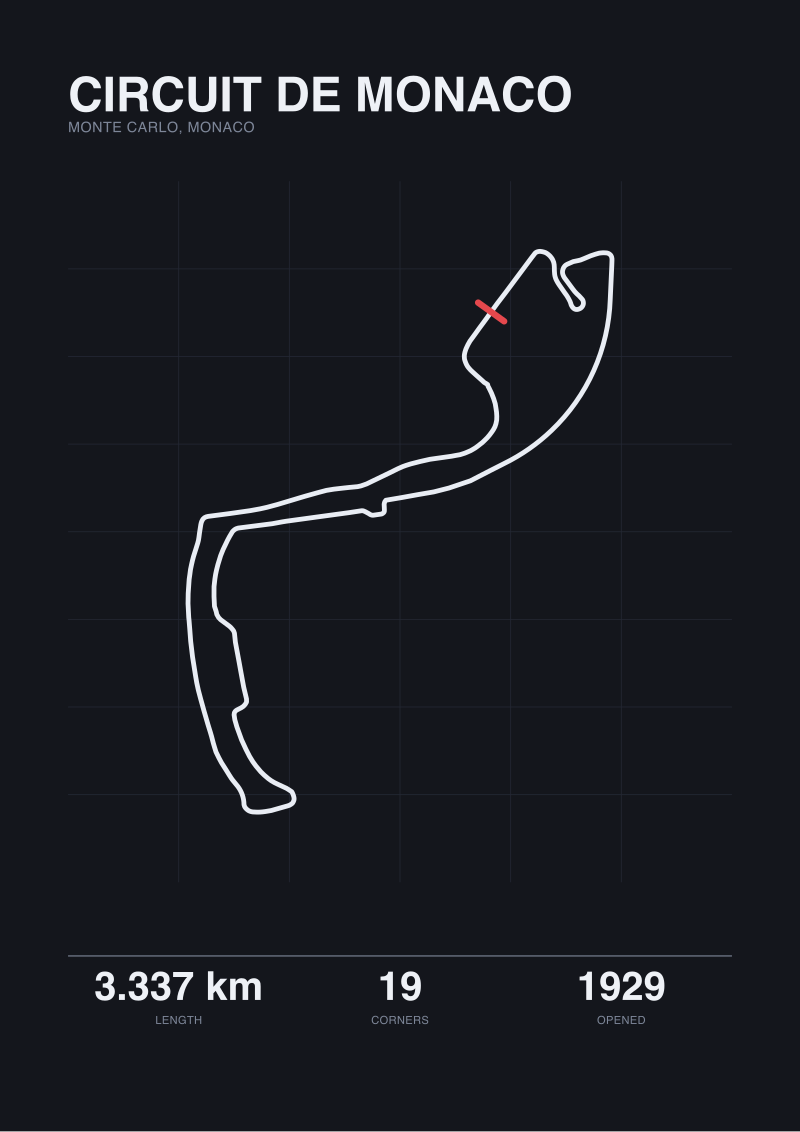 Circuit de Monaco
The print from this article · from €29.95
View the print →
Circuit de Monaco
The print from this article · from €29.95
View the print →
Nineteen Corners, Largely Set in Place Since 1929
Monaco's other advantage for a student of circuits is temporal. The circuit opened in 1929, and its layout — not its cars, not its barriers, not its run-off — has changed comparatively little since. The route through Sainte Dévote, up the hill, around Casino Square, down through Mirabeau, through the hairpin, out of the tunnel and along the harbour is recognisably the same figure it was almost a century ago. The nineteen corners we count today are not the nineteen corners of 1929 in every detail — sections have been modified, the swimming pool complex is a post-war insertion, the pit lane has moved — but the underlying geometry has an unusual persistence.
That persistence is what makes Monaco useful as a reference. When cars change and Monaco does not, the circuit becomes an instrument for measuring what has changed about the cars. A modern car negotiating the hairpin is doing something the 1929 car could not have imagined; the hairpin itself is doing what it has always done. The reader who has internalised the shape of the Monaco lap can watch six decades of Monaco footage and read the difference between eras out of a single fixed geometry.
Baku and Singapore do not offer this. Both are recent circuits, and both have been modified since introduction. There is no version of either that has stood long enough to serve as a fixed instrument for reading anything against. In fifty years this may be different; today it is not. Monaco earns its place at the front of the queue partly on age, and this is not sentimentality — it is the practical value of a stable reference surface.
| Dimension | Monaco | Baku | Singapore |
|---|---|---|---|
| Published length | 3.337 km | not in our archive | not in our archive |
| Map-traced length (Gridline) | 3.319 km | not yet traced | not yet traced |
| Corners (published) | 19 | not in our archive | not in our archive |
| Opened | 1929 | not in our archive | not in our archive |
| Geometry source | OpenStreetMap raceway (ODbL) | pending | pending |
The table is honest about its gaps. We would rather show them than fill them with figures we have not verified. The absence is itself part of the argument: only one of these three circuits is currently, in this desk, an object we have handled.
Why 3.337 Kilometres and 3.319 Kilometres Are Both Correct
The eighteen-metre gap between the published length and our traced length is worth stopping over, because it is the sort of thing readers assume must be one number wrong and the other right, and it is neither.
The 3.337 kilometre figure is the homologated length. It comes out of the process by which a circuit is certified for its class of racing, which uses defined survey methods, defined reference lines, and specifications for where along the track width the measurement runs. That figure exists in official documentation and is the one used in race regulations. It is not our measurement, and it is not something we can second-guess without doing our own homologation-grade survey, which we have not done.
The 3.319 kilometre figure is the length we recover when we take the raceway geometry as it exists in OpenStreetMap — released under the Open Database Licence — and integrate along the centre line of that geometry. It is a map-derived measurement. It uses a different reference line than the homologation figure (the centre of the drawn line, not the racing line or the surveyed centre), and it inherits whatever generalisations the OSM contributors made when they drew the raceway. Eighteen metres of divergence over roughly three and a third kilometres is what we would expect from these two methods disagreeing at their edges: it is not evidence of error in either. It is evidence that they are different measurements of the same object.
The reason to name both figures rather than pick one is that a student of the circuit benefits from knowing which method sits under which number. If you compare the "length of Monaco" to the "length of some other circuit" and one of the numbers is homologated and the other is map-traced, you have not compared like with like. Most casual comparisons commit exactly this error and produce differences of a few dozen metres that read as meaningful and are not.
For Baku and Singapore we have neither number yet — not the homologated length, not the map-traced length, not to our own standard. Which means that any street-circuit comparison written today from our desk starts, honestly, with the one circuit for which we hold both figures and can explain the gap between them.
What You Should Actually Do
If you are the reader we opened for — someone who wants to understand street circuits as designed objects — the sequence is: study Monaco first, on the geometry, not on the broadcast. Sit with the trace. Learn which sections are true straights and which are gentle curves you had misread as straights. Learn the nineteen corners in the order the lap presents them, and learn which ones share family resemblance with each other. Once the Monaco shape is internalised as a fixed reference, Baku and Singapore stop being mysterious and start being differences from a known thing. That is how comparison actually works. It is not a scoreboard; it is a series of differences from a baseline you understand well.
When you are ready to hang a print of Monaco on the wall so that this baseline is in the room with you — corner names, traced kilometrage, the full nineteen-corner figure at scale — our shop carries it as one of the circuits we have drawn ourselves. That single print, on a wall you walk past every day, does more for your reading of the other two circuits than any amount of race-weekend commentary will. Once we have traced Baku and Singapore to the same standard, they will join it. Until then, we would rather say what we know and where our knowledge ends than write past the edge of it.
FAQ
Why can Gridline only speak to Monaco's specific dimensions here?
Our grounding for this piece contains a single circuit record: Circuit de Monaco, with its published length of 3.337 km, our map-traced length of 3.319 km, nineteen corners, and a 1929 opening date. We treat the grounding as the outer edge of what we will state as fact. Baku and Singapore have public documentation of their own, but until we have drawn our own trace from raceway data we would rather describe them generally than cite figures we have not verified in-house.
What is the difference between a homologated length and a map-traced length?
A homologated length is produced by a formal survey along a defined reference line, using specifications that govern where within the track width the measurement runs. It is the figure that appears in race regulations. A map-traced length is calculated by integrating along the centre line of the raceway as drawn in an open geographic dataset. Both are legitimate measurements of the same physical circuit; they differ because the reference lines and the survey methods differ, not because one is mistaken.
Is eighteen metres of difference between the two Monaco figures large?
For a circuit of roughly 3.3 kilometres, eighteen metres is about half a per cent. That is the range of divergence we would expect between a homologation-grade survey and a map-derived integration. It becomes a problem only when someone compares a homologated figure for one circuit to a map-traced figure for another and treats the difference as meaningful. When both numbers are named alongside their method, the gap is informative rather than misleading.
Has Monaco's layout really not changed since 1929?
The underlying route is recognisably the same figure it was at opening: up the hill through Casino Square, down through Mirabeau, through the hairpin, out of the tunnel and along the harbour. Sections have been modified over the decades — the swimming pool complex is a post-war addition, pit facilities have moved, barrier systems and run-off have been revised many times — but the geometric skeleton is unusually persistent for a circuit still in current use. Persistence of layout is why Monaco works as a reference against which changes in the cars can be read.
Why not just include Baku and Singapore numbers from their official sources?
We do publish other circuits' figures when we hold our own trace to set alongside the official number. In this article we hold only Monaco to that standard. Quoting Baku and Singapore lengths from external sources without a map trace of our own would make the comparison uneven — three circuits described, one of them at a different depth than the other two. Naming the gap is more useful to the reader than papering over it.
When will Baku and Singapore be traced to the same standard?
We are working outward from the circuits we already hold in-house. Each trace involves pulling the raceway geometry from an open dataset, verifying the centre line against secondary references, and integrating the length to a figure we are willing to publish under our own name. It is slower than reproducing a published figure, and it is the reason our archive grows one circuit at a time rather than in batches. When Baku and Singapore are traced, we will write about them at the depth we have written about Monaco here.
Does Monaco still make sense as a modern street-circuit benchmark, given how much cars have changed?
Yes, and precisely because of the change. A benchmark is useful when it holds still while other things move around it. The cars of 1929, 1969 and 2026 have almost nothing in common; the Monaco lap has almost everything in common with itself across those decades. A reader who knows Monaco's shape can watch any era of Monaco footage and read what the cars are doing against a geometry that is not itself changing. Baku and Singapore, both younger and both modified since introduction, cannot yet play that role.
From the collection
New circuits and 10% off your first print.
One email now with your code. No noise after.