Silverstone measures 5.891 kilometres by its official homologated length and 5.881 kilometres when we retrace it from OpenStreetMap raceway data — a ten-metre gap between the paperwork and the pavement. Eighteen turns. Opened as a motor racing circuit in 1948. Before that it was RAF Silverstone, a Class A bomber airfield built for the Second World War. The runways became the racing surface, the perimeter roads became the return legs, and almost every geometric decision the circuit has made in the seven decades since traces back, in some form, to what the airfield left behind on the Northamptonshire flats.
How did a wartime bomber base end up as the home of the British Grand Prix?
1943: RAF Silverstone Opens as a Class A Bomber Airfield
The site was built to a standard the Air Ministry called Class A: three intersecting concrete runways laid out in a rough triangle, connected by a perimeter track that ran the outer edge of the field. This template was repeated across dozens of wartime airfields in the English Midlands, and the geometry it produced is the reason so many post-war British circuits look the way they do.
Silverstone's version sat on the border between Northamptonshire and Buckinghamshire, on high flat farmland that made for good drainage and unobstructed approaches. It opened in 1943 as a training base for Wellington bombers, part of the operational chain that fed crews into the strategic bombing campaign over occupied Europe. The runways were long — long enough for a fully-loaded heavy bomber to lift off — and they were built wide, in the reinforced concrete standard that would still be structurally sound thirty years later when it was carrying single-seater race cars.
The perimeter road is the piece that matters most for what came next. Class A airfields ran a service road around the outside of the runway triangle, connecting dispersal points where aircraft parked between missions. That perimeter road was continuous, closed, and hard-surfaced. It was, in the language of circuit design, a lap. Nobody in 1943 was thinking about this. But when the war ended and the airfield fell into disuse, what was left on the ground was a purpose-built loop of tarmac with three straights cutting through the middle.
October 1948: The First British Grand Prix on the Runways
Silverstone's motor racing life began the same way most former airfields entered civilian use in post-war Britain: informally, and slightly against the rules. The Royal Automobile Club took a lease on the site in 1948 and organised the first British Grand Prix there in October of that year. The layout used a combination of runway and perimeter, with the racing surface stitched together from the concrete already on the ground. Hay bales and oil drums marked the boundaries. The pit lane was a strip of the perimeter road.
The original 1948 course ran both the perimeter and sections of the runways, with cars crossing paths at controlled intersections — an arrangement that would not survive contact with modern safety standards but which, at the time, made sense as a way to extract a longer, more varied lap from the airfield's geometry. Within a year the layout had been simplified to run only the perimeter, and the shape that would become recognisable as Silverstone — a fast, flowing loop with long straights and open corners — started to settle.
What this early period established is the character the circuit has never fully shed. Silverstone is fast because the airfield was flat and the perimeter was long. It is open because the original corners were defined by the geometry of dispersal loops rather than by any designer's vision of what a racing corner should be. The first drivers were not asked to interpret a design. They were asked to read the existing tarmac.
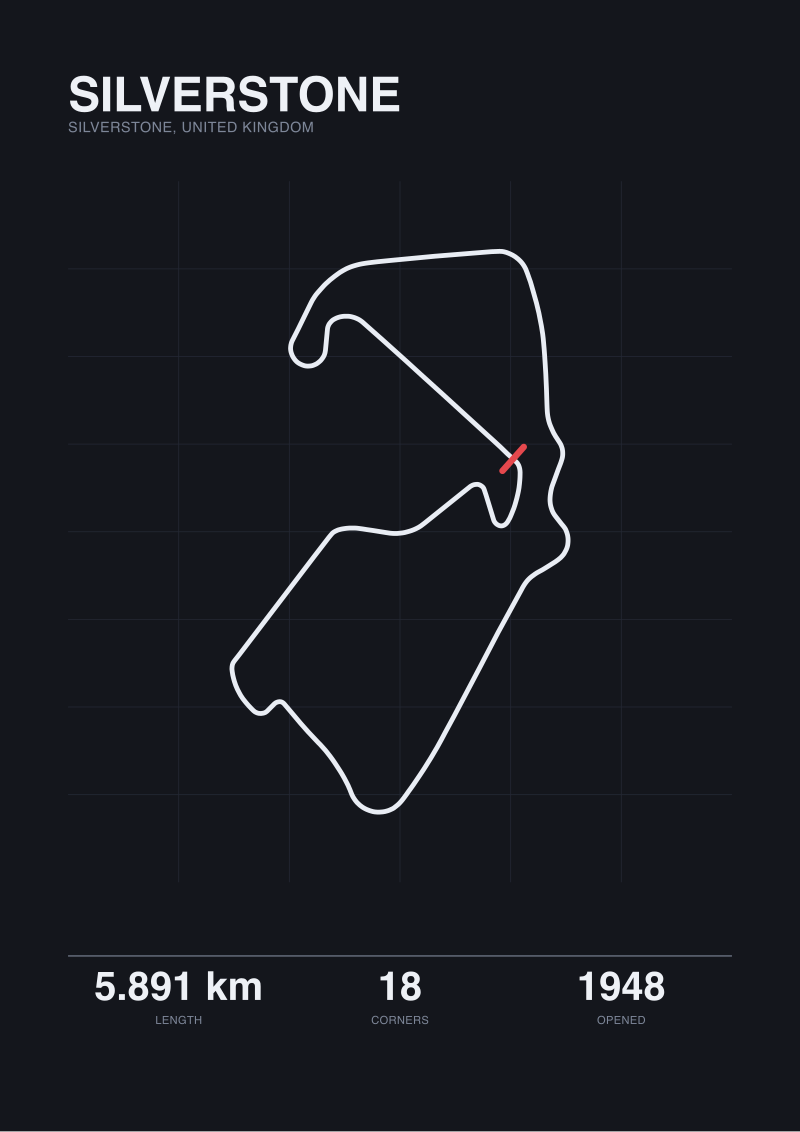 Silverstone
The print from this article · from €29.95
View the print →
Silverstone
The print from this article · from €29.95
View the print →
May 1950: Silverstone Hosts the Inaugural Round of the Formula One World Championship
When the FIA constituted the Formula One World Championship for 1950, the calendar needed an opening round, and Silverstone got it. The race was held on 13 May 1950 and remains one of the most-cited dates in the sport's history: the first World Championship Grand Prix at any venue, run on the perimeter-road layout that had been formalised the year before.
The significance for the circuit itself is less about the race and more about what the classification did to the venue's trajectory. Silverstone was no longer a former airfield hosting a national event. It was a World Championship circuit, which meant its infrastructure had to be measured against every other circuit in the calendar. That comparison — Silverstone against Monza, Silverstone against Reims, Silverstone against Spa — is the pressure that has driven every subsequent redesign. Once a circuit is on the World Championship calendar, its geometry stops being a local decision and starts being an international one.
The airfield character remained visible for decades after 1950. Aerial photographs from the 1950s and 1960s show the runway triangle still intact inside the perimeter loop, unused for racing but structurally present, a reminder that the venue was two things at once: an active motor racing circuit and the ghost of an operational bomber station. The pit facilities in this period were minimal, essentially wartime infrastructure repurposed for a sport that had not yet grown into the commercial machine it would become in the 1970s.
1975: Woodcote Gains a Chicane and the Airfield Geometry Starts to Break
For roughly its first quarter-century as a Grand Prix circuit, Silverstone was defined by four fast, mostly-open corners linked by long straights: Copse, Becketts, Stowe, and Woodcote. Woodcote was the last corner before the start-finish line, and it was very fast — a long right-hand sweep taken close to flat in the ground-effect era's predecessors. It was also, by the mid-1970s, generating cornering speeds that the run-off could no longer safely absorb.
The response in 1975 was to install a chicane at Woodcote. This was the first significant geometric change to the perimeter-road layout, and it marked the point at which Silverstone stopped being a pure airfield circuit and started becoming an engineered one. A chicane is not something you inherit from a wartime perimeter road. It is something you decide to build, and the decision is always the same decision: the cars have got too fast for the geometry we have, and we cannot move the tarmac outward, so we must add corners to slow them down.
The Woodcote chicane was the first of many such interventions. Over the following decades, sections were tightened, run-off was extended, kerbs were reshaped, and new corner combinations were carved into the infield. Each change moved the circuit further from its airfield origin. But the underlying diagram — three runways, one perimeter, a flat plain in Northamptonshire — remained visible in the shape of the lap. You can still see it today, if you know where to look.
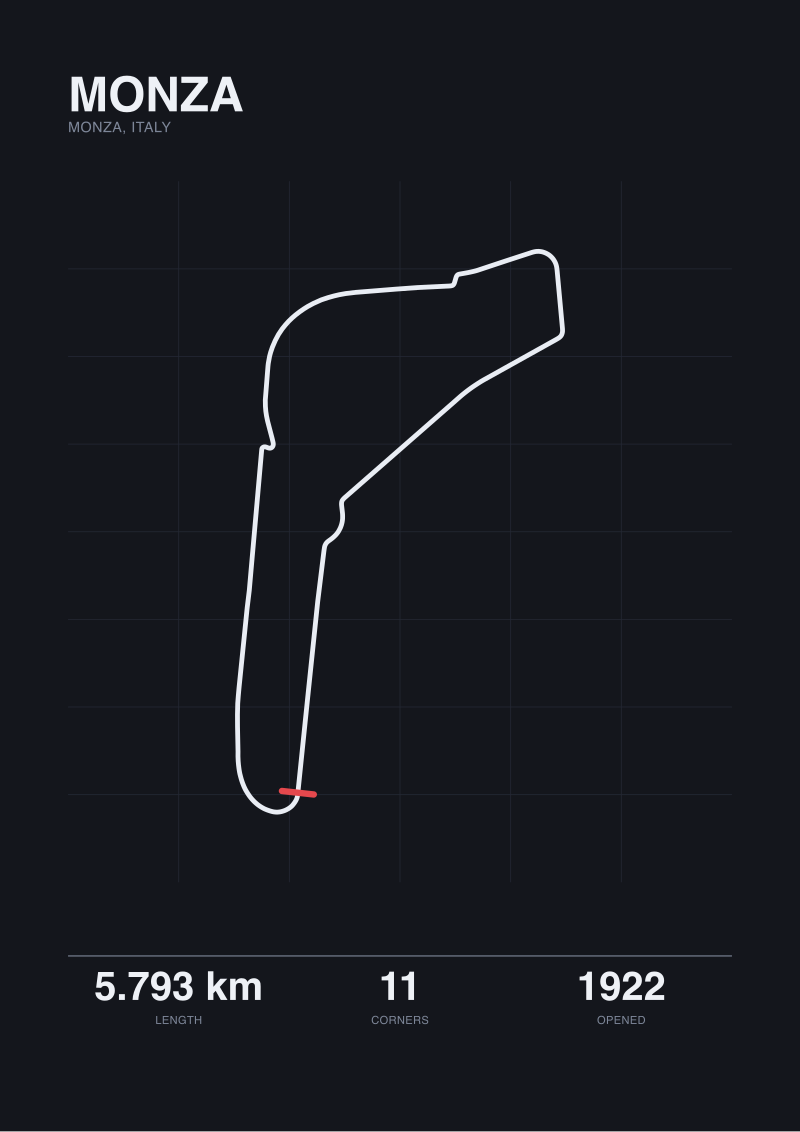 Monza
The print from this article · from €29.95
View the print →
Monza
The print from this article · from €29.95
View the print →
2010: The Arena Layout Rewrites the Second Half of the Lap
The largest single geometric change in Silverstone's history came for the 2010 British Grand Prix, when the circuit opened the Arena section — a new complex of corners that replaced the old Bridge–Priory sequence in the second half of the lap. Arena added a series of infield corners cutting inward from what had been a fast run down toward Luffield, extending the total lap length and giving the venue a second identifiable character alongside the historic Copse–Maggotts–Becketts run in the first sector.
The Arena redesign was driven by two pressures. The first was safety: Bridge Corner was very fast and had become progressively harder to marshal as cornering speeds climbed through the 2000s. The second was commercial: modern Grand Prix venues need overtaking zones, spectator sightlines, and hospitality infrastructure, and the old layout could not accommodate any of the three without significant intervention. Arena solved all of it at once, though not without cost — it also broke, structurally, the last major continuous section of original airfield perimeter.
A year later, in 2011, the pit and paddock complex moved to a new building — the Wing — sited on the outside of the Arena section rather than on the old start-finish straight. This shifted the start-finish line itself, meaning that the lap now begins and ends in a section of tarmac that did not exist as racing surface before 2010. The current 5.891 km configuration, with its 18 turns, is the composite of three distinct eras of construction layered on top of the original 1943 airfield: the perimeter loop, the 1970s–1990s chicanes and tightenings, and the 2010–2011 Arena and Wing rebuild.
The ten-metre discrepancy between the official 5.891 km and our map-traced 5.881 km is the kind of number that only matters if you take the geometry seriously. Official length is homologated: it is measured by the FIA to a defined racing line, usually one metre inboard of the outer edge of the track. Our trace follows the centreline of the raceway polygon in the OpenStreetMap data. Different reference lines produce different lengths. Both are correct measurements of different things.
What It All Means: Reading Silverstone as a Palimpsest
A palimpsest is a manuscript that has been scraped and reused, with earlier text still faintly visible beneath the current writing. Silverstone is a palimpsest in tarmac. The 2010 Arena is written over the 1975 Woodcote chicane, which is written over the 1949 perimeter simplification, which is written over the 1943 Class A airfield. Every layer changed the geometry, but no layer completely erased what was underneath.
This is why the circuit reads the way it does when you stand at Copse or watch onboard footage from Maggotts and Becketts. The first sector is still, essentially, the airfield: fast, flat, open, defined by radii that were chosen by a wartime engineer trying to solve a dispersal problem rather than by a circuit designer trying to solve a racing problem. It is the accidental geometry that makes it distinctive. No modern greenfield circuit would draw a sequence like Maggotts–Becketts–Chapel on a blank sheet of paper. It exists because the perimeter road turned the way it turned, and because subsequent generations of circuit engineers chose to preserve that character rather than smooth it away.
The lesson is not that Silverstone is uniquely lucky, though it is. The lesson is that circuit character is cumulative. What a track feels like to race is not a single design decision but the accumulated residue of every decision made about the tarmac over its entire history — including the decisions made before anyone thought of it as a racing venue at all. Read the runways beneath the racing line and the circuit stops being a layout and starts being a document. That is the reading our studio prints and sells at our shop: the runway triangle, the perimeter loop, and the current 18-turn line, all drawn from the same map data, at the same scale, so you can see the airfield still there beneath the Grand Prix.
FAQ
What was RAF Silverstone used for during the war?
RAF Silverstone opened in 1943 as an Operational Training Unit airfield in the Bomber Command chain, used to prepare crews on Wellington bombers before they were assigned to frontline squadrons. It was built to the Class A standard, meaning three intersecting concrete runways connected by a continuous perimeter road — the same specification applied to dozens of British bomber airfields constructed during the same period.
When did the first Formula One World Championship race take place at Silverstone?
The first round of the newly constituted Formula One World Championship was held at Silverstone on 13 May 1950. The circuit had already hosted the British Grand Prix in 1948 and 1949 under the Royal Automobile Club's earlier arrangement, but the 1950 race is the historically significant one because it marks the beginning of the World Championship era, which the venue opened.
How long is the current Silverstone circuit?
Silverstone's official homologated length is 5.891 kilometres across 18 turns. Our map-traced measurement, taken from OpenStreetMap raceway data along the centreline of the racing surface, comes out at 5.881 kilometres — a difference of ten metres. The gap reflects the different reference lines used: the FIA measures to a defined racing line inboard of the outer edge, while our trace follows the geometric centreline.
Why do modern Silverstone laps still feel like an airfield?
The first sector — the run from Copse through Maggotts, Becketts and Chapel — is essentially the original wartime perimeter road, preserved through every subsequent redesign. Those corners were not designed for racing; their radii were dictated by the geometry of the airfield's dispersal loops and runway intersections. Subsequent circuit engineers chose to keep that character rather than smooth it away, so the airfield's accidental shape still defines how the fastest part of the lap reads.
What was the Woodcote chicane and why was it added?
Woodcote was the last corner before the start-finish line and, until 1975, one of the fastest sweeping right-handers on the Formula One calendar. As cornering speeds rose through the mid-1970s, the corner's run-off could no longer safely absorb an off. The chicane installed in 1975 was Silverstone's first major geometric intervention against its inherited perimeter-road layout, and it set the pattern for every subsequent tightening decision the circuit has made.
What changed at Silverstone in 2010?
Silverstone opened the Arena section for the 2010 British Grand Prix, replacing the fast Bridge–Priory sequence with a new complex of infield corners. In 2011 the pit and paddock moved to the Wing complex on the outside of the Arena, shifting the start-finish line itself. This was the largest single geometric change in the circuit's history and produced the current 18-turn, 5.891 km configuration.
Is Silverstone the oldest Formula One circuit still in use?
Silverstone hosted the very first Formula One World Championship race in 1950, which makes it one of the venues most closely tied to the sport's origin. Whether it is the "oldest" depends on how the question is framed: several circuits used in Grand Prix racing pre-date the World Championship era, and some current venues occupy sites with continuous motor racing histories reaching further back. What Silverstone can claim without dispute is Round 1 of Championship history.
From the collection
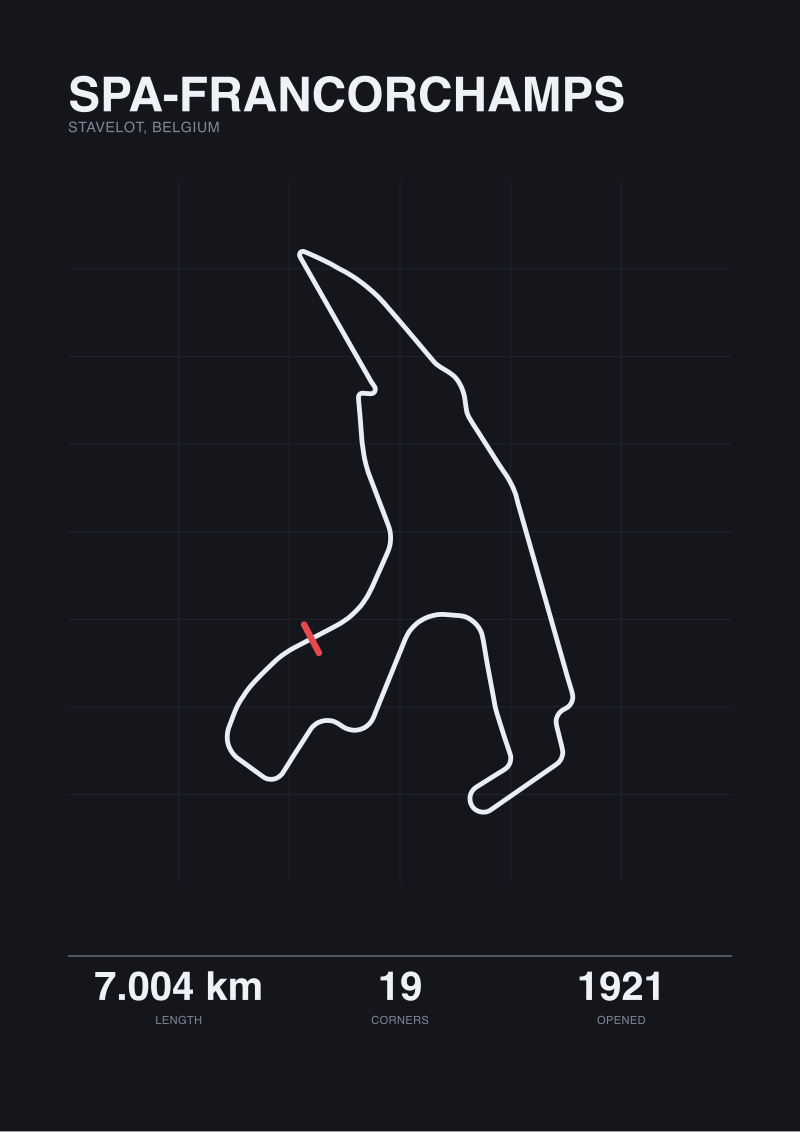
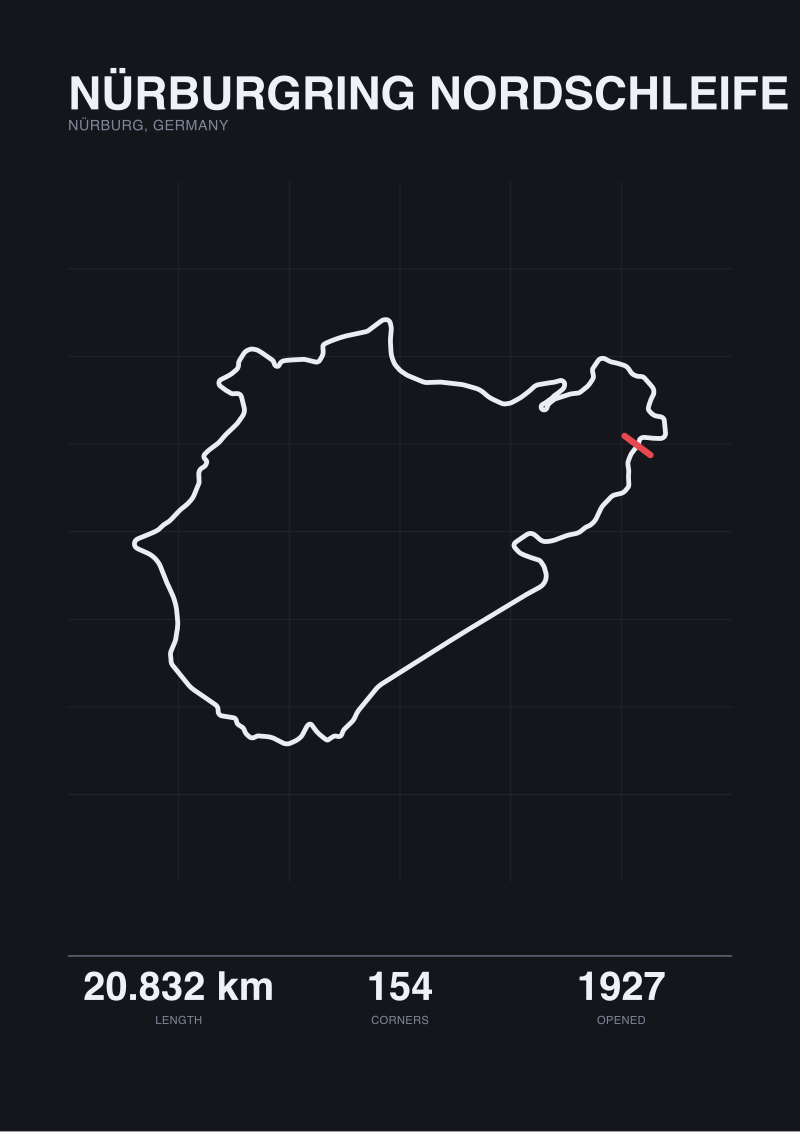
New circuits and 10% off your first print.
One email now with your code. No noise after.