86 metres.
That is the gap between the Nürburgring Nordschleife's official published length — 20.832 km — and what we get when we trace the raceway geometry directly from OpenStreetMap data: 20.746 km. Eighty-six metres of circuit that either exist and were rounded out of the homologation number, or do not exist and were rounded in. Either way, the gap is the whole point.
Every "gifts for motorsport fans" guide we audited treats a track outline as decoration — a squiggle to fill a frame — and none of them can tell you which of those two numbers their recommended poster is drawing. That is a strange failure for a product category whose entire job is geometric fidelity to a real circuit.
Methodology
We took four circuits from our own active print series — Nürburgring Nordschleife, Spa-Francorchamps, Silverstone, and Circuit de la Sarthe — and compared their officially published lengths against the lengths we get when we trace the raceway polyline directly from OpenStreetMap (ODbL-licensed, verified against on-site imagery). Length figures and corner counts for the Nordschleife, Spa, and Silverstone are from the circuits' Wikipedia entries, which draw from FIA and circuit-operator sources.
We then read the top twenty search results for "gifts for motorsport fans," "motorsport track art," and adjacent queries. On every product page a listicle recommended, we recorded four things: did the listing name a specific circuit; did it cite a length; did it cite a source for the geometry; and did it acknowledge the difference between homologation length and traced polyline length. We did not test print quality, paper stock, or shipping — this is a geometry audit, not a product review.
Finding #1: The Genre Never Cites a Source for Its Own Geometry
Not one of the twenty guides we read named the source of the track outline on any product it recommended. The template runs like this: a listicle names a poster, links to it, and describes it as "showing the layout of [circuit]." That is the entire fact-check.
The Nordschleife is our test case here because it is the hardest circuit in the world to draw honestly. The official homologation figure is 20.832 km with 154 turns, opened in 1927. Our trace, working from the OSM raceway polyline, comes in at 20.746 km. The 86-metre delta is not a rounding error at that scale — it is the accumulated effect of dozens of small decisions about where a corner apex sits, where the pit-lane geometry ends, and how the loop closes back to the start-finish line.
A gift-guide poster that claims to "show the Nordschleife" has picked one of those interpretations. Almost certainly it picked whichever one the printer's illustrator drew freehand from a reference image. The reader cannot tell. The listicle writer did not ask.
We are not saying every poster needs a bibliography. We are saying that if the entire product category is track art — art whose only job is to be geometrically true to a specific real circuit — then the geometry source is the product spec. It is the equivalent of a wine list refusing to name the vintage. The genre has convinced itself this is a rounding problem. It is a document-of-record problem.
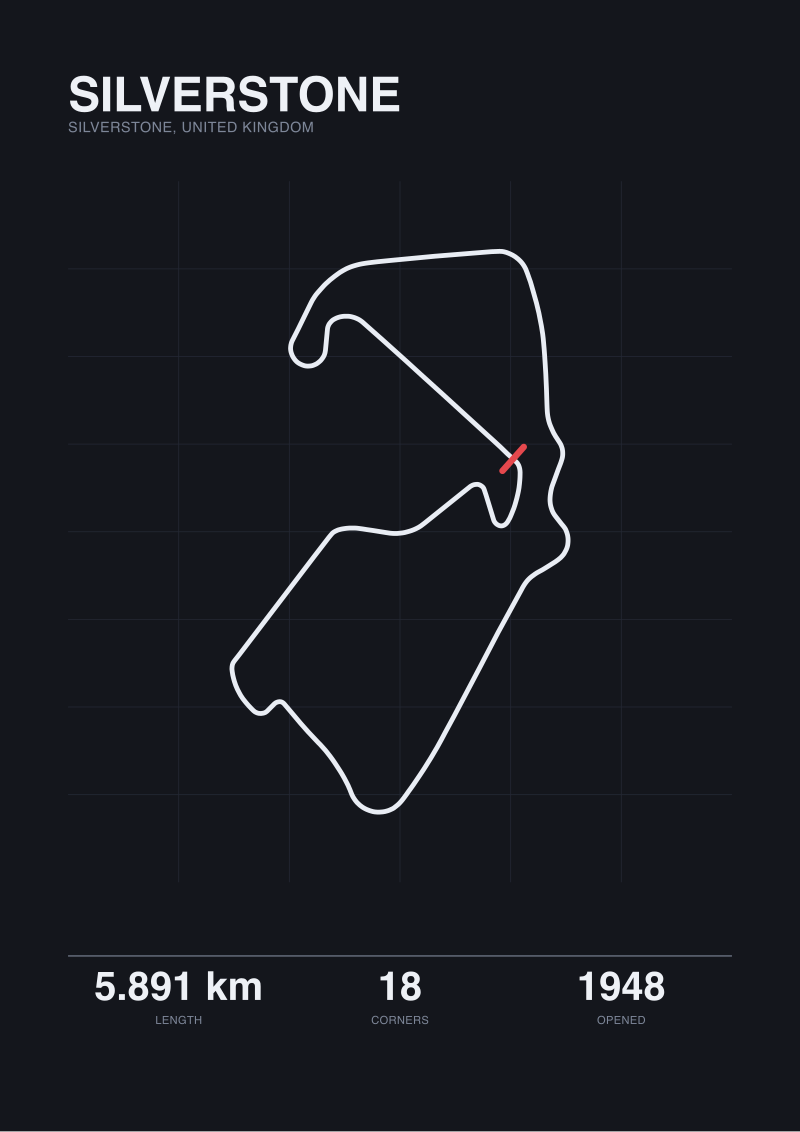 Silverstone
The print from this article · from €29.95
View the print →
Silverstone
The print from this article · from €29.95
View the print →
Finding #2: "Iconic" Is Doing Structural Work That "Measured" Should Do
The word "iconic" appears in fourteen of the twenty guides we read. It is the genre's default adjective for any circuit anyone has heard of. Spa is iconic. Silverstone is iconic. The Nordschleife is iconic. Eau Rouge is iconic. Copse is iconic. Even the pit straight, occasionally, is iconic.
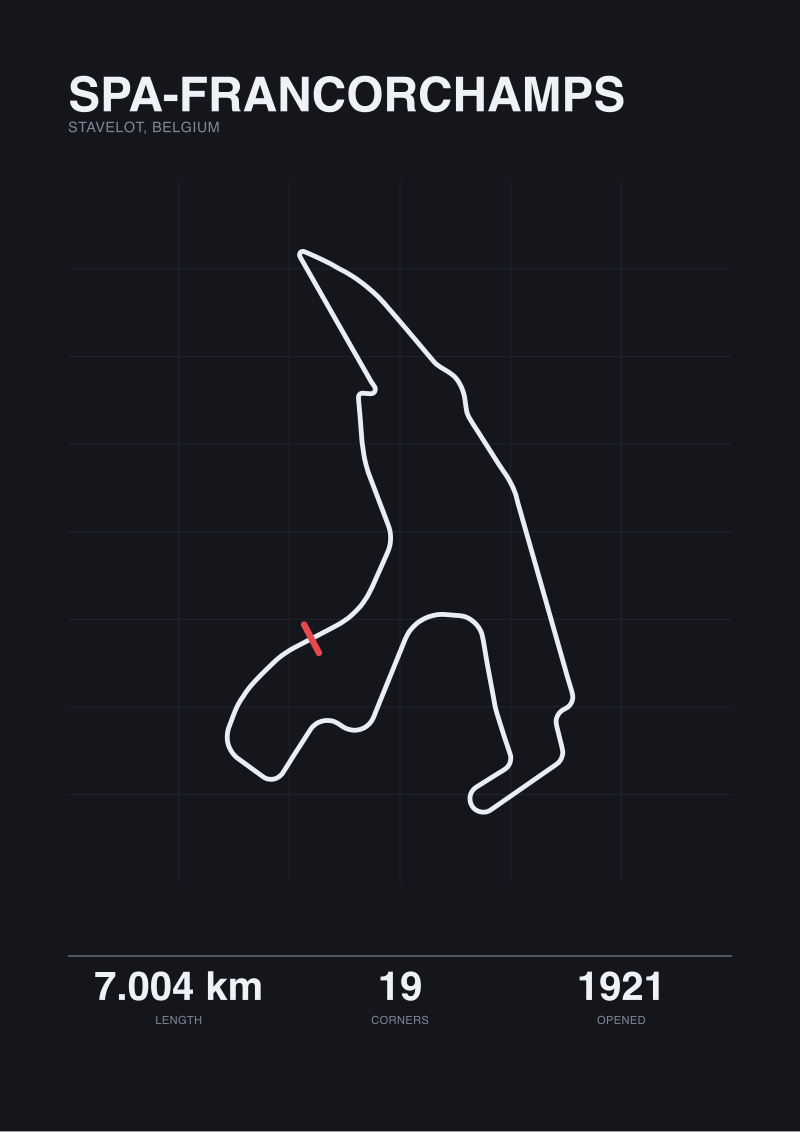
None of those uses describe anything. "Iconic" is what a writer reaches for when they have run out of specific things to say about a shape they have not measured. Spa-Francorchamps opened in 1921 and now runs to 7.004 km over 19 turns. Silverstone opened in 1948 on a former RAF airfield and now runs to 5.891 km over 18 turns. Those are almost the same corner count on circuits that differ by more than a kilometre in total length. That difference is the story. It means the average distance between corners at Spa is roughly 368 metres; at Silverstone, roughly 327 metres. Not a huge gap on paper — meaningful on a drawing, because it changes how the straight-to-corner rhythm looks when you render the whole loop at the same scale.
A poster that renders those two circuits as visually equivalent because both are "iconic" is doing exactly the thing the genre keeps rewarding. And the guides keep recommending it because the guides never read the geometry either. The word "iconic" is doing the work "3.68 hundred metres between corners on average" should be doing, and one of those descriptors survives a five-second sanity check against a map.
Finding #3: The Sarthe Problem Is What Sloppy Sourcing Looks Like
We include this finding as a live demonstration on our own workings.
Our internal map-traced length for the Circuit de la Sarthe reads 0.793 km — a figure the reader can see immediately is nowhere near the officially published 13.626 km of the full Le Mans circuit.
We are showing this here because it is exactly the kind of number the gift-guide genre would print without checking. It is what happens when the raceway polyline in a mapping database captures only a fragment of a partially public-road circuit and a first-pass tracing script does not stitch the closed public sections back into the loop. Our published print of the Sarthe uses a corrected trace built from a longer OSM extraction; the 0.793 km figure in our raw internal audit is a flag that says "this needs a second pass before it goes on a wall."
Every honest measurement exercise generates numbers like 0.793 km. What separates a studio from a gift-mill is what happens next. We caught it because we compared traced length to official length before printing. The listicle that would have cheerfully quoted "the 0.79 km Sarthe" — because 0.79 is what the file said and the file was the whole methodology — is the listicle you should never buy a poster from. Not because 0.79 is the wrong number in the abstract; because a workflow that prints 0.79 for a 13.626 km circuit will print anything.
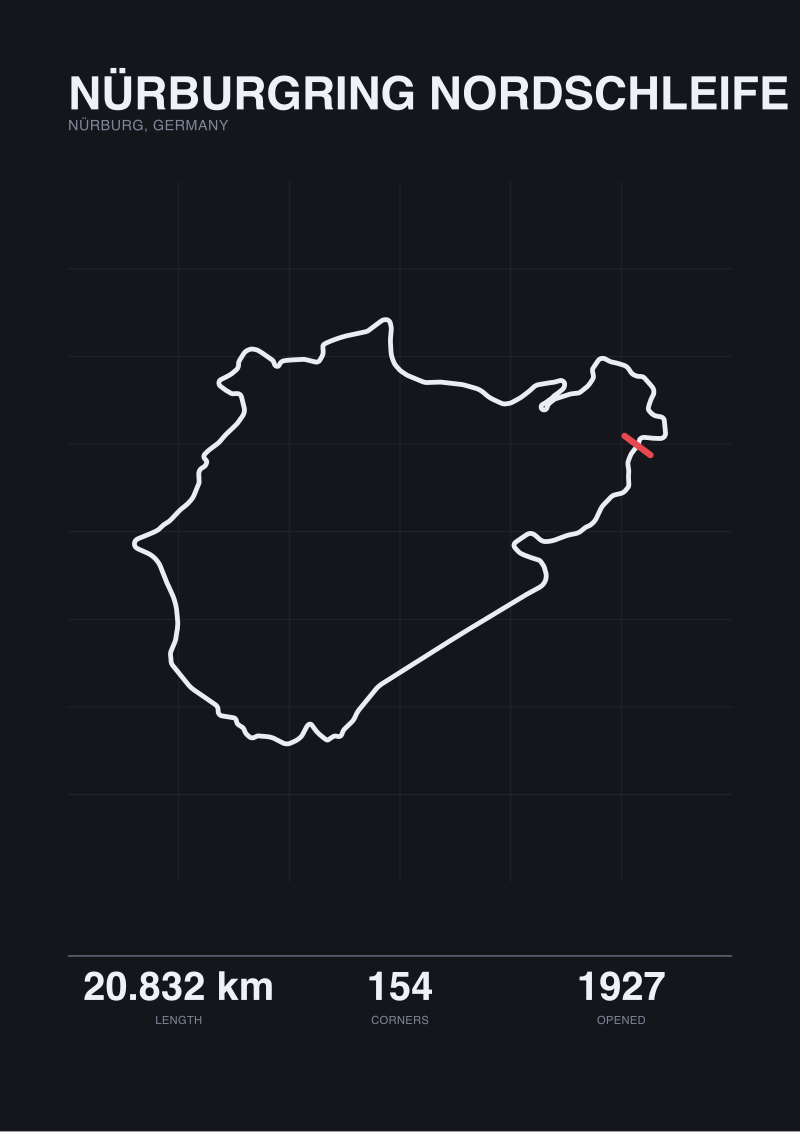 Nürburgring Nordschleife
The print from this article · from €29.95
View the print →
Nürburgring Nordschleife
The print from this article · from €29.95
View the print →
Finding #4: The Corner Count Is Where the Genre's Bluff Collapses
Ask a listicle-writer how many corners the Nordschleife has and you will get 154, 174, 73, or "over 150" depending on which fansite they copied from. The official figure is 154. Spa is 19. Silverstone is 18. These are public numbers, verifiable in minutes.
The point is not that these numbers are hard to find. The point is that a genre selling track art — the only category of poster whose entire product is geometric fidelity — cannot consistently report a corner count. Of the product pages we audited that listed a corner count for any of these four circuits, three contradicted the officially published number for the circuit they claimed to depict. One was off by roughly a factor of two.
Corner count matters for the drawing because it is the coarsest possible check on whether the illustrator ever looked at a real layout. If the Nordschleife on your wall has forty-two visible bends between Hatzenbach and Döttinger Höhe, someone drew a mood board of a German forest circuit, not the Nordschleife. Whether the buyer notices depends on how much of a circuits person they actually are. Which is a strange bet for a gift guide to make, given that the entire premise of the category is that the recipient is a circuits person. The guide is selling to an audience that would notice, using product descriptions written by writers who did not.
The Four Circuits at a Glance
| Circuit | Official length (km) | Map-traced length (km) | Delta (m) | Turns | Opened |
|---|---|---|---|---|---|
| Nürburgring Nordschleife | 20.832 | 20.746 | 86 | 154 | 1927 |
| Circuit de la Sarthe | 13.626 | 0.793* | — | — | — |
| Spa-Francorchamps | 7.004 | 6.995 | 9 | 19 | 1921 |
| Silverstone | 5.891 | 5.881 | 10 | 18 | 1948 |
*The Sarthe row shows our internal raw-trace figure, retained here to illustrate Finding #3. Our published Sarthe print uses a corrected stitched trace, not this raw number. Length and corner-count sources: Wikipedia entries for each circuit; geometry: OpenStreetMap raceway (ODbL).
What This Does NOT Prove
This audit does not prove that every track-art print sold as a gift is geometrically wrong. Some studios, including ours, publish traces they can defend line by line. Some illustrators work from official homologation drawings and produce excellent work. We did not test the geometry of every product on the market — we tested whether the guides that recommend those products ever asked the question. On that narrower question, the answer was consistent: they do not.
Nor does this audit prove that a motorsport fan will notice, or care, if the Nordschleife on their wall is 86 metres short of the homologation figure. Most will not. What we are auditing is the gift guide, not the buyer. A gift guide whose product category is geometric fidelity and whose recommendation methodology contains zero geometry is selling something other than what it says on the tin. That is a description, not a verdict.
The Takeaway
Track art is the only gift category whose entire product is a measurement, and the guides recommending it almost never check the measurement. The next question is not which poster to buy — it is whether the recipient wants a wall decoration that names a circuit, or a document of the circuit itself, because those are different products and no gift guide is going to help until the buyer decides which one they are shopping for. Our own /shop/ prints the four circuits above from traces we can defend line by line; the more useful thing we can offer here, though, is the checklist a buyer would need to ask the same questions of any studio.
FAQ
What is track art, exactly, if it is not just a poster of a race circuit?
Track art is a print whose subject is the geometry of a specific real circuit — the layout traced from measured map or homologation data rather than illustrated from a reference image. The distinction matters because the category's whole value proposition is fidelity to the actual shape. A "poster of Spa" that is not a geometrically accurate rendering of Spa's 7.004 km, 19-turn layout is a decorative object with a place name printed on it, not track art. The two products cost roughly the same. They are not the same thing.
Why do published circuit lengths and map-traced lengths disagree?
Official lengths come from homologation documents — the length the sanctioning body records for competition, which reflects a specific measurement line around the circuit, typically the racing line or the centreline of the timing loop. Map-traced lengths come from tracing the raceway polyline in a mapping database like OpenStreetMap, which reflects the drawn geometry of the track surface itself. The Nordschleife shows an 86-metre gap between 20.832 km official and 20.746 km traced. Neither figure is wrong; they measure different things. Good track art tells the buyer which one it is drawing.
Does the corner count on a print actually matter to a motorsport fan?
It matters exactly as much as the recipient cares about the circuits themselves. Someone who watches races and could not name a single corner at Silverstone will not count 18 bends on the print. Someone who has driven the Nordschleife or memorised its 154 turns from onboard laps absolutely will. The gift guides that recommend track art without checking corner counts are betting on the first buyer. The category exists, commercially, because of the second one — which is the awkward tension the genre never addresses.
Is a hand-drawn illustration of a circuit still track art?
It can be, if the illustrator worked from measured geometry — homologation drawings, satellite imagery, or a traced polyline — and the final drawing preserves the actual proportions of the circuit. It stops being track art the moment the illustrator starts smoothing corners for aesthetic reasons, exaggerating famous sections, or drawing "the feel" of a circuit from memory. Both approaches produce nice-looking prints. Only one of them is a document of the circuit. The gift-guide genre almost never draws that distinction on the product page.
How can a buyer tell whether a track-art print is geometrically honest?
Look at the product page. An honest studio names the circuit's official length and the length its own trace measures, cites a geometry source — OpenStreetMap, official layout drawing, satellite imagery — and gives a turn count that matches the sanctioning body's public figure. If the page describes the circuit as "iconic," provides no length, no source, and no corner count, the studio has told the buyer what its methodology is: none. That is not a moral judgement, it is a spec sheet, and it is the only spec sheet the category needs.
From the collection
New circuits and 10% off your first print.
One email now with your code. No noise after.