4.309 kilometres. That is the published length of the Autódromo José Carlos Pace in São Paulo, the circuit Brazil has raced on, in the same direction, since 1940. Fifteen corners, one of the shortest layouts still on a Formula One calendar, and the argument you hear every November is the same one: Interlagos runs anticlockwise because the elevation demands it. The bowl of the Senna S falls away from the pit straight, the Subida dos Boxes climbs back up, and the geometry, we are told, only works with the cars turning left. Compelling. Almost airtight. That is precisely the problem.
Why This Is Actually True
The elevation argument is not a bad one. It survives because it observes something real. Interlagos is one of the few circuits on the calendar where the topography is legible from the grandstand — you can stand at the entry to the Senna S and watch the road fall away from you in a way it does not fall at Silverstone, at Barcelona, at Sakhir. The bowl is not a metaphor. The track drops through Turn 1 and Turn 2 into a natural depression, threads the infield along the low ground, and then climbs, properly and unavoidably, back up the Subida dos Boxes onto the pit straight. That is a real gradient carrying real load.
Given that geometry, an anticlockwise reading almost writes itself. Turn a car left into the Senna S and gravity helps it. The car settles onto its outside-front, the rear rotates under weight transfer, and the driver arrives at the bottom of the bowl already pointed at Turn 3. Turn a car right into the same section and you fight the camber the whole way down; the load goes onto the wrong tyres, the entry is uphill in the wrong sense, and the exit throws the car toward the outside of a corner it should have been leaning into. Every table-napkin sketch of a mirrored Interlagos anyone has bothered to make ends with the same complaint: the bowl works one way.
The Subida completes the case. A long uphill traction zone onto a start-finish straight rewards a car that has been progressively loading its rear tyres through a chain of long left-handers. Anticlockwise gives you that. Clockwise gives you a downhill braking zone into a slow right, immediately followed by the wrong kind of climb. On paper, the layout is committed to left. This is the version of the argument you hear every November, and it is not wrong. It just is not complete.
The problem is not that the elevation reading is false. It is that the elevation reading stops explaining the circuit somewhere around Turn 4.
Where It Breaks Down
Interlagos is 4.309 kilometres long — 4.308 by our own trace of the OpenStreetMap raceway, close enough that the discrepancy sits inside standard survey tolerance and we cite the official figure for consistency. Fifteen corners. That is a short lap by modern standards, and the corner-per-kilometre density is what the elevation argument keeps quietly ignoring. Because once the car is out of the Senna S and into the infield, the ground stops meaningfully moving. The middle sector of Interlagos — the slow, technical stretch between the bottom of the bowl and the exit of Junção — is where the majority of the lap's cornering happens, and it is close to flat.
Trace the map yourself. From Turn 3 through the infield and into the Ferradura, the vertical component of the geometry is small enough that a designer starting from a topographic survey would not be forced by the ground into any particular rotation. The corners in that section have the shape they do because someone drew them, not because water drained them. A clockwise version of that middle sector would work. It would be a different circuit, and worse in ways we will get to, but it would not be defeated by the terrain. There is no gravitational veto operating there.
Which puts the elevation argument under pressure in an interesting place. If two of the fifteen corners — Turn 1 at the top of the drop, and Junção at the bottom of the climb — are the only ones genuinely committed to a direction by the ground, then eighty-seven per cent of the corner inventory is directionally optional. That is not a layout dictated by topography. That is a layout that uses topography at two specific hinge points and then chooses everything else.
The published length gives us the second clue. 4.309 km is short enough that the two elevation events dominate what a driver remembers. Ask anyone who has raced there what Interlagos feels like and they will describe the bowl and the Subida, in that order, because those are the two moments where the ground is doing work on the car. That memory-weighting is what makes the elevation argument feel airtight. It is not that the ground dictates the layout. It is that the ground dictates the two most salient corners on a short lap, and the mind fills in the rest.
The rest is drawn. The rest is a designer's decision. And once you see that, "the elevation demands it" becomes a claim about two corners out of fifteen, not about the circuit.
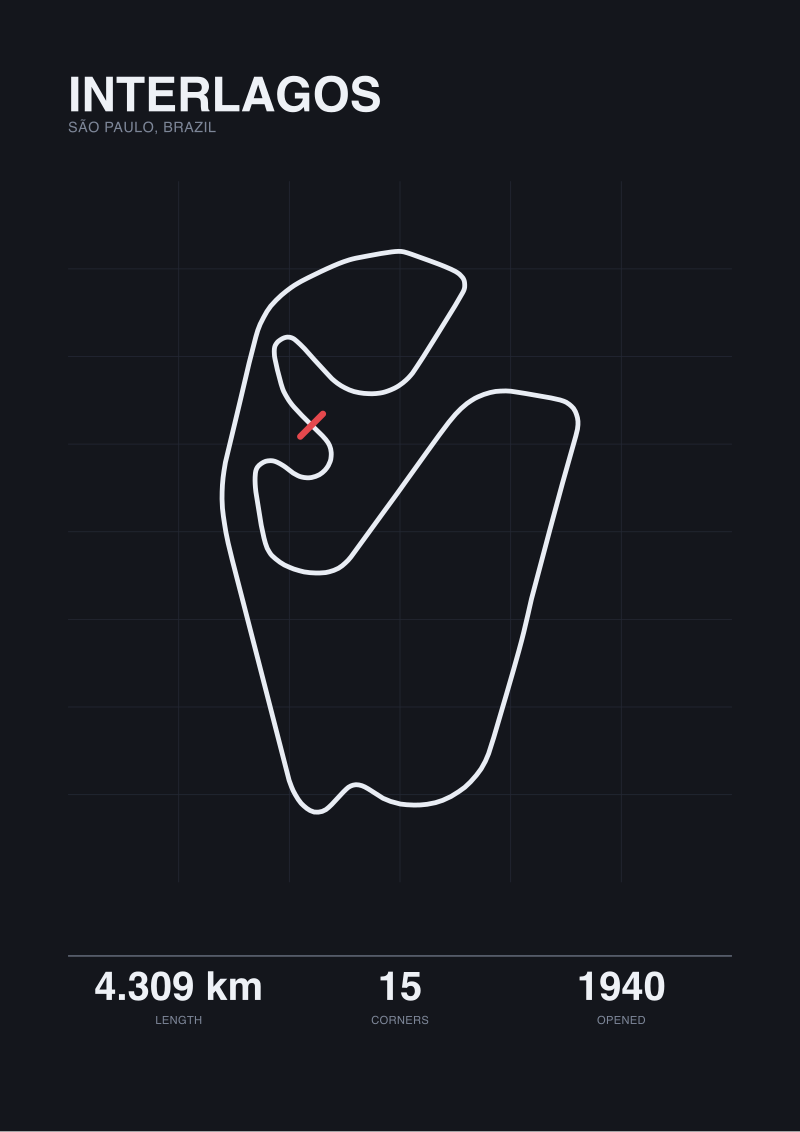 Interlagos
The print from this article · from €29.95
View the print →
Interlagos
The print from this article · from €29.95
View the print →
The Rule I Use Instead
Read a circuit's direction from its slowest sector, not its steepest one. That is the working rule at this desk.
The reasoning is mechanical. Elevation moves the car through weight transfer, which matters most in high-load, high-speed transitions — the kind of thing a bowl at Turn 1 produces. But the slowest sector of any circuit is where lap time is actually manufactured. It is where the driver spends the most seconds, where overtakes get set up, and where the geometric asymmetries between a left-handed and a right-handed layout are most punishing to reverse. Designers know this. When they pick a direction for a new track, or preserve a direction for an old one, they look at the slow stuff first and the fast stuff second.
Applied to Interlagos, the slowest sector is the infield — the sequence from the exit of Turn 3 through the Ferradura and into the run down toward Junção. That sector is dominated by long, patient left-handers taken at medium speed, and it feeds into a slow left at Junção that spits the car onto the traction zone up the Subida. If you mirrored that sector, you would be asking drivers to spend the majority of the lap loading a tyre set that then has to survive the fast, high-load right-handers of a mirrored bowl. The tyre model would object. The pit-lane exit geometry would object. And, quietly, the overtaking model would object too, because the entry into Junção — the actual overtake corner at Interlagos, the one the whole circuit is arranged around — only works as a slow left leading onto an uphill exit.
That is the argument the elevation reading skips. Interlagos runs anticlockwise because its slow sector was designed anticlockwise, and the slow sector is where the racing is. The bowl and the Subida cooperate with that decision. They do not make it. Move the hinge from "the ground demands it" to "the racing demands it" and the whole layout snaps into a different kind of legibility — one where the topography is a resource the designer is using, not a constraint the designer is obeying.
When the Old Rule Still Wins
There are circuits where the elevation reading is not a heuristic but the whole story. Mount Panorama at Bathurst is one; the top is a genuine mountain, not a bowl, and the direction of the lap is fixed by a chain of gradients severe enough that a designer never had a real choice to reverse. The old Nordschleife falls into similar territory: the ground is dramatic enough, over enough kilometres, that direction stops being a design variable and starts being a survey outcome.
Interlagos looks like it belongs in that company. It does not. The two hinge points — the drop at Turn 1 and the climb up the Subida — are the loudest events on a short lap, and they lend the whole circuit an aura of topographic inevitability that the middle sector never actually earns. The elevation reading is honest about what it sees. It is just looking at two corners out of fifteen, and calling them the circuit.
 Silverstone
The print from this article · from €29.95
View the print →
Silverstone
The print from this article · from €29.95
View the print →
FAQ
How long is Interlagos, and why do sources disagree on the exact figure?
The published length is 4.309 kilometres, per the circuit's own documentation and the FIA homologation record. Our own trace of the OpenStreetMap raceway data returns 4.308 km. The one-metre gap sits comfortably inside standard mapping tolerance and reflects the difference between a homologated centreline measurement and a polyline traced from public map data. For editorial purposes we use the official 4.309 km figure and flag the trace where the two disagree materially. Here, they do not.
How many corners does the Interlagos layout have?
Fifteen, per the current circuit map. That corner count includes the Senna S as two distinct corners (Turn 1 and Turn 2), the infield chicane sequence, the Ferradura, and Junção as the final left before the climb up the Subida dos Boxes. Corner counting is a soft convention — different sources sometimes split or merge certain sections — but the standard modern reading of the layout is fifteen turns across the 4.309 km lap.
What does "anticlockwise" actually mean at a circuit level?
It means the majority of the lap's turning load is in one rotational direction — in Interlagos's case, to the left — and that direction is fixed by the way the pit lane, start-finish line, and racing line are arranged. Most Formula One circuits run clockwise; the small anticlockwise minority includes Interlagos, and the direction change carries real consequences for neck loading on drivers, tyre wear asymmetry, and the geometry of overtaking zones.
When did Interlagos open, and has the direction ever changed?
The circuit opened in 1940 and has run in the same anticlockwise direction throughout its history. The layout itself has been shortened and reprofiled over the decades — the original configuration was longer and used a larger portion of the surrounding land — but the rotational direction has been a fixed feature of the circuit's identity since day one. That continuity is unusual, and it is part of why the elevation-dictates-direction argument feels so structurally sound.
Why do most Formula One circuits run clockwise if direction is a design choice?
Because the majority of purpose-built modern circuits inherit conventions from an era in which clockwise was treated as the default, and because clockwise loads the driver's neck in a direction that most training and seat geometry has been optimised around. That is a design convention, not a physical law. Circuits that run anticlockwise typically do so because a specific piece of geometry or terrain — or, as at Interlagos, a specific slow sector — makes anticlockwise the better racing choice.
Does the elevation change at Interlagos actually favour anticlockwise?
It favours it, but does not require it. The drop through the Senna S and the climb up the Subida dos Boxes are both easier to design around with the car turning left through the bowl and accelerating uphill onto the pit straight. But those two events involve two corners out of fifteen. The middle sector of the lap sits on comparatively flat ground and would work in either direction. The elevation argument is directionally correct at the two hinge points and directionally silent everywhere else.
Why is a 4.309 km circuit still on the Formula One calendar when most modern tracks are longer?
Because corner density and elevation change per kilometre produce racing quality that longer, flatter circuits struggle to match. Interlagos packs fifteen corners and a meaningful vertical profile into a lap that most modern permanent circuits would consider a warm-up loop. Short does not mean simple; the density is what generates the overtaking, the strategic variety, and the visual legibility that has kept Interlagos on the calendar for decades.
From the collection
New circuits and 10% off your first print.
One email now with your code. No noise after.