Every circuit history that names Tamburello treats it as a corner. It has not been one, in the geometric sense the word implies, for the better part of three decades. Hear us out. What is now called Tamburello at the Autodromo Enzo e Dino Ferrari is a low-speed chicane occupying the ground where a long left-hand curve used to sit. The name outlived the geometry. We keep seeing this pattern when we trace circuits from map data: Imola's official length is published at 4.909 kilometres; our own cartographic trace of the raceway comes in at 4.904 kilometres. The gap between those two numbers is where every interesting design decision at Imola lives.
The Two-Length Pattern: When Homologation and Cartography Disagree at Imola
There is a pattern we keep meeting when we trace permanent circuits from open map data. The number printed on the homologation certificate and the number produced by measuring the centreline of the raceway from an authoritative geospatial source rarely agree to the metre. At Imola the published figure is 4.909 kilometres. Our own trace, drawn along the raceway polyline in OpenStreetMap, closes the lap at 4.904 kilometres. Five metres is a small gap. It is not a rounding error, and it is not evidence that either party got it wrong.
Homologation length is a documented number. It is produced by an accredited surveyor walking (or driving, with instrumentation) a defined racing line — typically the theoretical centreline at a specified offset from the inside kerb, following a governing body's measurement protocol. The result is filed with the sanctioning federation and becomes the official length of the circuit for the purposes of record-keeping and competition. It is a legal fact.
A cartographic trace is a different object. It follows the geometry of the paved raceway as recorded in the map source — in our case the OpenStreetMap raceway relation, published under the Open Database Licence. The map is authored by contributors working from aerial imagery and, where available, GPS traces. The polyline it produces approximates the same physical track, but the racing line the homologation surveyor walked and the polyline our software integrated are not the same curve. They diverge by centimetres through every fast corner, and those centimetres accumulate.
We name both numbers in every Imola figure we publish. When we say the circuit is 4.909 kilometres, we mean the documented length. When we say 4.904, we mean the traced length. Both are true. Neither is more real than the other. Confusing the two is how you end up publishing a lap-average speed that is half a kilometre per hour off, which is enough to be wrong about which car was actually the fastest through a given section.
The Chicane Reflex: How Fast Corners Get Interrupted Rather Than Removed
There is a pattern that governs how permanent circuits respond to a demand for lower cornering speeds. The demand almost never produces a new circuit. It produces a chicane inserted into the existing geometry of an old corner. The corner is not removed. It is interrupted.
Imola's Tamburello is the textbook case. The original left-hand curve occupied a long, sweeping arc on the far side of the raceway from the pits. In geometric terms it was a fast, constant-radius bend taken flat or near-flat, with an entry, an apex, and a clean exit onto the next straight. When the case for slowing that corner became overwhelming after 1994, the redesign did not carve the land into a new shape. It laid a chicane down inside the existing footprint of the curve. The paved surface still occupies the same real estate. A car that ran wide off the new chicane's exit runs onto asphalt that was, three decades ago, on the racing line.
The reason is economic before it is architectural. Rebuilding the earthworks and drainage of a permanent circuit costs an order of magnitude more than repainting the racing surface. Homologation is faster when the underlying ground plan does not change. Broadcast rights, garage infrastructure, marshal posts, camera pylons and photographer positions are all keyed to the existing circuit envelope; every metre of new geometry that pushes outside that envelope triggers a cascade of secondary rebuilds. A chicane inserted into an old curve preserves every one of those relationships. A new corner does not.
A chicane is not a design solution to a fast corner. It is a financial solution to the political impossibility of removing one.
The consequence is that "the same corner" at Imola is now a very different racing problem. Where the original Tamburello rewarded commitment through a long constant-radius arc — a corner where lifting cost you position — the current chicane rewards braking discipline into a tight left-right sequence at a fraction of the entry speed. The two are separated by a decade of political pressure, one fatal weekend, a set of insurance actuaries, and roughly the width of a paint stripe on the map. On the map it is the same piece of ground. On the stopwatch it is not the same corner.
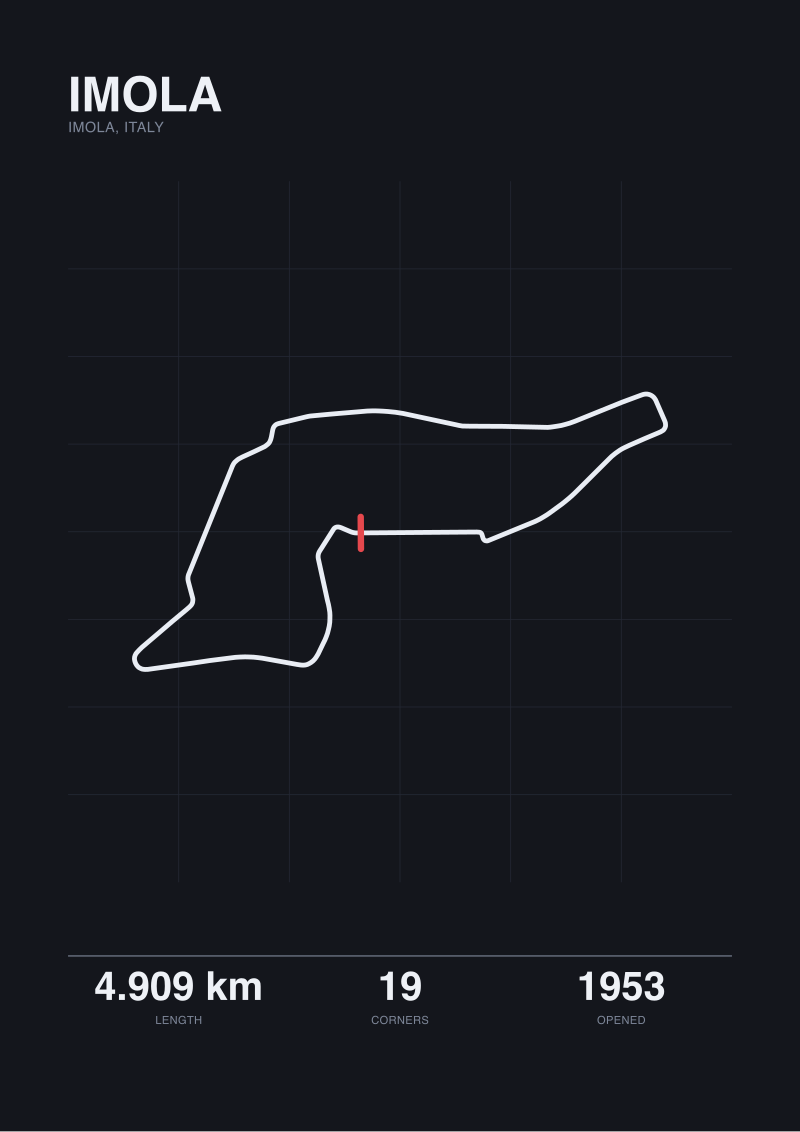 Imola
The print from this article · from €29.95
View the print →
Imola
The print from this article · from €29.95
View the print →
The Name-Survives-Geometry Pattern: Why Tamburello Still Exists on Paper
There is a pattern in how circuits handle the relationship between corner names and corner geometries. When a corner is redesigned, the name migrates to whatever now occupies the ground. This is not how the words were originally used. It is how the words are used now, and it is worth being explicit about why.
Corner names on European circuits are, almost without exception, toponyms. They refer to a physical feature — a farm, a chapel, a bar, a bend in an adjacent road, a stretch of woodland, a piece of local history. Tamburello, at Imola, took its name from a small farmhouse that stood near the outside of the original curve. The name identified a location on the property. It did not identify a particular geometry. When the geometry inside that location was changed in the mid-1990s, the toponym remained tied to the ground, not to the shape of the racing line that had made the ground famous.
The result is that "Tamburello" now identifies two distinct racing objects, depending on which side of the redesign you are standing on. Before the change, it was a long left-hand curve. After the change, it is a chicane. The word carries the same syllables and, for the reader unfamiliar with the geometric history, the same apparent meaning. It does not carry the same corner.
This matters because most of the discourse around Imola conflates the two. A description of "Tamburello" that draws on pre-1995 telemetry — cornering speeds, minimum radii, downforce loading — is describing a shape that no longer exists. A description drawing on modern onboard footage is describing a shape that did not exist for the first four decades of the circuit's life. Both descriptions can be technically correct and simultaneously incompatible. The name is the same. The reference is not. When we write about Tamburello in a Gridline piece, we say which one.
The 19-Turn Convention: How a Circuit's Corner Count Is Decided
There is a pattern in how corner counts get assigned to a circuit, and it does not survive close inspection as a physical measurement. Imola is documented as having nineteen turns. That number is a convention. It is not a count of anything a physicist would recognise as a corner.
Ask what a "turn" is and the answer becomes slippery quickly. A chicane consisting of a left kink and a right kink separated by twenty metres of asphalt can be counted as one corner, two corners, or three, depending on the convention. A long constant-radius arc can be counted as one, or as an entry-apex-exit sequence of three. A double-apex bend can be one corner or two. The nineteen at Imola reflects the current sanctioning body's diagram; other diagrams, at other moments in the circuit's history, would have produced different totals for materially the same ground plan.
What the number does communicate is roughly proportional to the number of separate braking, turning and accelerating events a driver has to solve per lap. Nineteen is high for a circuit of 4.9 kilometres. It suggests, correctly, that Imola is a rhythm circuit — one where the lap is a sequence of short decisions rather than a small number of long ones. The braking-into-turning-into-throttle cycle repeats more often at Imola than at, say, a circuit of similar length built around a smaller set of fast sweepers. The number nineteen encodes that fact without stating it.
We use the corner count the way we use the two lengths: as a signal, not as a physical constant. When a comparison depends on it — say, comparing Imola's average braking events per kilometre against another circuit's — we say which counting convention we adopted and check it against the other circuit's diagram. Otherwise we are comparing two different arithmetic objects and calling it geometry.
So What Do You Actually Do When You Read Imola
Read Imola as a circuit that has been continuously renegotiated on top of its original footprint, and read every published number about it as the output of a specific convention. When you see a length quoted, ask whether it is the homologation figure or a traced figure. If the source does not say, treat it as the homologation figure and expect a metre-scale gap against any cartography-based calculation you do yourself. The five-metre difference between 4.909 and 4.904 is small enough to ignore for a lap-time discussion and large enough to matter for anything that integrates position over distance — energy modelling, tyre wear projections, fuel-load calculations.
Read every mention of "Tamburello" as ambiguous until proven otherwise. If the discussion is about a fast, committed, long-radius corner, the reference is to the pre-1995 layout — the geometry that no longer exists on the ground. If it is about braking, apex placement and a tight chicane, the reference is to the current corner. Both can be described in the same sentence and mean opposite things about racing. When we write about the corner in our own maps and prints, we distinguish "original Tamburello" from "current Tamburello" because we have to; the word alone is no longer specific enough to trace.
Read the nineteen-turn figure as a rhythm indicator, not a physical count. It tells you Imola asks the driver to solve a decision problem roughly every 258 metres on average — the length divided by the turns, using whichever length figure you prefer. That number, and not the turn count in isolation, is what shapes how the lap actually feels. Two hundred and fifty-eight metres between decisions. That is the figure we would keep in mind before deciding whether Imola belongs in your studio wall alongside the sweepers, or on a different shelf entirely. The math is on the map.
From the collection
New circuits and 10% off your first print.
One email now with your code. No noise after.