The number everyone quotes for Formula 1 track width is twelve metres. It is the FIA Grade 1 minimum, the licence tier a circuit must hold to host a Formula 1 race, and it appears in every explainer written on the subject. Twelve metres, homologated, drawn on the plan, the same from pit exit to final chicane. Silverstone traces from OpenStreetMap raceway data at 5.881 kilometres against an official 5.891. Spa-Francorchamps traces at 6.995 against 7.004. The lengths agree to within ten metres. The width, the assumption goes, is settled to within centimetres of that same tolerance. This is the version of the answer that sounds finished. It is not.
Why the Twelve-Metre Answer Is Actually Right
The twelve-metre figure is not a myth. It comes from the FIA's Grade 1 licence, the top tier of circuit homologation, and Grade 1 is the only tier that permits a Formula 1 world championship round. A circuit without a current Grade 1 certificate does not run F1 cars, full stop. The width prescription inside that document is a minimum of twelve metres across the racing surface for most of the lap, with tighter and more forgiving allowances at specific geometric points that the regulation identifies by function rather than by location.
There is nothing arbitrary about the number. It is set to the width of a modern F1 car multiplied by a factor that permits two cars racing side by side, plus a lateral margin that keeps a car with a punctured tyre from immediately colliding with the barrier. The regulation is a piece of engineering, and it is calibrated to the vehicle it exists to accommodate. When Silverstone was extended and reprofiled for the 2010 grand prix, the new Arena section was homologated to that width. When Spa rebuilt its run-off and repaved through the 2022 works, the racing surface was measured against the same figure. Circuits that fall out of compliance either invest to return, or they lose the licence.
So when a reader asks how wide an F1 track is and receives the answer "twelve metres, minimum, by regulation", that reader has received a true statement. It is verifiable against a public rulebook. It is what the drawings show. It is what the paint marks. For the ninety per cent of the question that a general reader is actually asking, twelve metres is the correct answer and there is no reason to complicate it further.
But the reason we can measure length to within ten metres and cannot honestly do the same for width is that length is a fixed line and width is a decision made corner by corner.
Where the Number Breaks Down
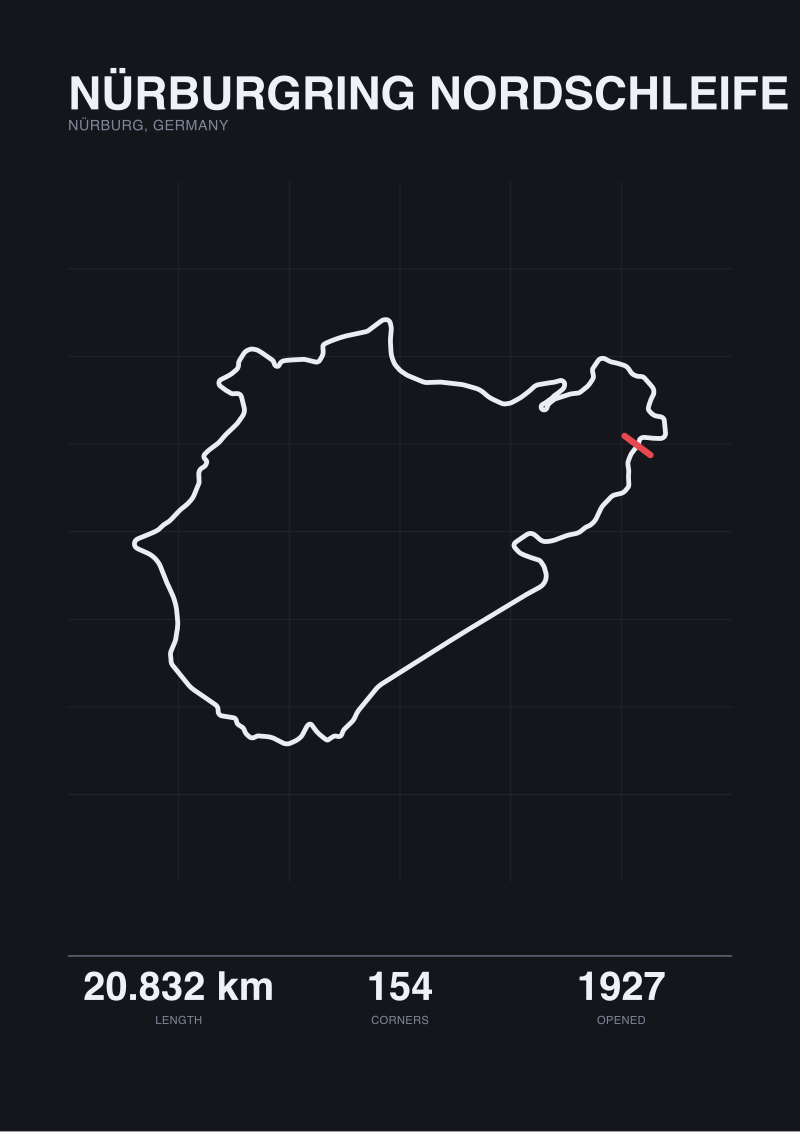
Consider what our own map traces actually give us. Silverstone: 5.881 kilometres pulled from OpenStreetMap raceway geometry, against 5.891 published by the circuit. Spa-Francorchamps: 6.995 against 7.004. The Nordschleife: 20.746 against 20.832, a delta of 86 metres over a circuit whose length has been argued about since 1927. These are respectable agreements. They are not identical numbers, and the disagreement is instructive. It tells us that even the length of a circuit, the single most tractable measurement anyone could ask for, depends on which reference line you chose to measure and which datum the circuit itself decided to homologate against.
Now try to do the same exercise for width. The map trace we used at Gridline gives us a centreline, a single continuous polyline that follows the raceway as OpenStreetMap has drawn it. That polyline has no width. It is a one-dimensional object. To produce a width figure we would need either a second polyline for the outer edge, or a set of orthogonal measurements taken at intervals, or the homologation drawings themselves. The first two require field survey. The third is not published as a public document by most circuit owners.
This matters because the regulation says minimum twelve metres. It does not say uniformly twelve metres. On the run down to Les Combes at Spa, the racing surface widens considerably to accommodate the braking zone and the double-apex sequence that follows. Through the Radillon after Eau Rouge the width narrows as the surface climbs and the run-off geometry closes in. At Silverstone, the entry to Copse is a different width than the exit from Stowe, and both are different from the ribbon that runs through the Maggotts-Becketts complex where the fast direction changes demand more lateral room than the pure straight preceding them.
The Nordschleife, homologated at Grade 2, is the extreme statement of this point. Its 154 turns run across 20.832 official kilometres of a road that was built in 1927 as a work-relief project and has been continuously in use ever since. Sections of the Nordschleife are narrower than any modern Grade 1 minimum. Sections through the Döttinger Höhe are broader than most permanent circuits. The single-number question does not survive contact with the road. The answer "how wide is the Nordschleife" is a set of measurements, not a figure.
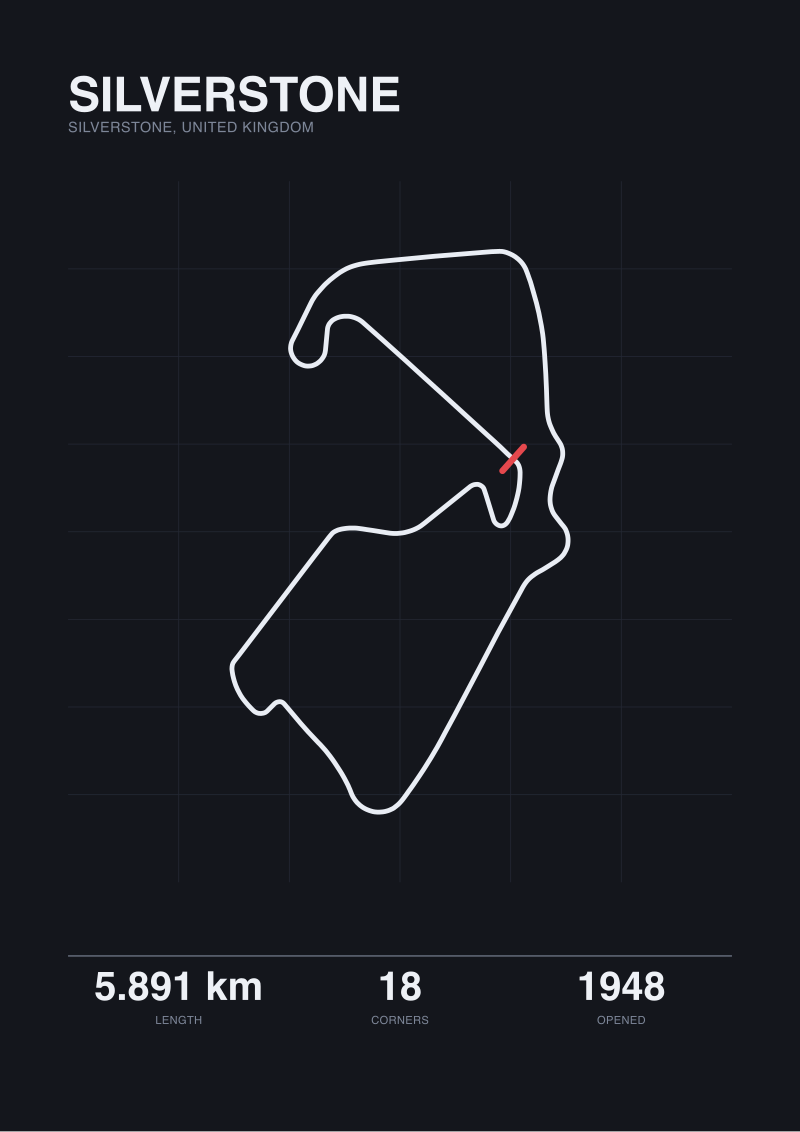 Silverstone
The print from this article · from €29.95
View the print →
Silverstone
The print from this article · from €29.95
View the print →
The Rule We Use Instead
When we sit down to draw a circuit at Gridline, we do not think of width as a scalar. We think of it as a function of what each section of the track is asked to do. A racing surface has four jobs it can be doing at any given metre, and the width the circuit designer awarded to that metre reveals which of those jobs the designer prioritised.
The first job is the overtaking zone. These are the long braking approaches to slow corners, and they are drawn wide on purpose. A car committing to the inside line and a car defending the outside must both fit, with a margin, and the width has to permit both to survive if one of them locks up. At Silverstone the approach to Stowe is a canonical example. At Spa the descent into the bus stop chicane serves the same purpose. Read the width here and you are reading the designer's intent to produce racing.
The second job is the commitment corner. Eau Rouge, Copse, the Nordschleife's Fuchsröhre. These are fast direction changes taken near full throttle, and the width narrows because the correct line is essentially singular. There is no wide line and tight line. There is the line. Widening the surface here would not add a second racing option; it would only add asphalt that no driver ever uses. Designers know this and do not spend the metres.
The third job is the transitional radius. These are the sequences where a car is changing direction repeatedly and quickly, and the width has to accommodate the lateral load path of a car that is not on any single geometric arc. Maggotts, Becketts and Chapel at Silverstone are the textbook case, drawn wide because the car is threading a path that a narrower ribbon would forbid.
The fourth job is the historical fossil. Long sections of the Nordschleife, opened in 1927, are the width they are because that is the width the road-crew laid in 1927. Spa's oldest surviving segments, from a circuit opened in 1921, carry the same trait. The width is not a design decision. It is what the past allowed.
When the Old Rule Still Wins
None of this means the twelve-metre answer is wrong. If a reader arrives at a search engine wanting to know whether an F1 car has room to overtake, or whether the sport races on roads or on something wider, or whether the tracks they see on television are drawn to a common standard, the FIA Grade 1 minimum is the right sentence to give them. It is true, it is short, and it lands the correct mental model on the first attempt.
The rule we use instead is for a different reader. It is for someone standing over a track map with a pencil, or looking at a corner on television and wondering why a specific overtake was possible there and not two hundred metres later, or trying to understand why a circuit that measures 6.995 kilometres on our trace still races differently than one of the same length elsewhere. For that reader, twelve metres is the beginning of the question, not the end. For most readers it is genuinely both.
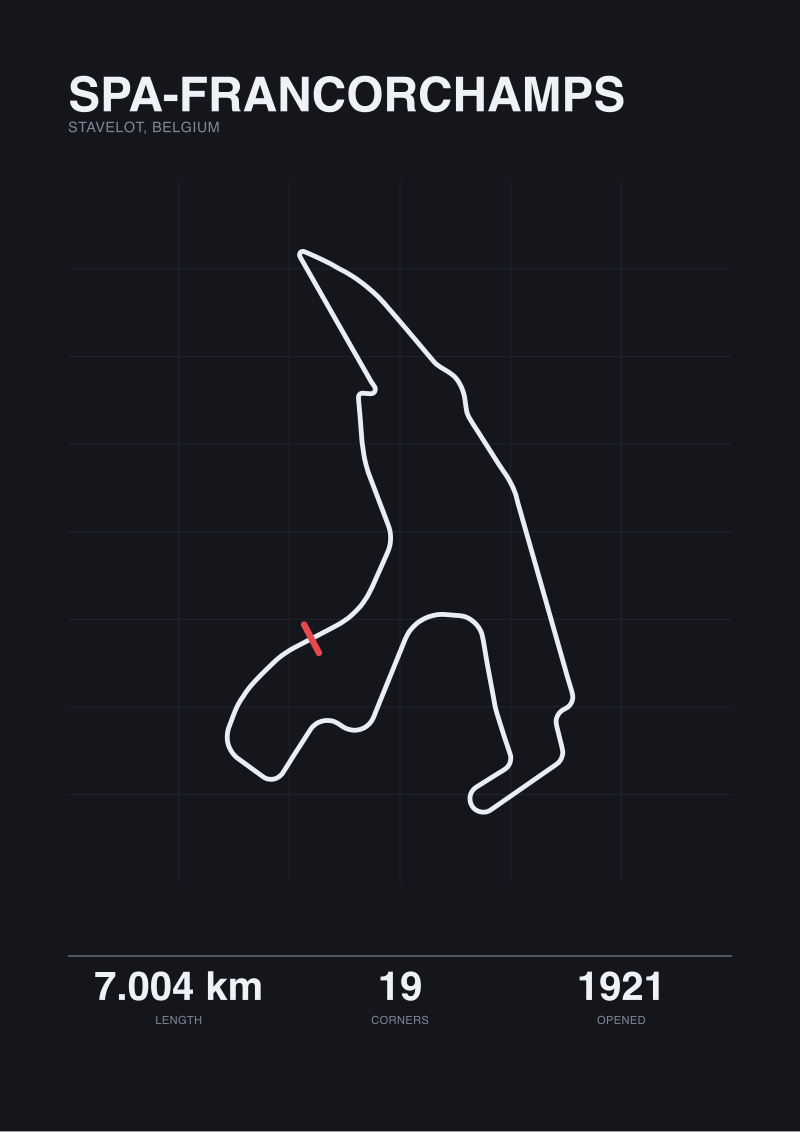 Spa-Francorchamps
The print from this article · from €29.95
View the print →
Spa-Francorchamps
The print from this article · from €29.95
View the print →
FAQ
What is the minimum width of a Formula 1 track under FIA regulations?
The FIA Grade 1 licence, which is the only circuit tier permitted to host a Formula 1 world championship round, prescribes a minimum racing surface of twelve metres for most of the lap. The regulation allows local variation at specific geometric points identified by function, but a circuit that falls below the minimum across general sections loses its Grade 1 status and cannot run F1 cars until the licence is restored.
Are all Formula 1 tracks exactly twelve metres wide?
No. Twelve metres is a minimum, not a fixed value. Actual racing-surface width varies corner by corner along a single lap. Braking zones and overtaking approaches are drawn considerably wider to permit side-by-side racing, while commitment corners such as Eau Rouge at Spa are narrower because a widened surface would add no usable racing line. The single-number answer is a regulatory floor, not a constant.
Can you measure a Formula 1 track's width from map data?
Not reliably. Public map sources such as OpenStreetMap store raceway geometry as a centreline polyline, a one-dimensional object with no width attribute. Producing a width figure from that data requires either a second polyline for the outer edge, a set of orthogonal field measurements, or the circuit's homologation drawings. Most circuits do not publish those drawings, which is why widths across a lap are rarely reported as measurements even when lengths are.
Why do circuit lengths sometimes disagree between official figures and map traces?
Our own traces show Silverstone at 5.881 kilometres against an official 5.891, Spa at 6.995 against 7.004, and the Nürburgring Nordschleife at 20.746 against 20.832. The gaps come from which reference line the measurement follows. Official figures are homologated against a specific racing line datum, while a map trace follows the raceway centreline as drawn in OpenStreetMap. Both are legitimate; they answer slightly different questions.
Is the Nürburgring Nordschleife the same width as an F1 circuit?
No. The Nordschleife is homologated at Grade 2, not Grade 1, and does not host Formula 1 races. Its 154 turns run across 20.832 kilometres of a road built in 1927 as a work-relief project, and the width varies considerably along its length. Some sections are narrower than any modern Grade 1 minimum. Others are broader than most permanent circuits. It is a historical road first and a homologated circuit second.
How much has track width changed as F1 cars have grown?
Modern F1 cars are wider than earlier generations, and the FIA minimum has been recalibrated over time to accommodate them alongside a margin for side-by-side racing and safety. The minimum is not fixed for eternity; it is set against the current vehicle and updated when the vehicle changes. Older circuits that predate current cars, such as Spa-Francorchamps which opened in 1921 or Silverstone which opened in 1948, have been repeatedly modified to remain compliant.
Why does F1 have a minimum width rule at all?
The rule exists so that two cars can race side by side with a lateral margin that keeps a car suffering a puncture or contact from immediately reaching the barrier. It is a safety and racing-quality prescription combined. Without a minimum, a circuit could theoretically homologate a surface that permitted only single-file running, which would make wheel-to-wheel racing impossible. The twelve-metre figure is the current compromise between those two demands.
From the collection
New circuits and 10% off your first print.
One email now with your code. No noise after.