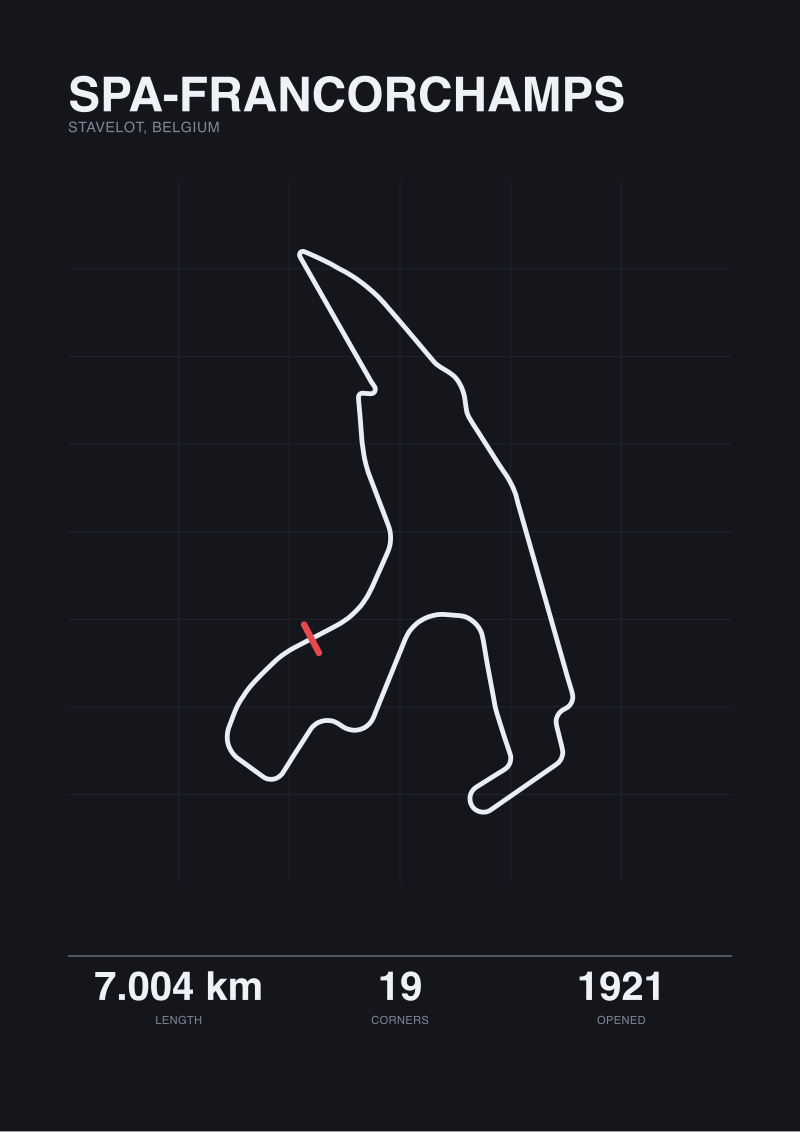
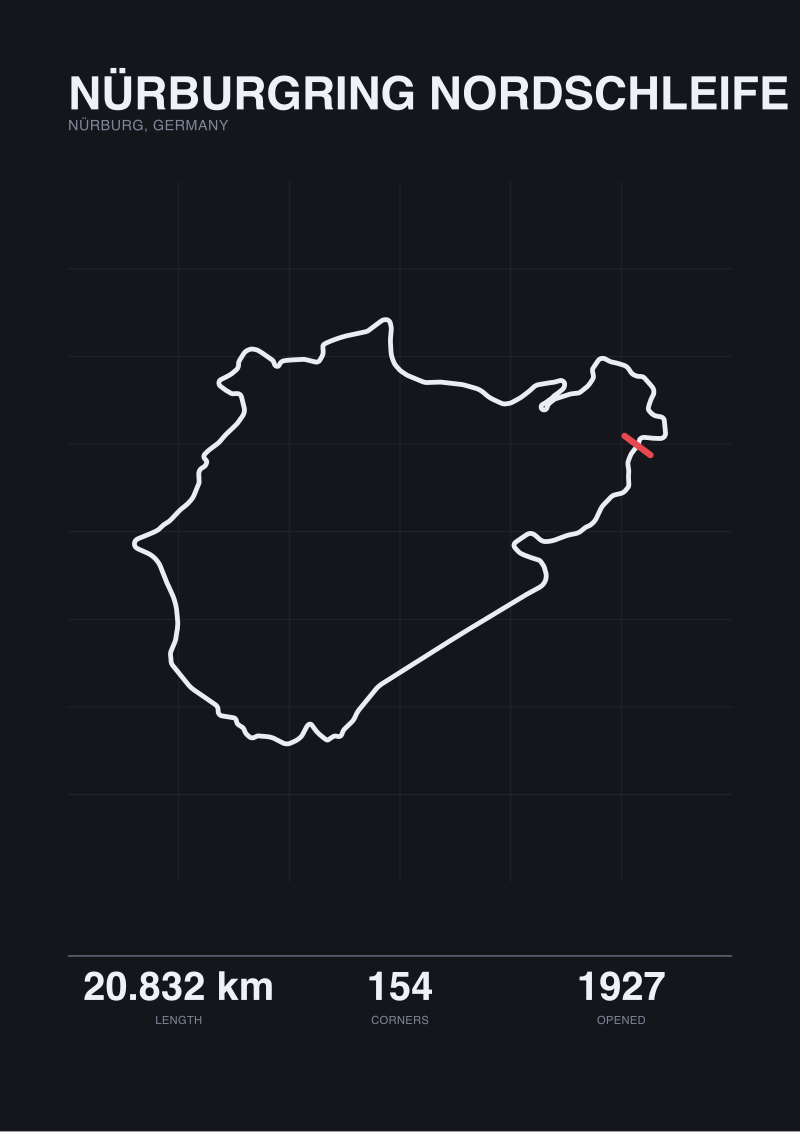
A track map is fresh when three things agree: the geometry file underneath it, the published length on the sanctioning body's page, and the corner count on the current homologation certificate. When they disagree, the map is either old, wrong, or measured on a different basis. This piece walks four questions in order, each one a fork. Nordschleife's 20.832 km official figure sits 86 metres above our OpenStreetMap trace of 20.746 km. Spa's 7.004 km sits 9 metres above a 6.995 km trace. Both are fresh. One is a rounding argument, the other is a measurement argument, and the difference matters.
Question 1: Does the Map Cite a Geometry Source, or Just a Number?
The first fork is the cheapest to check and the most often skipped. A fresh map is downstream of a geometry file — a polyline of coordinates that a human can open, count and re-measure. An unfresh map is downstream of a length figure someone typed above a drawing. The two look identical on screen. Only the source line tells them apart.
The reason this matters: length figures propagate. A circuit's page changes after a repaving that shifts the pit-lane exit by twelve metres, but the poster in the merchandise shop keeps quoting the pre-repaving number for another decade. If the map you are reading does not name a raceway file, an OSM extract, a GeoJSON, or a homologation trace, you cannot tell which decade you are in. You are just looking at ink.
If Yes
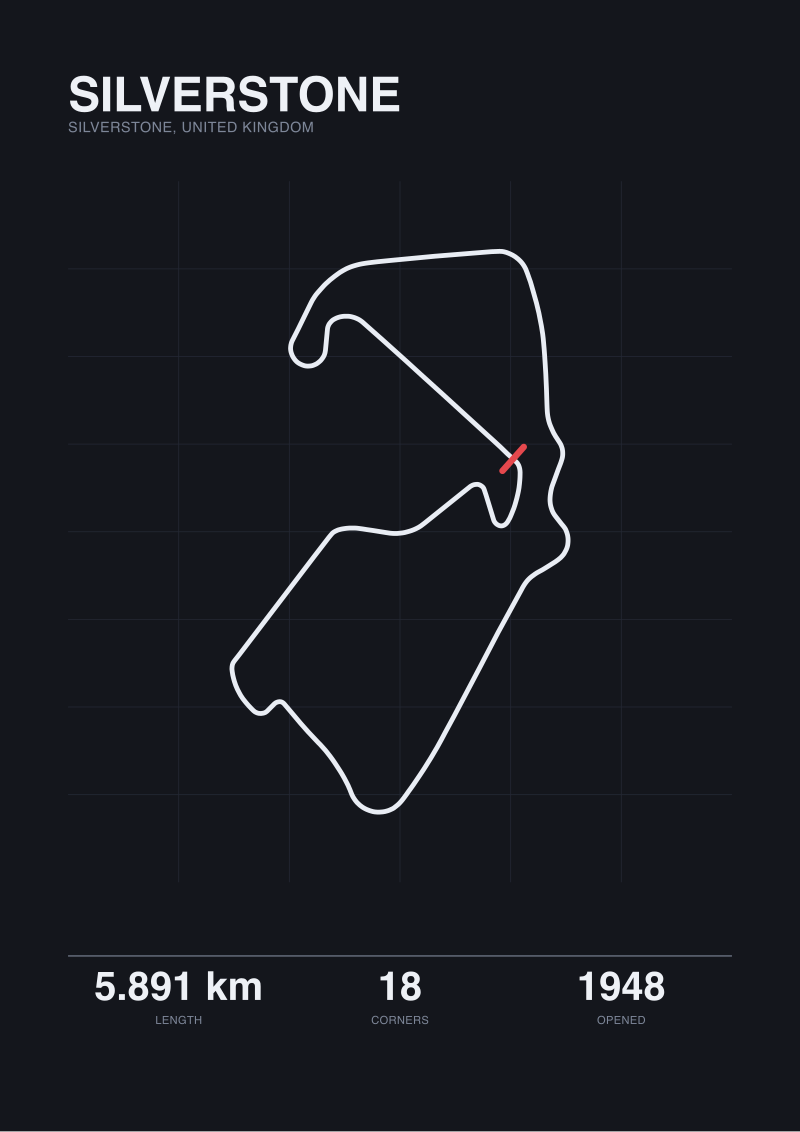
Open the source. For our four reference circuits the geometry is OpenStreetMap raceway data under the ODbL, and the traces resolve to 20.746 km for the Nordschleife, 6.995 km for Spa, 5.881 km for Silverstone, and 0.793 km for the Circuit de la Sarthe. That last number is not a fresh map of a 13.626 km road course — it is a partial extract, and a partial extract is honest about being partial. Ask whether the traced number is credibly the full lap. If yes, proceed to Question 2. If no, the map is fresh in the strict sense but incomplete in the useful sense.
If No
Stop. A map with only a number under it is decorative. You can still enjoy it as a drawing, but you cannot use it as a reference. The Nordschleife has 154 turns and opened in 1927; a decorative map may not reflect either the corner count or the layout the corners belong to. Treat unsourced maps as art, not as data, and route your citation elsewhere.
Question 2: Does the Traced Length Match the Published Length Within 1 Percent?
The second fork is arithmetic. If the map cites geometry, measure the polyline and compare it against the sanctioning body's published length. A one percent tolerance is generous — closer to a smoke alarm than a precision instrument — but it catches the meaningful failures. Below one percent the disagreement is about measurement basis. Above one percent the disagreement is about vintage.
The mechanics: 20.832 versus 20.746 is a delta of 86 metres, or 0.41 percent. 7.004 versus 6.995 is 9 metres, or 0.13 percent. 5.891 versus 5.881 is 10 metres, or 0.17 percent. All three sit comfortably inside one percent. A map that disagrees with the published number by 4 percent is not making a measurement-basis argument. It is describing a different circuit.
If Yes
The map is a candidate for fresh, but you have not confirmed it yet — you have only confirmed that the length is plausibly current. A layout can be re-drawn with an inflated pit-lane, a re-profiled kerb, or a moved apex, and still resolve to the same total length within centimetres. Length is a necessary but not sufficient signal. Proceed to Question 3 and check the corner count.
If No
The map is stale, or it is drawn against a different homologation. There is a third possibility worth naming: the map is fresh but the published length is stale — sanctioning bodies revise official length figures less often than the tarmac gets re-laid. If the disagreement is larger than one percent and the map is dated more recently than the sanctioning body's page, the map may actually be the more current document. This is rare. Assume staleness first, revision second, and verify with Question 3.
 Silverstone
The print from this article · from €29.95
View the print →
Silverstone
The print from this article · from €29.95
View the print →
Question 3: Does the Corner Count Match a Recent Homologation?
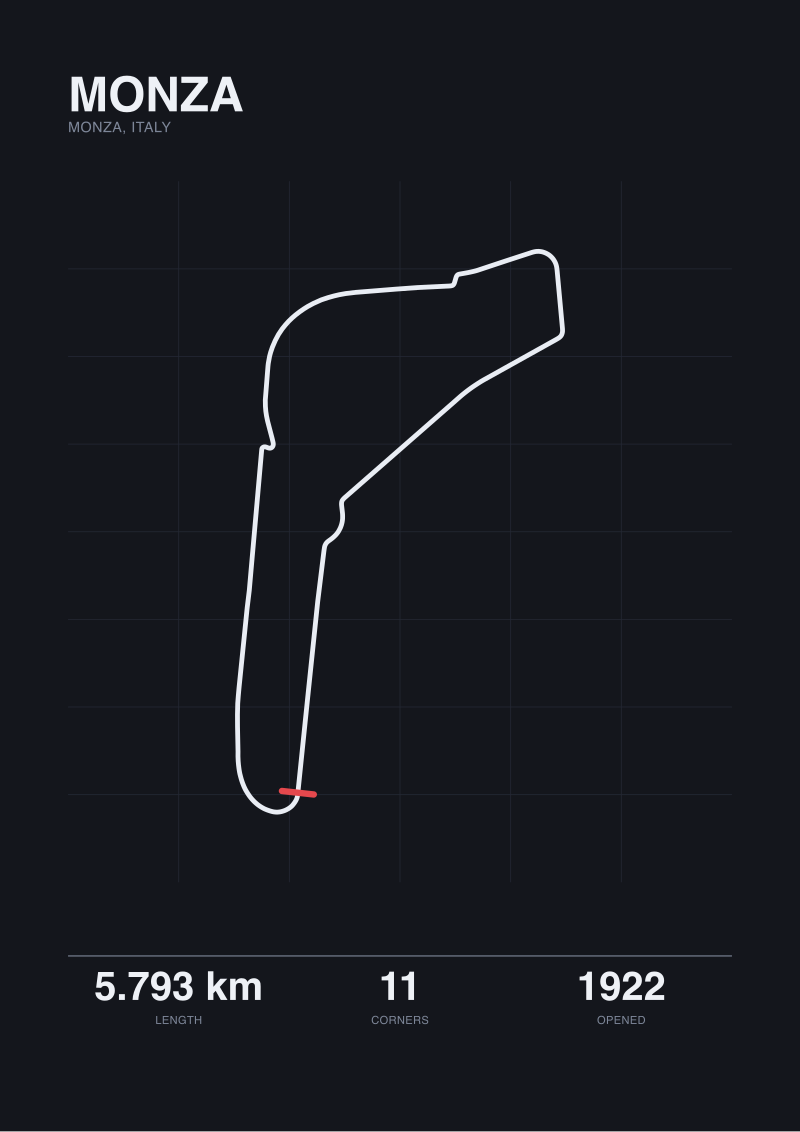
The third fork is the one most maps fail. Length is easy to keep current because it changes rarely and only in small amounts. Corner count changes whenever a chicane is added, removed, softened or split. Nordschleife's 154-turn figure is a corner-anatomy total that only a taxonomy nerd loves; Spa runs at 19 turns, Silverstone at 18. If the map you are checking labels a different count, the layout it describes is not the current one.
The subtlety: corner numbering conventions differ. Some documents count Eau Rouge as one corner, some as two, some as three including the run up to Raidillon. That is a naming argument, not a freshness argument. The freshness test is whether the map's count reconciles with a recent homologation certificate under the same convention. Convention drift explains most of the small disagreements. It does not explain the large ones.
If Yes
You have two signals aligned — length within one percent and corner count against a current homologation. This is the strongest freshness position most maps can occupy without a version stamp. It is enough to trust the map as a reference for design analysis, for tracing corner sequences, and for print. Proceed to Question 4 only if the map will be used as a dated document — for example, comparing the 2005 Silverstone layout with the post-2010 revision.
If No
The map is describing a different corner era. This does not automatically make it useless. A map of the pre-2007 Silverstone or the pre-1979 Nordschleife is a valuable historical document; it is just not a reference for the current circuit. Recategorise: is this a fresh map of a former layout, or an old map of the current one? The former has archival value. The latter has only decorative value.
Question 4: Is the Layout Version Dated, or Just Named?
The final fork is the most stringent and the least often satisfied. Circuits are versioned in practice — Spa-Francorchamps has undergone significant revisions since opening in 1921, Silverstone since 1948, and the Nordschleife has multiple documented eras since 1927 — but most maps describe a version by name only. "Spa 2022" is a label. "Spa layout homologated on YYYY-MM-DD per FIA document reference N" is a version. The difference is what you can and cannot compare.
Named layouts are stable to the eye and unstable in the archives. Two maps both labelled "current Silverstone" may have been produced two years apart with a repaved apex between them. Neither map is wrong. Both are potentially stale relative to the other. A version stamp resolves this. A name does not.
If Yes
The map is fully fresh: sourced geometry, length within tolerance, corner count reconciled, and version stamped. This is the strongest position a track map can hold and is the standard we treat as necessary for any print that carries a date. Cite the version. Cite the source. If the sanctioning body publishes a homologation certificate reference, cite that too. The reader who cares about freshness will look for these three lines and stop trusting the map when they are absent.
If No
Treat the map as fresh-by-name. This is the common case for public-facing circuit graphics and is workable for most editorial uses. It is not workable for archival comparison. If the argument you are building depends on comparing this circuit's layout with an earlier version of itself, a version stamp is not a nice-to-have; it is the argument's spine. Without it, the comparison is between two named documents whose dates you do not know.
 Spa-Francorchamps
The print from this article · from €29.95
View the print →
Spa-Francorchamps
The print from this article · from €29.95
View the print →
If You Answered Everything: The Freshness Matrix
Sixteen combinations are possible across four yes/no forks. The eight combinations below are the ones that arise in practice. The others collapse into these because Question 1 gates the rest — a "No" on the source question voids the answers downstream, and the recommendation is the same regardless of what you might have found underneath.
| Q1 Source | Q2 Length | Q3 Corners | Q4 Version | Recommendation |
|---|---|---|---|---|
| Yes | Yes | Yes | Yes | Fully fresh reference; cite geometry source, length, corner count and version stamp. |
| Yes | Yes | Yes | No | Fresh-by-name; use as current reference but not for archival comparison across eras. |
| Yes | Yes | No | Yes | Fresh map of a former layout; label the era explicitly and treat as historical document. |
| Yes | Yes | No | No | Named layout of unclear era; usable for shape but not for corner sequence claims. |
| Yes | No | Yes | Yes | Length disagrees beyond tolerance; verify whether the published figure or the trace is stale. |
| Yes | No | Yes | No | Length mismatch with no version stamp; do not use as a length reference. |
| Yes | No | No | Any | Different circuit or different era; recategorise before use. |
| No | — | — | — | Decorative only; not a reference document regardless of what it depicts. |
The point of the matrix is not to grade maps as pass or fail. It is to route each map to the argument it can carry. A decorative map of the Nordschleife is fine on a wall and misleading in a footnote. A fresh-by-name map of Spa is fine in an editorial and incomplete in an archive. The mistake is not producing an imperfect map. The mistake is using an imperfect map to carry a claim it was never sourced to support.
Freshness, in the end, is a chain of custody. Geometry file, published length, corner count, version stamp. Four links. When all four are present the map is a reference. When one is missing the map is still useful — you just need to know for what. When the source line itself is missing, there is no chain at all, and you are back to ink on paper.
FAQ
Why does the Nordschleife trace read shorter than the official length?
The 20.832 km figure is the published length on the sanctioning body's page. Our OpenStreetMap raceway trace reads 20.746 km — a delta of 86 metres, or 0.41 percent. That gap sits comfortably inside a one-percent tolerance and is best read as a measurement-basis disagreement, not a staleness signal. The published figure and the map trace are measured on different bases. Both are fresh; they simply do not answer the same question.
Is a difference under one percent between traced and official length always benign?
Not always, but usually. A sub-one-percent gap is the fingerprint of measurement-basis divergence: the sanctioning body measures along a defined racing line while a map trace follows the road centreline, or one measurement rounds where the other does not. Spa's 9-metre gap and Silverstone's 10-metre gap sit inside this regime. A gap above one percent is a different animal and typically indicates the map and the published length are describing different versions of the circuit.
How do I check the geometry source on a track map I did not draw?
Look for a caption, footnote or legend citing a specific dataset — OpenStreetMap under ODbL, a homologation trace, a GeoJSON file, a raceway extract. If the caption cites only a length figure or a circuit name, no chain of custody exists. The map is downstream of a number, not of coordinates, and you cannot re-measure it. Treat it as art rather than as reference material.
Why does the Circuit de la Sarthe traced length read 0.793 km against a 13.626 km official figure?
The trace covers a partial extract of the circuit, not the full public-road lap. A 0.793 km reading against a 13.626 km published length is not a freshness failure — it is a scope disclosure. The extract is honest about being partial. Using it as a full-lap length reference would be an error introduced downstream by whoever cites it, not by the trace itself.
Do corner counts change often enough to matter for freshness?
Yes. Length is the more stable signal; corner count changes whenever a chicane is added, softened, split or removed. Spa runs 19 turns, Silverstone 18, and the Nordschleife 154 under the corner-anatomy convention. A map labelling different counts is either using a different counting convention or describing a different era. Convention drift explains small discrepancies. Layout revision explains everything else.
What is the difference between a named layout and a versioned layout?
A named layout is labelled by circuit and rough era: "current Spa", "post-2007 Silverstone". A versioned layout is stamped against a specific homologation reference and date. Named layouts are visually stable but archivally ambiguous — two maps sharing a name can differ in detail. Versioned layouts are comparable across time because the reference is external and dated. Editorial work usually tolerates named. Archival work usually does not.
If a map fails the freshness test, does it become useless?
No. A map that fails the corner-count question may be a valid historical document — a fresh map of a former layout is still fresh, just not of the current circuit. A map that fails the version-stamp question is workable for editorial use and unworkable for archival comparison. The point of the four questions is not to grade maps as usable or unusable; it is to route each map to the argument it can actually carry.
Which of the four questions is the strictest in practice?
Question 4, the version stamp. Most public-facing circuit graphics — including well-drawn, well-sourced ones — carry a name but not a homologation reference. This is not laziness; it is convention. The strictness matters only when the map has to support archival comparison across circuit revisions. For everyday reference use, sourced geometry, in-tolerance length and reconciled corner count are enough.
From the collection
New circuits and 10% off your first print.
One email now with your code. No noise after.