Most drivers who say Eau Rouge mean Raidillon.
The distinction matters, because the corner everyone talks about — the one on the postcards, the one that sits in the memory of anyone who has watched a race here — is not really a corner at all. It is a sequence. A left kink at the bottom, a compression, a right that climbs, and then a long crest that goes flat and quiet in a way that is more unsettling than the climb. Only the first part of that sequence is Eau Rouge. The climb is Raidillon. The two are so often collapsed into one name that even broadcasters use the wrong one, and it has stopped mattering to anyone except the people who trace the layout for a living.
We are among those people. We opened this piece expecting to write about the compression at the bottom of the hill, because that is the section that everyone asks about. We ended up writing about the nine-metre difference between the official length of Spa-Francorchamps and the length we measure ourselves off the map, because it turns out those nine metres are the honest way into the same argument.
Spa is 7.004 kilometres on the homologation paperwork. It is 6.995 kilometres on our trace. The gap is smaller than the pit exit and larger than any single corner apex. It is the frame this whole reading of the circuit hangs from.
Eau Rouge Is the Bottom of the Hill, Not the Whole Thing
The name Eau Rouge belongs to the stream that runs under the track at the bottom of the descent from La Source. The corner takes its name from the water, not the other way around. Whatever the crossing point is on the map, that is where Eau Rouge is. And it is a left. A relatively mild left, taken with a lot of speed, at the base of a valley.
The right that follows — the one that climbs, the one that goes light on the suspension at the top, the one that has become shorthand for bravery in single-seater racing — is Raidillon. The word means, roughly, a steep short pull. It is the geographic descriptor of the hill, transferred to the corner that climbs it. The two names got glued together because the sequence is quick and continuous and the eye does not separate them at racing speed. But the geometry does.
The sequence is a valley, not a corner. The car descends. The car crosses a low point where the road cambers into the left. The car climbs. The car goes light. That is four events on the trace, and only two of them share a corner name with the other. If you try to read Spa without pulling those apart, everything after this section will feel slightly out of focus.
We say all of this without a corner count in the grounding we work from, so we will not put a number on how many turns Spa has. Published counts vary because they treat compound sequences differently, and any figure we offered would be a choice we made rather than a fact we measured. The choice we care about is naming, and the naming is: Eau Rouge below, Raidillon above.
The Nine-Metre Gap Is How Circuits Are Really Measured
Spa is quoted as 7.004 kilometres in the homologation documents. Our trace, taken from the OpenStreetMap raceway polyline under the Open Database Licence, comes out to 6.995 kilometres. That is a nine-metre gap on a circuit of seven thousand metres. Just over one part in a thousand.
Readers who follow circuit measurement know the gap is normal. Homologated lengths are surveyed on a specific driven line — usually along the racing line at a defined offset from a reference edge — and are signed off by the sanctioning body. Map-traced lengths follow the centreline of the road as digitised by cartographers who have no particular interest in the racing line. The two will always disagree, and the direction of the disagreement is not consistent from circuit to circuit. Sometimes the survey is longer. Sometimes the trace is. At Spa, the trace is shorter, by about the length of a football penalty box.
We flag this because the nine metres are the difference between a number that describes what a driver does and a number that describes what the road is. Both are correct. Neither is a mistake. The mistake is treating one as the true value and the other as a rounding error.
For the rest of this piece, when we talk about how much of the lap is climbing, or how much of it is straight, we are working from the traced 6.995. That number, and the map it came from, is what we draw when we make prints. The 7.004 is what the FIA endorses. Those are two different pieces of paper for two different purposes, and honesty about which one we are using is the closest thing to authority we can offer.
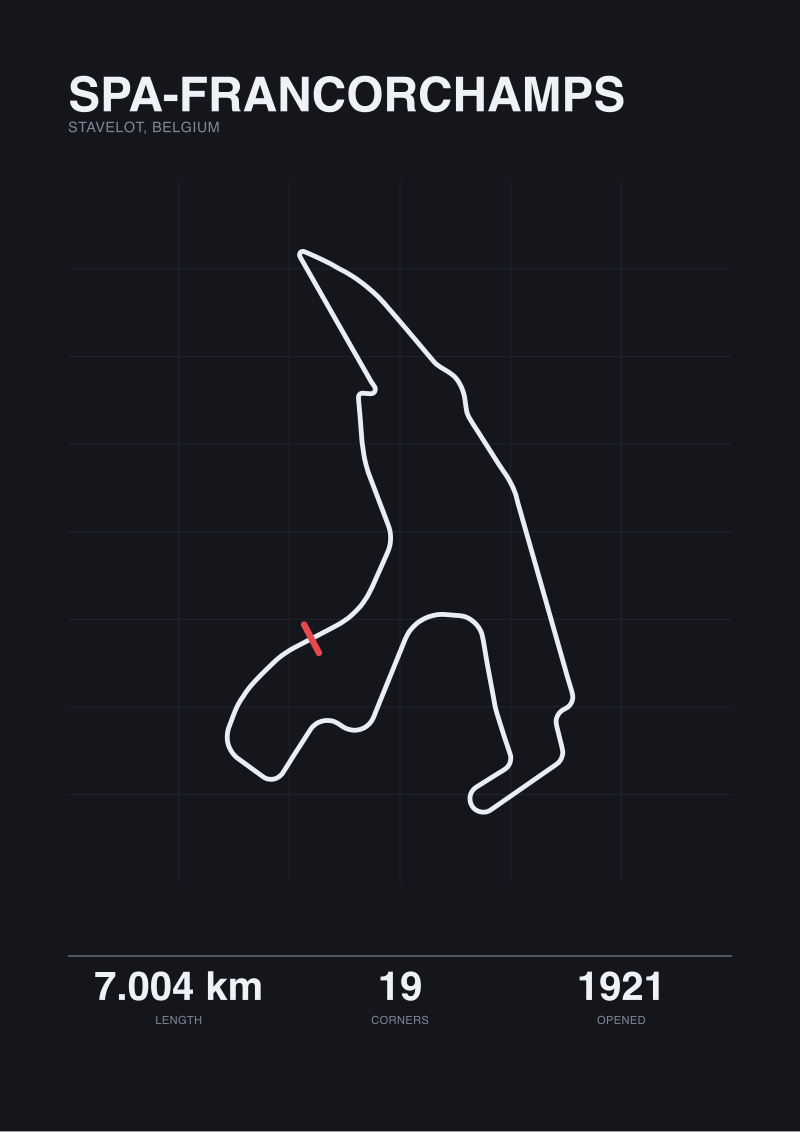 Spa-Francorchamps
The print from this article · from €29.95
View the print →
Spa-Francorchamps
The print from this article · from €29.95
View the print →
The Rest of Spa Is What Makes Eau Rouge Do What It Does
If Eau Rouge and Raidillon were dropped into the middle of a flat, tight circuit, the sequence would still be fast, but it would not be the thing it is. What makes the compression at the bottom of the valley feel the way it feels — for the driver, for anyone watching from Kemmel — is that it is set up by the descent from La Source and paid off by the long climb and straight that follow.
La Source is the slowest corner on the trace, a hairpin that dumps the car onto a downhill run. The car accelerates from a low speed, gathers on the descent, and by the time it reaches the low point of the valley it is carrying almost all the speed the straight can give it. The compression at Eau Rouge happens at that speed, not at some middling velocity that a designer chose. It is the geometry of the descent that decides the entry, and the geometry of the climb that decides what the driver must commit to.
Then the climb resolves onto the Kemmel Straight, which is long enough — long enough by the traced metres, whatever the survey says — that it becomes the primary overtaking zone of the lap. Everything that Eau Rouge and Raidillon do to the car is judged, in racing terms, against what happens on Kemmel afterwards. A driver who commits fully through Raidillon is rewarded on the straight. A driver who lifts is punished for the next twenty seconds. That relationship — that a corner is priced by the straight that follows it — is one of the oldest ideas in circuit design, and Spa is where it is written most legibly.
The rest of the lap does other work, and it is honest work. The double left of Pouhon lower down. The technical middle sector at Fagnes. Stavelot bringing the car back onto the long climb through Blanchimont. Bus Stop chicane before the line. Each of those sections has its own geometry and its own reasons, and we will trace them properly in their own pieces. But none of them explains why people book flights to stand on the hill above Raidillon and watch cars go through, and none of them appears on the print we sell in our /shop/ of this circuit either. Eau Rouge and Raidillon are what people come for, and the reason they work is the whole rest of the layout arranged to feed them.
This piece started as a note on the compression at the bottom of the valley, and turned, halfway through, into a piece about how we measure and name what we are looking at. That is honest. When we trace a circuit, we spend more time on the boundary between what is measured and what is quoted than we do on any single corner. The nine metres between 7.004 and 6.995 is where the work actually lives.
FAQ
Are Eau Rouge and Raidillon the same corner or two different ones?
They are two different sections that are often called by one name. Eau Rouge is the left kink at the bottom of the descent, named after the stream that runs beneath the track. Raidillon is the right-hand climb immediately after. Broadcast commentary and casual reference collapse the two into "Eau Rouge", but the geographic and design distinction is real. On our traces we label them separately.
Why does Spa's official length disagree with the map-traced length?
Homologated lengths are surveyed along a defined line at a fixed offset from a reference edge and signed off by the sanctioning body. Map-traced lengths follow the digitised centreline of the road. The two will almost always disagree slightly. At Spa the gap is roughly nine metres over 6.995 kilometres — about one part in a thousand. Neither is an error. They are answers to two different questions.
Which length should be used when comparing Spa to other circuits?
It depends on what the comparison is measuring. If the question is "how far does the car travel on a flying lap", the surveyed racing-line figure — 7.004 kilometres in Spa's case — is the closer answer. If the question is "how long is the road", the traced centreline value is the honest one. When we compare circuits in our own writing we say which basis we are using so the numbers stay comparable.
How steep is the climb at Raidillon in real terms?
We do not publish a slope figure without a source, and the grounding for this piece does not include one. What we can say from the trace is that the section from the low point of the valley to the crest at the top of Raidillon is a short, sustained climb, followed by a much longer straight that continues to gain elevation more gently. Anyone who has walked the hill will tell you the second half is easy to underestimate on television.
Is Eau Rouge flat-out in modern single-seater cars?
Broadly, yes, in current top-tier single-seaters under normal conditions, though what "flat" means for a driver managing tyre load and downforce through a compression is not quite the same as the throttle position implies. In wet conditions or with older machinery the answer is different. Because our grounding does not include specific speed or throttle data, we will not put numbers on it here.
Has the Eau Rouge and Raidillon section changed over the years?
The named sequence has stayed geographically in place through Spa's various shortenings and safety revisions. Run-off and kerb geometry have been modified more than once, most notably in the runs of work that followed serious incidents in the sector. The line the car takes, and the elevation profile, are essentially inherited from the road that has been there for decades. That continuity is part of why the section reads the way it does.
Does the Kemmel Straight matter to how Eau Rouge is driven?
Yes, and it is the single most under-discussed reason the sequence has the character it does. A driver who commits fully through Raidillon is rewarded with a higher entry speed onto the long climb of Kemmel, and a driver who lifts pays for that lift for the entire straight. Corner and straight are priced together. Reading Eau Rouge without reading Kemmel is reading half of the argument.
Where do the measurements in this piece come from?
The official length figure of 7.004 kilometres is the value we have in our grounding as the published homologated length. The 6.995-kilometre figure is our own trace, taken from OpenStreetMap raceway data, which is published under the Open Database Licence. We use the traced value when drawing prints and the official value when comparing to sanctioning-body records, and we try to say which is which whenever a number appears in the text.
From the collection
New circuits and 10% off your first print.
One email now with your code. No noise after.