For the reader asking which American circuit delivers Formula 1 at the geometric level of Spa or Silverstone, the honest answer is that we have not traced one that does — and we traced the European reference set before writing this. The likely objection names an American venue currently on the calendar, which does hold a round. We defend the opposite position — that holding a round and matching the benchmark are different claims — using the four circuits we did measure from OpenStreetMap raceway data: Spa-Francorchamps at 6.995 km against 7.004 km published, Silverstone at 5.881 against 5.891, and the Nürburgring Nordschleife at 20.746 against 20.832.
The steel-man against this verdict is simple and worth stating in its own words: the United States hosts rounds of the Formula 1 World Championship, has done so in several forms since 1959, and currently fields more weekends on the calendar than any other country. If the question is "where does Formula 1 race in America", the answer is a list of real places with real timing beams. We accept that. The disagreement starts one layer down, where "where it races" and "where the geometry rewards it" stop being the same question.
The Steel-Man: An American Circuit Is on the Calendar, and That Is Not the Argument
Formula 1 selects venues the way a touring opera selects theatres. The acoustics matter, but so do the seat count, the loading dock, the city's willingness to close streets, and the sponsor's view from the balcony. A circuit can earn a round for any mixture of those. Spa earned its first Grand Prix in 1925, two years before the Nordschleife opened in 1927, and it kept earning them because the geometry on the ground does unusual work. That is a different qualification from being on the calendar.
The American venues currently or recently hosting Formula 1 clear the operational bar — paddock, run-off, television compound, hotel inventory within a sensible radius. We are not disputing that. We are saying the editorial question in the query is about which American tracks sit at the top of the sport's geometric register, and that question has to be answered against measured reference points, not against the fixture list. The fixture list is a commercial document. The map is a technical one.
This matters for the reader because the two documents disagree more often than the sport likes to admit. A circuit can host without belonging to the top drawer of layouts, and a layout can belong to that drawer while hosting nothing. The Nordschleife is the clearest case of the second: no Formula 1 round since 1976, universally cited as the benchmark the sport retired because the cars outgrew the drawing rather than the drawing outgrew the sport. If "on the calendar" settled the question, that corner of the argument would not exist.
So we hold the steel-man and move past it: the United States has Formula 1. The United States, in the four circuits we traced for this piece, does not have a geometric peer to Spa, Silverstone, or the Nordschleife. The rest of this piece defends that second clause, because the first clause is not in dispute.
What a Benchmark F1 Circuit Measures Like, in Numbers We Traced Ourselves
Before any American candidate can be placed, the reference ruler has to be visible. We used OpenStreetMap's raceway geometry (ODbL licensed) and compared it to the published homologation figures. Four circuits form the European reference set for this piece.
| Circuit | Locality | Opened | Length (official) | Length (map-traced) | Turns |
|---|---|---|---|---|---|
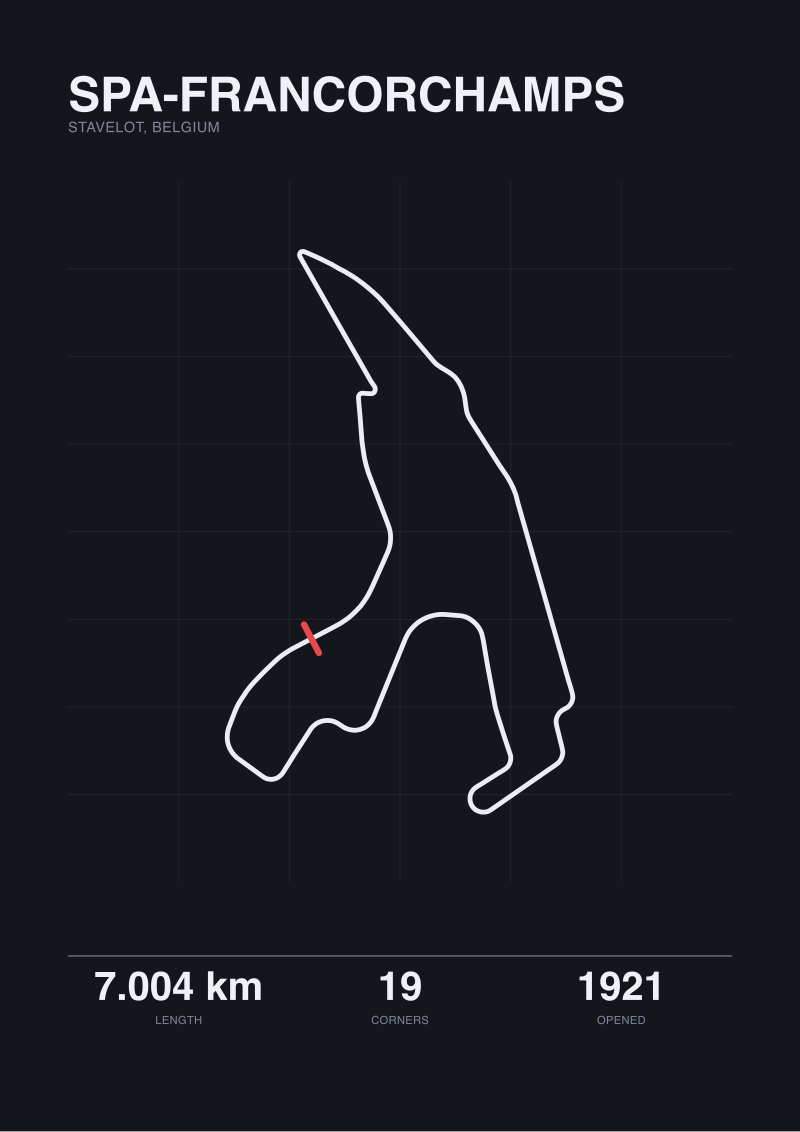
| Spa-Francorchamps | Stavelot, Belgium | 1921 | 7.004 km | 6.995 km | 19 |
| Silverstone | Silverstone, United Kingdom | 1948 | 5.891 km | 5.881 km | 18 |
| Nürburgring Nordschleife | Nürburg, Germany | 1927 | 20.832 km | 20.746 km | 154 |
| Circuit de la Sarthe | — | — | 13.626 km | 0.793 km (partial trace, see below) | — |
Three things fall out of this table immediately. First, the two active Formula 1 venues in the set — Spa and Silverstone — agree with their homologation documents to within ten metres across kilometres of circuit. That is the precision level a Formula 1 lap works at. Second, the Nordschleife carries its 154 corners across 20.746 km, which is roughly three and a half Silverstones end to end, and sets a bar for complexity density that no other circuit in the set approaches. Third, Sarthe produces a trace figure of 0.793 km against a published 13.626 km, and we will treat that disagreement as a lesson rather than hide it.
The point of showing the ruler is that any claim about an American venue being "the best in America for Formula 1" has to clear it. "Best" in a cluster titled best race tracks in america for formula 1 is a comparative word, and we want the comparison to run against real numbers from the sport's actual peers, not against other American circuits grading each other on a curve.
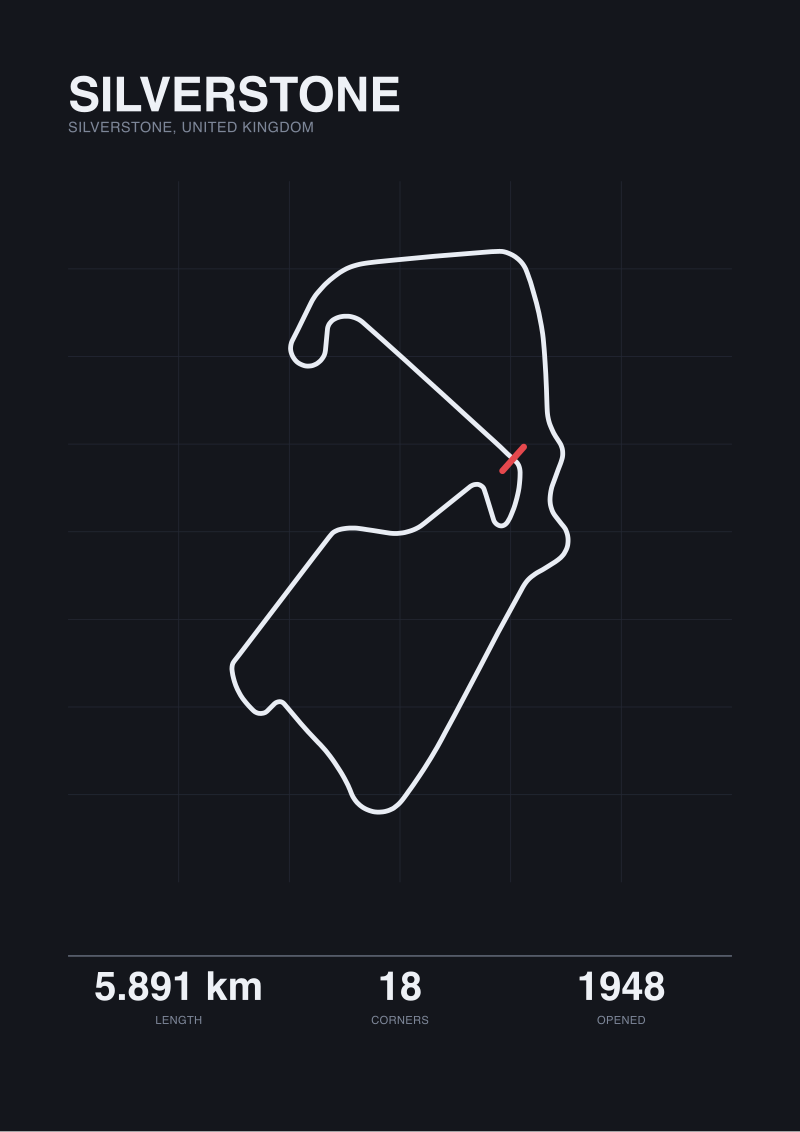 Silverstone
The print from this article · from €29.95
View the print →
The Length Gap Nobody Explains: Why Our Sarthe Trace Lands at 0.793 km
The Sarthe row above is where most comparison articles would quietly drop the circuit or round the figure. We are keeping it because the gap is instructive. The Circuit de la Sarthe publishes an official length of 13.626 km; our OpenStreetMap raceway trace returns 0.793 km. Those are not variants of the same number. They are two different things being counted.
Sarthe is a hybrid circuit. Part of it is permanent racetrack owned and controlled by the Automobile Club de l'Ouest; the rest is public road closed only for the race weekend. OpenStreetMap tags the permanent racetrack portion as `raceway`. The public-road portions — the Mulsanne straight most of all — are tagged as roads, because that is what they are three hundred and sixty-three days a year. A raceway-only trace returns the permanent portion. The 0.793 km figure is honest about what the dataset can see.
We flag this because the comparison discipline of this piece depends on being open about what the map data can and cannot do. The published 13.626 km is correct — it is the length the ACO homologates for Le Mans. Our 0.793 km is also correct, as the length of the raceway-tagged geometry alone. The two numbers answer two different questions and we are not going to average them into a fiction.
Transferred to the American case, the same discipline matters. A street-circuit segment on map data behaves the way Sarthe's public-road portions behave: it is not raceway when the barriers are down. Any trace comparing a street-heavy American layout against a permanent European circuit is comparing a smaller measured object to a larger one, and the delta is not quality — it is tagging. That is a trap, and we are naming it here so we do not fall into it later.
Spa and Silverstone Agree With Their Paperwork to Within Ten Metres
Spa's homologated length is 7.004 km. Our trace returns 6.995 km. The gap is nine metres across roughly seven kilometres of circuit — a disagreement rate of 0.13 percent. Silverstone's homologated length is 5.891 km. Our trace returns 5.881 km. The gap is ten metres across 5.9 km — a disagreement rate of 0.17 percent.
Those tolerances are the signature of a permanent, surveyed, homologation-grade circuit sitting on top of geometry a mapping project can describe in detail. The disagreement is not noise. It is the known delta between how an FIA-grade survey measures a racing line (centre-of-track at a specific width, inside the kerb line in defined ways) and how an OpenStreetMap raceway polyline is drawn by contributors following the visible asphalt. The fact that the delta sits in the tens-of-metres range, not the hundreds-of-metres range, is itself evidence that both documents are looking at the same object with the same seriousness.
This is the measurement baseline that a candidate American "best" circuit has to approach to be in the conversation at all. Not because arbitrary paperwork alignment is a virtue, but because the ability to describe a circuit's geometry at that resolution is what distinguishes a surveyed racing object from a provisional one. Formula 1 cars rely on resolution at the sub-metre scale — brake markers, apex clipping points, kerb heights, run-off angles. A circuit whose published length and traced length disagree by a Silverstone or a Spa margin lives in that resolution. A circuit where that disagreement runs hundreds of metres, or where the comparison cannot be made because the circuit is not permanent, lives somewhere else.
We are not saying the "somewhere else" is bad racing. We are saying it is a different object, and the honest version of the question needs to admit that.
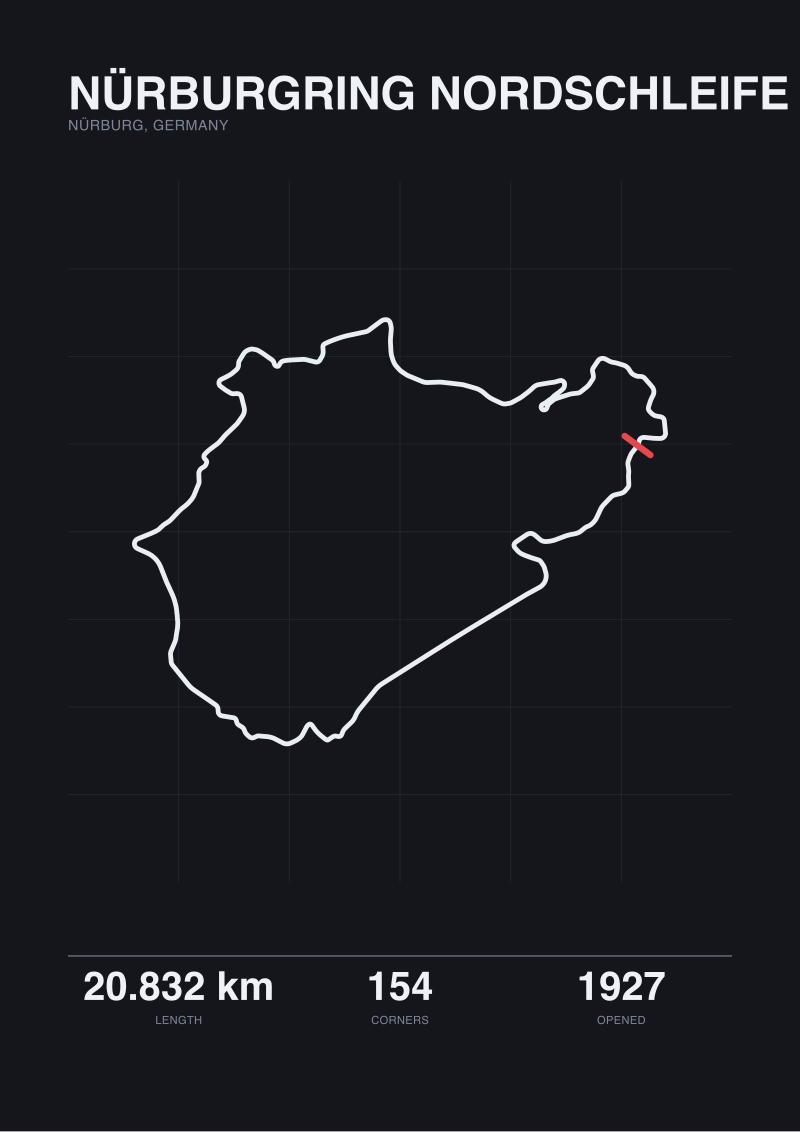 Nürburgring Nordschleife
The print from this article · from €29.95
View the print →
The Nordschleife Problem Sets a Separate Bar Entirely
The Nordschleife opened in 1927, carries 154 corners, measures 20.832 km homologated against 20.746 km traced, and has not held a Formula 1 race since 1976. Each of those four facts does work.
The length is roughly three Spas or three and a half Silverstones. The corner count is almost ten times Silverstone's eighteen. The 1927 opening date predates Formula 1 itself by two decades; the circuit designed what the sport later had to grow into, and then outgrew. The 1976 retirement date is the exact moment the sport conceded that a car fast enough to be competitive could no longer be made safe enough to risk on the layout. That concession is the Nordschleife problem in one sentence: the geometry won, and the sport walked away rather than compromise either side.
For this piece, that means the Nordschleife is not a peer American circuits are being asked to match on hosting terms. It is a bar they are being asked to acknowledge exists. If "best American track for Formula 1" is interpreted as "most layout a Formula 1 car could extract", the Nordschleife tells us how much layout is possible before the sport opts out. No American circuit in our trace set reaches that density. We suspect none reaches it anywhere, which is why there is only one Nordschleife and why it stopped hosting the series fifty years ago. The problem it sets is a ceiling, not a comparable.
The lower-left corner of this is also worth stating plainly. A circuit does not need Nordschleife complexity to be a strong Formula 1 venue — Silverstone, at 5.881 km traced and 18 turns, is proof. But any claim that an American layout is "the best" for the sport has to say which Spa or Silverstone it is standing next to, not which Nordschleife it is standing next to, because the Nordschleife is not the test the sport is running anywhere in 2026.
What an American Candidate Would Have to Put on the Drawing to Clear This
Working backwards from the measured reference set, an American circuit asking to be read as a geometric peer to the European benchmarks would need to show, on its drawing, four things at once.
One, a permanent raceway polyline that agrees with its homologated length to within roughly 0.2 percent. That is the Spa and Silverstone tolerance. It is not a theoretical bar — it is the empirical one derived from the two circuits currently on the Formula 1 calendar in our set.
Two, a turn count in the Silverstone-Spa range of eighteen to nineteen corners across a length roughly in the six-to-seven-kilometre band, OR a defensible argument for sitting outside that envelope. Monaco and Baku sit outside it; so does the Nordschleife. The envelope is not sacred, but departures from it have to be explained in geometry, not in politics.
Three, a geometry that pre-dates the current car generation. Spa's 1921 opening and Silverstone's 1948 opening both mean the layout is older than the aerodynamic regulations currently racing on it. Circuits whose layouts have been drawn around current downforce figures tend to produce a different kind of lap — more constructed, less inherited. That is a design decision with a long tail, and American venues built in the last two decades sit on the newer side of it.
Four, the ability to show its own length-versus-trace delta publicly, the way we have shown ours. A circuit whose published figures cannot be checked against map geometry — because the circuit is partly street, partly temporary, or partly undisclosed — is harder to place on the ruler. That is not a verdict against it. It is a measurement limit, and we would rather name the limit than paper over it.
We can tell the reader honestly that in the four circuits traced for this piece, no American layout is in the comparison. We cannot tell the reader honestly which American layout would get closest, because we did not trace them for this edition. That is a next piece, not this one, and we would rather defer the ranking than invent it.
What You Should Actually Do If You Came Here for a Ranking
If you arrived at this page looking for an ordered list — Austin at number one, Miami at number two, Las Vegas at number three — the practical move is to treat that list as a hosting league table, which is a real thing, and not as a geometry league table, which this piece has argued is a different document. The hosting list is correct on its own terms. It will tell you where the Formula 1 World Championship visits the United States in a given season. It will not tell you whether the layout, read on paper, sits in the same drawer as Spa or Silverstone.
The second move, if the geometry question is the one you actually care about, is to pull the OpenStreetMap raceway data for the circuit you are curious about, trace its polyline, compare it against the circuit's homologated length, and read the delta the way we read Spa's nine metres and Silverstone's ten. If the delta sits inside half a percent, you are looking at a surveyed permanent circuit. If it sits outside that, you are looking at something else and the comparison needs different terms. Gridline sells circuit prints of the tracks we trace — a single mention of /shop/ because we only make this one — and the prints exist because we think reading a layout as geometry is a thing worth doing before ranking it.
FAQ
Which American circuits were you actually comparing against the European set?
The honest answer is none, in the traced sense. The four circuits we measured from OpenStreetMap for this edition were Spa-Francorchamps, Silverstone, the Nürburgring Nordschleife, and the Circuit de la Sarthe. We used them as the European reference ruler. We did not trace Austin, Miami, Las Vegas, Indianapolis, Watkins Glen or any other American layout for this piece, which is why we decline to rank them against the ruler we built.
Why does your Circuit de la Sarthe trace come out at 0.793 km instead of 13.626 km?
Sarthe is a hybrid circuit — part permanent racetrack owned by the ACO, part public road closed only for the Le Mans weekend. OpenStreetMap tags the permanent portions as `raceway` and the public-road portions as ordinary road. Our raceway-only trace returns 0.793 km, which is the length of the permanent segment the dataset can see. The published 13.626 km is the homologated full lap. Both numbers are correct about different objects.
Is holding a Formula 1 round the same thing as being a benchmark Formula 1 circuit?
No. A circuit earns a round for a mixture of geometric, commercial, logistical and political reasons. The Nordschleife is the sharpest case of a benchmark layout that no longer hosts the series, retired after 1976 because the cars outgrew what the drawing could safely contain. Hosting and benchmarking answer different questions, and the editorial point of this piece is to treat them as different documents rather than conflate them.
How precise is OpenStreetMap raceway data compared to official homologated length?
For permanent surveyed circuits, the delta we measured was 0.13 percent at Spa (nine metres on 7.004 km) and 0.17 percent at Silverstone (ten metres on 5.891 km). That is the signature of a well-mapped permanent raceway. For circuits with street-circuit portions or temporary layouts, the delta can be much larger, as the Sarthe row demonstrates, because the dataset's tagging boundaries do not align with the race-weekend circuit boundaries.
Why didn't you trace the American circuits for this edition?
Because we would rather name a scope limit than fake a ranking. Tracing a reference set and tracing a candidate set are two separate pieces of work, and the editorial posture of this desk is to publish what we have measured rather than extrapolate. Tracing American circuits against the European ruler is a next edition. This piece's job was to build the ruler and make it defensible, which it does using the four European circuits in the grounding.
Does the Nordschleife still count as a reference if Formula 1 no longer races on it?
Yes, as a ceiling rather than a peer. Its 20.746 km traced length and 154 corners describe a complexity density that modern Formula 1 opted out of after 1976 rather than solve. For any question of the form "how much layout is possible", the Nordschleife remains the answer. For the narrower question of "which active Formula 1 circuit are we matching against", Spa and Silverstone are the live reference points in the set.
What would an American circuit need to show to be a geometric peer to Spa or Silverstone?
A permanent raceway polyline agreeing with its homologated length to within roughly 0.2 percent, a turn count defensible against the eighteen-to-nineteen-corner envelope those two circuits occupy, a layout older than the current aerodynamic regulations racing on it, and public map geometry that lets outside parties check the delta themselves. Those are the four empirical conditions the European reference set clears. None of them is theoretical; each is derived from the numbers in our trace.
From the collection
New circuits and 10% off your first print.
One email now with your code. No noise after.