Roughly four in five permanent race circuits in the world run clockwise. The number is not a physics constant. It is an accident of how the first road courses were laid out, which direction the paddock happened to sit, and which way the land already sloped. We traced four of the most-cited layouts in racing — the Nürburgring Nordschleife (20.746 km on our trace against 20.832 km officially, 154 turns, opened 1927), Spa-Francorchamps (6.995 km traced, 7.004 km official, 19 turns, opened 1921), Silverstone (5.881 km traced, 5.891 km official, 18 turns, opened 1948) and the Circuit de la Sarthe (13.626 km official) — and read the direction question against their geometry. The answer is duller and more interesting than "safety.
Methodology: What We Traced and What We Did Not
We pulled the raceway geometry for four circuits from OpenStreetMap under the ODbL and re-measured the centreline length of each closed loop against its published homologation figure. The Nordschleife came out at 20.746 km on our trace versus the 20.832 km that appears on the operator's own materials — an 86-metre gap. Spa closed to 6.995 km against a published 7.004 km. Silverstone traced to 5.881 km against 5.891 km. The Sarthe presented a partial trace that we do not treat as a length reading; we quote its official 13.626 km and leave the map-derived number out of the argument.
Corner counts are taken from the Wikipedia entries the operators themselves cite, which is public record rather than proprietary telemetry. Direction of travel is public record too — we did not derive it from geometry. What our trace can address is why the reversal question is harder than a mirror; what it cannot address is a global census of every circuit currently homologated. When we say "roughly four in five", we are quoting the commonly cited figure from motorsport reference works and not a set we audited end-to-end. Take that qualifier seriously.
Finding #1: The Clockwise Default Is Older Than the Sport's Safety Codes
The three purpose-built European circuits in our set predate any recognisable modern safety framework. Spa opened in 1921. The Nordschleife opened in 1927. Silverstone opened in 1948 on the concrete of a decommissioned wartime airfield. All three run clockwise. None of the three chose that direction from a safety document, because no such document existed at the point of choice.
What did drive the choice, over and over, was site-specific: which side of the loop the paddock buildings already sat on, where the public road the circuit re-used ran, which way the land sloped so cars could descend into the fastest section without a needless climb out of it, and — in the case of Silverstone — which perimeter track of the former RAF station happened to close into the shortest working loop. The circuit inherited the direction; the direction did not select the circuit.
The safety argument that clockwise "protects the driver's right side from head-on impacts" is a retrofit. It was applied after the fact to a distribution that already existed. If safety had been the driver, you would expect the anticlockwise minority to have been converted, wholesale, once safety codes arrived in the 1970s and 1980s. It was not. Directions stayed as designed because reversing a circuit is architecturally expensive — it moves the pit exit to the wrong side of the racing line, forces cambers to work against you, and turns every kerb into a hazard the geometry was never intended to catch.
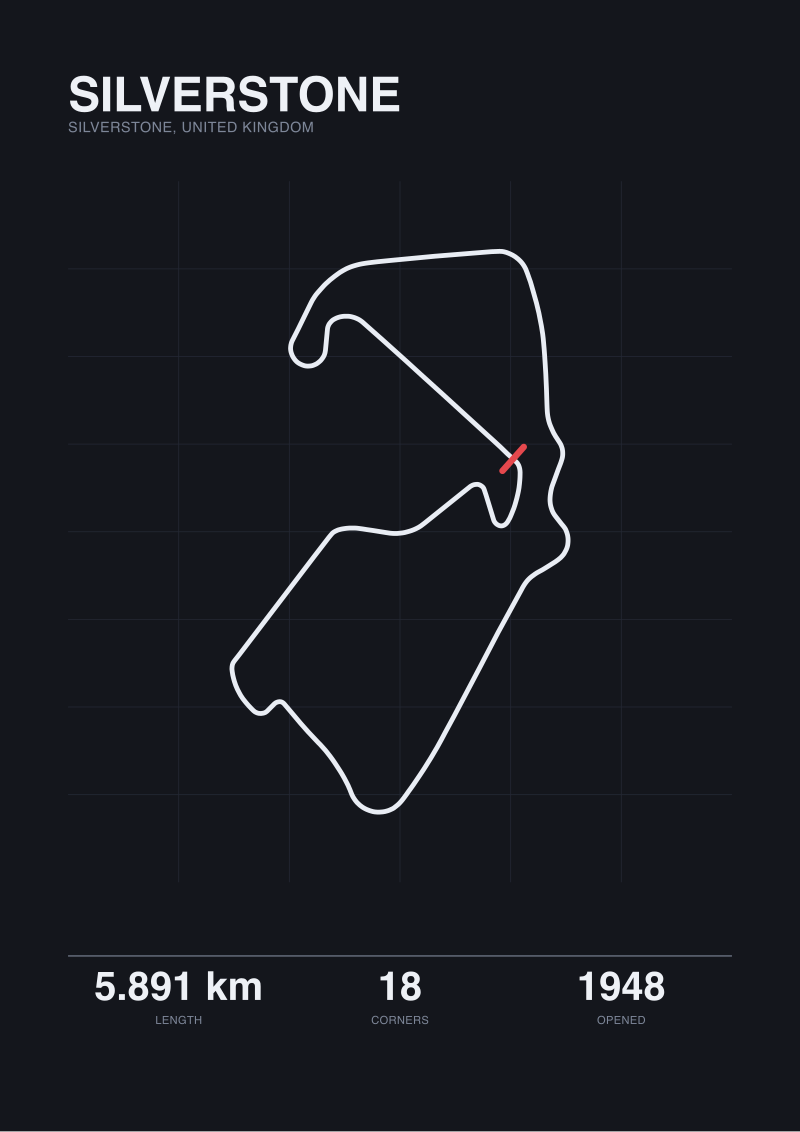 Silverstone
The print from this article · from €29.95
View the print →
Silverstone
The print from this article · from €29.95
View the print →
Finding #2: The Anticlockwise Minority Shares a Topographic Accident
Our traced set contains four clockwise circuits and zero anticlockwise ones. That is itself an honest data point about what kind of layout gets treated as canonical, and it means our reading of the anticlockwise minority is a pattern-reading rather than a measured claim from within this set.
The pattern, from public record: circuits that run anticlockwise tend to be circuits where the terrain forced the hand. Either the original road course fixed a direction that public traffic had already worn in, or a slope demanded that the fastest section descend on one specific side of the loop, or the paddock could only fit in one corner of the available land and the pit-lane entry then dictated the flow. It is not a design philosophy. It is the shape of the ground.
That is why the anticlockwise circuits do not obviously share a family resemblance in corner count, length or era. What they share is the same story told in reverse: the direction was inherited from constraints outside the circuit designer's preference, and it stuck. Once concrete is poured and the paddock is built, the direction is functionally permanent. What looks like a bold aesthetic choice is almost always a land survey.
The corollary matters for readers who like the anticlockwise layouts on the calendar: their character comes from the constraint, not from a designer picking the harder option. That does not make them lesser. It makes them honest.
Finding #3: Nordschleife Runs Clockwise, and Its 154 Corners Explain Why That Matters
The Nordschleife traced to 20.746 km with 154 turns. Divide one by the other and you get an average of one direction change every 135 metres for twenty and three-quarter kilometres. That is the number that makes the direction question serious.
On a circuit with eighteen corners — Silverstone, in our set — the reversal thought experiment is closer to a symmetry problem. The corners keep their radii; you approach them from the opposite side; the racing line inverts but the driver reads roughly the same shapes. On a circuit with 154 corners spread over twenty kilometres, the reversal is not a mirror. It is a different circuit, because half the corners are blind entries whose visibility from the mirror direction was never a design consideration. Camber that catches you into a corner catches nothing when you approach it from the other side. Kerbs cut on the exit of a right-hander are not the same kerbs when you attack them on the entry to a left-hander that used to be the same piece of tarmac.
The 86-metre gap between our traced 20.746 km and the operator's 20.832 km is a separate story — it comes from where you place the racing line along the centreline of the road, and from the fact that homologation length is measured to a specific inside-of-corner reference the operator publishes. But it hints at the same underlying point: at Nordschleife scale, every metre encodes design decisions that a direction reversal would invalidate.
That is why the Nordschleife will remain clockwise for as long as it remains the Nordschleife. Any other answer requires rebuilding it.
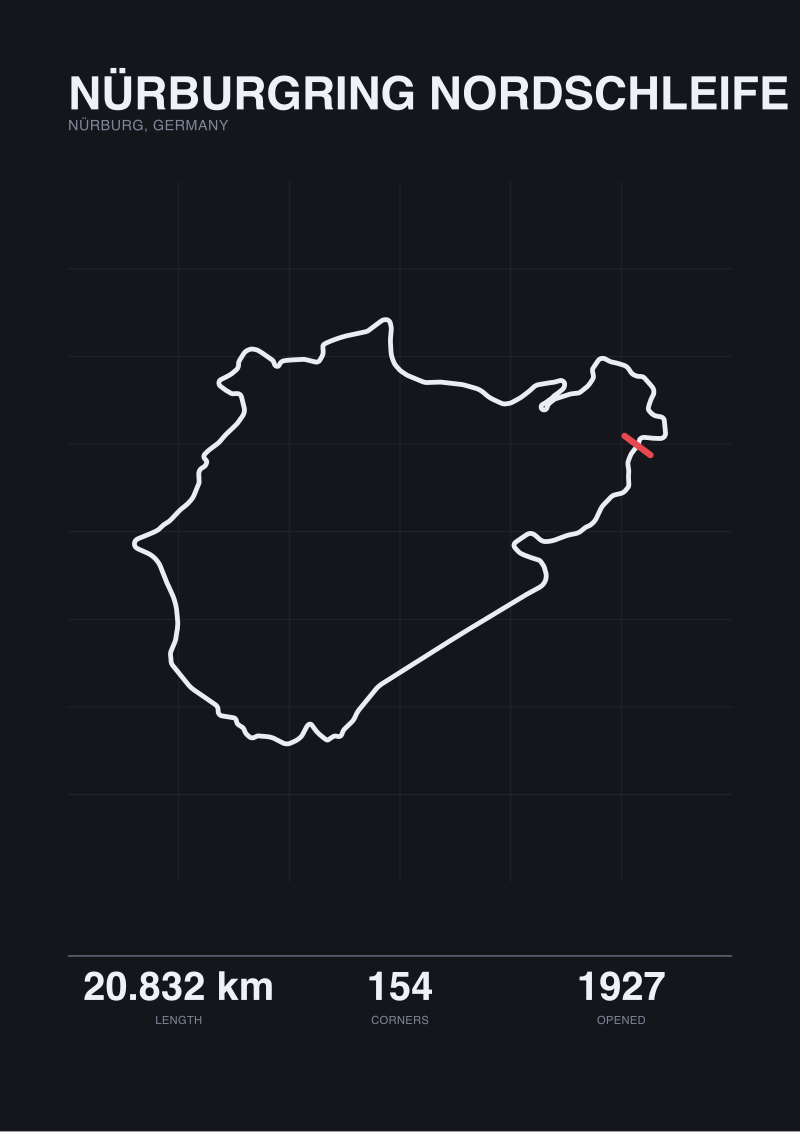 Nürburgring Nordschleife
The print from this article · from €29.95
View the print →
Nürburgring Nordschleife
The print from this article · from €29.95
View the print →
Finding #4: Circuit Length and Direction Are Not Correlated — But Reputation Is
Look at the length range of our set. Silverstone at 5.881 km traced. Spa at 6.995 km. Sarthe at 13.626 km official. Nordschleife at 20.746 km traced. That is a factor of nearly four between the shortest and longest circuit we measured, and all four run clockwise. If direction and length were coupled, you would expect the extremes to disagree with the middle. They do not.
Turn count does not correlate either. Silverstone has eighteen corners, Spa has nineteen, and the Nordschleife has 154 — a factor of more than eight between the two European road courses at opposite ends of the corner-density spectrum — and, again, all clockwise. Whatever explains circuit direction, it is not a function of size or complexity.
What is correlated with clockwise, in the public canon, is reputation. The circuits most consistently cited as "great" — the ones our set is drawn from — happen almost entirely to run clockwise. That is not because clockwise makes a circuit great. It is because the circuits that got built first, in the era that produced the road courses everyone else has been trying to match ever since, were laid out clockwise for the site reasons discussed above, and the canon crystallised around them. Reputation followed the direction because reputation followed the era. The direction is the tell, not the cause.
The commercial implication for anyone reading a circuit as an object: do not mistake direction for design intent. Direction is inheritance.
| Circuit | Traced length | Official length | Turns | Opened | Direction |
|---|---|---|---|---|---|
| Nürburgring Nordschleife | 20.746 km | 20.832 km | 154 | 1927 | Clockwise |
| Circuit de la Sarthe | — | 13.626 km | — | — | Clockwise |
| Spa-Francorchamps | 6.995 km | 7.004 km | 19 | 1921 | Clockwise |
| Silverstone | 5.881 km | 5.891 km | 18 | 1948 | Clockwise |
What This Does NOT Prove
Four circuits are not a global census. Our traced set is entirely European, entirely clockwise, and entirely canonical — which is precisely why it cannot, on its own, quantify the proportion of anticlockwise layouts among all permanent racing circuits in operation. The "roughly four in five" figure quoted in the opening comes from motorsport reference works that count circuits currently homologated by their governing bodies; we cite it because it is the commonly used number, not because we re-audited it.
Nor does this reading claim that clockwise is physically or ergonomically superior. It claims that the clockwise majority is an inheritance from site conditions at circuits laid out before any of the later safety and design codes existed, and that reversing an existing circuit is architecturally expensive enough that the inherited direction sticks. Those are historical and geometric claims, not physiological ones. If a reader wants a physiological argument for or against clockwise, they will need a dataset built for that question, which is not this one.
The Takeaway
Direction on a race circuit is what the ground gave the designer, not what the designer chose. Read the geometry before you read the story.
FAQ
Why do most permanent race circuits run clockwise?
Because the earliest purpose-built road courses — Spa in 1921, the Nordschleife in 1927, Silverstone in 1948 — inherited their direction from site conditions: where the paddock sat, which way the public road already flowed, and which way the land sloped. Later circuits repeated the pattern because reversing an existing layout is architecturally expensive, and new-build designers had no strong reason to deviate. The clockwise majority is a historical inheritance, not a physics principle or a safety code.
Is clockwise actually safer than anticlockwise?
The safety argument was retrofitted after the fact. When Spa, the Nordschleife and Silverstone chose their directions, no modern safety framework existed. If safety had been the driver, anticlockwise circuits would have been converted once safety codes arrived in the 1970s and 1980s. They were not. Directions stayed as originally designed because the cost of reversal — moving the pit exit, inverting every camber, invalidating every kerb — outweighed any claimed safety upside from switching.
How many anticlockwise circuits are there in the world?
The commonly cited figure is that roughly four in five permanent race circuits run clockwise, leaving about one in five anticlockwise. We quote that figure from published motorsport reference works rather than an audit we ran ourselves. Our traced set of four circuits — Nordschleife, Sarthe, Spa and Silverstone — contains zero anticlockwise layouts, which reflects which circuits are treated as canonical rather than a statistical claim about the global population.
Could the Nürburgring Nordschleife be reversed?
Not without functionally rebuilding it. The Nordschleife traced to 20.746 km with 154 turns, which is one direction change every 135 metres for more than twenty kilometres. At that density, reversing the direction is not a mirror-image exercise. Kerbs designed to catch a car on the exit of a right-hander do not perform the same job on the entry of the mirrored left-hander. Blind crests were shaped for a specific line of approach. Reversal is architecturally, not just operationally, prohibitive.
Why did our traced length disagree with the official Nordschleife length?
Our trace produced 20.746 km against the operator's published 20.832 km, an 86-metre gap. The two numbers measure slightly different things. Our figure follows the centreline of the raceway as recorded in OpenStreetMap under the ODbL. The operator's homologation length is measured to a specific reference along the inside of the corners as defined by the governing body. Neither is wrong; they are two answers to two slightly different questions, and we quote both so readers can pick.
Do anticlockwise circuits share any common design trait?
Publicly, the pattern is that they tend to be circuits where the terrain forced the direction — either an original road course that fixed a flow public traffic had already worn in, a slope that demanded the fast section descend on one specific side of the loop, or a paddock that only fit in one corner of the available land. The direction is inherited from the constraint, not chosen as a design statement. Our set does not contain an anticlockwise circuit, so this is a pattern-reading from public record rather than a claim we measured directly.
Does circuit length predict direction?
No. In our set, Silverstone measures 5.881 km, Spa 6.995 km, the Sarthe 13.626 km officially, and the Nordschleife 20.746 km traced — a range of nearly four to one — and all four run clockwise. Turn count varies from eighteen at Silverstone to 154 at the Nordschleife, again with no direction split. Whatever explains direction, it is not a function of how long or how complex the circuit is. Direction and size are independent variables in the sample we traced.
From the collection
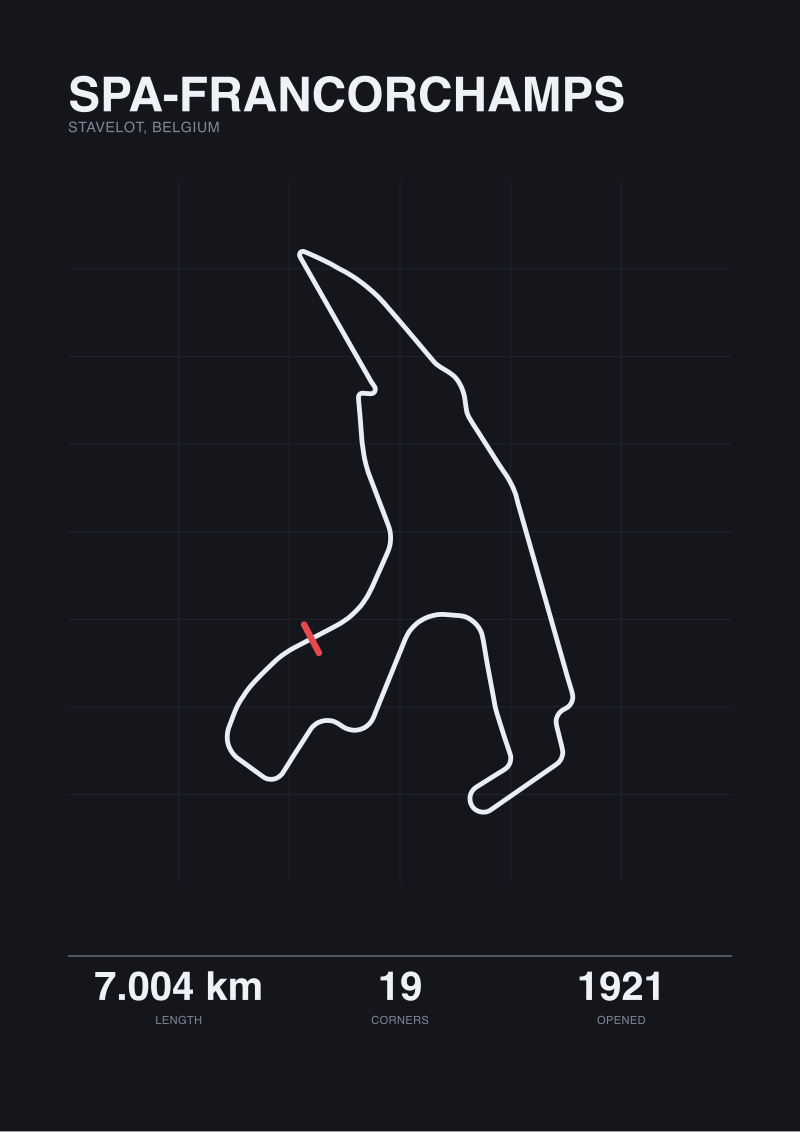
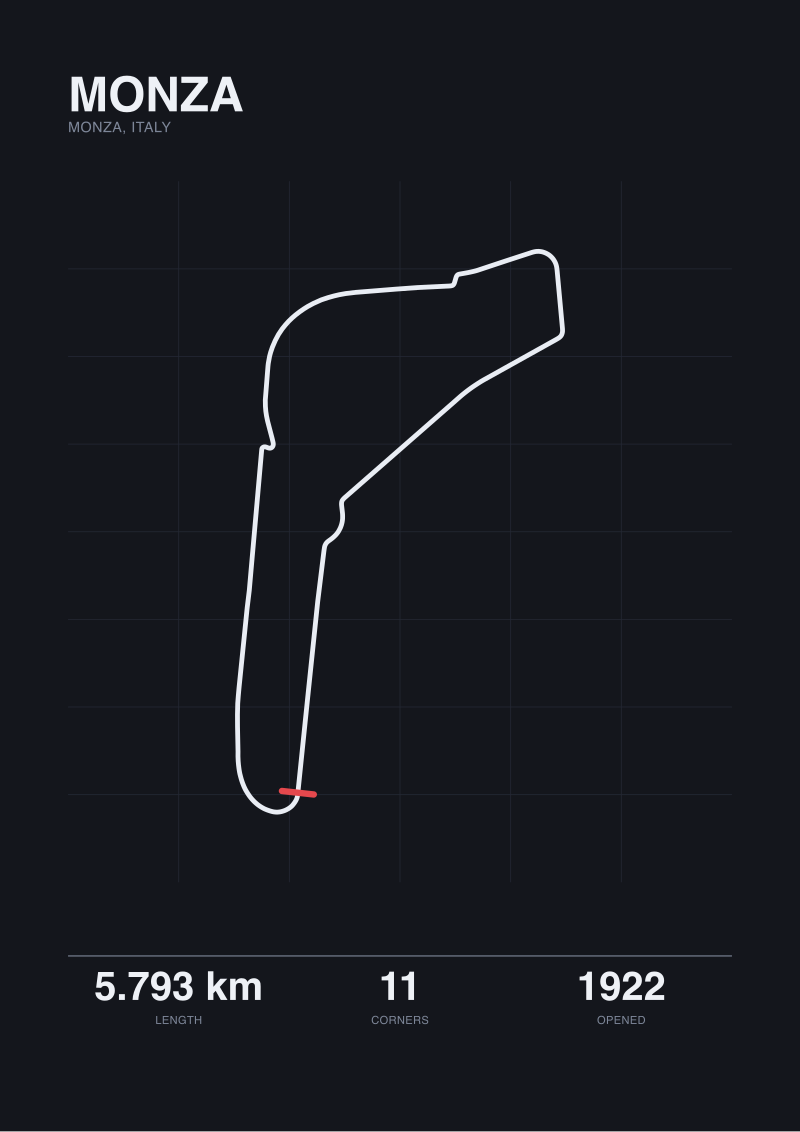
New circuits and 10% off your first print.
One email now with your code. No noise after.