For readers who see a chicane on a modern layout and read it as evidence the circuit has been ruined — a flowing section pasted over by regulators who did not understand what they were breaking — the correct reading is almost the opposite. A chicane is not a design failure. It is the drawn record of a decision made against a corner that already existed, and its geometry tells you what that corner had become. Hear us out. We will defend this over the sections that follow.
The strongest argument against chicanes is real, and worth conceding before we go further. A chicane replaces a flowing section with a mechanical one: brake, turn, turn, throttle. The rhythm the car was carrying through the previous corner does not survive. When Spa's Masta straight was cut, or when Silverstone reprofiled its high-speed sections, something specific was lost — the compression of a section reading as one long argument. If you love circuits as engineered rhythm, chicanes are the interruption where the argument stops mid-sentence. That reading, though, treats the chicane as an addition. It is more useful to treat it as a subtraction.
A Chicane Is a Speed Deletion, Not a Corner
Read a chicane geometrically and it stops looking like a corner. A corner asks a car to negotiate a change of direction the underlying geometry demanded — the road went that way because the land did. A chicane exists to prevent a car from reaching a speed the surrounding geometry would otherwise permit. The direction change is incidental. The speed cap is the point.
You can measure this from the drawing. The distance between the two turn-ins of a chicane determines the minimum speed the car must slow to. The offset between entry and exit determines whether the sequence can be threaded on a single arc or must be braked into in a straight line first. A well-drawn chicane threads. A bad one is a compression the driver has no way to make continuous with the corner that follows.
This is why arguments about chicanes so often talk past each other. If you evaluate a chicane as a corner — how it flows, how it rewards commitment, how it opens onto the next section — you are asking the wrong question. Chicanes are not competing with corners. They are competing with the alternative interventions available at the same point on the circuit: moving a wall, extending a run-off, reprofiling the approach, or slowing the whole section by narrowing the track. Each of those has different costs. The chicane's cost is rhythm. Its benefit is that it can be drawn without moving any earth.
Spa's 7 km Is Already the Answer
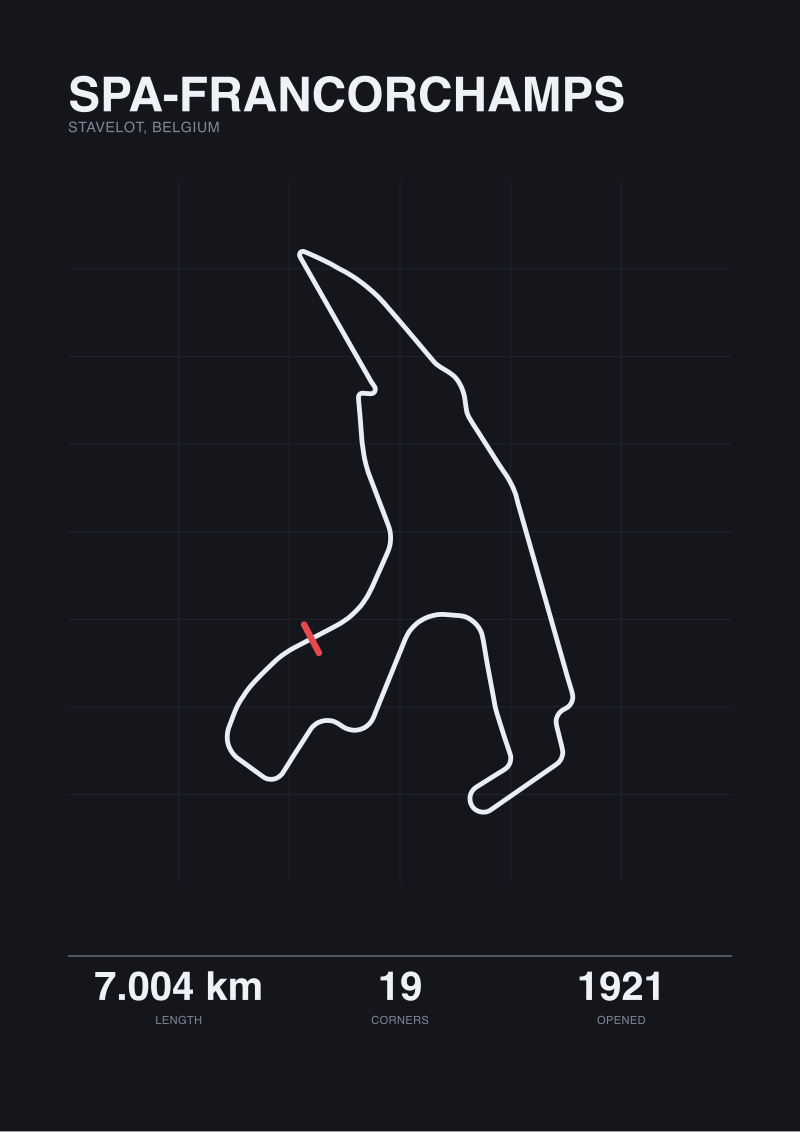
Spa-Francorchamps opened in 1921 in Stavelot, Belgium, and today runs 7.004 km. Our own tracing from OpenStreetMap raceway data measures 6.995 km, nine metres short of the published homologation figure — a level of agreement we would expect from a permanent circuit with a fixed pit complex. The current 19-turn layout is a shorter circuit than the one raced in the 1960s. The pre-1979 configuration ran the public road out through Masta and back. The current circuit is what that layout was cut down to when the argument that had been running for a decade — that certain sections were too fast to survive with the cars of the era — finally won.
There is a lesson about chicanes here that most treatments miss. The entire modern Spa is, in one reading, itself a chicane. Not the single insertion drawn late in the lap, but the whole decision to close roughly half the original layout and keep the rest. If you insist chicanes are compromises, then Spa's current form is compromise all the way through.
We prefer to read it differently. The 7.004 km that remained after the cut is a coherent piece of geometry — 19 turns that carry across elevation, through a valley, and back up a hill. The circuit works. The single-object chicane drawn late in the lap does in miniature what the whole 1979 decision did at scale: it deletes a speed that the surrounding geometry would otherwise generate. The lap drivers remember is not the lap the geometry survives. Spa proves both things at once, and the modern layout is the honest answer, not the concession.
| Circuit | Locality | Official length | Traced length | Turns | Opened |
|---|---|---|---|---|---|
| Nürburgring Nordschleife | Nürburg, Germany | 20.832 km | 20.746 km | 154 | 1927 |
| Spa-Francorchamps | Stavelot, Belgium | 7.004 km | 6.995 km | 19 | 1921 |
| Silverstone | Silverstone, United Kingdom | 5.891 km | 5.881 km | 18 | 1948 |
Official lengths are homologation figures published by the circuits' operators. Traced lengths are our own measurements from OpenStreetMap raceway data under the Open Database License. The disagreements are small and honest — they reflect the difference between a homologation survey and a digitised centreline.
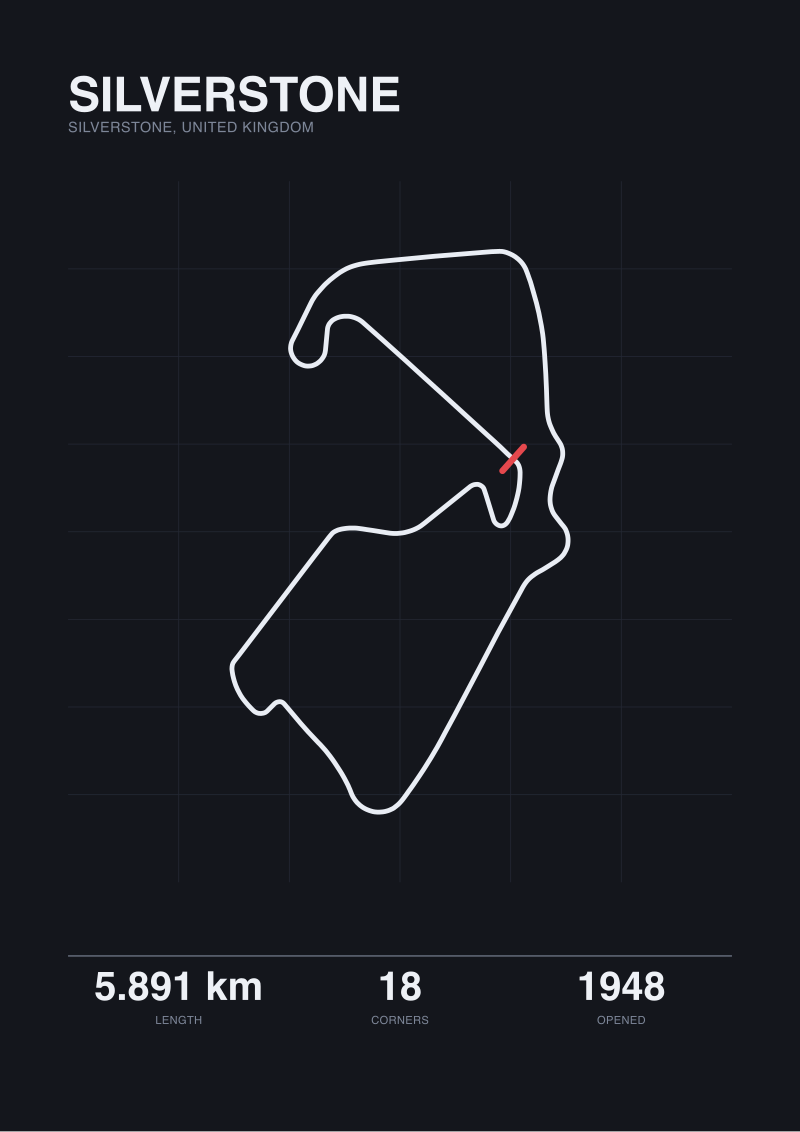 Silverstone
The print from this article · from €29.95
View the print →
Silverstone
The print from this article · from €29.95
View the print →
Silverstone's Layout Is a Chicane Archive
Silverstone opened in 1948 on the perimeter roads of a wartime airfield. It runs 5.891 km today over 18 turns. The traced measurement, 5.881 km, sits within ten metres of the published figure. That kind of agreement is what a permanent circuit with a fixed pit complex should produce, and it is a useful baseline for how seriously to take small discrepancies elsewhere.
What is interesting about Silverstone is that the geometry has been rearranged more than most people realise. The airfield's original layout gave the circuit a set of high-speed corners the cars kept outrunning. Successive reprofilings are the history of chicanes being added, then reconsidered, then absorbed into corner sequences that no longer read as chicanes at all. A chicane that becomes part of the flow, over time, stops looking like a chicane. This is not a rebranding exercise. It is what happens when the cars change — different tyre compounds, different downforce regimes, different crash structures — and the speed the chicane was drawn to cap is no longer the constraint. The drawn kink stays, but its function moves.
This is the point most arguments about chicanes miss. A chicane is not a permanent object. It is a decision drawn onto a circuit at a moment when the cars had reached a speed the original geometry could not survive. When the cars change, the chicane can be redrawn, softened, or absorbed. Several of Silverstone's current 18 turns began as chicanes and are now read as corners. The distinction, at the drawing-board level, is one of intent, not shape.
If you want to read Silverstone the way its designers do, look for the offsets. Where the racing line kinks in a way the underlying land does not seem to require, there was once a straight the cars were taking faster than the surrounding geometry could catch.
The Nordschleife Refuses to Prove You Wrong
The Nürburgring Nordschleife opened in 1927 and runs 20.832 km by homologation. The 154-turn count is famous but slippery — the number depends on which small direction change you count and which you smooth over. Our own traced measurement, 20.746 km, sits 86 metres short of the official figure. That gap is the honest answer to a straightforward question: map data traces the racing surface as OpenStreetMap volunteers have digitised it; homologation length is the operator's own survey. Neither is wrong. They are measuring slightly different things, and the discrepancy is the largest of any circuit in our set precisely because 86 metres over 20 km is a smaller proportional error than nine metres over seven.
What the Nordschleife has, mostly, is no chicane. Sections have been reprofiled — Flugplatz being the best-known example — but the specific gesture of a chicane drawn onto the plan to cap a speed has been resisted for nearly a century. This is the counterfactual the argument needs. If chicanes were purely bureaucratic vandalism, the Nordschleife's refusal to add them would look like editorial courage held against pressure. It does not read that way. It reads as a circuit that survives because it is used differently — no permanent modern grand prix grid, no championship pressure to homologate a specific lap time within a specific window — rather than as a circuit that has held out on principle.
Read this way, the Nordschleife's 154 turns are the shape of a decision to leave the geometry alone and let the use change instead. Every other permanent circuit that hosts modern single-seaters has, at some point, drawn a chicane onto its plan and lived with the record of that decision. The Nordschleife has not, because the Nordschleife is not being asked to. The chicane is what happens when a circuit must serve two masters at once: the geometry it was drawn as, and the cars that outgrew it.
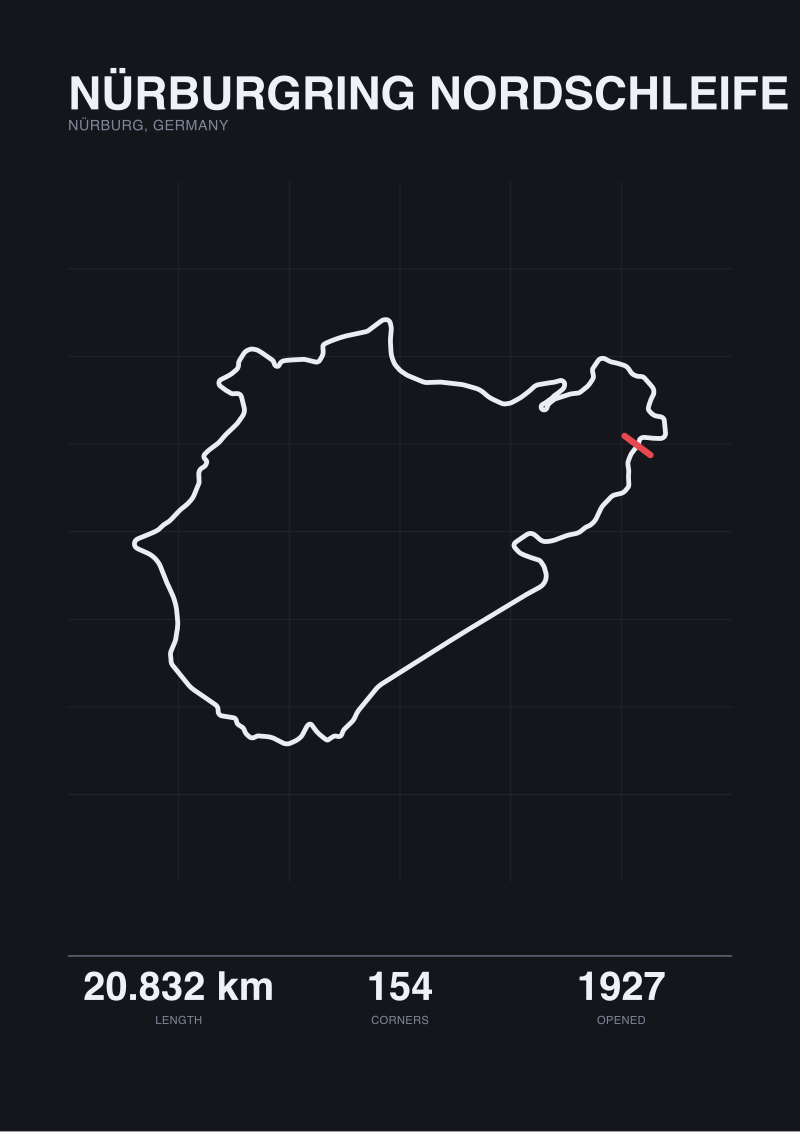 Nürburgring Nordschleife
The print from this article · from €29.95
View the print →
Nürburgring Nordschleife
The print from this article · from €29.95
View the print →
What You Should Actually Do
Read chicanes as artifacts. When you see one on a modern layout, do not treat it as a designer's compromise. Treat it as the visible record of a corner that used to be somewhere else — usually a fast section the cars had come to take flat, sometimes an approach whose escape geometry could no longer catch a mistake at the speed the surrounding straight was generating. The chicane's own geometry — the distance between its turn-ins, its offset, the angle of its exit onto the next section — tells you what speed the original section was carrying and what speed the current section is being held to. That is a legible piece of evidence, not a scar.
Then look at the sections without chicanes and ask the same question in reverse. Spa's 7.004 km, Silverstone's 5.891 km, and the Nordschleife's 20.832 km each represent a different answer to the same problem. Spa cut the circuit and kept a small chicane at the point where the remaining geometry generated too much exit speed. Silverstone kept its length and let its chicanes migrate into corner sequences over successive reprofilings. The Nordschleife left the geometry alone and changed what it is used for. Reading a modern chicane properly means asking which of those three strategies the circuit in front of you chose — and which of them, if any, it now regrets. That is where the next question starts, and it is not one this piece can answer.
FAQ
What actually counts as a chicane in circuit design?
A chicane is a rapid pair of direction changes drawn onto a circuit specifically to cap the speed a car can carry through that point. Unlike a conventional corner, whose direction change is dictated by the terrain the circuit was routed through, a chicane's turns are incidental — the speed reduction is the point. Some layouts absorb their chicanes into flowing corner sequences over time as the cars change, at which point the distinction becomes one of intent rather than shape.
Why do circuits add chicanes instead of just extending run-off?
Run-off catches errors; a chicane prevents the error happening at high speed in the first place. When a section's approach speed exceeds what escape geometry can plausibly catch — because there is no room to extend, or because a fixed object cannot be moved — capping the speed itself becomes the only remaining lever. Extending run-off works when land is available and speeds are within a bounded window. Chicanes work when neither of those conditions holds.
Do published circuit lengths always match what a map trace measures?
No, and the disagreement is honest. The Nürburgring Nordschleife publishes 20.832 km against a traced 20.746 km — an 86-metre gap. Spa publishes 7.004 km against a traced 6.995 km. Silverstone publishes 5.891 km against a traced 5.881 km. Official figures come from homologation surveys the operator commissions; map traces measure the digitised centreline of the racing surface. Neither is more correct — they are answering slightly different questions, and the proportional gap tends to be smallest at the shorter circuits.
Is the current Spa layout the real Spa?
The current 7.004 km circuit is what remained after the pre-1979 sections that ran onto public road were closed. Whether it is the real Spa depends on whether you define a circuit by continuity of geometry or by continuity of location. The section from the descent to Stavelot and back up the hill is broadly the same geometry that always ran there. The Masta straight is not, and no argument about the modern layout can put it back.
Has the Nordschleife ever had a chicane inserted?
Not in the conventional sense. Sections have been reprofiled across the 154-turn layout — Flugplatz being the most cited example — but the specific gesture of a chicane drawn onto the plan to cap a speed has been resisted for nearly a century. That resistance is easier to sustain because the Nordschleife does not host a permanent modern championship grid on the full layout, so its homologation pressures differ from those Spa and Silverstone answer to every season.
Why does Silverstone have 18 turns on only 5.891 km?
Eighteen turns over 5.891 km gives a direction change on average every 327 metres — dense for a permanent circuit. The count reflects the airfield's perimeter-road origins, where the layout was constrained by existing pavement rather than drawn from an unmarked field. Successive reprofilings added and absorbed chicanes as the cars outgrew the original high-speed sections. Several of the corners now counted in the 18-turn total began their lives as chicanes and are now read as corners because the cars caught up to them.
How can I tell which corners on a modern circuit were once chicanes?
Look for offsets in the racing line that the underlying land does not obviously require. Where a corner sequence kinks in a way that pulls the car off the line the surrounding geometry would otherwise permit, there is usually a chicane somewhere in the layout's history — drawn to cap a straight the cars had come to take flat. Historical circuit maps confirm what geometry alone can only suggest, and the two together are more useful than either on its own.
From the collection
New circuits and 10% off your first print.
One email now with your code. No noise after.